Enrico FermiView profile
Professor
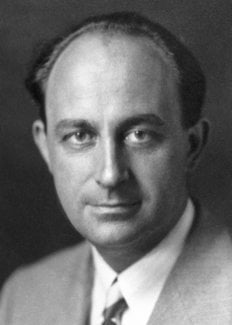
Enrico Fermi was an Italian-American physicist and professor, renowned for pioneering contributions in nuclear physics and quantum mechanics. He held professorships at the University of Rome (1927–1938), Columbia University (1939–1942), and the University of Chicago's Institute for Nuclear Studies (1946–1954). His work on neutron-induced reactions led to the discovery of slow neutrons and nuclear fission, culminating in the first controlled nuclear chain reaction (Chicago Pile-1, 1942) during the Manhattan Project. A Nobel laureate (1938), Fermi also contributed to cosmic ray theory and high-energy physics. He was naturalized as an American citizen in 1944. Educations: Scuola Normale Superiore di Pisa (Ph.D., 1922), studies with Max Born (Göttingen, 1923) and Paul Ehrenfest (Leiden, 1924). Research Interests: Nuclear transformations, statistical mechanics, particle physics, cosmic rays. His later work at Chicago focused on pion-nucleon interactions and cosmic ray acceleration theories. Fermi’s legacy includes foundational papers on Fermi-Dirac statistics, beta decay theory, and neutron moderation. He advised on the development of the atomic bomb and remained a central figure in postwar nuclear research. Awards: Nobel Prize, Enrico Fermi Award, Royal Academy of Italy membership. His team at Los Alamos and Hanford advanced reactor design and plutonium production. Collaborators included Emilio Segrè and Leo Szilard. Labs/Teams: Manhattan Project (Chicago Met Lab, Hanford, Los Alamos), University of Chicago’s Institute for Nuclear Studies.