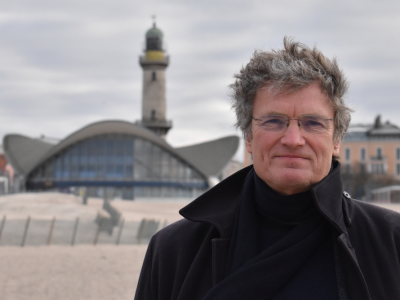
Hans Burchard is a Professor at the University of Rostock and Deputy Head of the Department of Physical Oceanography and Instrumentation at the Leibniz Institute for Baltic Sea Research . His research focuses on estuarine and coastal oceanography , with expertise in turbulence closure modeling (GOTM), three-dimensional numerical model development (GETM), and sediment dynamics . He leads projects examining anthropogenic impacts on coastal systems , long-term variability , and climate-driven mixing processes . Key projects include Skamix-WMT , CoastalFutures-2 , and GROCE-II , addressing issues like salinity intrusion , ice-ocean interactions , and ocean turbulence . Recent publications highlight diahaline mixing in marginal seas, storm-driven submesoscale processes , and numerical methods for ocean dynamics . Hans actively supervises PhD and Master’s students in topics related to ocean modeling , estuarine circulation , and sediment transport . He contributes to international collaborations through initiatives like the Virtual European Physical Oceanography and Shelf Sea Seminar Series (VEPOSSSS) and Gordon Research Conference on Coastal Ocean Dynamics (GRC) .
Dr. Svenja Papenmeier is a Researcher in the Marine Geophysics Working Group at the Leibniz Institute for Baltic Sea Research Warnemünde . She previously worked at the Alfred Wegener Institute (2012–2019) and the Christian-Albrechts-University of Kiel (2008–2012). She holds a PhD in Marine Geology from Kiel University, a Master’s in Marine Geosciences from the University of Bremen, and a Bachelor’s in Geosciences from the same institution. Research Focus: Hydroacoustic habitat mapping in the North Sea, Baltic Sea, and Siberian Arctic Development of seabed mapping standards (BSH No: 7201) Automated stone/boulder detection in acoustic datasets using neural networks Paleogeographic evolution of the Elbe River valley and Sylt Outer Reef Long-term analysis of dynamic bedforms and sediment distribution Scientific Contributions: Published 15+ peer-reviewed articles on marine sedimentology, AI applications in acoustic data, and coastal dynamics Key projects: OTC Stone (BMBF-funded), DAM CREATE , LABS , PaleoElbe , AMIN Regular presenter at international conferences (GeoHab, EGU, AGU) on topics like AI-based habitat mapping and sediment dynamics
Andrea Funck is a Professor for Conservation and Restoration of Archaeological, Ethnological and Artistic Objects at the State Academy of Fine Arts Stuttgart, where she also serves as Deputy Chair of the Conservation and Restoration Study Commission and University Council member (since 2024). She previously held leadership roles as Vice-Rector for Research and Young Talent Development (2020–2024), Director of the Doerner Institute (2017–2019), and Head of Restoration Workshops at Landesmuseum Württemberg (2010–2017). Education: Cologne University of Applied Sciences (restoration of wood and modern materials, 2002–2007), Part-time Master in Cultural Management (2008–2010) Current Research: Focus on conservation ethics, values in restoration, plastics conservation, preventive conservation, and knowledge transfer between academia and museums Her recent publications and lectures analyze value frameworks in restoration, sustainable exhibition technology, and the role of conservators in museum practices. She supervises doctoral students researching topics like Baroque coffin preservation, blended learning for restorers, and organic findings from Hallstatt-period graves. Andrea Funck actively participates in professional networks, including the German Museum Association, ICOM, and supervisory boards at Deutsches Museum Munich and German Maritime Museum. Her work bridges technical conservation with public engagement and institutional policy-making.
Manuel Kautz is a Research Associate at the Chair of Political Theory within the Faculty of Economics, Law and Social Sciences at the University of Erfurt. He serves as a Student Academic Advisor for the Bachelor's program in Social Sciences and participates in organizing academic events like panels and workshops on political theory topics. University of Erfurt (Faculty of Economics, Law and Social Sciences) Research Associate at the Chair of Political Theory Academic Advisor for Bachelor Social Sciences His research focuses on Political Representation , Political Theory , and the History of Political Thought . He explores dynamics of democratic theory, ocular democracy, and feminist perspectives on representation claims. Current publications analyze lottocratic models and gender-based parliamentary representation. Recent academic activities include: Panel on Conflict Dynamics in the Polycrisis (2024, Göttingen) Workshop on Representation of Conflict (2024, Erfurt) Presentation on Representative Claims in Political Thought History (2025, Augsburg) He teaches tutorials on Democracy Theory and seminars about feminist theories of political representation, including courses on Bundestag election representation claims and historical political ideas.
Dr. rer. nat. Stefan Lankes is an academic researcher at the Chair of Automation of Complex Power Systems, RWTH Aachen University's Faculty of Electrical Engineering and Information Technology. His work focuses on operating systems, high-performance computing (HPC), cloud computing, and lightweight virtualization techniques for embedded and real-time systems. Stefan holds a PhD in Electrical Engineering (2003) for his dissertation on real-time distributed platforms. His career spans roles from Scientific Assistant (1998-2004) to Academic Director (since 2019), with key contributions to HPC infrastructure and simulation environments. Research highlights include Rust-based OS development ( HermitCore unikernel ), GPU virtualization in distributed systems, and energy-efficient embedded computing paradigms. He pioneered the FlippedOS digital teaching platform using virtual workstations for operating systems education. Scientific awards include the 2016 Digital Teaching Fellowship and the 2021 RWTH Lecturer distinction. His publications cover topics from NUMA memory management to real-time CORBA protocols, with recent works addressing unikernel security and CUDA virtualization. Stefan leads simulation infrastructure and HPC virtualization projects, with affiliations to the E.ON Energy Research Center and involvement in European workshops like Euro-Par. His work bridges system software innovation with practical applications in energy systems and supercomputing.
Prof. Dr. Henner Gärtner is a full Professor for Industrial Logistics in the Department of Mechanical Engineering and Production at Hamburg University of Applied Sciences (HAW Hamburg). He is also Program Coordinator of the cooperative Mechanical Engineering program with the University of Shanghai for Science and Technology, Chairman of the Study Reform Committee, and deputy member of the Department Council. Education & Academic Focus Doctorate (Dissertation on stock-out cost quantification, PZH-Verlag, 2011) Research stays and teaching activities in Germany and China Research Interests Prof. Gärtner’s work spans decentralized production control , Industry 4.0 testbeds , autonomous transport systems (AGVs) , and real-time ergonomic monitoring . A flagship project is the Shared Guide Dog 4.0 , an AI-equipped autonomous rollator that supports blind and visually impaired pedestrians through advanced navigation and puddle-detection algorithms. Scientific Awards Hamburger Lehrpreis 2022 – Excellence in Teaching Projects & Funding SafeWalker – safe navigation assistance for elderly pedestrians Shared Guide Dog 4.0 – AI-driven mobility aid (with DAAD & BMAS support) GehwegNavi – sidewalk navigation for the visually impaired Decentralized Manufacturing Control testbed – “swimming-pool” model for resource negotiation Collaborative projects with Lufthansa Technik Logistik Services, VTG AG, DESY, and Krüss GmbH Teaching & Supervision He teaches bachelor and master modules such as Industrial Logistics , Production Planning & Control , Operations Management , and Project Management & Communication . Prof. Gärtner has supervised more than 30 bachelor and master theses on topics ranging from decentralized AGV control to AI-based computer-vision apps for barrier-free mobility. Labs & Teams Prof. Gärtner leads activities within the Institute for Product and Production Management (IPP) at HAW Hamburg and coordinates interdisciplinary student teams working on robotics, lean production, and service engineering.
Diana Dushkova is a Senior Researcher at the Helmholtz Centre for Environmental Research – UFZ in Leipzig, Germany. Her academic background includes a PhD in Geography (summa cum laude, Moscow State University, 2008) and a M.Sc. in Geography (Moscow State University, 2005). She has held postdoctoral positions at Humboldt University Berlin and Moscow State University, with guest research at Leibniz Institute for Regional Geography and Martin Luther University Halle. Current Affiliation: Helmholtz Centre for Environmental Research – UFZ, Department of Conservation Biology & Social-Ecological Systems Past Affiliations: Humboldt University Berlin (2017–2020), Moscow State University (2014–2017), Leibniz Institute for Regional Geography (2013–2014) Her research focuses on nature-based solutions (NBS) , urban ecosystem services , and social-ecological systems , with an emphasis on how blue-green infrastructure enhances urban resilience and human well-being. She explores therapeutic landscapes, environmental risks, and co-creation models for NBS implementation. Her work spans European and Russian contexts, addressing climate change, post-socialist urban transitions, and sustainable development. Dushkova’s recent publications (2021–2025) cover topics such as urban greening in Moscow and Saint Petersburg , empowerment programs for coastal communities , and ecosystem service assessments in Russian cities. She evaluates NBS impact through frameworks like the RECONECT project and advocates for interdisciplinary collaboration in urban planning. She supervises B.Sc. and M.Sc. students and contributes to EU Horizon 2020 projects like RECONECT (Grant 776866) and EmpowerUs (Grant 10105995). Her methodological expertise includes cartographic modeling, ecosystem service valuation, and social construction of landscapes. Dushkova collaborates with institutions such as Humboldt University Berlin , Moscow State University , and Leibniz Institute for Regional Geography . She leads projects like the Leibniz-DAAD initiative on cultural landscapes and the DAAD-East-Partnership on urban ecosystem services.
V. Arvind is a Professor in the Theoretical Computer Science faculty at the Institute of Mathematical Sciences (IMSc) , Chennai. His research is centered on computational complexity theory, with a focus on structural complexity, randomized and algebraic computation, and quantum information and computation. He explores the deep connections between theoretical computer science and mathematics. Institution: Institute of Mathematical Sciences (IMSc), Chennai School: Theoretical Computer Science Academic Rank: Professor Arvind's research interests include computational complexity, structural complexity theory, algebraic computation, derandomization, and quantum computing. He is particularly interested in the interplay between mathematical structures and computation. His work often bridges theoretical computer science with algebra, combinatorics, and logic. His recent publications, primarily expository articles in the EATCS Bulletin’s Computational Complexity Column, cover a wide range of topics such as robust oracle machines, the Alon-Roichman theorem, noncommutative arithmetic circuits, graph isomorphism, and quantum computation. These works reflect trends in foundational complexity theory, algebraic methods in computation, and the exploration of quantum models. The articles emphasize structural insights, lower bounds, and connections to mathematical disciplines. Professional Service and Editorial Roles: Associate Editor, ACM Transactions on Computation Theory Editor, EATCS Computational Complexity Column (since June 2011) Editorial Board Member, International Journal of Computer Mathematics (2009–2013) Co-organizer, ICM Satellite Conference on Algebraic and Probabilistic Aspects of Combinatorics and Computing Program Committee Member for WALCOM 2014, STACS 2012, COCOON 2009, FSTTCS (multiple years, including chair roles), CCC 2006, INDOCRYPT (2002, 2005), and others Teaching: Arvind has taught advanced courses including Computational Complexity, Algorithms, Algebra and Computation, and Discrete Mathematics, often based on foundational texts and notes from leading experts. Lecture notes from his courses have been compiled by students and collaborators. Collaborations: He has an extensive list of co-authors, including prominent researchers such as Manindra Agrawal, Eric Allender, Johannes Köbler, Meena Mahajan, Jacobo Torán, and Ramprasad Saptharishi, indicating strong collaborative research networks in complexity theory and algorithms.
Jan Vitek is a Professor of Computer Science at Northeastern University's Khoury College of Computer Sciences. He also holds an appointment at Charles University in Prague supported by an ERC.CZ grant. With a background rooted in Czechoslovakia (birth) and Switzerland (education), Prof. Vitek has established himself as a leading researcher in programming languages and systems. Prof. Vitek's research spans programming language design, implementation, and application across multiple domains. His work has significantly impacted real-time embedded systems, concurrent and distributed systems, and more recently, scalable data analytics. He has published extensively in top venues including Programming Languages, Virtual Machines, Compilers, Software Engineering, Real-time Computing, and Bioinformatics. His publication record shows a clear evolution from foundational work on programming language theory to practical implementations and modern data science applications. Early work focused on ownership types and real-time Java systems, while recent publications center on dynamic languages (particularly R and Julia), compiler optimizations, and large-scale code analysis. His research demonstrates consistent innovation in bridging theoretical foundations with practical implementations. Selected Awards: Dahl-Nygaard Senior Prize (2020) ACM SIGPLAN Distinguished Service Award (2019) ECOOP Test of Time Award (2018) ISSTA Distinguished Artifact Award (2018) OOPSLA Distinguished Artifact Award (2017) As an advisor, Prof. Vitek has mentored numerous PhD students through successful thesis defenses on topics ranging from type stability in Julia to analyzing large code repositories. He has also been deeply involved in the research community through conference organization, having chaired major events including SPLASH, PLDI, ECOOP, ISMM and LCTES. Currently serving as Editor in Chief of TOPLAS, he continues to shape the field while actively conducting research with his team at the PRL lab. His research group, the PRL (Programming Research Laboratory) and PRL-PRG, focuses on creating beautiful code that solves real-world problems, with particular emphasis on making software development more efficient, reliable, and accessible.
Rüdiger Wilhelmi is a Professor at the Department of Law, University of Konstanz, focusing on civil law, commercial and corporate law, business law, and comparative law. He is also the Director of the Institute for Legal Research and Vice Rector for Academic Affairs since 2024. His research spans liability law, family and inheritance law, and Legal Tech. Professor, Department of Law, University of Konstanz (since 2010) Director, Institute for Legal Research (since 2012) Vice Rector for Academic Affairs (since 2024) Principal Investigator, Cluster of Excellence "The Politics of Inequality" (since 2019) His work emphasizes comparative legal analysis across jurisdictions like the USA, UK, and Netherlands, with a focus on patent law , financial regulation , and digitalization of law . Publications include monographs on capital maintenance in GmbH law, environmental liability, and EMIR regulation. He has contributed extensively to legal commentaries and handbooks. Wilhelmi's lectures and conferences address topics like AI liability , multi-party arbitration , and banking regulation . He co-edits volumes on legal digitalization and participates in interdisciplinary workshops on topics like "Banking beyond Banks" and "Diversity in Financial Markets".
Oliver Reis is a Professor at the Institute for Catholic Theology within the Faculty of Cultural Studies at the University of Paderborn. His work focuses on Religious Education with Special Consideration of Inclusion , integrating systematic theology, didactic methodologies, and empirical research in teacher training. Education: Abitur (1990) 1. Staatsexamen in Catholic Theology for Primary Education (1996) 1. Staatsexamen in Catholic Theology and Philosophy for Gymnasium (2005) Dr. phil. in Systematic Theology (2003) Dr. theol. in Religious Education (2013) His research spans systematic theology , transformation of theological content for education , and empirical studies on teacher competency development . Recent publications explore topics like praxeological analyses of Catholic schools, SoTL methodologies, and interdisciplinary approaches to inclusion. Scientific Awards: Dissertationspreis 2003 for his first dissertation on sustainability and theology Reis has held leadership roles in editorial projects such as the Jahrbuch für eine konstruktivistische Religionsdidaktik and served in university self-governance committees. He is active in academic societies like the Deutsche Gesellschaft für Hochschuldidaktik and Europäische Gesellschaft für Katholische Theologie .
Polina Sharapova serves as an Assistant Professor in the Department of Physics at the Faculty of Natural Sciences, University of Paderborn, where she leads the Theoretical Quantum Optics research group. Her academic profile integrates cutting-edge research with teaching responsibilities in quantum theory and laboratory projects. Her research centers on non-classical states of light , including single photons, biphoton pairs, squeezed states, and bright squeezed vacuum. She investigates these states in both bulk optics and integrated quantum photonic systems , focusing on properties, correlations, and applications for quantum cryptography, teleportation, computing, and ultra-sensitive interferometry. Current work emphasizes theoretical frameworks for quantum light generation and light-matter interactions in semiconductor nanostructures. Analysis of her 2023-2025 publications reveals a cohesive trajectory in quantum optics theory, particularly in multimode squeezed light dynamics in lossy media and microscopic modeling of excitonic systems coupled to quantum light. These studies advance foundational knowledge for quantum information processing and metrology while addressing practical challenges in nonlinear optical circuits. No scientific awards were documented in the source materials. Dr. Sharapova holds leadership roles in the Collaborative Research Center TRR 142, directing project C10 ( Generation and Characterization of Quantum Light in Nonlinear Systems: A Theoretical Analysis ) and contributing to the broader initiative Tailored Nonlinear Photonics: From Fundamental Concepts to Functional Structures . Her teaching portfolio includes Theoretical Quantum Optics , Lab Project , and Current Topics in Theoretical Quantum Optics , reflecting her commitment to training next-generation quantum scientists. She directs the Theoretical Quantum Optics group, which operates within the Department of Physics at Paderborn. The group collaborates extensively through the TRR 142 research center, focusing on theoretical modeling of quantum photonic systems with experimental validation pathways.
Prof. Dr. Chris Volkmar is a Professor for Electric Space Propulsion and Electromagnetic Compatibility at the Technical University of Mittelhessen (THM) since October 2019. He serves as Co-Head of the TransMIT EMC Laboratory and leads the Space Electronics Research Group. His institutional affiliations include membership in the Competence Center for Nanotechnology and Photonics (NanoP) and the Research Campus Mittelhessen (FCMH) in the field of space applications, where he serves as Deputy Spokesperson since April 2025. Prof. Volkmar's academic background includes: PhD (2015) from Justus Liebig University Giessen with dissertation on 'Self-consistent numerical 1D/3D hybrid modeling of radio frequency ion thrusters' Master of Science in Electrical Engineering and Information Technology (2012-2014) from THM Graduate Engineer in Information and Communication Technology (2007-2011) from THM Specializing in electric space propulsion systems and electromagnetic compatibility, Prof. Volkmar's research bridges plasma physics with spacecraft engineering. His work focuses on radio frequency ion thrusters, developing innovative measurement techniques and specialized testing facilities including vacuum-compatible reverberation chambers and semi-anechoic chambers for electromagnetic compatibility testing of electric propulsion systems. His expertise spans power electronics for space applications, plasma diagnostics, and spacecraft system integration challenges. Prof. Volkmar's publication record reveals a consistent trajectory from fundamental plasma modeling toward increasingly sophisticated engineering solutions for space applications. His recent work emphasizes system-level integration challenges of electric propulsion systems, with particular attention to electromagnetic compatibility issues that arise when integrating these systems into spacecraft. The research demonstrates strong collaboration between theoretical modeling and practical engineering validation. Ombudsperson for Good Scientific Practice at THM (2023-2027) Deputy Member of the Executive Committee for Young Researchers at THM (2022-2025) Board Member for Instruments (MDPI) journal Guest Editor for Frontiers in Space Technologies research topic 'Advances in Electric Propulsion Systems' Prof. Volkmar actively supervises student research through structured thesis programs at THM, with formal guidelines and LaTeX templates provided for academic work. His research is supported through institutional affiliations with TransMIT GmbH, the Competence Center for Nanotechnology and Photonics, and the Research Campus Mittelhessen. He serves on multiple examination boards and departmental committees, demonstrating significant institutional involvement in academic governance and quality assurance across both THM and joint programs with Justus Liebig University (JLU). As Co-Head of the TransMIT EMC Laboratory and leader of the Space Electronics Research Group, Prof. Volkmar directs specialized testing facilities for electromagnetic compatibility of electric propulsion systems. His team has developed vacuum-compatible reverberation chambers and semi-anechoic chambers specifically designed for spacecraft component validation. The research group maintains strong connections with the German Aerospace Center (DLR) and participates in international conferences including the Electric Rocket Propulsion Society events, contributing to the advancement of electric propulsion technology for space exploration.
Prof. Dr.-Ing. Sven Keller is a Professor of Business Administration with a focus on Business Informatics at the Technical University of Central Hesse (THM), where he has held a professorship since March 2003. He served as Vice Dean of the Faculty of Economics from March 2013 to February 2016 and as Dean of the Faculty of Economics from March 2016 to March 2022. His academic career began with Industrial Engineering studies at the University of Siegen (1989-1993), followed by work as a Research Associate at the Institute for Manufacturing Automation (1994-2000), where he completed his dissertation on integrated modeling of structures and processes in manufacturing companies. Professor Keller's research spans multiple domains within business informatics, with a strong focus on emerging digital technologies and their business applications. His work particularly emphasizes artificial intelligence, blockchain technologies, digital transformation strategies, and human-computer interaction systems. He has supervised numerous theses exploring applications of AI in service sectors, blockchain implementations, digital voice assistants, and chatbot development. His current research interests include social robotics in healthcare settings, AI-supported drone logistics, and business model innovation for technology applications. His publication record shows consistent contributions from the early 2000s to present, with recent work focusing on AI adoption in regional economies, ethical implications of digitalization, and healthcare technology integration. The trajectory of his publications demonstrates an evolution from traditional manufacturing systems and e-business strategies toward contemporary topics in artificial intelligence and digital transformation. Professor Keller maintains active industry engagement through multiple supervisory board positions, including as Chairman of the Supervisory Board for Volksbank in Südwestfalen eG (since 2019), COCUS AG (since 2020), and CURSOR AG (since 2025). He also co-founded and maintains shareholdings in technology companies including AVENTUM GmbH, medmedias GmbH, and Apptivic GmbH. His supervisory approach emphasizes practical business applications of emerging technologies, with current thesis topics focusing on humanoid robots in healthcare, AI-supported drone logistics, and business models for social robots. Many of his supervised projects involve collaboration with industry partners and address real-world implementation challenges of digital technologies.
Guillaume WEICK serves as an Associate Professor at the University of Strasbourg within the Physics and Engineering Department, conducting research at the Institut de Physique et Chimie des Matériaux de Strasbourg (IPCMS). His academic journey began with a PhD in Condensed Matter Theory from Universität Augsburg and Louis Pasteur University (2003-2006), followed by postdoctoral positions at Freie Universität Berlin (2006-2009) and CNRS-IPCMS (2009-2012) before joining the faculty in 2012. Dr. WEICK's research program centers on theoretical investigations of quantum phenomena at the nanoscale. His work spans several interconnected domains: Mesoscopic quantum systems and transport phenomena Topological aspects of light-matter interactions Collective excitations in nanostructured materials Orbital magnetism in confined quantum systems Quantum effects in artificial materials mimicking graphene properties His theoretical approach combines quantum mechanics, electromagnetism, and statistical physics to model complex behaviors in engineered nanostructures. Analysis of his recent publications (2018-2025) reveals a strong focus on topological aspects of polaritonic and plasmonic systems, quantum transport in disordered environments, and magnetic properties of nanoscale objects. His work demonstrates increasing sophistication in handling complex light-matter interactions, particularly in systems exhibiting topological protection and edge states. The research shows clear progression from fundamental plasmonic phenomena toward more complex topological and many-body quantum effects. As an educator, Dr. WEICK teaches across the physics curriculum from undergraduate to master's level, covering foundational topics like electrostatics and fluid mechanics alongside advanced subjects including quantum mechanics, nonlinear physics, and statistical physics. His teaching portfolio reflects deep expertise in both classical and quantum theoretical physics. He actively participates in the GDR 2426 Mesoscopic Quantum Physics research network and contributes to the Interdisciplinary Thematic Institute QMat focused on quantum science and nanomaterials. His laboratory work is primarily theoretical, developing models to explain and predict quantum phenomena in nanoscale systems without experimental apparatus requirements.