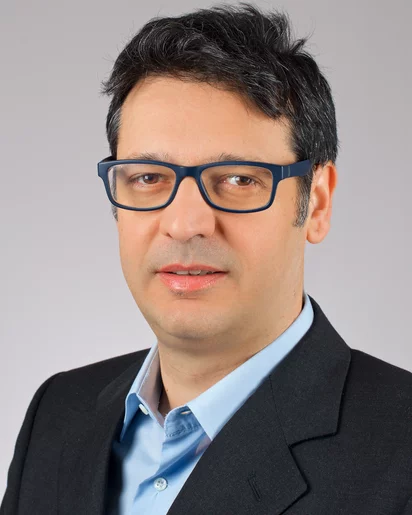
Ronald UlbrichtView profile
Researcher
Dr. Ronald Ulbricht is a Group Leader at the Max Planck Institute for Polymer Research in Mainz, Germany, where he leads the Ultrafast Microscopy group. His research focuses on developing and employing advanced time-resolved spectroscopic microscopy techniques to investigate quantum materials and phenomena at ultrafast timescales. Dr. Ulbricht received his physics diploma from TU Dresden and earned his PhD in 2012 from the FOM Institute AMOLF in Amsterdam for work on THz spectroscopy of semiconductors. He subsequently completed prestigious postdoctoral fellowships as a JSPS fellow at Hokkaido University (picosecond photoacoustics), Rubicon fellow at the University of Colorado, Boulder (optical near-field scanning probe microscopy), and DFG fellow at Nanyang Technological University in Singapore (transient optical dynamics of nitrogen-vacancy centers in diamond). His research group specializes in transient absorption spectroscopy capable of capturing optical dynamics from femtoseconds to seconds across the visible to infrared spectrum. A primary application is studying electronic properties and dynamics of color centers in diamond and silicon carbide, complemented by time-resolved photoluminescence, THz spectroscopy, photocurrent measurements, and nonlinear optical techniques like stimulated Raman scattering. His work bridges fundamental quantum physics with potential applications in quantum sensing and quantum information processing. Dr. Ulbricht's recent publications (2024-2025) demonstrate a strong focus on nitrogen-vacancy and silicon-vacancy centers in diamond, with research spanning electronic structure characterization, magnetometry applications, and quantum information science. His work shows interdisciplinary connections between physics, materials science, and data science, including applications of deep learning to analyze time-resolved spectroscopic data. As a Group Leader at the Max Planck Institute, Dr. Ulbricht oversees research projects, mentors junior scientists, and maintains active collaborations both within the institute and internationally, contributing significantly to the field of ultrafast quantum material characterization.