Marc Erich Latoschik is a Professor in the Department of Human-Computer Interaction at the University of Würzburg, Germany. He previously held roles at Bayreuth University, Bielefeld University, and FHTW Berlin. His research focuses on virtual and augmented reality, embodiment, human-computer interaction, and applications in health, education, and social systems. Education: Completed his PhD in 2001 at Bielefeld University with a thesis on multimodal interaction in virtual reality. Research Interests: Embodied interaction, virtual embodiment, presence and plausibility in VR/AR, avatar design, social virtual reality, health applications (e.g., VR therapy for body image issues), and XR security/privacy. Active in developing frameworks like Reality Stack I/O and MAIL for VR/AR research. Key Projects: ViTraS study on body image exercises in VR, avatars for mass use via smartphone reconstruction, and motion-based biometrics in XR. Collaborates with medical teams on cybersickness detection and emergency training simulations. Labs/Teams: Leads research groups on immersive technologies and social VR applications. Involved in interdisciplinary projects combining HCI, AI, and healthcare.
Prof. Martin Boeker is a Professor of Medical Informatics at the Technical University of Munich (TUM), affiliated with the TUM School of Medicine and Health. His work focuses on advancing healthcare through AI-driven solutions, interoperability frameworks, and precision medicine initiatives. Key projects include the German Medical Text Corpus (GeMTeX) and the MIRACUM DIFUTURE Alignment Hub. Expertise: Medical Informatics, AI in Healthcare, Federated Learning, Health Data Integration Key Contributions: FHIR-based systems, clinical decision support, patient-centered outcomes research Leadership: Director of the Institute for AI and Informatics in Medicine at TUM Hospital Right of the Isar Research emphasizes bridging clinical practice and data science through projects like modular health crawlers, automated guideline adherence monitoring, and cross-institutional medical NLP solutions. His work spans oncology informatics, rare disease management, and pandemic response data ecosystems. Recent articles highlight innovations in digital twins for precision oncology, federated analysis in oncology, and German-language medical NLP challenges. He collaborates internationally on EHR standardization and healthcare interoperability, contributing to the Medical Informatics Initiative (MII) and pandemic evidence ecosystems. Grants and collaborations involve the German Federal Ministry of Education and Research, European initiatives, and industry partnerships. Educational efforts focus on training future medical informatics professionals through MII competency programs.
Prof. Dr. Johanna Heitzer is a University Professor for Mathematics Education at RWTH Aachen University since 2011. She leads the Teaching and Research Area of Mathematics Education within the university's mathematics department. Her office is located in Room 352 of the Kreuzherrenstraße 2 building in Aachen. She serves as co-editor of the journal 'mathematik lehren,' co-author of the 'Mathematics - New Ways' textbook series, and holds numerous committee positions including membership in the Faculty Advisory Board and Structural Commission of the Center Council. 1989: High school diploma 1989-1994: Mathematics and Physics Teacher Training at RWTH Aachen 1994-1996: Traineeship at Aachen Teacher Training College 1997: Research assistant at University of Münster 1998-2007: Mathematics and Physics teacher at Korschenbroich Gymnasium 2007-2010: Scientific assistant and doctorate at RWTH Aachen 2011-present: University Professor at RWTH Aachen Professor Heitzer's research focuses on the training and further education of mathematics teachers, development of contemporary teaching materials, applied and interdisciplinary mathematics, and the transition from school to university. Her work emphasizes concept formation, linguistic communication in mathematics, and the historical development of mathematical ideas as teaching resources. She investigates mathematics-specific learning and cognitive processes through multiple research projects including the Aachen school-university project iMPACt. Her recent scholarly output demonstrates a strong trend toward integrating digital technologies in mathematics education, particularly 3D printing and e-learning tools. She has increasingly focused on the social relevance of mathematics, exploring concepts of fairness, sustainability, and citizen empowerment through mathematical modeling. Her work bridges theoretical mathematics education with practical classroom applications, maintaining a strong connection to both historical perspectives and contemporary educational challenges. Special prize from Sparkasse Bad Hersfeld-Rotenburg for best mathematics Abitur (1989) Borchers Plaque for doctoral examinations passed with distinction (2011) DMV honor as Mathemaker of the Month (2013) Brigitte Gilles Prize 2013 for the MINT-L4 Center Professor Heitzer has supervised numerous doctoral students, serving as primary or secondary advisor for at least nine PhD dissertations between 2016-2021. Her research projects include the School-University Project MathePlus Aachen (iMPACt), e-Learning 'Mathematics for Civil Engineers,' and the development of mathematics items for StudiChecks NRW. She has secured funding through the Quality Initiative for Teacher Education (both phases) and participates in the ComeIn project focused on digitalization in teacher training. Her grants consistently emphasize practical applications of mathematics education research with direct impact on classroom practice. As a founding member of the MINT-L4@RWTH center and initiator of the working group Mathematical Education for Sustainable Development, Professor Heitzer has established significant collaborative structures. She participates in the Subject Didactics Forum at the Teacher Training Center of RWTH Aachen and has served in leadership roles including Chair of the Center Council (2014-2016) and Board member of the Teacher Training Center (2014-2017). Her work connects with national and international networks through her membership in the Society for Mathematics Education (GDM), the German Association for Mathematics and Science Education (MNU), and the German Mathematical Society (DMV).
Prof. Dr.-Ing. Elisabeth Clausen is a Professor and Director of the Chair and Institute for Advanced Mining Technologies at RWTH Aachen University. She holds key roles in the Specialist Group for Raw Materials and Disposal Technology, serves as a rectorate representative, and leads the Commission for EU Research Funding. Her research spans Underground mining automation Acoustic emission diagnostics Sustainable mining systems Space resource extraction Advanced sensor technologies Her recent publications focus on autonomous mining machinery, underground communication systems, and acoustic emission analysis across 15+ studies from 2013–2025, with particular emphasis on Ultra-wideband positioning Thermographic detection Crack monitoring in planetary gearboxes Explosive atmosphere safety Mineral processing diagnostics Digitalization trends Prof. Clausen contributes to mining education reform through initiatives like CDIO™ and has developed innovative learning spaces in underground mines. She coordinates international educational labs and integrates sustainability into mining engineering curricula, with publications on Adaptive ventilation systems Mining education frameworks Future-proof mineral extraction Entrepreneurial mindset in engineering
Prof. Dr. med. Franz Lennard Ricklefs is a Senior Physician and Head of the Working Group at the Department of Neurosurgery, University of Hamburg Faculty of Medicine. He is a Medical Specialist in Neurosurgery with cross-disciplinary expertise in neuro-oncology, molecular pathology, and extracellular vesicle research. Affiliations: University Medical Center Hamburg-Eppendorf (UKE), European Liquid Biopsy Society (ELBS), International Consortium on Meningiomas (ICOM) Research Interests: His work focuses on neurosurgical oncology, particularly glioblastoma and meningioma pathobiology. He investigates DNA methylation patterns, extracellular vesicle biomarkers, and liquid biopsy implementation in clinical neuro-oncology. Additional interests include surgical outcomes for epilepsy and aneurysm management. Article Trends: Over the last decade, Dr. Ricklefs has published extensively on: Extracellular vesicle applications as liquid biopsy markers DNA methylation subclasses for glioblastoma and meningioma Multicenter surgical outcome benchmarking Immune evasion mechanisms in neuro-oncology Technological innovations in neurosurgical visualization Molecular characterization of rare CNS tumors Professional Contributions: He co-authored the MISEV2023 guidelines for extracellular vesicle studies and participates in international consensus reviews for meningioma classification. His collaborations span institutions across Europe and North America.
Prof. Dr. Poldi Kuhl is a Professor of Educational Psychology at Leuphana University , Lüneburg, since 2021. Affiliated with the Institute of Psychology in Education (IPE) and the Center for Empirical Research on Language and Education (ERLE) , Kuhl specializes in educational psychology, developmental psychology, and inclusive education. Their research focuses on data-driven decision-making, digital learning platforms, academic language demands, and teacher professional development. Education: Diploma in Psychology (2003) and PhD in Philosophy (2008) from Freie Universität Berlin. Kuhl’s recent work examines how academic language features affect learning outcomes, digital data utilization in primary education, and mental health literacy among teachers. Their publications span topics from virtual reality training tools to inclusive teaching strategies in mathematics. Kuhl’s career includes leadership roles at the Research Data Center (FDZ) at the Institute for Quality Improvement in Education (IQB) and a Junior Professorship at Leuphana University. They have collaborated with institutions like the Universitat Oberta de Catalunya and the Max Planck Institute for Human Development .
Prof. Dr. Katja Scharenberg is a faculty member at the Ludwig-Maximilians-Universität München (LMU) , affiliated with the Faculty of Psychology and Education. Her research focuses on inclusive education, heterogeneity in classrooms, teacher training, science education, and sustainability education. She leads and collaborates on multiple projects funded by the German Federal Ministry of Education and Research (BMBF) and the European Union’s Horizon 2020 program. Her work examines how heterogeneous learning environments impact student outcomes, particularly in science and sustainability education. She investigates teacher diagnostic competence in inclusive settings and develops digital learning environments to support accessible experimentation. Current projects include evidence-based modular continuing education programs for teachers and studies on ethnic school segregation’s effects on educational attainment in Germany and Switzerland. Key publications include empirical analyses of sustainability competencies in schools, inclusive pedagogy in primary and vocational education, and classroom dynamics affecting students with special educational needs. She serves on editorial boards and collaborates with networks like the European Association for Research on Learning and Instruction (EARLI) and the Deutsche Gesellschaft für Erziehungswissenschaft (DGfE) . Her research is supported by grants from the BMBF and EU Horizon 2020 . She supervises students in inclusive education and teacher training, and her work integrates research-based learning with practical school reforms in the Freiburg region.
Andrew Ho is an active academic researcher with publications spanning computer science, electrical engineering, and interdisciplinary applications. His recent work focuses on hybridizable discontinuous Galerkin methods for plasma simulations (2024) and AI/LLM applications in scholarly knowledge organization. 2025: Project Alexandria (LLM for copyright-free knowledge) 2024: Hybridizable DG plasma methods, GPU-accelerated kinetic simulations 2023: Low-resource translation techniques 2022: Multimodal VR interfaces 2003-2006: High-speed serial link transceivers and radiography artifact detection His research interests include: Computer science applications in plasma physics and medical imaging LLM-based scholarly knowledge graphs and literature reviews High-speed communication systems Educational technology implementations Co-authors include Vladimir Stojanovic (Stanford, 2003-2005), Carl W. Werner (2003-2005), and Genia Vogman (GPU plasma simulations, 2024).
Ulrich Schroeders is a Professor of Psychological Diagnostics at the University of Kassel, where he has been employed since October 2017. His work focuses on developing and validating psychological assessment tools, with particular expertise in cognitive diagnostics and educational measurement. He teaches various programs for approximately 500 students annually and serves as a supervisor for teacher training students preparing for their oral state examinations in Pedagogy/Psychology. Dr. Schroeders earned his PhD from Humboldt University of Berlin in 2010 with a dissertation titled "Measurement of Cognitive Abilities Using Modern Technologies: Artifacts, Equivalence, and New Constructs." Prior to that, he completed his Diploma in Psychology at Julius-Maximilians-University Würzburg in 2004 with a thesis on diagnosing dyscalculia in first-grade students. His research spans several key areas in psychological assessment. He specializes in technology-based competency diagnostics, developing innovative methods for measuring cognitive abilities and school competencies. A significant portion of his work involves applying Machine Learning and metaheuristics to psychometric problems, particularly in structural equation modeling. His methodological expertise includes advancing techniques in Local Structural Equation Modeling (LSEM) and Meta-Analytic Structural Equation Modeling (MASEM), with applications across educational and clinical psychology contexts. Analysis of Dr. Schroeders' recent publications reveals a strong focus on computational approaches to psychological assessment. His work frequently employs optimization algorithms like Ant Colony Optimization and Bee Swarm Optimization to address challenges in test construction and validation. There's a clear trajectory toward game-based and technology-enhanced assessment methods, as seen in studies using Mastermind and Wordle as assessment tools. His research also demonstrates growing interest in applying machine learning to predict behavioral outcomes, including juvenile delinquency, suicide risk, and psychotherapy outcomes. Dr. Schroeders has secured significant research funding, including projects funded by the German Research Foundation (DFG) and the Hector Foundation. His current projects include "Facing the Replication Crisis in Machine Learning Modeling" (2025-2027) and "PINGUIN: Potenzialidentifikation IN der GrUndschule" (2024-2027), which focuses on identifying elementary students' initial competencies. He leads the development of the BEFKI assessment system (Berliner Test zur Erfassung fluider und kristalliner Intelligenz), which includes versions for different age groups (5-7, 8-10, and 11+). His methodological toolbox includes specialized approaches for test construction and validation, particularly focusing on optimization algorithms applied to psychological measurement problems.
Prof. Dr. Barbara Sophie Hänel-Faulhaber is a Professor at the University of Hamburg’s Faculty of Education , specializing in German Sign Language (DGS) and audiopedagogy . Her research focuses on language acquisition and processing in DGS , particularly among deaf children and inclusive educational settings . She leads the Deafness, Language and Learning Lab (D2L) and contributes to the faculty’s core research area Literacy in Diversity Settings . Education: Dr. phil. in Sign Languages (University of Hamburg, 1999–2003) Magister Artium in Sign Languages, Linguistics (University of Hamburg, 1996–1999) Double Degree in Deaf Education, Elementary Education (LMU Munich, 1992–1996) Her work examines bimodal-bilingual education , iconicity in early sign learning , and structural conditions in inclusive daycare centers . She develops diagnostic tools like the DGS-Version of MBK 0 for assessing numerical competencies in deaf children. Current projects include Coactivation of Difference (2023–2026) and Sign4Inclusion (Math) (2023–2024). Scientific Awards: Institutional Prize for German Language 2023 Heinrich Böll Stiftung Promotionsstipendium (1999–2003) Wilhelm-Stiftung Post Doc Fellowship (2005) She collaborates with institutions like the Institute of German Sign Language and Deaf Communication and the Graduate School Martha Muchow , with recent publications spanning sign language diagnostics , inclusive pedagogy , and cross-modal literacy studies .
Prof. Gabriele Kaiser is a Full Professor of Mathematics Education at the University of Hamburg’s Faculty of Education. She holds a part-time professorship at the Norwegian University of Science and Technology and an honorary professorship at the Australian Catholic University (ACU). Her research focuses on mathematical modeling, teacher professional competence, and comparative studies in education (East-West). She led the ICME-13 conference in 2016 and serves as former Editor-in-Chief of ZDM Mathematics Education. Key contributions include the TEDS research program on teacher education and the development of video-based assessment tools for teacher noticing. Awards include top Springer downloads for her edited volumes and leadership in international educational initiatives. Roles: Chair of ICME-13, Editor of ZDM, ICMI Representative, ICTMA President Affiliations: University of Hamburg, ACU Brisbane, University of Macau collaborations Research Interests: Mathematical modeling, teacher education, inclusive mathematics, flipped classrooms, and cross-cultural studies Her work emphasizes innovation in teacher training, classroom observation methodologies, and addressing diversity in mathematics education. Recent projects include studies on Chinese and German teachers’ competencies and the use of AR/VR in STEM education. Awards: Honorary professorships in Australia and Hong Kong, board member of Hamburg Scientific Foundation, and recognition for impactful publications.
Lutz Frankenstein is a Professor and Senior Physician ( Oberarzt ) at the Department of Cardiology, Angiology, and Pulmonology at Heidelberg University Hospital. He also serves as Medical Director of the Heart Failure Outpatient Clinic and leads the Working Group on Chronic Heart Failure/Health Economics. Education: Executive MSc in Health Economics (London School of Economics), Habilitation at Heidelberg University Clinical Specialties: Chronic Heart Failure, Performance Physiology, Submarine Medicine, Health Economics His research focuses on clinical cardiology , particularly chronic heart failure , with emphasis on new diagnostic techniques , risk prediction models , and health economics . He has published extensively on beta-blockers, SGLT2 inhibitors, and multidisciplinary care for heart failure patients. Recent article trends span cardiovascular outcomes in diabetes , sex-based treatment disparities , and health policy reforms for transcatheter valve interventions. His work integrates clinical trials , network meta-analysis , and health services research . Frankenstein is actively involved in clinical training (e.g., interventional cardiology certification) and healthcare policy , including roles in DRG evaluation and ESC guidelines. He leads research on resilience in chronic heart failure and periodontal-heart disease links .
Prof. Dr. Kathleen Stürmer is a faculty member at the University of Tübingen, affiliated with the Tübingen School of Education (TüSE) and the Hector Institute for Empirical Educational Research . As Deputy Director of TüSE for Internationalization since 2021, she leads initiatives to enhance global collaboration in teacher education. Research Focus: Teacher professional vision, simulation-based learning environments, diagnostic competence development, and technology integration in classrooms. Methodologies: Eye-tracking studies, meta-analytic reviews, and longitudinal analyses of teacher training efficacy. Key Projects: Observer (video-based diagnostic tool), Di-MaL (simulation framework for pedagogical diagnostics), and quality initiatives in digital distance teaching during the pandemic. Her recent publications highlight trends in educational technology (AI, tablets), teacher cognition (professional vision, attention processes), and structural innovations in teacher education programs. She actively develops standardized instruments for measuring pedagogical expertise and explores the impact of individual and contextual factors on instructional quality. Labs & Teams: She collaborates with the Hector Institute for Empirical Educational Research and leads internationalization efforts at TüSE, focusing on interdisciplinary frameworks for diagnostic competence across professions like teaching and medicine.
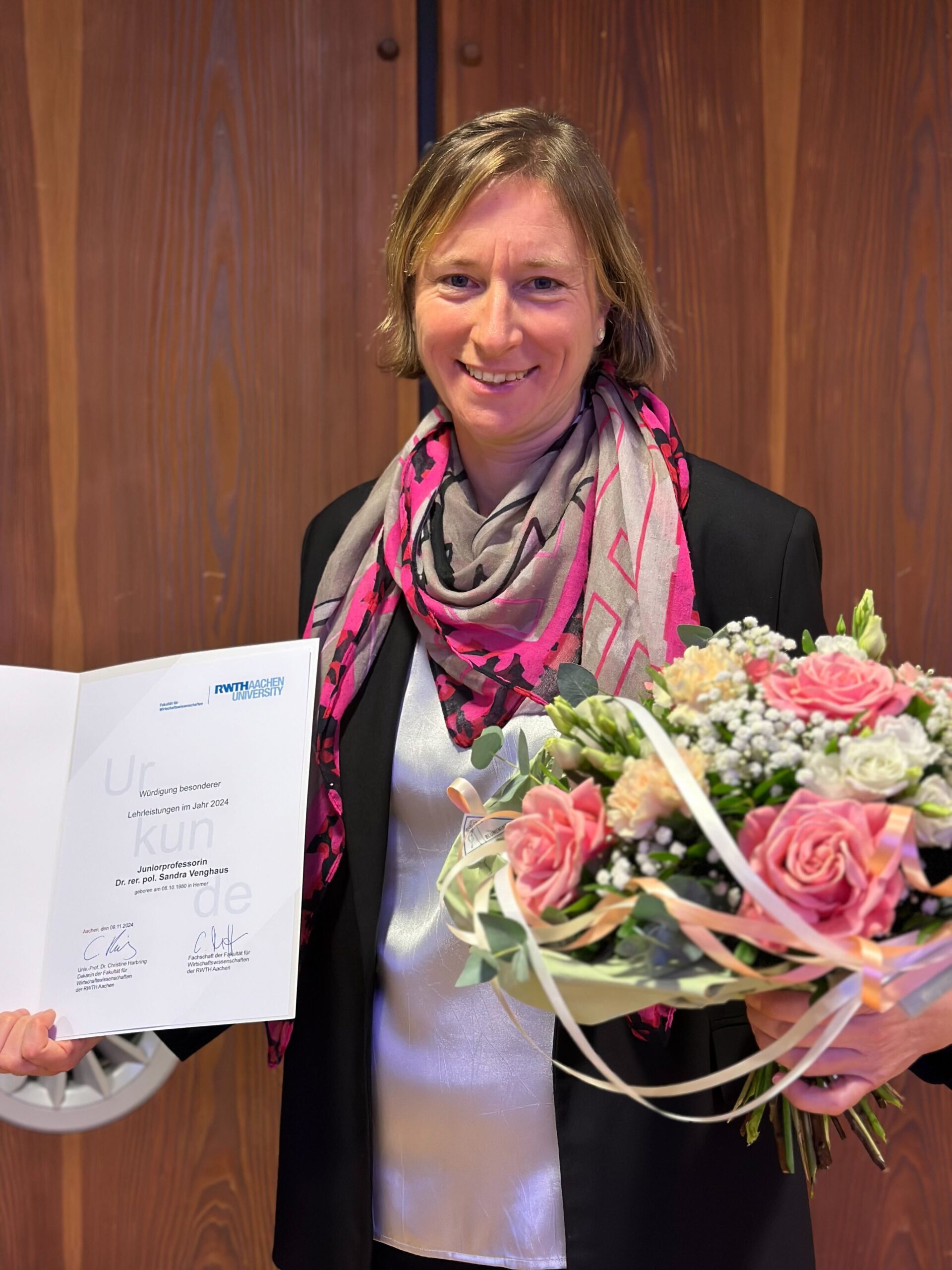
Sandra Venghaus serves as Assistant Professor for Decision Analysis and Socio-Economic Assessment at RWTH Aachen University's Faculty of Business and Economics, leading the dedicated research group in this field. She additionally coordinates the BioSC Competence Platform "Transform2Bio: Integrated Transformation Processes and their Regional Implementations: Structural Change from Fossil Economy to Bioeconomy". Her academic foundation includes: Environmental Science and Public Policy studies at Harvard University (2000-2004) Doctoral degree in Complex System Innovations from Leibniz University Hannover Professor Venghaus's research centers on quantitative modeling of complex socio-ecological systems , specifically analyzing how political decisions impact social, economic, and ecological outcomes. Her work spans critical domains including: Governance of the Sustainability Transformation Innovation in Socio-Ecological Systems Computational Resource Economics Decision Analysis Sustainability Assessment Bioeconomy development Markets, Circular Economy, and Water-Energy-Land Nexus dynamics Recent publications (2023-2024) demonstrate evolving focus on renewable energy market barriers, bioeconomy's climate mitigation potential, and sustainability-digitalization intersections. Her interdisciplinary work integrates energy economics, environmental science, and policy analysis within German and European contexts, emphasizing quantitative assessment frameworks for resource security and transformation pathways. She has received recognition through the Faculty of Business and Economics Teaching Prize. Teaching Prize of the Faculty of Business and Economics Information regarding her advisees and grant funding specifics was not provided in available sources. Professor Venghaus leads the Decision Analysis and Socio-Economic Assessment research group while coordinating the Transform2Bio platform, which drives integrated strategies for transitioning from fossil-based economies to sustainable bioeconomies through regional implementation frameworks.
Prof. Dr. Annika Goeze holds the Chair of Educational Science with a focus on professional and company-based continuing education at the Eberhard Karls University of Tübingen since April 2021. She was previously a professor at TU Chemnitz (2019-2021) and has held visiting positions at Ruhr University Bochum and Karl-Franzens University of Graz. Her work centers on professional development , digital media in education , and implementation research in adult education. Her research includes: Video case-based teaching for competence development Digital sovereignty in language education Personnel diagnostics in continuing education Teacher training program evaluation Implementation research in educational systems Recent article trends emphasize digital media integration in teacher training, leadership development, and evidence-based professional development. She leads the DFG-funded DigiNICs project and has secured grants from BMBF and the State of Baden-Württemberg. Scientific awards include the Leibniz Mentoring Program scholarship and DFG Young Researchers’ Academy admission. Grants & Projects : "Digitally Supported Networked Improvement Communities" (BMBF, 2023-2025) "Quality Offensive for Teacher Training" (BMBF, 2021-2023) Leadership training evaluation (Baden-Württemberg, 2023) Ongoing DFG/DIE research on personnel diagnostic competencies (since 2013) Labs & Teams : She co-leads the Institute of Educational Science at Tübingen and coordinates research groups within the Tübingen School of Education . Her collaborative work includes the development of the Online Case Laboratory (www.videofallarbeit.de).