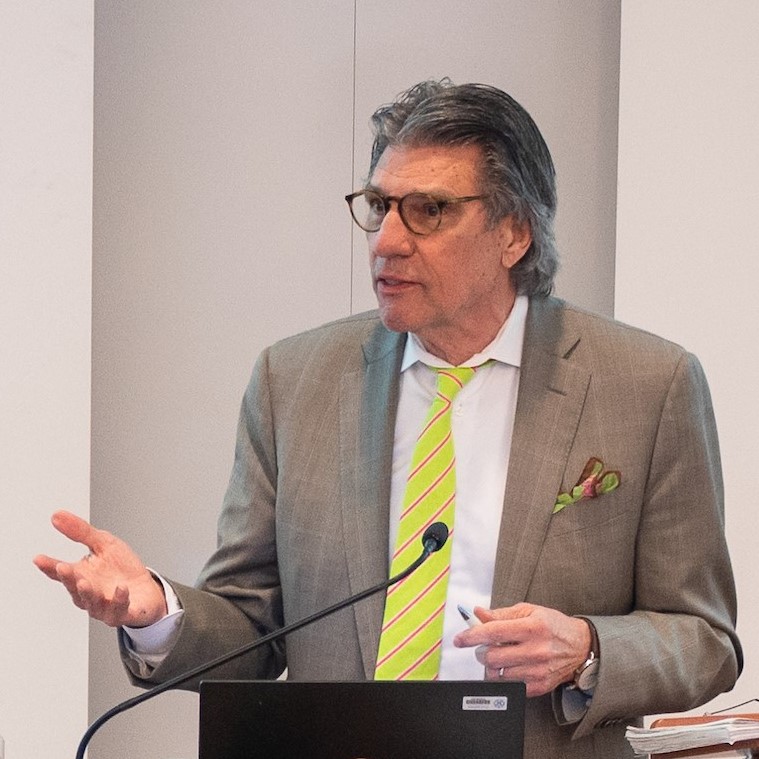
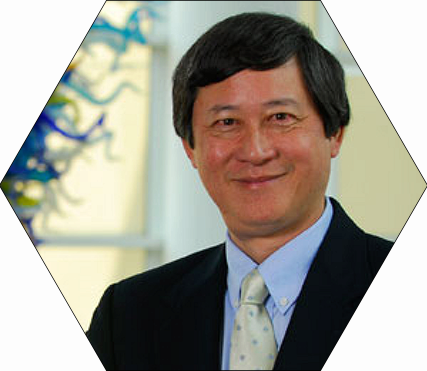
David S. Caudill is a Professor of Law and the inaugural Arthur M. Goldberg Family Chair at Villanova University’s Widger School of Law since 2005. He also holds the title of Senior Fellow at the University of Melbourne Law Faculty. Caudill has held visiting appointments at the University of Texas, Southern Illinois University, Cardozo School of Law, and the University of Florida. Education: J.D., University of Houston Law Center (1981) Ph.D., Philosophy, Free University of Amsterdam (1989) B.A., Philosophy, Michigan State University (1973) Postdoctoral work: Science & Technology Studies at Virginia Tech (2001) and Washington Psychoanalytic Institute (1994-95) Caudill’s research bridges law and science studies , law and literature , and sports and entertainment law . His recent work examines the legal implications of scientific consensus, confidentiality in business contexts, and the ethical dimensions of literary narratives in jurisprudence. His five 2025 publications reflect interdisciplinary engagement with legal ethics, scientific evidence in courtrooms, and the intersection of law with cultural and scientific discourse. Articles address topics like non-disclosure agreements, climate change litigation, and the use of literature in legal ethics training. Scientific Awards: SKAPP grant (2007) Société de Chimie Industrielle Fellow (2007/2008) Before academia, Caudill practiced real estate and sports law, clerked for the Fifth Circuit, and taught as an adjunct professor at the University of Texas. His presentations span themes like expertise crises, psychoanalytic theory in law, and religious aspects of legal epistemology.
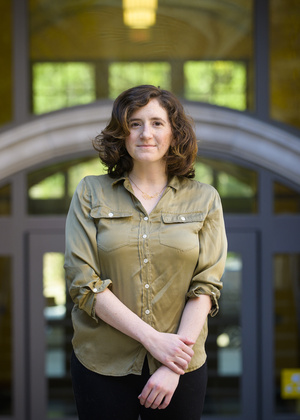
Ching Crumley is a Senior Lecturer in the Economics Department at Bentley University, joining in summer 2024. Previously, they taught at Grinnell College (liberal arts college) and Texas Tech University across courses including Time Series Econometrics and Intermediate Macroeconomics. Education: Ph.D. in Economics from Texas Tech University (2023) International Business from Zhongnan University of Economics and Law (2018) Research focuses on Macroeconomics—specifically monetary policy mechanisms—and Energy Economics, with deep analysis of oil market volatilities and comparative studies between developed and developing economies. Their work directly supports UN Sustainable Development Goals related to economic growth and sustainable energy systems. Recent publications (2023-2024) reveal an interdisciplinary trajectory connecting business cycle modeling, zero lower bound monetary policy, BRICS trade integration, pandemic-era oil price asymmetries, and high-skill labor market dynamics. These works demonstrate rigorous application of econometric models like GTAP-E across macroeconomic and energy sectors. Teaching experience has cultivated strong advising capabilities for both coursework and research projects, though no formal advisees or grants are specified. No scientific awards or laboratory affiliations are documented in the available materials.
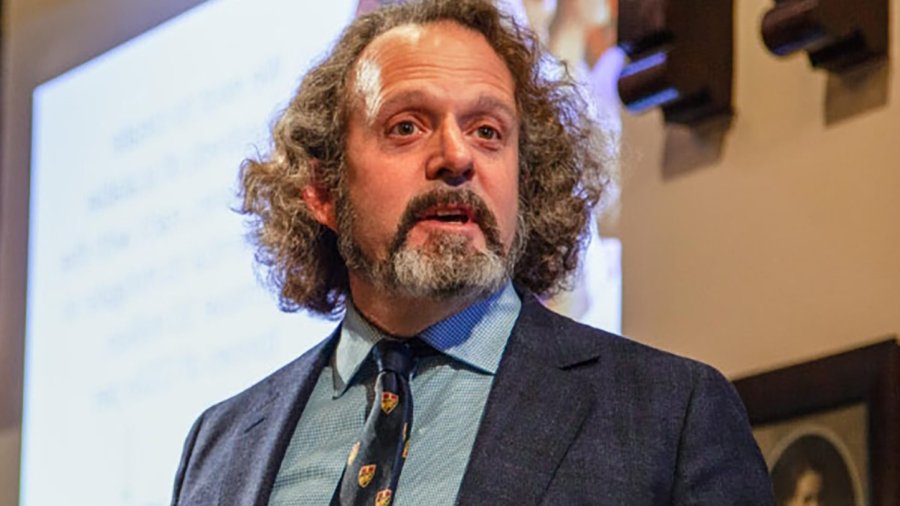
Abigail Jacobs is an Assistant Professor at the University of Michigan , jointly appointed in the School of Information and the College of Literature, Science, and the Arts . She is also affiliated with the Center for Ethics, Society, and Computing (ESC) and the Michigan Institute for Data Science (MIDAS) . Education: PhD in Computer Science, University of Colorado Boulder (2015-2019) BA in Mathematical Methods in the Social Sciences and Mathematics, Northwestern University (2011-2015) Research Interests: Dr. Jacobs examines measurement and validity in machine learning , focusing on hidden assumptions in AI systems, governance structures in sociotechnical systems, and inequality in algorithmic design. Her work bridges AI, data science, and social science methodologies, emphasizing interdisciplinary collaboration. Recent Publications (2024-2025) explore generative AI evaluation, algorithmic transparency in government (e.g., US Census Bureau), motion capture data ethics, and sociotechnical frameworks for AI governance. Earlier works (2023) address fairness in ranking systems and racial categorization in algorithmic bias studies. Scientific Awards: Microsoft Research AI & Society Fellowship (2024) NSF Graduate Research Fellowship (during PhD) Advising & Grants: She co-advises Ph.D. students Amina Abdu and Meera Desai . Her research includes a Notre Dame-IBM Tech Ethics Lab grant on AI audits and collaborations with institutions like UC Berkeley, Microsoft Research, and the National Academies .
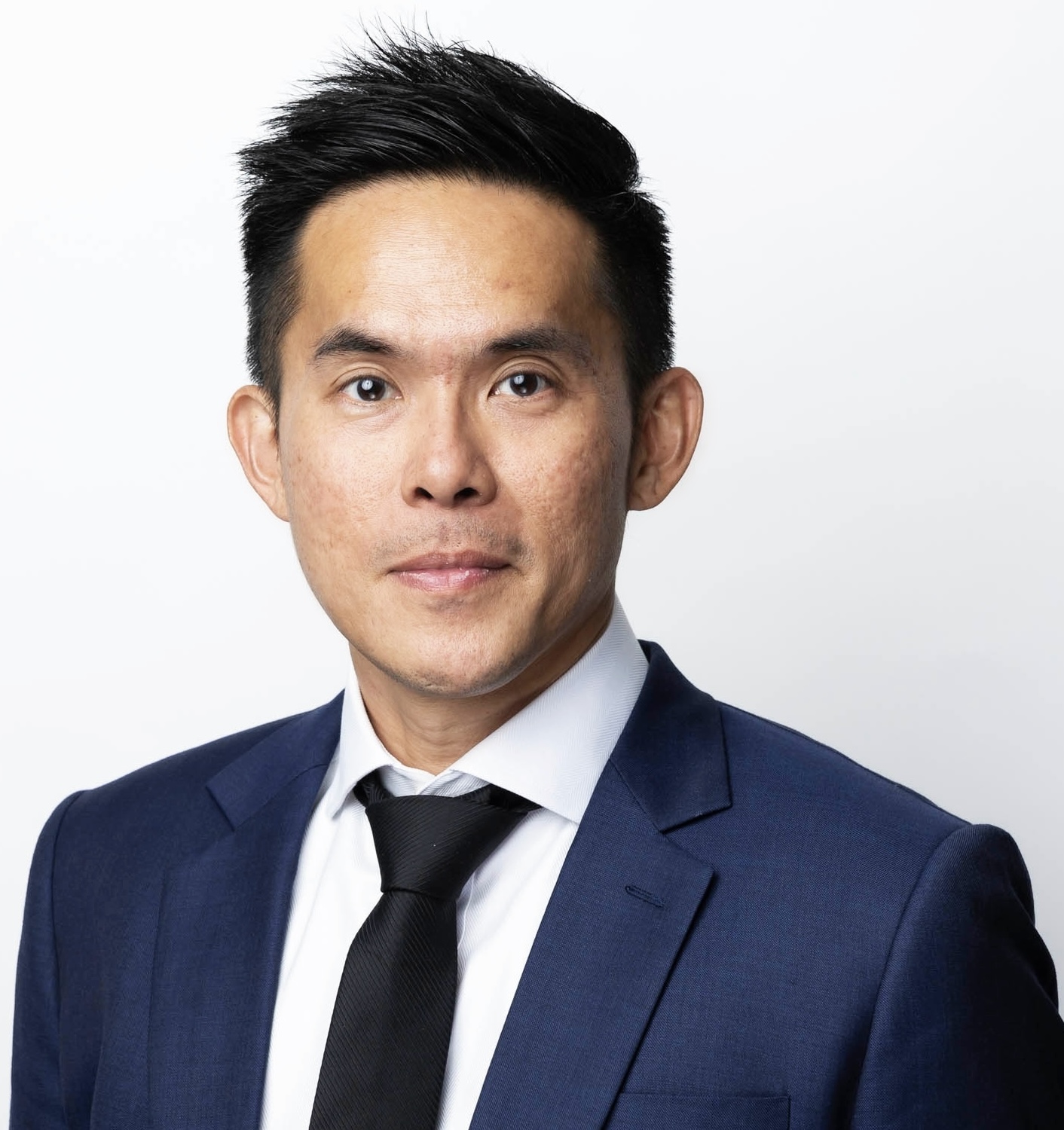
Thompson S.H. Teo is a Professor in the Department of Analytics and Operations (DAO) at the National University of Singapore (NUS) Business School. He holds editorial roles in top journals including European Journal of Information Systems, International Journal of Information Management, and Communications of the AIS. His research spans information systems strategy, business-IT alignment, e-commerce, sustainability, and AI's societal impacts. With over 200 publications, he ranked #143 globally in 2023 among business scientists (research.com) and was recognized in Stanford's top 2% global scientists (2021-2023). Awards include the Best Associate Editor Award (2017) and AIS Distinguished Membership. Thompson's research interests include IT adoption, cyberloafing, supply chain digitalization, and green innovation. He teaches courses on innovation, Industry 4.0, and strategic IT at undergraduate, masters, and executive levels. Notable contributions include frameworks for commute experience analysis and AI adoption market signals. His work bridges theory and practice, addressing challenges in sustainability, organizational behavior, and digital governance. Affiliations: NUS Business School, Distinguished Editorial Advisory Board (IJoIM), Senior Member (INFORMS) Grants & Leadership: Extensive editorial leadership, supervised China Scholarship Council PhD students, and executive programs on innovation design thinking. Key Contributions: Over 270 publications, four co-edited books on IT/e-commerce, and policy-relevant studies on environmental regulations and green tech adoption. His research often employs mixed methods (e.g., QCA for corruption analysis, PLS-SEM for cyberloafing models) and addresses global issues like fake news mitigation via ChatGPT and pandemic-era customer engagement in short videos.
Chris Coleridge serves as Management Practice Associate Professor at Cambridge Judge Business School, University of Cambridge, and holds a Fellowship at Wolfson College. He specializes in entrepreneurship and strategic management education, with particular emphasis on climate-related innovation and net zero entrepreneurship. He founded Cambridge's first Master's degree in Entrepreneurship and currently chairs Wolfson College's Entrepreneurship Hub. His academic credentials include: MBA from London Business School MSc in Organisational and Social Psychology from London School of Economics PhD in Management (focusing on business model innovation) from London School of Economics Research centers on top management team dynamics within startups and scaleups, examining how entrepreneurial networks drive collaborative innovation and ecosystem development . His work bridges theoretical frameworks with practical climate-tech applications, particularly through venture building processes and strategic scaling decisions for sustainability-focused enterprises. Recent publications (2020-2024) reveal consistent focus on corporate governance structures in high-technology ventures, with recurring analysis of board leadership efficacy, CEO duality implications, and heterogeneity impacts on competitive strategy. The research integrates agency/stewardship theories to explain governance dynamics in climate innovation contexts. Professional recognition includes: Five teaching awards during tenure at University College London Through active industry engagement, Coleridge translates academic research into climate solutions via Carbon13 (a climate venture builder) and Faster Climate Impact (an ecosystem integrator for climate tech). His advisory work focuses on strategic scaling of climate startups, mergers and acquisitions in sustainability sectors, and net zero business model innovation. He leads Wolfson College's Entrepreneurship Hub and contributes to global sustainability initiatives including the Business Schools for Climate Leadership consortium's Global PhD Course. Current efforts prioritize building 'climate powerhouses' through acquisition-driven integration of climate technology firms.
Professor Barney Tan serves as Professor of Information Systems and Senior Deputy Dean (Impact and Partnerships) at UNSW Business School. Previously, he held the position of Head of School (Information Systems and Technology Management) and was formerly Professor of Strategic Information Systems at The University of Sydney. Professor Tan completed his PhD in Information Systems at the National University of Singapore in 2012, following a Bachelor of Computing (Honors) in Information Systems from the same institution in 2004. His research focuses on strategic information systems, AI management and implementation, digital platforms and ecosystems, fintech, and information systems for sustainable development with particular emphasis on IT trends in the Asia-Pacific region including China and ASEAN countries. As an engaged researcher, Professor Tan is deeply passionate about translational research that contributes toward sustainable development and frequently provides advisory support to organizations he has studied, including national governments through his work with the United Nations International Think Tank for Landlocked Developing Countries. His research has been published in top-tier journals including MIS Quarterly, Information Systems Research, Journal of Association of Information Systems, Information Systems Journal, and The Journal of Strategic Information Systems. Senior Editor, Information Systems Journal (2022-Present) Senior Editor, Information Technology and People (2019-Present) Associate Editor, Internet Research (2020-Present) Associate Editor, Information and Management (2016-Present) Editorial Board Member, Information Systems Research (2022-Present) Editorial Board Member, IEEE Transactions on Engineering Management (2017-Present) Professor Tan has received numerous prestigious teaching and research awards throughout his distinguished career: 22 awards in 11 years at The University of Sydney SUPRA Teacher of the Year award for 2019 and 2020 SUPRA Supervisor of the Year award for 2019, 2020 and 2021 The University of Sydney Business School Dean's Award for Teaching in 2019 Multiple Dean's Citations for Teaching across various courses and semesters Professor Tan has successfully secured multiple competitive research grants: Hong Kong University Grants Committee General Research Fund (2020-2022): 'The Impact of Social Media on Digital Guanxi Formation in the Chinese Workplace', Co-Investigator, HKD$475,617 (A$88,286) The University of Sydney Business School Industry Partnership Grant (2017): 'International Think Tank for Landlocked Developing Countries Research Development Project', Chief Investigator, A$27,238 Zhejiang Gongshang University Strategic Research Grant (2016-2019): 'Emerging Digital Commerce Platforms: Development Patterns and Usage Behavior', Principal Investigator, CNY$300,000 (A$60,535) Multiple University of Sydney Bridging Support Grants (2015-2016) focused on digital commerce and Australian-China trade Professor Tan is frequently featured in mainstream media outlets including ABC News, Business Insider, Sydney Morning Herald, The Australian, News.com.au, The Australian Financial Review, CIO, and Bloomberg Businessweek, where he provides expert commentary on technology-related topics such as cryptocurrency, digital platforms, and China's tech landscape.
Professor Dinusha Mendis is a leading academic in Intellectual Property and Innovation Law at Bournemouth University, where she serves as Director of the Centre for Intellectual Property Policy and Management (CIPPM). Her expertise bridges copyright law with emerging technologies like 3D printing, AI, blockchain, and the Metaverse, informed by extensive research and consultation with entities such as the European Parliament, UKIPO, and corporations like HP and Chanel. She holds a PhD from Edinburgh University and has authored seminal works on the intersection of technology and IP. BSc in Law from Aberdeen University LLM and PhD from Edinburgh University Called to the Bar of England and Wales Her research focuses on copyright challenges in immersive environments , AI-generated content regulation , and blockchain/NFTs . She led major studies for the European Commission and UKIPO , including the first peer-reviewed work on 3D printing and IP. Her 2019 co-edited book with Stanford and QUT scholars established foundational frameworks for additive manufacturing legal analysis. Recent publications highlight AI copyright disputes (2024 The Conversation ), NFT legal ambiguities (2022), and pandemic-era 3D printing (2020). Trends show increasing emphasis on decentralized IP systems and machine learning's impact on creative industries . Scientific Awards & Grants JSPS Visiting Professorship (2023) Daiwa Anglo-Japanese Foundation Grant (2024) EU Commission Research Funding (2020) AHRC Grant for 3D Jewellery Study (2017) As a PhD supervisor, she mentors researchers on AI copyright (Benjamin White), crypto-art (Bahar Dagli), and music creation law (Elizabeth Bailey). She contributes to global IP policy through the World Economic Forum's Metaverse Governance Team and EU IPR Enforcement Projects .
Maureen Meadows is a Professor of Strategic Management at Coventry University's Research Centre for Business in Society. Her work focuses on strategic decision-making, big data applications, privacy in business models, and M&A dynamics. She previously held leadership roles at the Open University and Warwick Business School, where she contributed to strategic management education and research. Education: PhD in Open University (2016) MSc in Management Science from University of Warwick (1987) Bachelor of Arts in Mathematics (Oxford University, 1986) Research Interests: Strategic management tools (e.g., scenario planning), customer data analytics, privacy implications of data sharing, and post-merger integration. She has co-led projects on surveillance society blurring and privacy in the digital economy, funded by Leverhulme and EPSRC. Key Projects: Leverhulme-funded 'Taking Liberties?' (surveillance society) EPSRC-funded 'Monetize Me?' (privacy and quantified self) Co-designing digital strategies for museums and education sectors Grants & Collaborations: Multiple internally-funded projects on board assurance frameworks, creative accounting, and hybrid business models in museums. Active in international conferences and professional bodies like BAM Council. Awards: While no specific prizes are listed, her h-index of 24 and 1,891 citations reflect significant scholarly impact.
Alicia Orea Giner is a Professor at the Faculty of Economics and Business Sciences of Rey Juan Carlos University, specializing in sustainable tourism and social justice. Her research focuses on Generation Z's sustainable consumption practices in food tourism, AI integration in hospitality, and ethical dimensions of tourism. She co-authored the award-winning article The way we live, the way we travel: generation Z and sustainable consumption in food tourism experiences , recognized with the 2024 Emerald Literati Outstanding Paper Award. Her work bridges sustainability, technology, and cultural studies. Key themes include feminist methodologies in tourism research, transformative travel through ecofeminism, and post-pandemic food tourism trends. She explores AI applications in service robots, wellness tourism's mental health connections, and marginalized communities' roles in culinary tourism. Recent studies address LGBTQ+ tourism challenges, stakeholder participation in World Heritage sites, and ghost tours' cultural narratives. Awards highlight her contributions to sustainability and social justice in tourism. Awards: 2024 Emerald Literati Outstanding Paper Award Research Foci: Food Tourism, AI Ethics, Feminist Tourism Studies, Cultural Heritage Management Labs/Teams: No specific lab mentioned; collaborates across interdisciplinary tourism research networks.
Prof. Dr. Dennis Herhausen is a Full Professor of Marketing and Head of the Marketing Department at Vrije Universiteit Amsterdam’s School of Business and Economics. Previously, he held positions as Associate Professor at KEDGE Business School, Visiting Professor at the University of St. Gallen, and Assistant Professor at the University of St. Gallen. His research focuses on digital communication, customer journeys, multichannel management, and social media strategies, with publications in top-tier journals like the Journal of Marketing and Journal of Marketing Research. His work addresses critical issues such as online firestorm mitigation, complaint de-escalation, and gig economy communication. He has been awarded multiple prestigious prizes, including the 2021 CBSIG Consumer Research Award and the 2019 William R. Davidson Award. Education: PhD in Marketing from University of St. Gallen (2011) Teaching: Courses on Customer Experience Management, Survey Research Methods, and Thesis Guidance Research Interests: His work explores digital marketing strategies, customer-centric innovations, and the dynamics of online platforms. Recent studies address topics like business-to-investor marketing signals, privacy orientation measurement, and machine learning biases in marketing. He actively contributes to editorial boards of journals including Journal of Marketing and Journal of Interactive Marketing. Awards: 2021 CBSIG Consumer Research in Practice Award 2021 Retail & Pricing SIG Best Paper Award 2021 SERVSIG Best Services Article Award 2020 William R. Davidson Award Grants & Editorial Work: His research has been funded by national/international grants, and he serves on multiple editorial boards. Notable datasets include studies on online retailer strategies and virtual brand sabotage responses.
Ed Petkus is an Adjunct Professor at the Anisfield School of Business (ASB), Ramapo College of New Jersey, where he has been teaching since 2006. He holds a Ph.D. in Marketing from the University of Tennessee, an M.B.A. in Marketing from Virginia Tech, and a B.S. in Biochemistry & Nutrition from Virginia Tech. Education Ph.D., Marketing, University of Tennessee M.B.A., Marketing, Virginia Tech B.S., Biochemistry & Nutrition, Virginia Tech Research Interests Dr. Petkus focuses on Marketing Education , Marketing History , Non-Profit Marketing , and Sustainability Issues . His work explores innovative pedagogical approaches, cross-cultural learning dynamics, and the integration of sustainability and aesthetics into marketing practices. Publications & Contributions His recent publications examine the role of natural environments in teaching, cross-cultural learning styles, historical marketing case studies, and the application of holistic marketing in nonprofit contexts. He has presented research at international conferences including the Academy of Marketing Science and Global Business Development Institute.
Daniel Leunbach is a Senior Lecturer at the School of Business, University of Oslo , specializing in Entrepreneurship . He teaches courses in strategy, innovation management, and entrepreneurship while integrating philosophy and psychology into his research to study decision-making under uncertainty. Ph.D. in Strategy and Entrepreneurship, University of Oslo MSc in Innovation and Entrepreneurship, University of Oslo BSc in Molecular Biology, University of Bergen His research explores the intersection of entrepreneurship theory , philosophy , and psychology , focusing on how entrepreneurs navigate situations where outcome probabilities are impossible to quantify. Recent publications investigate topics such as entrepreneurial imagination through poetry , resource acquisition negotiations , and Wittgensteinian approaches to defining entrepreneurship . Leunbach collaborates with scholars like Truls Erikson and Glenn Roger Kristiansen , publishing in journals such as Academy of Management Review , Scandinavian Journal of Management , and Journal of Business Venturing Design . He is affiliated with the Entrepreneurship (ENT) research group and consults on entrepreneurial decision-making frameworks.
Marshall Steinbaum is an Assistant Professor of Economics at the University of Utah and a Senior Fellow in Higher Education Finance at the Jain Family Institute. His empirical research focuses on employer power in labor markets, with applications to antitrust policy, student debt, and economic inequality. He holds a Ph.D. in Economics from the University of Chicago and a B.A. (Hons) in Philosophy, Politics, and Economics from Oxford University. Steinbaum's research investigates: The dynamics of labor market concentration and its impact on wages Antitrust enforcement in franchising and gig economies Student debt crises and higher education financing Historical and policy-driven causes of economic inequality His recent publications analyze trends in franchising restrictions, mergers' labor market effects, and student debt cancellation impacts. Articles consistently emphasize employer power, regulatory gaps, and structural inequities across labor and education sectors.
Prof. Dr. Bernd Skiera holds the first chair for electronic commerce in Germany at Goethe University Frankfurt am Main since 1999. He serves on the board of efl - The Data Science Institute and the Schmalenbach Society, while representing Germany at the European Marketing Community (EMAC). Chair of Marketing, Goethe University Frankfurt am Main Board member, efl - The Data Science Institute National representative, European Marketing Community (EMAC) His research focuses on MarTech/SalesTech integration, customer value management, online advertising analytics, data-driven pricing models, and the economic implications of internet privacy regulations. He leads the ERC Advanced Grant project on cookie usage restrictions' economic consequences. Recent publications examine dynamic pricing in digital markets, competition visualization using big data, and AI applications in marketing analytics. The ERC Advanced Grant research has produced empirical analyses of GDPR impacts on advertising ecosystems. 2015 Journal of Marketing Best Paper Award 2013 International Journal of Research in Marketing Best Paper Award Multiple MSI/H. Paul Root Award recognitions He has mentored 17 doctoral students who became professors globally, including at London Business School and LMU Munich. His work bridges marketing analytics with financial valuation through customer equity modeling.
David N. Ku is the Lawrence P. Huang Endowed Chair for Engineering Entrepreneurship and Regents' Professor at Georgia Institute of Technology. He holds appointments in the School of Mechanical Engineering (Woodruff School) within the College of Engineering. His research focuses on biofluid mechanics, medical device innovation, and translational technology, with emphasis on thrombosis mechanisms and vascular diseases. Education: M.D. from Emory University (1984); Ph.D. and M.S. from Georgia Tech (1983, 1982); B.A. from Harvard University (1978). Research interests include unsteady fluid dynamics in vascular systems, nanoparticle medical devices for thrombosis prevention, and porous thrombus applications for hemostasis. His work bridges bioengineering with entrepreneurship, teaching product development at the Business School and collaborating with Emory University, Paris Tech-Mines, and ETH Zurich. Key awards include the American Institute for Medical and Biological Engineering Fellowship, DLA Piper Inventor of the Year, and NSF Presidential Young Investigator Award. His research is funded by NIH, NSF, and industry partners. Labs/Teams: Leads a lab using microfluidics and computational mechanics for vascular disease solutions. Collaborates on technologies to address post-partum hemorrhage and traumatic bleeding.