Professor Bernd Möbius is a leading academic in Phonetics and Phonology at the Department of Language Science and Technology, Saarland University. His research bridges phonetic theory with speech technology applications, focusing on text-to-speech systems, prosody modeling, and computational simulations of speech processes. Current research projects: DFG SFB 1102, C1: Information density and phonetic structure predictability DFG SFB 1102, C4: Slavic intercomprehension and surprisal theory (INCOMSLAV) Research Themes: Key areas include text-to-speech synthesis, speech prosody analysis, experimental methods in speech production/perception, information density in phonetics, and cross-linguistic studies of Slavic-Germanic languages. Scientific Contributions: Recent work explores Parkinson-induced dysarthria detection, breath noise acoustics, surprisal-driven speech behaviors, multilingual BERT models for idiomaticity, and perceptual consequences of acoustic adjustments.
Bistra Andreeva is a full Professor of Phonetics and Phonology at Saarland University, Department of Language Science and Technology. She is also a principal investigator of the DFG-funded project “Judeo-Spanish in Bulgaria: a contact language between archaism and innovation” (2022-2025) and leads or co-leads several other externally funded projects on prosody, information structure, and language contact. She teaches and has taught at Saarland University, Sofia University “St. Kliment Ohridski”, and other European universities. Education & Academic Background Habilitation (kumulative Habilitationsschrift): “Contrastive Prosody: Bulgarian vs. German”, Saarland University, 2016. PhD (Dr. phil.): “Zur Phonetik und Phonologie der Intonation der Sofioter-Varietät des Bulgarischen”, Saarland University, 2007. Research Interests Andreeva’s research focuses on the phonetics and phonology of intonation and rhythm, cross-language and individual differences in the production and perception of syllabic prominence, the relation between intonation and information structure, minority languages (especially Judeo-Spanish in Bulgaria), and the interaction between information density and prosodic structure. Her methodological expertise includes experimental phonetics, corpus-based studies, and acoustic analysis. Major Projects SFB 1102 C1: “Information Density and the Predictability of Phonetic Structure” (DFG, 2014-2026) JuSpa: “Judeo-Spanish in Bulgaria: a contact language between archaism and innovation” (DFG, 2022-2025) Prosodic aspects of Bulgarian compared to other languages with lexical stress (Bulgarian National Science Fund, 2019-2024) Prosodic manifestations of focus in French and English from a Bulgarian point of view (DAAD & Sofia University, 2021-2023) Scientific Awards & Recognition While no major named prizes are listed, Andreeva’s work has been continuously supported by competitive grants from the German Research Foundation (DFG), DAAD, and Bulgarian National Science Fund. Her publications appear in top-tier journals and conference proceedings (Journal of the Acoustical Society of America, Interspeech, Speech Prosody, International Congress of Phonetic Sciences). Teaching & Supervision She offers a broad spectrum of courses including Experimental Phonetics, Prosody, Phonetics & Phonology of Slavic Languages, Introduction to Instrumental Phonetics, and seminars on language contact. She has supervised numerous BA, MA, and PhD theses and regularly teaches at the PhD School of Sofia University. Labs & Teams She is affiliated with the Phonetics Laboratory at Saarland University and collaborates closely with the Institute for Bulgarian Language (Bulgarian Academy of Sciences), working in interdisciplinary teams involving phoneticians, computational linguists, and field linguists.
Andrew Ollett is an Associate Professor and Director of Graduate Studies in the Department of South Asian Languages and Civilizations at the University of Chicago , where he has taught since 2019. His research focuses on the literary and intellectual traditions of South and Southeast Asia, particularly through works in Sanskrit, Prakrit, Apabhramsha, and Kannada from the first millennium CE. Co-founder and editor of NESAR (New Explorations in South Asia Research) Director of NEH-funded edition/translation of the Kavirājamārga (earliest Kannada literary manual) Expert in Prakrit and Kannada literary traditions His work explores the 'question of language'—examining how language choice shaped cultural production and change in premodern India. Current projects include a monograph on context-sensitivity in Indian language theories and a study of manuscript technology's impact on early South Asian knowledge communities. He has authored The Mirror of Ornaments (Naples: Unior Press, 2025) and Language of the Snakes (UC Press, 2017), and co-authored Lilavai (Harvard, 2021). Recent publications include interdisciplinary studies on: Sanskrit-Prakrit campū genre reevaluation Pragmatics in Mīmāṁsā interpretive concepts Manuscript literacy's influence on literary forms Historical linguistics of Middle Indic syllable reduction Philosophy of language in Śālikanātha and Kumārila Bhaṭṭa Awarded the NEH 'Scholarly Editions and Translations' grant , he teaches classical South Asian literature courses covering Sanskrit, Prakrit, and Tamil traditions. He maintains digital resources including a Prakrit Digital Texts Project and Mīmāṁsādigdarśinī digital text repository, and actively contributes to open-access scholarship.
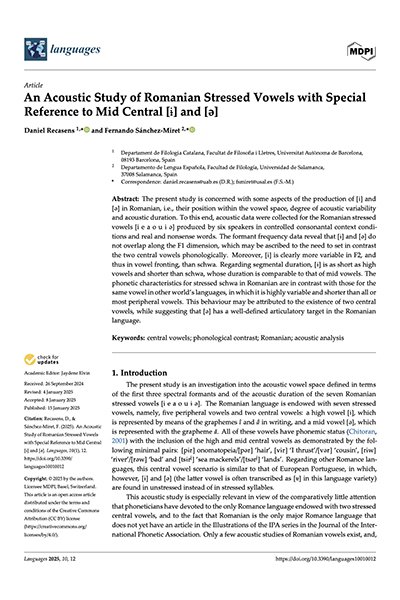
Daniel Recasens is a Full Professor in the Department of Catalan Philology at the Faculty of Arts, Autonomous University of Barcelona, where he has been a permanent faculty member since 1985. He is also affiliated with the Institute for Catalan Studies as a researcher. His academic work centers on experimental phonetics and phonology, with a focus on Romance languages, particularly Catalan. Research Interests: Daniel Recasens specializes in Experimental Phonetics , Phonology , Sound Change , and Phonetic and Phonological Universals . His research investigates articulatory and acoustic aspects of speech production, including coarticulation, assimilation, blending, and the phonetic motivations behind diachronic sound changes in Romance languages. He employs advanced techniques such as ultrasound imaging, electropalatography (EPG), and acoustic analysis to study consonant clusters, vowel-consonant interactions, and the evolution of phonological systems. Scientific Publications and Trends: His recent publications (2020–2025) reflect a consistent focus on the articulatory and acoustic foundations of phonological processes. Key themes include dynamic blending in fricative sequences, tongue configuration in stop-liquid clusters, and the phonetic causes of palatalization and vowel changes. His work combines empirical data with theoretical models such as the Degree of Articulatory Constraint (DAC) model, contributing significantly to laboratory phonology and historical linguistics. Scientific Awards: Member, Academy of Europe (Academia Europaea), 2018 Advising and Research Grants: Daniel Recasens has mentored several doctoral and postdoctoral researchers, including Clara Isabel Rodriguez Casado, Aina Espinosa, and Fernando Sánchez-Miret. While specific grant details are not listed, his extensive publication record and leadership in experimental phonetics suggest sustained research funding and collaborative projects in phonetic and phonological research. Labs and Research Teams: He is associated with the Center for Theoretical Linguistics (CLT) at the Autonomous University of Barcelona, a research group dedicated to theoretical and experimental studies of language. His work often involves collaboration with phonetics laboratories and international scholars in the fields of articulatory phonetics and historical linguistics.
Professor Aditi Lahiri is a Research Professor of Linguistics at the University of Oxford's Faculty of Linguistics, Philology and Phonetics. She holds positions in the Centre for Linguistics and Philology and directs the Language and Brain Laboratory. Her research focuses on phonology, phonetics, historical linguistics, psycholinguistics, and neurolinguistics, with special expertise in metrical theory, feature theory, and morphological complexity. Education : BA (Mathematics, Economics) from University of Calcutta (1971); MA (Comparative Philology) from University of Calcutta (1973); DPhil (Comparative Philology and Linguistics) from University of Calcutta (1979); PhD (Linguistics) from Brown University (1982). Research Interests : Her work spans experimental and theoretical linguistics, including prosodic phrasing, lexical representation, language change, and neural correlates of phonological processing. Key areas include: Metrical phonology and historical sound change Cognitive representation of speech sounds Morphological complexity in the mental lexicon Speech perception and production mechanisms Recent Research Trends : Over the past decade, her publications emphasize cross-disciplinary approaches, integrating experimental psycholinguistics with computational modeling (e.g., ERC-funded projects on morphophonological alternations). Recent work explores language processing in multilingual speakers and the neural basis of phonological features. Awards : Recipient of prestigious awards including the Leibniz Prize (2000), Max Planck Research Prize (1994), and Fellow of the British Academy (2010). She serves as Vice President of the British Academy and President of the Philological Society. Grants & Leadership : Secured over €8 million in research funding, including ERC Advanced Grants (e.g., MORPHON, WORDS). Directed the DFG-funded Sonderforschungsbereich 471 (2006-2008). Established key partnerships in India through endowed scholarships and academic outreach initiatives. Labs & Collaborations : Leads the Language & Brain Laboratory, collaborating internationally on projects combining neurolinguistic methods with historical and experimental linguistics. Supervised numerous PhD students who have become leading academics globally.
Niclas Abrahamsson is a Professor of Swedish as a Second Language at Stockholm University, where he also serves as the Director of the Centre for Research on Bilingualism . His research focuses on second language acquisition (SLA) , bilingualism , and phonological/phonetic development , particularly through the lens of age of acquisition and critical periods . He leads the MOB (Meta-research on Bilingualism) group, analyzing trends in bilingualism research and Swedish as a Second Language. PhD in Bilingualism (2001, Stockholm University) BA in Linguistics, Phonetics, and Psychology (1993) His research explores how age of onset and language aptitude influence nativelike attainment in L2 speakers, with a focus on voice onset time (VOT) analysis, neural constraints , and lexical deficits in bilinguals. His recent studies challenge the notion that bilingualism inherently causes linguistic costs, attributing observed deficits instead to second language acquisition processes. Abrahamsson has secured major grants from the Swedish Research Council (VR) , Bank of Sweden Tercentenary Foundation (RJ) , and Byggmästare Olle Engqvists Stiftelse . He supervises PhD students working on topics like Swedish compounding acquisition , language-dependent memory , and foreign accented speech perception . He teaches SLA, bilingual development, and psycholinguistics at all academic levels. Key Awards : VR Grant 2016-01630, RJ Sabbatical Grant SAB16-0051:1, Byggmästare Olle Engqvists Stiftelse Grant 200-0676 Abrahamsson's work frequently employs ERP studies and meta-analyses , emphasizing methodological rigor. He collaborates with institutions like the Multilingualism Lab and has contributed to foundational theories in critical period hypothesis and language aptitude research.
Nicholas Henriksen is an Arthur F. Thurnau Professor and Professor of Spanish & Linguistics at the University of Michigan, where he has held faculty positions since 2012. His research focuses on laboratory phonology, experimental phonetics, sociophonetics, and intonational grammar in Spanish and other Romance languages. Notable projects include studies on sound change in Andalusian and Patagonian Spanish, bilingualism (Afrikaans-Spanish), and second language speech learning. He directs the Michigan Speech Production Lab and co-leads initiatives integrating gender-diverse language into Romance curricula. Henriksen earned a PhD in Linguistics from Indiana University (2010), MA in Hispanic Linguistics (2006), and BA in Spanish/Mathematics from Rutgers (2003). His teaching spans undergraduate and graduate courses in Spanish linguistics, sociolinguistics, and phonetics, emphasizing applied research and pedagogical innovation. He has received prestigious awards, including the LSA Early Career Award (2021) and the Class of 1923 Teaching Award (2018). His research has been funded by grants from the University of Michigan ADVANCE Program and the Humanities Collaboratory, supporting projects like From Africa to Patagonia: Voices of Displacement . Collaborations include work with scholars in Argentina, South Africa, and Spain, examining language contact, heritage language maintenance, and sociolinguistic identity. Publications span over 30 peer-reviewed articles and book chapters, with a focus on phonetic variation, intonation, and bilingualism. He mentors graduate students in experimental phonetics and sociolinguistics, with advisees contributing to studies on Andalusian Spanish, heritage language acquisition, and voice quality.
Eugene Buckley is an Associate Professor of Linguistics at the University of Pennsylvania , affiliated with the School of Arts & Sciences and the Department of Linguistics . His research focuses on formal phonology, metrical and syllable structure, and the interplay between phonology and morphology. He also explores phonetic and functional explanations in phonological theory, the representation of spoken language categories in writing systems, and specializes in Native American (Kashaya, Alsea), Ethio-Semitic (Tigrinya), and Manam linguistics. Education: Ph.D., University of California, Berkeley (1992) Buckley has taught courses such as Phonology I/II , Writing Systems , and Structure of Kashaya . His current research centers on Kashaya, a Native American language of northern California. Contact: gene@ling.upenn.edu | Office: 330C, 3401 Walnut Street | Office Hours: By appointment.
Prof. Robert Fuchs holds the Frommann Professorship of Applied English Linguistics at the University of Bonn, leading the Chair of Bonn Applied English Linguistics (BAEL) within the Department of English, American and Celtic Studies. His research focuses on World Englishes, corpus linguistics, sociolinguistics, and the impact of artificial intelligence on linguistic analysis. He actively supervises PhD students in topics aligned with his research group's interests, emphasizing empirical work and data science. Recent research explores language change in varieties like Hong Kong English, Trinidadian prosody, and intensifier usage across cultures. Fuchs frequently presents at international conferences, including ISLE, ICAME, and Sociolinguistics Symposium, and publishes extensively in journals like World Englishes and Language and Speech . His teaching includes advanced courses on corpus linguistics and language in culture, with a focus on climate change discourse analysis. He maintains an active academic presence through ResearchGate, Academia.edu, and LinkedIn. Research Interests: Fuchs investigates sociolinguistic variation, AI applications in linguistics, and the structural features of postcolonial Englishes. His work addresses topics such as vowel mergers in Hong Kong English, lexical stress perception in Indian English, and the role of gender in language use. He also explores diachronic changes in aspects like stative progressives and the perfect-past alternation across Asian Englishes. Advising & Grants: Fuchs oversees PhD student recruitment through research associate positions and self-funded scholarships, prioritizing applicants with strong empirical and analytical skills. His funded projects include studies on pandemic discourse (DisCOVIndUK) and linguistic trends in Caribbean English. His lab, BAEL, collaborates internationally, with ongoing work on Trinidadian prosody and Northeast Indian linguistic ecology. Labs/Teams: The Bonn Applied English Linguistics (BAEL) group, part of the University of Bonn's IAAK institute, focuses on cutting-edge research in global Englishes and computational linguistics, hosting international workshops and fostering interdisciplinary collaboration.
Felicitas Kleber is Professor of Speech Science in the Department of Language Science and Technology at Saarland University (Universität des Saarlandes). Her research profile demonstrates extensive expertise in experimental phonetics and laboratory phonology with a particular focus on German dialects and sound change phenomena. She maintains active research collaborations, most notably with J. Harrington and Ulrich Reubold, resulting in numerous high-impact publications in leading linguistics and phonetics journals. Her research interests span experimental phonetics and laboratory phonology with specific expertise in speech production and perception , sound change processes, German dialectology , phonological acquisition , and prosody and intonation analysis. Her work frequently examines the acoustic, perceptual, and articulatory dimensions of speech, particularly focusing on vowel and consonant quantity phenomena in German varieties. Analysis of her publication record reveals consistent methodological rigor with emphasis on acoustic analysis, perception experiments, and longitudinal studies. Her research often investigates sound changes in progress, particularly examining vowel fronting phenomena in both German and English varieties, and the relationship between speech production and perception mechanisms. Much of her work employs apparent-time analyses to track diachronic changes through synchronic variation across age groups. Professor Kleber serves as an Associate editor for the Journal of the Acoustical Society of America, reflecting her standing in the field. She has secured significant research funding including the DFG-funded project "Typology of vowel and consonant quantity in South German varieties: acoustic, auditory, and articulatory analyses of adult and child speakers" (2016-2024) and the DAAD-supported "Form and function of prosodic structure in Hungarian and German" (2015-2016). Her research methodology typically combines acoustic analysis with perception experiments and sometimes articulatory measurements to provide comprehensive insights into phonetic phenomena.
Arto Anttila is an Associate Professor in the Department of Linguistics at Stanford University and holds an Adjunct Professor (dosentti) position in General Linguistics at the University of Helsinki. His research spans multiple linguistic subfields with particular focus on the interfaces between phonology, syntax, and prosody. Dr. Anttila's research interests include phonology, morphology, syntax, metrics, and language variation. His work often explores how phonological constraints interact with syntactic structures and how variation manifests across different linguistic domains. He has made significant contributions to Optimality Theory, MaxEnt grammar, and probabilistic approaches to phonology. His recent publications demonstrate a strong focus on metrical patterns, stress systems, syllable structure, and the relationship between prosody and syntax. Anttila frequently collaborates with researchers like Giorgio Magri, Adams Bodomo, and Ryan Heuser, examining phenomena across diverse languages including English, Finnish, and Dagaare (an African language). Anttila has developed several computational tools for linguistic research, including CoGeTo (Convex Geometry Tools for constraint-based phonology), MetricalTree (for English phrasal stress prediction), Prosodic (for automatic metrical scansion), T-Order Generator, and OTOrder. These tools reflect his interest in the mathematical and computational aspects of linguistic theory.
Jennifer L. Smith is a Professor and Associate Chair in the Department of Linguistics at the University of North Carolina, Chapel Hill. Her research focuses on phonology, particularly the interplay between phonological constraints, morphosyntactic categories, and experimental methods. Key areas include lexical-category effects (e.g., noun/verb phonological privilege), loanword adaptation, blend phonology, and intonation patterns in Fukuoka Japanese. She has pioneered experimental approaches using artificial-language learning and surfeit-of-the-stimulus experiments to test hypotheses about constraint interaction and phonological universals. Smith’s work bridges formal phonology and phonetics, addressing questions like how phonetic naturalness influences phonological constraints and whether category-specific phonology reflects innate biases. Recent projects include investigating positional effects in phonology (e.g., salient positions) and the role of core-periphery structures in loanword nativization. She has collaborated extensively with researchers like Elliott Moreton and Katya Pertsova on blend phonology and experimental phonology. Her teaching includes foundational courses like Linguistics 60: How Reading Works , emphasizing interdisciplinary connections between language, cognition, and literacy. Smith maintains key resources for the field, including a widely referenced Phonetics resources page with curated materials for teaching and research. Her office is located in Smith Building 309, and she holds regular office hours via Zoom.
Dr. Elisa Pellegrino is a senior Post-Doc in Phonetics at the Department of Computational Linguistics , affiliated with Zeppelin University and the Digital Society Initiative of the University of Zurich . Her research focuses on voice individualization, vocal accommodation, and the role of speaker-specific information in speech temporal variability. Role: Senior Post-Doc in Phonetics University: Zeppelin University School: Faculty of Arts and Social Sciences Department: Department of Computational Linguistics Email: elisa.pellegrino@uzh.ch Research Interests: Prosody and speech rhythm in native and second language acquisition Vocal accommodation in cross-dialectal interactions Speaker individuality and forensic phonetics Age-related speech temporal variability Speech disorders and Parkinson’s disease Applications of speech technology in linguistics and education
Donca Steriade serves as the Class of 1941 Professor of Linguistics in the Department of Linguistics and Philosophy at the Massachusetts Institute of Technology (MIT), where she also holds the position of Communications Director for the linguistics section. Her research centers on phonology, morphology, and historical linguistics with specialized focus on Greek and Latin. Steriade has pioneered theoretical frameworks including the Perceptibility map (P-map) for understanding phonological markedness, while her morphological work explores paradigm uniformity, morphomes, and cyclicity across diverse languages. She integrates empirical data from classical languages with cutting-edge phonological theory. Steriade's recent publications (2015-2025) reveal consistent exploration of quantitative meters in Greek/Latin poetry, morphophonological cyclicity in Romanian, and paradigm structure in Sanskrit reduplication. Her work demonstrates sophisticated interplay between phonological constraints and morphological processes, often revealing universal patterns through cross-linguistic analysis of classical and modern languages. As Communications Director, she actively shapes the department's academic outreach and scholarly discourse within the linguistics community.
Sharon Rose is a Professor in the Department of Linguistics at the University of California, San Diego. She holds a BA (Honors) from the University of Toronto, an MA from Université du Québec à Montréal, and a PhD from McGill University. Her research specializes in phonological analysis and descriptive fieldwork on African languages, particularly Semitic languages of Ethiopia/Eritrea and Kordofanian languages of Sudan. Her research examines phonological phenomena including: Long-distance consonant/vowel harmony Featural affixation and dissimilation Tone-intonation interfaces Grammatical tone in Heiban languages Musical pitch processing in tone language speakers She leads several research groups including the Field Research Lab, Phonetics-Phonology Research Community (PhonCo), and UCSD Phonetics Lab. Professor Rose is currently a Fellow at the Netherlands Institute for Advanced Study (2025) and an affiliated faculty member with African Studies Minor and Center for Research in Language.