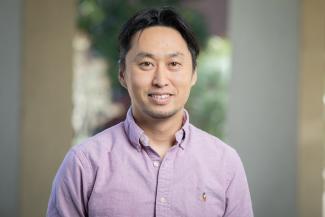
Kohsaku Tobioka is an Associate Professor in the Department of Physics at Florida State University. He joined the faculty in 2018 after postdoctoral appointments at Stony Brook University (2017-2018), High Energy Accelerator Research Organization (KEK) in Japan (2014), and a joint position at Tel Aviv University and Weizmann Institute of Science in Israel (2014-2017). Education: Ph.D. in Physics from the University of Tokyo (2014) His research focuses on theoretical particle physics, particularly exploring physics beyond the Standard Model through phenomena like supersymmetry, extra dimensions, dark matter, and axions. He integrates cosmology and astroparticle physics with experimental approaches at high-intensity facilities such as B/K meson factories. Scientific Recognition: JSPS Research Fellow for Young Scientists (2014-2016) Tobioka actively engages in outreach through programs like Saturday Morning Physics at Florida State University and is open to speaking engagements at local schools.
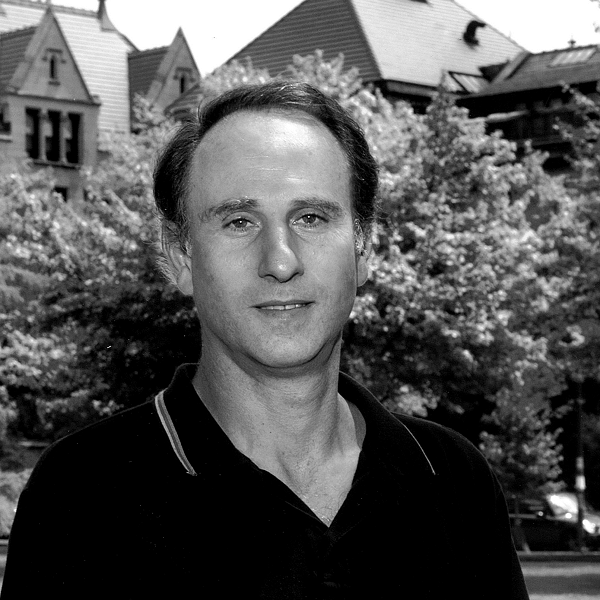
David Kutasov is a Professor in the Department of Physics at the University of Chicago, affiliated with the Enrico Fermi Institute. His research focuses on string theory and quantum field theory, particularly addressing dynamics of strongly coupled systems, supersymmetry breaking, black hole physics, and cosmological singularities. Kutasov has contributed to understanding the interplay between string theory and field theory, including mechanisms for vacuum selection in early universe scenarios and brane dynamics. His work explores theoretical frameworks such as holography, time-dependent backgrounds, and tachyon condensation, with applications to particle physics and cosmology. Key research directions include analyzing string theory's predictions for nature and applying string-based insights to experimental particle physics and cosmic phenomena. Notable contributions span topics like D-brane interactions, non-supersymmetric vacua, and dualities in Chern-Simons theories. Kutasov's publications often bridge abstract string theory constructs with observable phenomena, emphasizing tools for analyzing string theory's implications in diverse physical contexts. Despite extensive contributions, no specific scientific awards are explicitly listed in the provided materials. His research remains active across multiple frontiers of theoretical physics, maintaining a strong focus on foundational questions in high-energy physics.
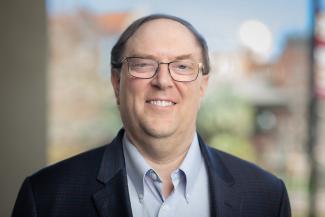
Todd Adams is a Professor in the Department of Physics at Florida State University . He leads research in particle physics (high energy experiment) with the CMS Experiment at CERN and previously the D0 Experiment at Fermilab , focusing on searches for new physics in underexplored datasets through long-lived particles , machine learning techniques , and charged particle detection . Education : PhD in Experimental Particle Physics from University of Notre Dame (1997); Postdoctoral researcher at Kansas State University (1997-2001) His research includes electromagnetic calorimeter studies for CMS, calorimeter upgrade investigations , and Monte Carlo simulation leadership for D0. He pioneered searches for neutral long-lived particles and top quark decay anomalies , co-authored key publications in Physical Review Letters and Journal of High Energy Physics , and served as Faculty Senate President and Board of Trustees member at FSU. Notable affiliations include: Collaborations : CMS, D0, NuTeV, NuSOnG Laboratories : CERN (Geneva), Fermilab (Chicago), Florida State High Energy Physics Group Key contributions: Co-convenor of D0 Monte Carlo Simulations and New Physics Signatures groups Expert in heavy quark production , dimuon analysis , and neutral current studies Publications on Higgs boson discovery implications, supersymmetry , and anomalous gauge couplings Scientific Awards : Fellow, American Association for the Advancement of Science Multiple Fermilab Result of the Week highlights (2006, 2008, 2013) Contributor to CMS Thesis Award Committee He advises graduate students in experimental particle physics and contributes to detector technology development, particularly in timing studies , calibration , and trigger systems . His research program will continue through the LHC's 2035 operations with ongoing CMS data analysis.
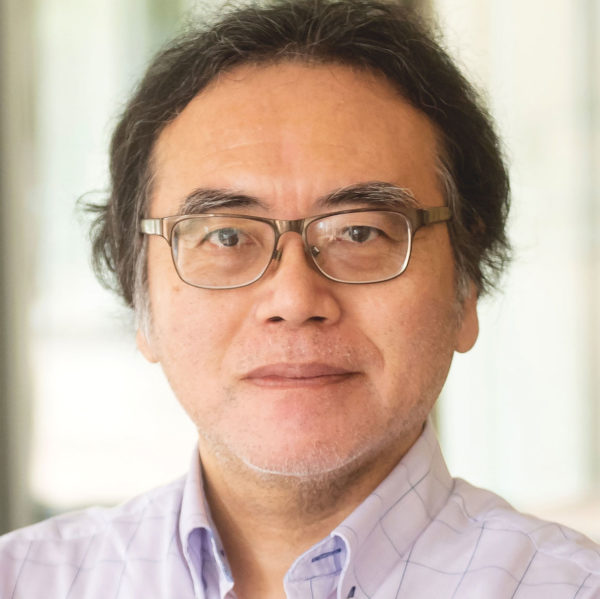
Teruki Kamon is a Professor at Texas A&M University affiliated with the Mitchell Institute for Fundamental Physics & Astronomy. As an active member of the CDF and CMS collaborations, he conducts experimental particle physics research at hadron colliders with focus on dark matter phenomenology. His research centers on testing particle physics models for cold dark matter, with Supersymmetry (SUSY) as a leading candidate. He pioneered SUSY searches in final states involving electrons, muons, and third-generation particles like tau leptons, specializing in: Compressed mass spectrum signatures Vector boson fusion topologies Soft tau lepton analyses Missing transverse momentum techniques Recent publications (2017-2020) demonstrate consistent leadership in LHC-based searches for supersymmetry and new physics, including unique contributions to CMS detector upgrades. His group dominates research on compressed-mass SUSY in vector boson fusion processes. No information regarding awards, student advising, or grant funding was provided in available sources.
Simone Giombi is a Professor of Physics at Princeton University and currently serves as Associate Chair and Director of Graduate Studies. He holds a B.Sc. in Theoretical Physics from the University of Bologna, Italy, and a Ph.D. in Physics and Astronomy from Stony Brook University (2007). His research focuses on high-energy theoretical physics, quantum field theory, string theory, and their interconnections, particularly exploring higher-spin gravity and holographic dualities. He has held postdoctoral positions at Harvard University and the Perimeter Institute for Theoretical Physics. Giombi's work includes groundbreaking contributions to AdS/CFT correspondence, Wilson loop defects, and quantum M2 branes. He has been recognized with prestigious awards, including the New Horizons in Physics Prize (2017) and the SIGRAV Prize (2014). His recent articles (2022–2025) emphasize non-planar corrections in ABJM theory, boundary reparametrizations in AdS2, and RG interfaces from double-trace deformations. His research also engages with fermionic CFTs, line defects, and quantum fluctuations in Wilson loops. Awards: New Horizons in Physics Prize (2017), SIGRAV Prize (2014) Advising: Students include Yagmur Erhan and Jieru Shan Labs/Teams: Active in Princeton's High Energy Theory Group
Silviu Pufu is a Professor of Physics at Princeton University, where he earned both his A.B. (2007) and Ph.D. (2011) in Physics. Prior to his faculty position, he was a Pappalardo Postdoctoral Fellow at MIT (2011–2013). His research focuses on quantum field theory, string theory, and gravity, with emphasis on conformal field theory, gauge/gravity duality, and lattice gauge theory. He has received the Alfred P. Sloan Research Fellowship (2017) and led the Simons Collaboration for Nonperturbative Bootstrap (2016–2023). His work explores advanced topics such as AdS/CFT correspondence, M-theory corrections, and non-perturbative bootstrap methods. Pufu advises three graduate students: Ross Dempsey, Debaditya Pramanik, and Benjamin Søgaard. His research outputs span theoretical frameworks like super-Yang-Mills theories, M-theory orbifolds, and lattice Hamiltonian formulations of QCD. His 2020–2025 publications highlight contributions to bootstrap techniques, holographic calculations, and precision studies of strongly coupled systems.
Joey W Huston is a Professor at the Department of Physics & Astronomy, Michigan State University, and a Visiting Professor at the Institute for Particle Physics Phenomenology, Durham University. He has over 600 publications with >30,000 citations, including 9 papers with >500 cites each. Positions: MSU Research Foundation Professor (1998-present), Visiting Professor at Durham (2003-present) Education: Ph.D. (1983) and B.S. (1976) from University of Rochester and Carnegie-Mellon University His research focuses on Quantum Chromodynamics (QCD) , Parton Distribution Functions , and Jet Physics . He contributes to Higgs Boson studies, Supersymmetry , and Dark Matter Searches via the ATLAS experiment at the LHC. Recent articles (2025) highlight advancements in Jet Flavour Tagging , Top-Quark Mass Measurement , and Exotic Higgs Decays , alongside computational innovations like Neural Simulation-Based Inference and Cloud Resource Optimization . Scientific Awards: APS Fellow (2025), Distinguished Visitor by Scottish Universities Physics Alliance (SUPA) Prof. Huston has co-spoken for the CTEQ collaboration and organized workshops at Les Houches, Kavli Institute, and Fermilab. He authored the Handbook on Perturbative QCD and is writing a book on QCD at the LHC for Oxford University Press.
Clay Córdova is an Associate Professor at the University of Chicago, associated with the Enrico Fermi Institute, James Franck Institute, Kadanoff Center, and Kavli Institute. His research focuses on theoretical physics, particularly quantum field theory, non-invertible symmetries, and their applications in particle and condensed matter physics. Córdova’s work explores topological phases, gauge theories, and string theory, with recent contributions to non-invertible symmetry classification and their role in phase transitions. His research interests include categorical symmetries, topological defects, and anomaly matching in quantum field theories. He has pioneered studies on soliton-particle degeneracies, anyon condensation mechanisms, and anomalies in non-invertible symmetry frameworks. Córdova’s work bridges high-energy physics with condensed matter systems, often employing advanced mathematical techniques from category theory and algebraic topology. His 2023 Sloan Research Fellowship highlights recognition of his contributions. Key research trends span non-invertible symmetries across dimensions, topological field theory applications, and interdisciplinary methods combining machine learning with lattice gauge theory. Current projects include exploring duality defects, gapped phase obstructions, and symmetry-enriched phases in (3+1)D systems.
California Institute of Technology (Caltech)United States
Sergei Gukov is the John D. MacArthur Professor of Theoretical Physics and Mathematics at the California Institute of Technology (Caltech), where he has been a faculty member since 2005. He serves in the Division of Physics, Mathematics and Astronomy, with primary affiliation in the Department of Mathematics. His research bridges the fields of mathematics and theoretical physics, focusing on deep connections between geometry, topology, and quantum field theory. Gukov received his B.S. from Moscow Institute of Physics and Technology in 1997, followed by an M.S. and Ph.D. from Princeton University in 2001. He joined Caltech as an Associate Professor in 2005, was promoted to Professor in 2007, and was named the John D. MacArthur Professor in 2021. His research spans several interconnected areas at the frontier of mathematics and physics. A central theme is the exploration of quantum topology and its connections to mathematical physics. He has made significant contributions to the geometric Langlands program, gauge theory, and the categorification of knot and 3-manifold invariants. His recent work increasingly incorporates machine learning approaches to mathematical problems, reflecting his interest in the intersection of traditional mathematical research and modern computational techniques. Gukov's work often reveals deep connections between seemingly disparate areas of mathematics and physics, such as the relationship between Rozansky-Witten geometry and Coulomb branches in supersymmetric gauge theories. Gukov's publications demonstrate a consistent focus on the mathematical structures underlying quantum field theories and their topological implications. His recent work shows an increasing emphasis on computational approaches to mathematical problems, particularly through his interest in mathematics and machine learning. The recurring themes across his research include the application of physical insights to solve mathematical problems and the discovery of new mathematical structures through physical reasoning. He serves on the editorial boards of several prestigious journals including the Journal of Knot Theory and Its Ramifications, Communications in Mathematical Physics, and Letters in Mathematical Physics. Gukov is also active in the academic community, having delivered plenary talks at major conferences such as the First International Congress of Basic Science and presenting at String Math 2023 on the potential impact of AI on mathematical research. Gukov teaches Ma 146 ab, Introduction to Knot Theory and Quantum Topology, a course that reflects his research interests. He also runs a seminar on Mathematics and Machine Learning, held Tuesdays from 2-3pm in East Bridge Conference room 114, demonstrating his commitment to fostering interdisciplinary research at the intersection of mathematics and computational methods.
Julia Thom-Levy is a Professor of Physics in the College of Arts and Sciences at Cornell University, serving as Deputy Director of the Cornell Laboratory of Accelerator-Based Sciences and Education and Vice Provost for Academic Innovation. Her career at Cornell progressed from Assistant Professor (2005-2012) to Associate Professor (2012-2018) and Professor (2018-present), following prior research roles at SLAC and Fermilab. She earned her Physics Dipl. (1997) and Ph.D. (2001) from Hamburg University. Her research centers on experimental particle physics, with expertise in heavy quark physics, hadron collider physics, and silicon detector development for both particle physics and X-ray science applications. She leads critical work on CMS experiment upgrades at CERN's LHC, focusing on radiation-hard pixel detectors and Higgs boson/top quark physics analysis. Her 2013-2018 publications reveal a consistent focus on precision measurements in top quark physics and Higgs boson studies through CMS collaboration, alongside innovative detector technology development. The research demonstrates strong interdisciplinary connections between high-energy physics and advanced materials science. Awards and Honors: Fellow, German National Scholarship Foundation (1993-1997) She advises graduate student Lena Franklin and has mentored postdocs Joseph Reichert and Jose Monroy, along with undergraduates Hannah Hu, Benjamin Myers, Jeffrey Backus, and Alexander Albert. Her group secures significant funding including a $3.8M NSF grant for early universe research and $2.7M for the Active Learning Initiative. She directs detector R&D for CHESS light source applications and leads Cornell's academic innovation efforts through the Active Learning Initiative, which has transformed classroom instruction across STEM disciplines.
Mark Trodden is the Dean of the School of Arts & Sciences and Thomas S. Gates Jr. Professor of Physics and Astronomy at the University of Pennsylvania. He previously served as the Fay R. and Eugene L. Langberg Professor of Physics, Department Chair, and Co-Director of the Center for Particle Cosmology. His career includes faculty roles at Syracuse University (2000–2009) and visiting positions at Case Western Reserve University and Cornell University. Ph.D. and M.Sc. in Physics, Brown University (1992–1995) Advanced Study in Mathematics, University of Cambridge (1990–1991) M.A. in Mathematics, University of Cambridge (1987–1990) Trodden’s research focuses on the intersection of cosmology and particle physics, addressing fundamental questions such as the nature of dark energy, dark matter, the baryon asymmetry of the universe, inflation, and modified gravity theories. His work explores how cosmological data can constrain physics beyond the Standard Model and general relativity. His publications span topics like dark energy models , inflationary spacetimes , topological defects , and BPS states in supersymmetric theories , reflecting his expertise in connecting high-energy physics to cosmological observations. At Penn, Trodden has held editorial roles for journals like Physics Letters B and Journal of Cosmology and Astroparticle Physics , and has contributed to collaborative workshops advancing cosmology and particle physics.
Zackaria Chacko is a Professor in the Department of Physics at the University of Maryland and a founding member of the Maryland Center for Fundamental Physics (MCFP). His research focuses on theoretical particle physics, addressing unresolved questions in the Standard Model through novel frameworks like weak scale supersymmetry, extra dimensions, and composite Higgs models. His work intersects with experimental efforts at the Large Hadron Collider, dark matter detection, neutrino oscillation studies, and gravitational tests. Affiliations: Maryland Center for Fundamental Physics (MCFP) Teaching: Courses include Mathematical Methods for Physics I/II, Advanced Quantum Mechanics, and Advanced Quantum Field Theory. Research Interests: Chacko explores dark matter, baryogenesis, and neutrino physics, with connections to cosmological observations (e.g., cosmic microwave background) and precision measurements. His theories aim to resolve gaps in fundamental physics, such as the hierarchy problem and matter-antimatter asymmetry. Awards: Elected Fellow of the American Physical Society (APS). Labs/Teams: Active contributor to MCFP’s theoretical physics initiatives, collaborating on projects bridging particle physics and cosmology.
Massachusetts Institute of TechnologyUnited States
Pavel Etingof is Professor of Mathematics at the Massachusetts Institute of Technology (MIT), Department of Mathematics, where he has been a distinguished faculty member for many years. He serves as the Chief Research Adviser of MIT-PRIMES, an all-year high school math research program that provides exceptional research opportunities for talented high school students. Additionally, he holds the prestigious position of Editor-in-Chief of Selecta Mathematica. Professor Etingof's research spans multiple advanced areas of pure mathematics with a particular focus on representation theory, tensor categories, Lie algebras, Hecke algebras, and algebraic structures. His work consistently bridges algebra, geometry, and mathematical physics, revealing deep connections between abstract algebraic structures and physical phenomena. His research has evolved to increasingly explore tensor categories in positive characteristic, connections between representation theory and fractal structures, and applications to quantum field theory. His recent publications (2021-2025) demonstrate continued productivity and innovation, with numerous papers on tensor categories in various characteristics, representation theory of Lie groups, and connections to mathematical physics. These works show sophisticated exploration of representation theory in prime characteristic, novel applications to quantum field theory, and deep investigations into the structure of tensor categories. Editor-in-Chief of Selecta Mathematica Chief Research Adviser of MIT-PRIMES Professor Etingof has mentored numerous Ph.D. students at MIT and other institutions, establishing a significant mathematical genealogy in representation theory. His teaching includes advanced courses on algebraic groups, Lie theory, representation theory, and specialized topics. He has also co-organized many student seminars on cutting-edge mathematical topics including Deligne categories, symplectic reflection algebras, quantum cohomology, and double affine Hecke algebras, fostering collaborative research environments for students and colleagues.
Raphael Bousso is a Professor and holds the Chancellor's Chair in Physics at the University of California, Berkeley, within the Department of Physics. He maintains strong affiliations with the Lawrence Berkeley National Laboratory (LBNL) and the Berkeley Center for Theoretical Physics, reflecting his dual institutional presence in theoretical physics research. His academic journey commenced with a Ph.D. from Cambridge University in 1998, followed by pivotal postdoctoral appointments at Stanford University and the Kavli Institute for Theoretical Physics. In 2002/03, he was a fellow at Harvard University's physics department and the Radcliffe Institute for Advanced Study before joining UC Berkeley in July 2003. Bousso's research centers on quantum gravity and theoretical cosmology , where he confronts fundamental conflicts between quantum mechanics and general relativity. His seminal work on the black hole information paradox—particularly the 'firewall paradox'—challenges whether information is preserved during black hole evaporation. He has pioneered the covariant entropy conjecture and quantum focusing conjecture, reshaping understanding of holography. His landscape research in string theory provides critical frameworks for explaining the cosmological constant and matter abundance coincidences. Analysis of his publication record reveals persistent focus on holographic principles applied to black holes and cosmology. His work consistently bridges abstract quantum gravity concepts with observable cosmological phenomena, demonstrating exceptional continuity in addressing the measurement problem in eternal inflation and the implications of string theory's landscape. No specific scientific awards are documented in the provided materials, though his Chancellor's Chair appointment signifies institutional recognition of his scholarly impact. While student advising details are absent from the source text, his leadership of the Bousso Group drives collaborative research in quantum gravity. The text provides no explicit grant information, though his sustained publication output implies active research funding. He directs the Bousso Group at UC Berkeley, which serves as the primary research hub for exploring holography, black hole physics, and cosmological implications of string theory through theoretical and mathematical approaches.
Carsten Rott is a Professor in the Department of Physics & Astronomy at the University of Utah and holds the Jack W. Keuffel Memorial Chair until December 2025. His academic journey began with a Ph.D. in Physics from Purdue University (2004), preceded by undergraduate studies at the Universität Hannover. Rott has held academic positions at institutions including The Ohio State University (CCAPP Senior Fellow 2009-2013), Penn State University (postdoc 2005-2008), and Sungkyunkwan University in South Korea (Assistant Professor 2013-2017, Associate Professor 2017-2025). He has been a member of the IceCube Neutrino Telescope collaboration since 2005 and serves on committees like the IceCube-Gen2 Coordination Committee and JSNS2 Speakers Board. His research spans Particle Physics , Neutrino Astronomy , and Dark Matter Detection . Key projects include analyzing IceCube data for sterile neutrino signatures, studying cosmic-ray anisotropy, and investigating terrestrial gamma-ray flashes. Notable achievements include the Bruno Rossi Prize (2021) for high-energy astrophysics contributions. Rott's work involves multimessenger observations (neutrinos, gamma-rays, radio signals) and detector calibration innovations, such as those for the JSNS2 experiment. Recent publications focus on atmospheric neutrino oscillation parameters, TGF spectroscopy, and dark matter constraints. He employs machine learning techniques (CNNs) for event reconstruction and leads initiatives like the IceCube Master Class for student engagement. Grants include funding for IceCube upgrades (2024-2026) and Hyper-Kamiokande collaborations (2023-2026). As department chair since 2023, Rott continues to bridge experimental particle physics with astrophysical discoveries.