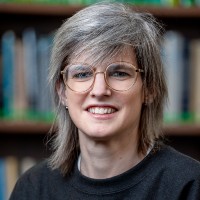
Andrea Carriero is a Professor of Economics at Queen Mary University of London, affiliated with the School of Economics and Finance. His research focuses on applied macroeconometrics, empirical macroeconomics, and financial econometrics, with a particular emphasis on the term structure of interest rates and forecasting with large datasets. He has consulted for institutions such as HM Treasury Debt Management Office, the European Central Bank (ECB), and central banks of the Czech Republic and Estonia. His work bridges econometric methodology and real-world macroeconomic challenges, including uncertainty quantification and structural modeling. Notable contributions include Bayesian vector autoregressions (BVARs), volatility analysis, and nowcasting techniques. His research has implications for policy-making, financial markets, and economic forecasting.
Claudia Ravanelli is a Senior Research Fellow at the University of Zurich's Department of Banking and Finance, associated with the Center for Finance and Insurance. Her research focuses on financial risk management, actuarial science, and mathematical finance, with expertise in insurance economics and stochastic modeling. She holds a Ph.D. in Economics from the University of Lugano and a Mathematics diploma from the University of Milan. Education: 2004: Ph.D. in Economics (summa cum laude), University of Lugano 1999: Diploma in Mathematics (highest score), University of Milan Research Interests: Her work addresses ambiguity-sensitive preferences, capital requirements under model risk, longevity risk modeling, and optimal investment strategies in insurance contexts. She explores theoretical frameworks in mathematical finance and their applications to real-world financial and actuarial challenges. Publications: Her articles span topics like risk measures, insurance firm optimization, and longevity risk management, reflecting a focus on bridging theoretical finance with practical regulatory and economic issues. Teaching & Engagement: She has taught courses in quantitative finance and statistics at USI and the University of Zurich. She serves as a referee for top journals like Mathematical Finance and Finance and Stochastics . Professional Activities: Invited speaker at conferences including the Bachelier Finance Conference and the Sorbonne University's honor event for Nicole El Karoui. Active in academic networks like the Swiss Finance Institute and the Swiss Banking Institute.
Julien Hambuckers is a Professor at the University of Liège - HEC Liège , Belgium, where he focuses on advanced financial and economic modeling. His research bridges empirical finance, econometrics, and risk management. His research interests include: Operational and systemic risk analysis Extreme value theory applications in finance Econometric modeling of hedge fund tail risks Monetary policy impacts on financial uncertainty Stochastic volatility in currency markets Statistical methods for market microstructure analysis His work frequently employs: Penalized likelihood techniques Proxy structural vector autoregressions Non-stationary extreme value regression models Censored maximum likelihood estimation Bootstrap validation methods Generalized Pareto distributions Notable collaborations include research with experts from: ESSEC Business School University of Göttingen European University Viadrina Université d'Avignon CREAR Risk Research Center Recent methodological contributions appear in: Journal of Finance (2024) International Journal for Forecasting (2024) Journal of Financial Economics (2023)
Professor Sandra Nolte holds the position of Personal Chair and Heads the Department of Accounting and Finance at Lancaster University Management School. Her research focuses on empirical finance, applied econometrics, and behavioral finance, with specific interests in individual trading behavior, order flow dynamics, high-frequency sentiment indicators, and forecasting methodologies. She investigates how qualitative survey data can address nonlinear forecasting challenges involving misclassification and studies the learning patterns and rationality of individual forecasters. Her publications demonstrate strong focus on financial econometrics, market microstructure, and forecasting techniques, with recent work exploring high-frequency volatility modeling and factor investing strategies. The research spans theoretical econometrics and practical financial applications, consistently addressing market behavior and prediction methodologies. Awards: CQA 2023 Best Paper Award - Power Sorting She supervises PhD students including Marco Cinquetti and has led research projects on labor market surveys and econometric methods. She participates in research groups including the Centre for Financial Econometrics, Asset Markets and Macroeconomic Policy.
Mark Shackleton is a Professor in the Department of Accounting and Finance at Lancaster University Management School. His office is C29, Charles Carter Building. Current research investigates ESG and low CO2 investing, equally weighted portfolio returns, and corporate finance applications. Recent publications analyze CSR-insider horizon relationships, macro factor investing, and equal-weight portfolio outperformance. Supervises PhD student Ziran Zuo. Teaches courses on corporate finance, investments, and real options. Research group affiliations include Accounting, Finance, Governance and Banking; and Energy Lancaster. Editorial board member for Journal of Banking and Finance. Awards include ESRC Award and multiple teaching prizes. Extensive seminar presentations on real options and sustainability finance. Advised UK government bodies through ESRC Business Centre. Current activity includes Good Growth Programme development.
Chetan Dave is a Professor of Economics at the University of Alberta's Department of Economics within the Faculty of Arts. He holds a PhD from the University of Pittsburgh, an MA from the University of British Columbia, and a BA (Hons.) from McGill University. His expertise spans macroeconomics, behavioral economics, and experimental economics, with a focus on macroeconomic forecasting, policy analysis, and structural econometrics. He served as an associate editor of the Journal of Economic Behavior and Organization (2011–2016) and has presented globally. Key awards include the 2018 EBES Best Paper Award for work on public goods and inequality aversion. His teaching includes undergraduate courses on money and graduate courses in macroeconomic theory and structural econometrics. Education: Bachelor’s in Economics (Hons.), McGill University Master’s in Economics, University of British Columbia PhD in Economics, University of Pittsburgh Research Interests: Macroeconomic modeling with fat tails Behavioral and experimental economics Public goods and policy design DSGE models and structural econometrics Advising & Grants: Supervised PhD students across institutions and secured grants including a $30K City of Edmonton grant (2021) and NSF awards. His work bridges theoretical macroeconomics with empirical and experimental applications.
Feike C. Drost is an Associate Professor in Mathematical Statistics and Quantitative Finance at Tilburg University's Department of Econometrics & Operations Research within the Tilburg School of Economics and Management. His research focuses on statistical aspects of financial models including semiparametric time series analysis, properties of diffusion models, and discrete-continuous time model relationships. Research Interests: Mathematical statistics, quantitative finance, time series analysis, financial modeling, semiparametric methods, and statistical properties of diffusion processes. Teaching: Current courses include Probability and Statistics, Statistics for Econometrics, Life Insurance, and Data Analysis. He has supervised numerous BSc, MSc, and PhD students. Recent Publications: Focus on unit root testing methodologies, panel data analysis, and asymptotic inference for financial models with cross-sectional dependencies and state-dependent intensities.
Giulia Livieri is an Assistant Professor in the Department of Statistics at the London School of Economics and Political Science (LSE), a position she has held since November 2022. Previously, she served as a fixed-term Assistant Professor (2020–2022) and Post-Doctoral researcher at Scuola Normale Superiore (SNS) in Pisa. She holds a PhD in Financial Mathematics (2017, SNS), a postgraduate diploma in Mathematical Finance (2013, University of Bologna), and a first-class Mathematics degree (2012, University of Padova). Her research integrates financial econometrics, stochastic analysis, and machine learning to address problems in financial markets modeling and Mean-Field Game theory. Giulia's work focuses on developing stochastic models for high/low-frequency market dynamics, Mean-Field Game frameworks, and applying MFG theory to design Deep Neural Networks. Recent contributions include causal deep learning models for dynamical systems and statistical inference techniques for market microstructure analysis. She has published in top journals and presented at international conferences, addressing topics like price staleness, volatility modeling, and singular control theory in financial contexts. Her educational background includes an internship at Mediobanca (2013) and academic excellence awards, including a 70/70 cum laude PhD thesis and a 110/110 undergraduate degree. While no formal grants or awards are listed, her academic trajectory reflects significant scholarly achievement. She maintains active collaborations in both academia and finance sectors.
Andrew Papanicolaou is an Associate Professor in the Department of Mathematics at North Carolina State University (NC State), within the College of Sciences. His research focuses on computational finance, stochastic systems for control and optimization, and financial data analysis. He holds a PhD in Applied Mathematics from Brown University, an MS in Financial Mathematics from the University of Southern California, and a BS in Mathematical Sciences from the University of California, Santa Barbara. His expertise includes non-Markovian and high-dimensional optimization problems, machine learning applications, and nonlinear filtering. He has secured grants such as 'Deep Neural Networks for Solving Non-Markov Optimization Problems,' addressing complex computational challenges in finance. His work bridges theoretical stochastic analysis with practical financial applications, including algorithmic trading strategies and volatility modeling. Key research trends in his publications include the use of deep learning for portfolio optimization, stochastic control in market dynamics, and analysis of VIX and SPX derivatives. He explores topics like impermanent loss in decentralized finance and optimal execution of large stock orders. His grants and projects highlight innovation in applying advanced mathematical tools to real-world financial systems. While no scientific awards are listed, his contributions to computational finance and stochastic systems have been disseminated through peer-reviewed articles. He advises on grants related to neural network algorithms and maintains active research collaborations in financial mathematics.
Dr. Cristina Scherrer is Associate Professor of Finance (Education) at the London School of Economics. She holds a PhD from Queen Mary University of London and specializes in financial econometrics and market microstructure. Her research focuses on volatility modeling, price discovery mechanisms, and information processing in cross-listed securities. She develops continuous-time frameworks for analyzing high-frequency financial data. Recent work examines volatility discovery across markets and the impact of exchange rates on cross-listed equities. Her methodologies advance understanding of market integration and information transmission. She teaches asset markets and managerial finance, bringing empirical rigor to financial modeling courses. As a Fellow of Advance HE, she promotes innovative pedagogies in financial education.
Bertram Düring is Professor of Mathematics at the University of Warwick, serving as Director of Graduate Studies and Director of the Mathematics Centre for Doctoral Training. His research focuses on applied and computational partial differential equations. Key applications include financial mathematics (option pricing models, stochastic volatility) and socio-economic systems (kinetic opinion formation, wealth distribution). Recent work develops high-order numerical schemes for financial PDEs and agent-based models for social dynamics. He contributes to interdisciplinary projects on pandemic modeling, fingerprint pattern formation, and optimal taxation policies. Current grants support research on kinetic opinion models and novel discretizations for higher-order PDEs. Royal Society International Exchanges grant on kinetic opinion formation (2022-2024) Leverhulme Trust Research Project Grant on nonlinear PDE discretizations
Les Mayhew is a part-time Professor of Statistics at Bayes Business School (formerly Cass), City, University of London, within the Faculty of Actuarial Science and Insurance. He is an Honorary Fellow of the Institute of Actuaries and a member of the Royal Economic Society. His career spans academia, government, and consultancy, with significant contributions to demography, pensions, health, and long-term care policy. His research interests include demographic methods, population ageing, the economics of ageing, and the exploitation of administrative data for population estimation and policy evaluation. He has pioneered the use of large administrative datasets and Geographical Information Systems in public sector research, particularly in health and local government applications. His work often bridges actuarial science, statistics, and public policy. The recent articles reflect a strong focus on health inequalities, longevity risk, pension sustainability, and innovative financing models for long-term care. Key themes include the impact of smoking on healthy life expectancy, gender convergence in survival, deprivation and lifespan inequality, and asset-based solutions for care funding. His research combines rigorous statistical analysis with practical policy implications. Twice winner of the Bayes research prize Winner of the University Project of the Year prize Joint winner of the University Research Impact Award Honorary Fellow of the Institute of Actuaries Les Mayhew advises central government, healthcare providers, and local authorities on policy evaluation, resource allocation, and service commissioning. He is the Managing Director of Mayhew Harper Associates Ltd., a research consultancy specializing in data linkage. He has supervised and collaborated with numerous researchers and students, though specific names are not listed. He has held visiting appointments at IIASA and the University of Newcastle, and previously served in senior roles at the Office for National Statistics and the Department of Social Security. He has led projects on population estimation using administrative data, transport policy (including the London congestion charge), and the economic impacts of population ageing. His future work appears focused on levelling up health outcomes, sustainable care systems, and the economic implications of longevity.
Linqi Wang is a Lecturer in Financial Mathematics at Queen Mary University of London's School of Mathematical Sciences. She holds a PhD in Statistics and Econometrics from Université catholique de Louvain and completed a postdoctoral fellowship at the University of Cambridge's Faculty of Economics. Her research focuses on developing novel models for financial market data, emphasizing volatility, correlation, liquidity, and their applications to risk management, portfolio allocation, and asset pricing. She is affiliated with the Centre for Probability, Statistics and Data Science. Education: PhD in Statistics and Econometrics (Université catholique de Louvain), Postdoctoral Research (University of Cambridge). Research interests include financial econometrics, time series analysis, forecasting, and quantitative finance. Her work bridges theoretical advancements with practical applications in financial markets. Recent publications address dynamic portfolio strategies, liquidity modeling, and asymmetric interest rate models. Publications highlight contributions to econometric modeling, volatility dynamics, and financial data analysis. No scientific awards are explicitly mentioned in the provided text. Her affiliations include Queen Mary's School of Mathematical Sciences and the Centre for Probability, Statistics and Data Science, reflecting her interdisciplinary research focus.
Dr Gopalan Nair serves as a Senior Lecturer in the Department of Mathematics and Statistics at The University of Western Australia's School of Physics, Maths and Computing. He joined UWA in 2008 after holding academic positions at Auburn University, The University of Queensland, Curtin University, UC Santa Barbara, and the National University of Singapore. His educational background includes: Bachelor's in Mathematics (with Statistics and Physics minors) from Calicut University, India Research scholarship at Tata Institute of Fundamental Research Centre, Bangalore PhD in Mathematical Statistics from the University of Melbourne (1989) Dr Nair's research centers on Probability Theory and Spatial Point Processes , with significant contributions to Queueing Theory and Financial Modeling . His work on point patterns on linear networks and combinatorial queueing methods bridges theoretical statistics with practical applications in spatial analysis and risk assessment. Recent publications emphasize regularization techniques (LASSO) in volatility modeling and spatial pattern analysis. His publication trends (2022-2025) reveal strong integration of statistical theory with computational algorithms, particularly in financial time series (ARCH/GARCH models) and earth sciences (mineral prospectivity analysis). These studies demonstrate cross-disciplinary applications in finance, geology, and road safety. Dr Nair has secured research funding for: Urban Monitor (D61 Challenge: E03) with CSIRO (2019, curtailed) Statistical Methodology for Events on Network Applications to Road Safety (ARC-funded, 2013-2015) He supervises Honours students as Departmental Coordinator and maintains an active collaboration as Visiting Scientist at CSIRO Floreat.
Professor Ruijun Bu is a Professor of Econometrics at The University of Liverpool Management School (ULMS). He holds a Bachelor’s degree in Engineering from Tongji University, China, and a Master’s in Finance and a Ph.D. in Economics and Finance from The University of Liverpool. His research focuses on financial econometrics, time series analysis, large-dimensional data, nonparametric statistics, quantitative finance, and energy economics. He has held significant roles, including Director of Research for the Economics Group at ULMS and Founder/Director of the Econometrics and Big Data research cluster (2012–2021). He has secured grants from the ESRC, British Academy, and others. His work has been published in top journals like the Journal of Econometrics and Energy Economics . Bu has collaborated with institutions such as Princeton University (as a Visiting Research Fellow) and international universities on topics like regime-switching models and energy economics. He is an Associate Editor of Economic Modelling (2020–present) and has contributed to academic committees and teaching modules in econometrics and financial economics. Education: Bachelor’s in Engineering, Tongji University Master’s in Finance, University of Liverpool Ph.D. in Economics and Finance, University of Liverpool Research Interests: Financial Econometrics Time Series Analysis Large-Dimensional Data Analysis Non- and Semi-Parametric Statistics Quantitative Finance Empirical Finance Energy Economics Grants and Awards: Dissecting Systemic Risks in Large Economic Sectors (British Academy, 2022–2024) Modelling Interest Rate Dynamics (ESRC, 2012–2014) Teaching and Advising: Supervised theses on econometric models and transformed diffusion applications. Teaches modules like ECON311 (Time Series Econometrics) and ECON308 (Quantitative Financial Economics). Labs and Collaborations: Led the Liverpool Advanced Methods for Big Data Analytics (LAMBDA) Research Centre. Collaborations with Professors at institutions like Keele University, University of Lille, and Sungkyunkwan University.