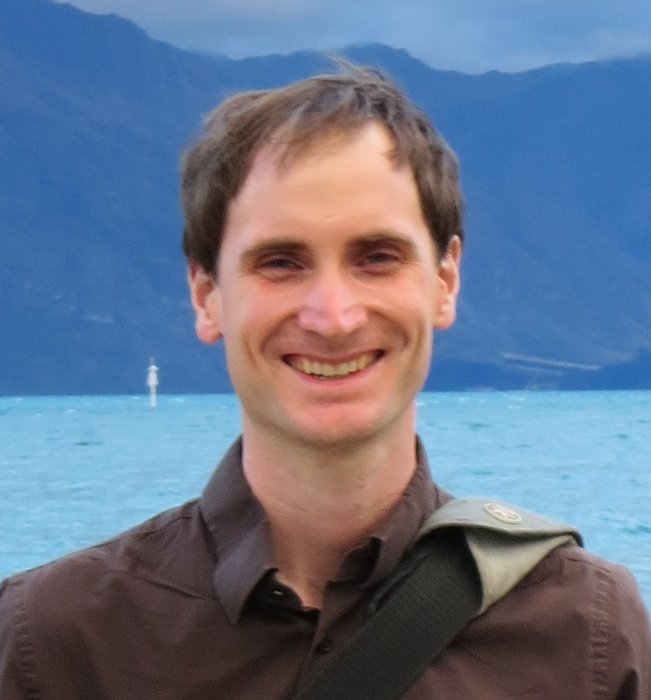
Habib Tabatabai is a Professor and Director of the Structural Engineering Lab in the Department of Civil and Environmental Engineering at the University of Wisconsin-Milwaukee's College of Engineering & Applied Science. He holds a PhD, ME, and BCe from the University of Florida. His research focuses on bridge reliability, construction materials, structural health monitoring, and infrastructure durability. He is currently on sabbatical for Fall 2024. Research interests include: reliability analysis of bridges, utilization of industrial byproducts in construction, damage detection methods, and rehabilitation techniques for aging infrastructure. His publications primarily explore themes in structural mechanics, materials science, and infrastructure sustainability, with recent articles focusing on concrete technology, bridge safety assessments, and recycled construction materials.
Dr. Jun Yan is a Professor in the Department of Statistics at the University of Connecticut. His research spans network analytics, spatial extremes, survival analysis, and statistical computing with applications in public health, finance, and environmental science. His core research interests include: network modeling and analysis, spatial statistics for climate extremes, survival analysis methodologies, statistical computing frameworks, and applications in interdisciplinary domains including sports analytics. Dr. Yan has developed significant statistical methodologies for network analysis, climate change detection, financial modeling, and health analytics. His recent publications demonstrate innovation in modeling complex network structures, analyzing climate extremes, developing computational approaches for massive datasets, and creating specialized statistical methods for health and finance applications. He maintains active collaborations across disciplines and contributes to open-source statistical software. Honors include: Guggenheim Fellowship, multiple Fromm Foundation commissions, and Barlow Endowment recognition.
Vân Anh Huynh-Thu is an Assistant Professor in the Department of Electrical Engineering and Computer Science at the University of Liège (Belgium). Her research focuses on improving machine learning techniques with an emphasis on model interpretability. She is based at B28: Systems and Modeling in Quartier Polytech, Allée de la Découverte 10, 4000 Liège, Belgium. Her primary research interests span Machine Learning , Bioinformatics , and Gene Regulatory Network Inference . Dr. Huynh-Thu has developed several influential methods including GENIE3, dynGENIE3, and Jump3 for inferring gene regulatory networks from expression data. Her work bridges the gap between machine learning theory and biological applications, particularly in understanding complex disease mechanisms through computational approaches. She has made significant contributions to interpretable machine learning models that maintain high predictive accuracy while providing insights into feature importance and model behavior. Her research demonstrates a progression from purely computational methods toward translational applications in medical research. Analysis of her recent publications reveals a clear trajectory from foundational work on gene regulatory network inference toward broader applications in medical research, particularly in Crohn's disease. Her research increasingly integrates machine learning with clinical applications, demonstrating a shift from purely computational methods to translational research with direct medical implications. The consistent emphasis across her work is on interpretability, rigorous validation, and the application of tree-based methods to complex biological systems, with a growing focus on proteomics and biomarker discovery for inflammatory bowel diseases. Dr. Huynh-Thu maintains an active GitHub presence with implementations of her methods, demonstrating her commitment to open science and reproducibility. Her software repositories have garnered significant attention from the research community, with GENIE3 alone having 88 stars and 37 forks on GitHub. She has developed multiple implementations of her algorithms in Python, MATLAB, and R, making them accessible to researchers across different computational environments. Her work has been influential in the DREAM challenges, where GENIE3 was the best performer in two network inference competitions.
Patrick Gagliardini is a Full Professor of Econometrics at the University of Lugano (USI) within the Faculty of Economics and the Institute of Finance. He also serves as Pro-Rector at USI. His academic journey includes a PhD in Econometrics from USI (2003) and studies in Physics at ETH Zurich (1998). He has held roles such as Visiting Fellow at CREST Paris (2003) and Assistant Professor at the University of St. Gallen (2004–2006). His research focuses on econometric methods (nonparametric techniques, GMM, latent factor models) and financial applications such as credit risk, asset pricing, and risk management. Competence areas include Big Data, investment decisions, and systematic risk analysis. He teaches courses in econometrics, financial econometrics, and time series at the undergraduate, graduate, and PhD levels. Recent publications explore latent factor models, econometric testing (e.g., eigenvalue tests for factor detection), and financial decision-making in small data regimes. His work bridges theoretical econometrics with practical applications in finance and risk modeling. Notably, his research addresses challenges in dynamic latent factor models, hedge fund performance evaluation, and granularity theory in financial systems. He maintains an active academic profile with contributions to both theoretical and applied econometrics.
Karthik Srinivasan is an Assistant Professor in the Analytics, Information, and Operations Academic Area at the University of Kansas School of Business. He holds a Ph.D. in Management Information Systems from the University of Arizona, an M.Mgt. in Business Analytics from the Indian Institute of Science, and a B.E. from Mumbai University. His research focuses on interpretable machine learning, explanatory modeling, text mining for business applications, and healthcare information systems. He develops methods to enhance transparency in AI systems and applies data science to healthcare, finance, and retail contexts. Recent work includes predictive modeling for incomplete data, graph-based retail analytics, and analyzing pandemic impacts on stock markets and public health. His publications span journals like MIS Quarterly, Decision Support Systems, and Nature Digital Medicine. He also contributes open-source tools like TextRegress and MoreThanSentiments for advanced text analysis. Teaching responsibilities include undergraduate and graduate-level data management courses. His research emphasizes practical applications in business and public health, leveraging interdisciplinary approaches to address real-world challenges.
Igor Molybog is an Assistant Professor at the University of Hawai'i at Manoa, holding joint appointments in the Departments of Electrical and Computer Engineering and Information and Computer Sciences. His research focuses on advancing artificial intelligence, particularly through large language models (LLMs), multimodal modeling, and core machine learning optimization. He leads the HawAII research group, exploring applications like LLM alignment, efficient inference systems, and scaling properties of foundation models. Education: Ph.D. in Engineering from UC Berkeley (2022), specializing in optimization algorithms for complex systems. Previously worked at Meta AI on LLaMa model development. Research Interests: Efficient LLM development and evaluation frameworks Multimodal AI integration (video/audio + text) Scalable optimization for large models Computational efficiency in training/ inference Recent Work: Presented REAL alignment method (2024), developed long-context scaling techniques (2023), contributed to Llama 2 chat models (2023). Collaborates with organizations like Epoch AI on scaling challenges. Teaching: Offers courses in AI, machine learning, and optimization across ECE and ICS departments. Labs/Teams: Leads HawAII Initiative fostering AI collaboration at UH Manoa, organizes paper reading seminars, and hosts technical talks with industry experts.
Jeremy Gaskins, PhD, is an Associate Professor in the Department of Bioinformatics & Biostatistics at the University of Louisville's School of Public Health and Information Sciences (SPHIS). He joined UofL in 2013 as an Assistant Professor, earning tenure and promotion to his current rank in 2019. His expertise lies in Bayesian statistical methods for complex data structures, including longitudinal analysis, missing data imputation, and joint modeling of mixed data types. He collaborates with researchers across multiple departments, including OB/GYN, Radiation Oncology, and Surgery. Education: Ph.D. (2013) in Statistics, University of Florida B.S. (2007) in Mathematics and Applied Mathematics, Auburn University Research Interests: Development of Bayesian methods for longitudinal and clustered data Computational strategies for complex model inference Applications in medical and public health research Missing data mechanisms and imputation techniques Teaching: PHST 661: Probability PHST 662: Mathematical Statistics Collaborations & Labs: Active collaborations with UofL medical departments on applied health research Focus on translational statistics for biomedical and public health problems
Margaret Michelle Torres is an Assistant Professor in the Department of Political Science at the University of California, Los Angeles (UCLA). Her research focuses on political methodology, computer vision, causal inference, and survey methodology, with substantive interests in political media communication, participation, and attitude formation. She holds a Ph.D. in Political Science and an A.M. in Statistics from Washington University in St. Louis, alongside a B.A. in Political Science and International Relations from CIDE (Mexico City). Her work bridges computational methods and social science inquiry, emphasizing innovative tools for analyzing visual and textual data. Recent projects explore how ideology influences perceptions of political groups, the role of visual frames in protests, and methodological issues in causal inference. Torres has authored influential papers on topics ranging from election dynamics to the application of machine learning in political analysis. Notable contributions include frameworks for unsupervised visual analysis and critiques of posttreatment variable pitfalls in experiments. Her research frequently intersects with questions of media representation, public opinion, and institutional trust. Torres advises students in quantitative methods and political behavior, though specific advisee names are not listed here.
Professor Mary Myerscough is an Associate Professor in the School of Mathematics and Statistics at the University of Sydney. Her research focuses on mathematical biology, particularly modeling atherosclerosis progression, honeybee colony dynamics, and social insect behavior. She has contributed to understanding macrophage lipid dynamics, plaque regression mechanisms, and hive thermoregulation. Her work combines mathematical models with biological systems, addressing topics like cell behavior, population dynamics, and disease mechanisms. Myerscough has secured grants including an ARC Discovery Project on atherosclerosis and collaborations in mathematical biology. Her research spans interdisciplinary areas from cardiovascular science to ecological modeling, with over 55 peer-reviewed publications. Education background and affiliations: Affiliated with the University of Sydney's Faculty of Science. Research interests include mathematical modeling of biological systems, atherosclerosis, and social insect behavior. Grants include projects on lipid-cell interactions and educational initiatives like shark bite analytics. Key contributions include models of honeybee colony collapse, termite architecture, and atherosclerotic plaque development. Her work bridges applied mathematics with life sciences, addressing both theoretical and applied questions in health and ecology.
Noah Simon is an Associate Professor in the Department of Biostatistics at the University of Washington School of Public Health. His research focuses on high-dimensional statistical methods, machine learning, and their applications in biomedicine. He develops computational tools for genomic and clinical data analysis, including penalized regression techniques and adaptive clinical trial designs. Education: B.A. Mathematics, Pomona College (2008) Ph.D. Statistics, Stanford University (2013), advised by Robert Tibshirani Research Interests: Dr. Simon specializes in high-dimensional estimation, algorithm optimization, and clinical trial methodology. His work addresses challenges in biomarker discovery, imaging-based diagnostics, and genomic data analysis. Key areas include sparse-group lasso regularization, adaptive enrichment designs for personalized medicine, and scalable computational methods for big data. Grants & Funding: NIH Director's Early Independence Award ($250k/year, 2014–2019) Amazon and Google Cloud Computing Grants for biomarker research Awards: Forbes 30 Under 30 in Science (2015) NSF Graduate Research Fellowship Honorable Mention (2010) Weiland Fellowship (2011–2013) Advising: He mentors PhD and MS students in biostatistical methodology and data science, with current advisees including Jean Feng, Brayan Ortiz, and Jeremy Roth. Notable collaborations include work on neural activity detection via calcium imaging (SCALPEL) and nonparametric variable importance assessment using neural networks. Lab & Affiliations: Based at the Hans Rosling Center for Population Health, his group develops open-source software (e.g., sgl , standGL ) and contributes to biomedical data science initiatives at UW.
Christophe Mues is a Professor of Data Science and Information Systems at the University of Southampton's Department of Decision Analytics and Risk. He specializes in credit scoring, consumer credit risk modeling, and predictive analytics, focusing on applications like loan default prediction and debt collection optimization. His work integrates advanced statistical methods and machine learning techniques to address challenges in financial risk assessment. Previously, he held a research position at KU Leuven (Belgium), where he earned his Doctorate in Applied Economics. Since joining the University of Southampton in 2004, he has led the Information Systems & Business Analytics section and contributed to organizing the biennial Credit Scoring and Credit Control conference. His teaching spans data-driven decision-making and business analytics. Key research interests include credit risk modeling for consumers and SMEs, leveraging non-traditional data sources with deep learning, ensuring fair credit scoring models, and optimizing debt recovery strategies. He currently supervises PhD students in Business Studies & Management, focusing on topics like AI-driven credit scoring and financial risk evaluation. His publications span journals like European Journal of Operational Research and International Journal of Forecasting , emphasizing methodological advancements in credit risk assessment and financial decision-making. He actively participates in interdisciplinary collaborations to bridge operational research, data science, and financial regulation.
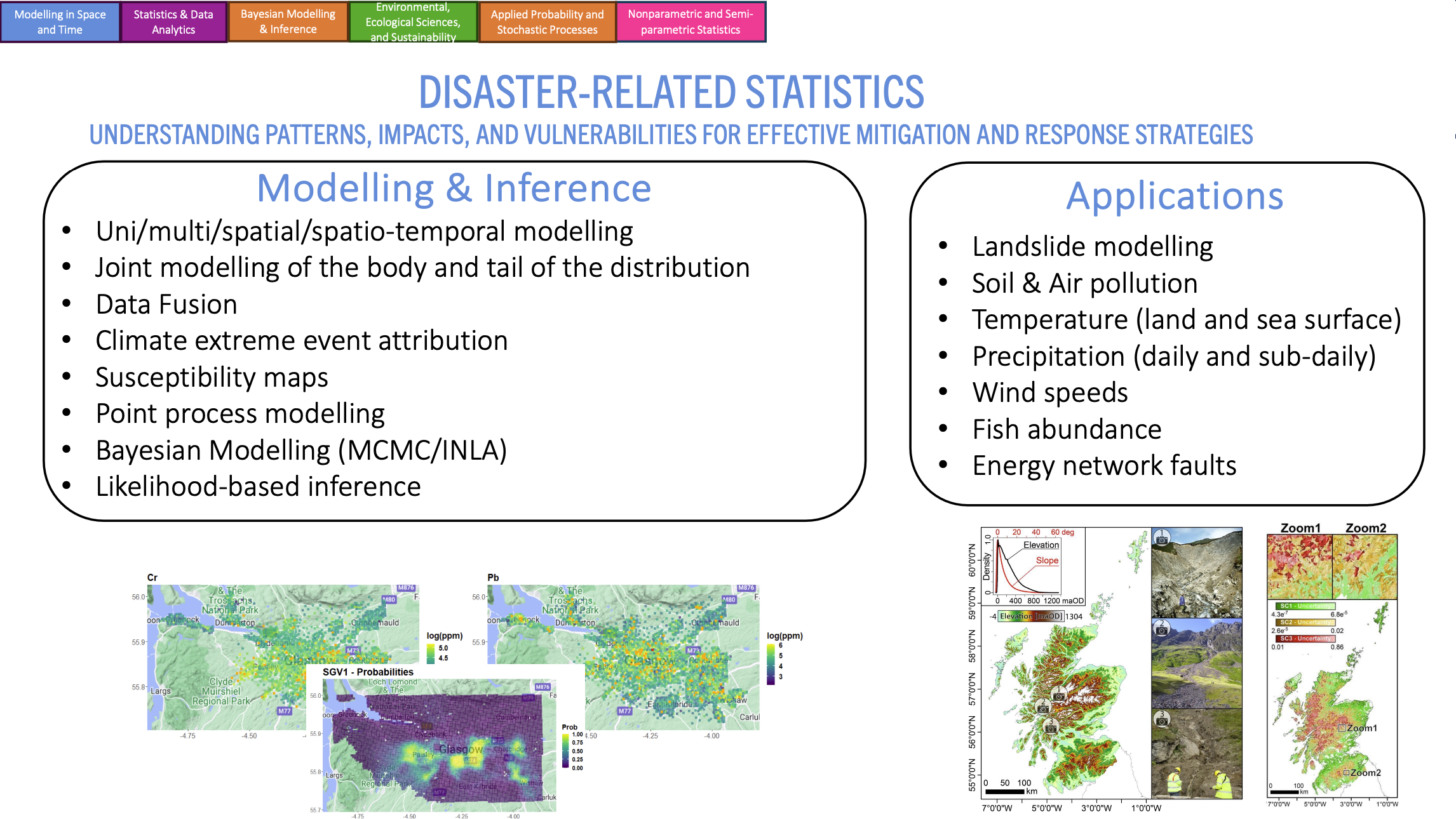
Dr. Daniela Castro Camilo is a Senior Lecturer in Statistics at the University of Glasgow's School of Mathematics & Statistics. Her research focuses on extreme value theory applied to environmental hazards, including landslides, climate extremes, and risk assessment. She leads projects like the Mitigating Landslides Impacts in Scotland (MLIS) and Geostatistical Binary Models for Extremes (GEOBEx) , funded by the Scottish Government and EPSRC. She collaborates with institutions such as the British Geological Survey and the Met Office. Her work bridges statistical methodology and environmental applications, with notable contributions to landslide hazard modeling and spatial extremes. She actively participates in international conferences and organizes events like the ESS-sponsored session at the 2024 RSS Conference. She is a core member of GLE²N (Glasgow-Edinburgh Extremes Network), fostering interdisciplinary research in statistical risk analysis. Recent projects include developing probabilistic forecasting tools for weather-driven faults in electricity networks and advancing Bayesian methods for extreme event prediction. Her research emphasizes practical solutions for resilience to environmental disasters, combining cutting-edge statistical techniques with real-world data challenges.
Adam Slez is an Associate Professor of Sociology and Director of Graduate Studies at the University of Virginia. He holds a Ph.D. in Sociology from the University of Wisconsin-Madison (2011) and previously served as a Postdoctoral Research Associate at Princeton University's Center for the Study of Social Organization. His research focuses on comparative-historical sociology, political sociology, quantitative methods, spatial data analysis, and network analysis. Slez examines the interplay between politics and markets, state-building, and spatial dimensions of political cleavages, with notable work on railroad expansion's impact on third-party mobilization in the American West and the U.S. Constitutional Convention of 1787. His work has been published in the American Sociological Review and other leading journals. His research methodologies emphasize integrating spatial data analysis with historical inquiry, addressing topics such as institutional development, political dynamics, and socio-economic structures. Slez’s contributions span theoretical and methodological innovations, particularly in applying quantitative techniques to historical social science.
Joseph G. Altonji is the Thomas DeWitt Cuyler Professor of Economics at Yale University and a Research Associate at the National Bureau of Economic Research (NBER). He previously held faculty positions at Columbia University and Northwestern University, and served as a visiting professor at Princeton and Harvard. His academic affiliations include memberships in the Econometric Society, the American Academy of Arts and Sciences, and the Society of Labor Economists (past president). He received the IZA Prize in Labor Economics (2018) and has advised numerous federal and academic bodies, including the Federal Reserve Bank of Chicago and the President’s Council of Advisors on Science and Technology. Altonji’s research focuses on labor economics, applied econometrics, and inequality dynamics. Key areas include labor market fluctuations, education economics, family income dynamics, and wage determination. Current projects address school choice impacts on inequality, graduate degree returns, and the interplay between marriage, earnings, and family income. His methodological contributions include techniques to address selection bias in observational studies, particularly in evaluating school and neighborhood effects. Publications highlight trends in advanced degree returns, decomposition of earnings into wage and hours effects, and analyses of pandemic-era labor market shifts. His work often bridges econometric rigor with policy relevance, emphasizing empirical strategies to isolate causal effects. Altonji’s advisory roles reflect his engagement with real-world economic challenges, from STEM education to unemployment insurance policy design.
Edwin P. Gerber is a Professor of Mathematics and Atmosphere/Ocean Science at New York University’s Courant Institute of Mathematical Sciences. He holds joint affiliations with the Department of Environmental Studies and the Center for Data Science. His research focuses on understanding climate variability and dynamics, particularly the role of stratosphere-troposphere interactions and simplified climate models. Gerber earned his Ph.D. in Applied and Computational Mathematics from Princeton University (2006), following an M.A. (2002) and B.S. in Mathematics and Chemistry from the University of the South (2000). His work bridges theory and Earth System models, investigating topics like the Brewer-Dobson Circulation, sudden stratospheric warmings, and ozone layer dynamics. Key achievements include the DynVarMIP initiative for CMIP6 and contributions to gravity wave parameterization. Gerber has received awards such as the Friedrich Wilhelm Bessel Research Award (2021) and Hertz Foundation Fellowship (2000-2005). His research has been supported by grants from NSF, NASA, and international collaborations. Gerber’s lab explores machine learning applications in climate modeling, including data-driven parameterization of gravity waves. He serves as Associate Editor for the Quarterly Journal of the Royal Meteorological Society and has led initiatives like the SPARC Reanalysis Intercomparison Project (S-RIP). His recent studies address tropical teleconnections, stratospheric ozone responses to global warming, and extreme event predictability. Gerber’s teaching includes courses on atmospheric dynamics, climate change, and differential equations. He emphasizes interdisciplinary approaches, integrating theory, computation, and observational data to advance climate science understanding.