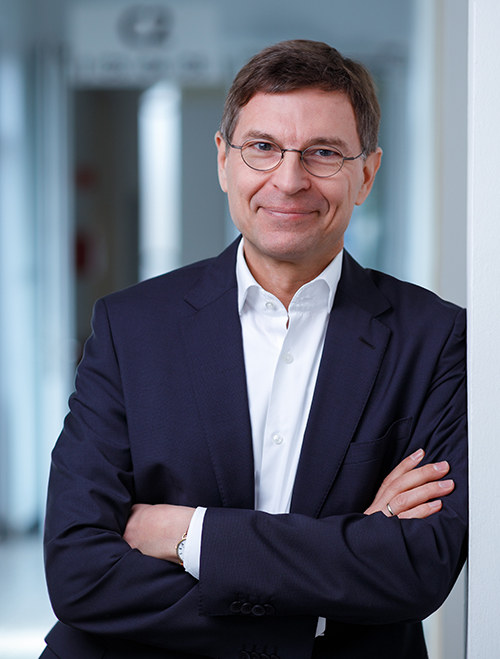
Prof. Stefan Wrobel is a Professor of Computer Science at the University of Bonn and Director of the Fraunhofer Institute for Intelligent Analysis and Information Systems (IAIS). He holds leadership roles, including Co-Director of the Lamarr Institute for Machine Learning and Artificial Intelligence and Managing Director of the Bonn-Aachen International Center for Information Technology (b-it). His research focuses on AI, machine learning, and big data applications in industry and society. He earned his PhD from the University of Dortmund and has held academic positions at Magdeburg University and Berlin Technical University. Active in national/international AI initiatives, he chairs the Fraunhofer Strategic Research Field on Artificial Intelligence and co-leads the Machine Learning Rhine-Ruhr (ML2R) Competence Center. Education: Master's (Georgia Tech), PhD (University of Dortmund). Research emphasizes intelligent algorithms, data analysis, and AI ethics. Awarded GI-Fellow (2022) and honored by the German Computer Science Society for contributions to AI history. Key roles include Editorial Board member of Machine Learning journals and advisory roles in AI ethics and certification. Scientific contributions span over 100 publications in machine learning, data mining, and visual analytics. Advised numerous PhD students on topics like graph mining and trustworthy AI. Leadership in institutions like Fraunhofer Technology Hub for Machine Learning and the German Computer Science Society's Special Interest Group on Knowledge Discovery.
Simran Kaur is a Senior Lecturer and Head of the Education Academy at Monash University Malaysia, School of Business, Department of Management. She holds a PhD in Management from the same institution and has a strong interdisciplinary background in psychology and business. Her academic leadership includes roles as Discipline Coordinator (2023–2024) and Change Champion for the Digital Learning Uplift Project. Her educational qualifications include: Bachelor of Psychological Science and Business (Hons.), Monash University Malaysia Doctor of Philosophy (PhD) in Management, Monash University Malaysia Postgraduate Certificate in Academic Practice (PGCAP), Lancaster University Simran Kaur’s research focuses on behavioural aspects in management and marketing, with key interests in consumer behaviour, brand management, decision-making, Islamic marketing, and higher education pedagogy. She integrates psychological insights into marketing theory, exploring how identity, religion, and digital media influence consumer choices. Her teaching philosophy emphasizes critical thinking, collaboration, and experiential learning, reflected in her training in LEGO® SERIOUS PLAY®. Her recent publications span topics such as sacred consumption, influencer marketing, country image during crises, and Halal consumer behaviour. These works reflect a strong trend in understanding cultural, emotional, and cognitive drivers of consumer decisions, particularly in Asian and Muslim-majority contexts. Her scientific awards highlight her excellence in teaching and academic development: Education Excellence Award (2023) Purple Letter for Teaching Excellence, S1 2024 Purple Letter for Teaching Excellence, S2 2022 Fellow of the Higher Education Academy (2021) She is actively involved in academic service, including peer review for Marketing Intelligence & Planning , supervision of non-HDR students, and organizing curriculum reviews and academic conferences. She serves as an invited speaker and contributes to digital pedagogy innovation. While no formal lab or research center is mentioned, her role as Change Champion and involvement in projects like the Digital Learning Uplift indicate leadership in educational transformation.
Jianping Fu is a Professor in the Department of Mechanical Engineering at the University of Michigan , with joint appointments in Biomedical Engineering and Cell and Developmental Biology. His research integrates micro/nanoengineering , mechanobiology , and stem cell biology to model human development and disease. Education: PhD (MIT, 2007), BE (University of Science and Technology of China, 2000) His research interests focus on stem cell bioengineering , developmental bioengineering , and mechanobiology , particularly in modeling early post-implantation human development, neural tube formation, and pluripotent stem cell mechanoregulation. His work combines biomimetic culture systems with microfluidic gradients to study embryogenesis and organogenesis. Recent publications highlight advances in human embryo modeling (2024 Cell, Nature, Cell Stem Cell), neural tube patterning (2024 Nature), and mechanobiology of stem cells (2024 Nature Reviews Physics). These studies emphasize computational methods , single-cell analysis , and standardization of embryo models . Scientific honors include: Friedrich Wilhelm Bessel Research Award (2022) ISSCR Merit Award (2024) Fellow, American Institute for Medical and Biological Engineering (2019) NSF CAREER Award (2012) Life Member, World Association of Chinese Biomedical Engineers (2024) Dr. Fu mentors extensively, with 20+ alumni including PhD students and postdocs now in academic and industry positions. His lab has received $3M NIH funding for immunological diagnostics and MTRAC grants for translational research. Collaborations with institutions like Cincinnati Children's Hospital and Rice University enhance his interdisciplinary approach to regenerative medicine.
Renny Edwin Fernandez is an Associate Professor in the Department of Engineering at Norfolk State University's College of Science, Engineering and Technology. His multidisciplinary research focuses on microsensing platforms for healthcare, pollution control, and agriculture applications. Education: PhD in Electrical Engineering (2010) from Indian Institute of Technology Madras His research integrates microfabrication, microfluidics, and machine learning to develop wearable biosensors, disposable electrodes, and IoT-enabled soil monitoring systems. Key trends in his recent publications include: Real-time health monitoring via flexible nanosensors Machine learning integration in agricultural IoT Plasma-aided printing of conductive nanomaterials Smart PPE systems with NFC technology Scientific Awards: Research Initiation Award (2020) for cognitive monitoring systems in extreme environments Dr. Fernandez mentors graduate and undergraduate researchers at NSU, with prior teaching experience at University of Indianapolis and Florida International University. He holds a patent for biosensor technology and has developed innovative solutions for: Salivary cortisol detection Soil nutrient analysis Cell viability assessment Smart irrigation systems
Dr. Anna Raffoni serves as a Senior Lecturer in Accounting and Finance at Loughborough Business School, Loughborough University, and holds the strategic role of Programme Lead for Social Science Research (Business and Management Studies). She joined the institution in January 2015 after accumulating academic experience at the University of East Anglia, Cranfield University School of Management, and the University of Bologna, establishing herself as a key contributor to the Accounting and Finance research group. Her academic foundation includes a PhD in Management Accounting (specializing in customer value management) awarded by the University of Florence in 2009, which continues to inform her interdisciplinary research trajectory. Raffoni's scholarly work centers on performance management, business analytics, and strategic management accounting, with publications appearing in premier journals including the European Journal of Operational Research, British Accounting Review, Production, Planning & Control, and Omega. Her research uniquely bridges quantitative operations research methods with accounting frameworks, particularly examining how data analytics transforms traditional performance measurement in banking and service sectors through techniques like machine learning and data envelopment analysis. Analysis of her 15 most recent publications (2012-2024) reveals a clear evolution toward integrating advanced analytics with performance management systems. She has pioneered multidimensional efficiency measurement in banking branches, explored total cost of ownership in supply chains, and investigated strategic performance measurement adoption, consistently demonstrating how operational research methods solve real-world accounting challenges while advancing theoretical models. Her scientific recognition features the Dean’s Award for Early Career Teacher of the Year (2017), acknowledging her excellence in undergraduate and postgraduate instruction. In her capacity as Programme Lead, Raffoni shapes research strategy and supports faculty development across Business and Management Studies. While specific supervisees and grant details aren't documented in available materials, her leadership role and active publication record indicate substantial engagement in research mentorship and academic community building. She actively collaborates within Loughborough's Accounting and Finance research group, contributing to interdisciplinary projects that address contemporary challenges in financial management through analytical approaches, with emerging work suggesting increasing focus on artificial intelligence applications in performance systems.
Stacy Alaimo is the Barbara and Carlisle Moore Professor of English and Core Faculty in Environmental Studies at the University of Oregon. She directs the English Department's Graduate Studies program. Her research bridges environmental humanities, science studies, and critical theory, focusing on transcorporeality, blue humanities, and material ecocriticism. She has authored seminal works like Bodily Natures (2010) and Exposed (2016), and co-edited foundational texts like Material Feminisms (2008). Her current projects include The Abyss Stares Back (2025) and Acid Seas . PhD from University of Texas at Austin Previous roles: Distinguished Teaching Professor at University of Texas at Arlington Research interests include oceanic studies, interspecies relations, and environmental justice. She co-edits Duke University Press's 'Elements' series and serves on academic committees for the College of Arts and Sciences. Her work has inspired art exhibitions, podcasts, and interdisciplinary collaborations globally. Awards include the MLA Ecocriticism Forum leadership and ASLE awards. Grants include leadership roles in sustainability initiatives and interdisciplinary programs. Labs/teams include collaborations with marine scientists and artists through blue humanities projects. Future works explore ocean acidification and deep-sea ecologies.
Bruno TASSIN is a Professor at École nationale des ponts et chaussées and serves as Research Director at the Ministry of Ecological and Inclusive Transition. His primary affiliation is with the Department of City Environment Transport Information. He leads research at the Water, Environment and Urban Systems (Leesu) laboratory and co-directs the Urban Futures Laboratory of Excellence (Labex). He also serves as deputy director of the EFLUVE Observatory of Universe Sciences. His work focuses on urban hydrology, water contamination dynamics, and microplastic pollution in urban watersheds. Since 2012, he has co-led a research program on plastics in urban waterways with Johnny Gasperi. He is a member of the ASTEE research committee and vice-president of the scientific council of the Seine Normandy water agency. Research interests include microplastic dispersion mechanisms, estuarine contamination, and policy applications for pollution mitigation. His projects integrate interdisciplinary approaches to address environmental challenges in urban and aquatic systems, emphasizing real-world policy support. Publications highlight advancements in understanding microplastic transport, estuary dynamics, and the impact of urban runoff. Key contributions include studies on the Seine River Basin and tropical river-estuarine systems, contributing to global plastic pollution discourse.
Giuseppe Bruno Averta is a Fixed-term Researcher at the Department of Control and Computer Science (DAUIN), Polytechnic University of Turin, and a member of the Interdepartmental Center SmartData@PoliTO - Big Data and Data Science Laboratory. He is affiliated with the College of Computer, Film and Mechatronics Engineering and contributes to national and international research in artificial intelligence and robotics. Averta has held a Visiting Researcher position at the Massachusetts Institute of Technology (MIT) from January to June 2019. His research interests include Computer Vision, Deep Learning, Robotics, Neural Architecture Search, Egocentric Vision, Embodied Intelligence (Edge/Tiny ML), and Human-Robot Collaboration . His work is aligned with ERC sectors in Artificial Intelligence, Machine Learning, and Robotics, and contributes to UN SDGs such as Good Health and Well-being, Industry Innovation and Infrastructure, and Responsible Consumption and Production. The recent publication trends highlight his focus on vision-language models (e.g., CLIP), egocentric action recognition, efficient neural architectures (e.g., BiSeNet, MaskFormer), and robust deep learning. His research bridges theoretical advances with practical robotics applications, including grasping and manipulation. Scientific Awards and Recognitions: Georges Giralt PhD Award (euRobotics AISBL, 2021) Wiley Best Reviewer (Wiley, Italy, 2021) Best Paper Award, ICUMT 2015 (2017) Fellow, ELLIS Network of Excellence (2022–) Fellow, DAAD AInet (2022–) DAAD AInet Fellowship Advising and Grants : Averta supervises multiple PhD students in the Artificial Intelligence and Computer and Systems Engineering doctoral programs at Politecnico di Torino. He is involved in teaching at both the master’s and doctoral levels, including courses on Robot Learning and Machine Learning and Deep Learning. He is also a co-inventor on a national and international patent for a method and algorithm for the automatic design of neural networks through machine learning, indicating active research funding and innovation. Labs and Research Groups : He is a member of the SmartData@PoliTO center and contributes to research in the VANDAL PoliTO lab (as indicated by his student Davide Buoso). His work is deeply integrated with teams working on egocentric vision, embodied AI, and neural architecture search.
Michelle MacLeod is a Professor of Gaelic and Head of the School of Language, Literature, Music and Visual Culture at the University of Aberdeen, where she has been a faculty member since 2004 and was promoted to Personal Chair in 2019. She is currently Dean for Impact and Engagement and leads research and teaching in Scottish Gaelic language, literature, and identity. Education: M.A. (Hons), PhD (University of Aberdeen) Her research centers on modern Gaelic literature, Gaelic drama, language planning, and the sociolinguistics of minority languages. She is deeply engaged in questions of Gaelic identity, adult language acquisition, and community language policy. Her work bridges academic scholarship and public policy, particularly through her role on Bord na Gaidhlig. The most recent publications show a strong focus on Gaelic cultural expression, language policy critique, and sociolinguistic analysis of new speakers and family language use. Her work increasingly integrates interdisciplinary methods, including digital pedagogy and motivational psychology in language learning. Scientific awards include: Donald Meek Prize for best non-fiction Gaelic book (2021) AHRC Future of Languages Research Fellow (2022) Students' Union & University of Aberdeen Prize for Most Inspirational Lecturer (2024) She supervises PhD students in Gaelic studies and linguistics and collaborates with institutions like Sabhal Mòr Ostaig and Comunn na Gàidhlig. Her leadership extends to national language planning and knowledge exchange, reflecting her commitment to the revitalization of Gaelic as a living community language. Michelle MacLeod is a key figure in the Gaelic academic community, leading both institutional and scholarly efforts to sustain and develop Scotland’s indigenous language through research, teaching, and policy engagement.
Prof. Dr. Kenny R. Cupers is Professor of Architectural History and Urban Studies at the University of Basel , affiliated with the Department of Social Sciences in the Faculty of Humanities and Social Sciences . He co-founded and leads the Urban Studies division, focusing on the intersections of architecture, urbanism, colonialism, and planetary design in African and European contexts. PhD, Harvard University (2010) M.Sc. and B.Sc. in Architecture, Catholic University of Leuven Studies in Visual Culture and Urban Theory, Goldsmiths College, London His research centers on architectural modernism, housing, infrastructure, and decolonization . Key themes include the planetary politics of design, coloniality of infrastructure, and the role of architecture in state transformation. He is currently working on two book projects in Kenya: one on unmaking the plantation system through arts and architecture, and another on post-independence Nairobi’s urban history. Recent publications include The Earth that Modernism Built: Empire and the Rise of Planetary Design (2024) and The Social Project: Housing Postwar France (2014). He leads the Sinergia project Governing through Design (2020–2025) and previously directed the SNF-funded How Infrastructure Shaped Territory in Africa (2018–2022). His work appears in journals such as e-flux Architecture , Antipode , and Architectural Theory Review . Scientific Awards: No specific awards listed in the provided text. As an educator, Cupers promotes engaged pedagogy and collaborative research, co-editing What is Critical Urbanism: Urban Research as Pedagogy (2022). His public research projects include Swiss Corporate Coloniality and Lamu Futures . He has advised multiple PhD and Master’s students, though specific names are not listed. He is part of a vibrant research team including Dr. Ernest Sewordor, Dr. Laura Nkula-Wenz, and Dr. Prita Meier. Laboratories and Research Teams: Urban Studies, University of Basel Critical Urbanisms Program Sinergia Project: Governing through Design How Infrastructure Shaped Territory in Africa (completed) Infrastructure Space and the Future of Migration Management (completed)
Chris Bryan is an Assistant Professor in the School of Computing and Augmented Intelligence (SCAI) at Arizona State University (ASU), part of the Ira A. Fulton Schools of Engineering. He leads the Sonoran Visualization Laboratory (SVL @ ASU), focusing on data visualization, human-computer interaction, and advanced interfaces for data science. His research includes explainable AI, augmented/virtual reality, and privacy-preserving visualization techniques. Educations: Ph.D. Computer Science, University of California, Davis (2018) B.S. Computer Science, University of Arkansas (2008) Research Interests: Bryan’s work spans data visualization, human-computer interaction, explainable AI, and immersive visualization. He develops tools for collaborative analysis, privacy-aware systems, and visual analytics for complex data. Current projects involve VR/AR interfaces, bias reduction in NLP tasks, and educational visualization tools. Recent Achievements: Recipient of the 2024 and 2023 Top Five Percent Faculty Award at ASU’s Ira A. Fulton Schools of Engineering. NSF grants for privacy-preserving visualization (SaTC #2224066) and visualization education (IUSE #2216452). Multiple publications in top venues like IEEE VIS, CHI, and EuroVis, including work on differential privacy, mind wandering in visualization, and LLM prompt exploration. Advising & Grants: Advises Ph.D., MS, and undergraduate students on visualization and HCI research. Collaborates with institutions like Los Alamos National Laboratory, Phoenix Children’s Hospital, and Nankai University. Lab focuses on mentoring and preparing students for academic and industry roles in visualization and AI. Labs & Teams: Leads the SVL @ ASU, which uses advanced hardware (HTC Vive, HoloLens 2) and tools like D3.js, React, and LaTeX. The lab emphasizes interdisciplinary projects with domain experts in medicine, engineering, and security.
Lisa Lowe is the Samuel Knight Professor of American Studies at Yale University, with affiliate appointments in the Programs in Ethnicity, Race, and Migration and Women's, Gender, and Sexuality Studies. She has previously taught at the University of California, San Diego, and Tufts University, establishing a distinguished interdisciplinary career in American Studies, Comparative Literature, and critical race theory. Education: Stanford University – European Intellectual History University of California, Santa Cruz – French Literature and Critical Theory Lowe's research focuses on the intersections of colonialism, race, immigration, and globalization. Her work critically examines how liberal modernity is built upon racial capitalism, settler colonialism, and transnational displacement. She is a leading voice in transnational feminism and Asian American studies, analyzing how immigrant subjects are constructed as 'perpetual foreigners' within national cultures. Her scholarship bridges literary analysis, historical critique, and political theory to interrogate the legacies of empire. Her recent publications show a sustained engagement with the entanglements of liberalism, empire, and intimacy across continents. Themes include racial capitalism, the transpacific, feminist resistance, and the cultural politics of globalization. Her work consistently challenges disciplinary boundaries and calls for a rethinking of American Studies through a global and decolonial lens. Scientific Awards and Honors: Guggenheim Fellow American Council of Learned Societies Fellow Rockefeller Foundation Fellow Mellon Foundation Fellow UC Humanities Research Institute Fellow University of California President's Faculty Research Fellow (2011–12) Visiting Fellow, School of Advanced Study, University of London F. Ross Johnson-Connaught Distinguished Visitor, Munk School of Global Affairs, University of Toronto (2012) Carl Bode - Norman Holmes Pearson Award (2018) Richard A. Yarborough Prize (2018) Finalist, John Hope Franklin Award (2016) Nicolás Guillén Outstanding Book Award (2018) 1997 Book Award in Cultural Studies, Association for Asian American Studies Lowe has been a mentor to numerous scholars, particularly from underrepresented backgrounds, recognized by the Richard A. Yarborough Prize. She has received multiple grants and fellowships supporting her research, including from the Mellon, Rockefeller, and Guggenheim Foundations. She co-convened the Mellon Sawyer Seminar 'Comparative Global Humanities' at Tufts and has been an Affiliate Scholar at the Boston Psychoanalytic Society and Institute (2022–2023). She has also served as a visiting fellow and speaker at numerous international institutions, indicating sustained collaborative and advisory engagement. Lowe co-edits the influential book series Perverse Modernities with Jack Halberstam at Duke University Press, shaping contemporary critical theory. She has also co-edited special issues and volumes that have advanced the field of Asian American Studies. Her scholarly network includes leading institutions across the U.S. and globally, and she continues to be a central figure in interdisciplinary humanities.
Tim Weyrich is Professor of Visual Computing (part-time) at University College London and Professor of Digital Reality at Friedrich-Alexander University Erlangen-Nürnberg. He leads the Digital Reality Lab and has affiliations with the Virtual Environments and Computer Graphics group at UCL, Eurographics, and the EPSRC Doctoral Training Centre (SEAHA). Previously, he held a Postdoctoral Teaching Fellowship at Princeton University. Research Interests: Content creation and computational photography Appearance modeling and fabrication Point-based graphics and cultural heritage analysis Digital humanities and 3D printing Article Trends: Recent work focuses on neural radiance fields (FruitNeRF++), 3D Gaussian splatting, mmWave radar inverse rendering, and texture anomaly detection. Applications span autonomous systems, cultural heritage, and medical imaging. Scientific Awards: Best Paper Honourable Mention (BMVC 2022) Best Student Paper Award (EG Workshop on GCH 2014) Honorable Mention (Eurographics 2011) Best Student Paper Honourable Mention (BMVC 2018) ACM SIGCHI Best Paper Honourable Mention (CHI 2013)
Univ.-Prof. Dr. Marc Siegel has been Professor of Film Studies at Johannes Gutenberg University Mainz since October 2020. He is based at the Institute for Film, Theatre, Media and Cultural Studies and also serves as artistic director of ZOOM – Labor Ludwig Schönherr . In parallel, he works as a freelance curator for international film festivals, museums and galleries, and is a founding member of the Berlin-based artist collective CHEAP . Education & Qualification: Although the provided text does not enumerate earlier degrees, Siegel’s title “Dr.” and his appointment as “Universitäts-Professor” indicate the completion of doctoral and post-doctoral qualifications. Research Interests: Siegel’s scholarship is situated at the intersection of queer studies , experimental film , and moving-image art/performance . He interrogates how cinema and related media articulate questions of sexuality, gender, race and anti-Semitism, often employing archival, curatorial and critical methods to foreground marginalized histories and aesthetics. His forthcoming monograph A Gossip of Images (Duke University Press) crystallizes these concerns. Publications & Trends: Across more than two decades Siegel has produced a consistent body of work that re-reads canonical avant-gardists (Warhol, Jack Smith, Werner Schroeter) and contemporary queer media alike. Recent essays expand into digital dissemination, camp temporalities, and the politics of ageing bodies, evidencing a trajectory from close textual analysis toward broader cultural critique. Scientific Awards & Distinctions: Member, Academy of the Arts of the World , Cologne Advisory Board, Forum Expanded , Berlinale Principal Investigator, AHRC-UK funded project “Serge Daney and Queer Cinephilia” (2018-2021) Research Grants & Collaborative Projects: DFG Graduate School “Configurations of Film” (GRK 2279), Goethe University Frankfurt am Main – associate researcher Swiss National Science Foundation project “Moving in Every Direction” , Lucerne University of Applied Sciences and Arts – associate researcher Laboratories & Teams: As artistic director of ZOOM – Labor Ludwig Schönherr Siegel mentors experimental media practices; he also co-founded the artist collective CHEAP , which produces queer interventions in urban and digital space.
Prof. Dr. Eva Ehninger is a leading academic at the Institute for Art and Visual History at Humboldt University of Berlin , holding the Professorship for Modern Art History . Her research bridges photography theory, modernism, postcolonial studies, and transcultural methodologies , with a focus on visual media’s role in constructing social order. Education: Heidelberg, University of Michigan, Frankfurt/Main Doctoral thesis: Vom Farbfeld zur Land Art (2011, Benvenuto-Cellini Prize) Her research explores how photography, media, and art mediate social, political, and cultural dynamics. Current projects include the Käte Hamburger Kolleg inherit-heritage in transformation and Art Education Between Heritage Making and Critical Transregionality , analyzing entanglements between South Asian and European art education histories. Publications like The Modern Dream of Order (2025) and Ed Ruscha’s Streets of Los Angeles contributions examine Los Angeles as a site of visual critique and urban documentation. Her scholarly output spans 15 recent works addressing topics such as Victorian photography’s social imagination , biological metaphors in Smithson’s art , and dialogue in Nauman’s practice , reflecting interdisciplinary intersections of art history, media theory, and critical studies . She has received prestigious support from institutions like the Getty Research Institute and Terra Foundation for American Art . Scientific awards: Benvenuto-Cellini Prize (for dissertation) Grants: Studienstiftung des deutschen Volkes, Fulbright Commission, BMBF Ehninger supervises 10 ongoing PhD projects and co-edits journals like kritische berichte and Zeitschrift für Kunstgeschichte . She is a Vertrauensdozentin (Trusted Academic Advisor) for the Studienstiftung des deutschen Volkes, demonstrating her commitment to academic mentorship.