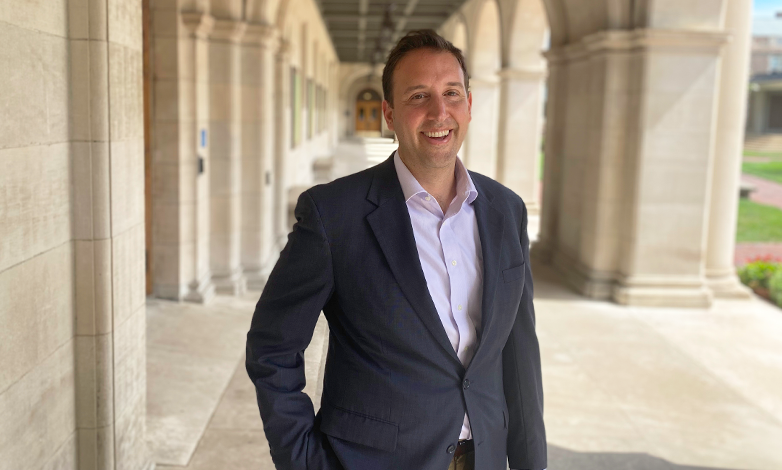
Ann Bisantz is the Vice Provost & Dean of Undergraduate Education and a SUNY Distinguished Professor in the Department of Industrial and Systems Engineering at the University at Buffalo. Her research focuses on cognitive engineering, human factors in healthcare, and decision-making systems in complex environments. She leads projects analyzing human-machine interaction, emergency medicine workflows, and the design of health IT systems. Education: PhD in Industrial Engineering Key Affiliations: School of Engineering and Applied Sciences Her research integrates cognitive systems engineering principles to improve healthcare safety, surgical team communication, and emergency department workflows. Notable projects include developing electronic health record displays for clinicians and studying trust in AI-driven medical decision support systems. Recent work emphasizes resilience engineering in healthcare, analyzing how systems can better anticipate and adapt to failures. Her articles explore automated driving safety, robot-assisted surgery communication, and mental health crisis support apps. Awards: SUNY Distinguished Professor designation Grants include funding from NSF, AHRQ, and the Department of Homeland Security. She has supervised numerous UB students in research projects addressing healthcare system challenges. Her work also extends to educational equity, applying systems approaches to support underrepresented minorities in STEM.
Lu Ding is an Assistant Professor in the Instructional Design and Development Program at the University of South Alabama's Department of Counseling and Instructional Sciences within the College of Education and Professional Studies. Their role emphasizes innovative teaching methodologies and research in educational technology. Education: B.S., Instructional Technology, Wuhan Sports University (2009) M.Ed., Journalism and Communication, Wuhan Sports University (2012) Ph.D., Learning, Design, and Technology, University of Georgia (2017) Research Interests: Focuses on the intersection of learning sciences and instructional design, particularly in online environments. Key areas include: Video-based learning strategies (e.g., tutoring-style videos, dialogue videos) Gamification in education (online discussions, course design) STEM education innovation AI literacy and automated feedback systems Student motivation and engagement mechanisms Article Trends: Recent work explores the efficacy of video formats in STEM education, AI integration in teaching, gamification mechanics, and automated feedback systems in programming courses. Studies emphasize practical applications in authentic classroom settings. Awards: No specific scientific awards mentioned. Active in peer review for journals like Computers and Education and Technology, Pedagogy, and Education . Advising & Grants: Information on current advisees or funded grants not provided in the text. Teaching responsibilities include courses like ISD 653 (Developing Online Instruction) and EDM 510 (Microcomputing Systems in Education). Labs/Teams: No formal lab affiliations explicitly stated. However, research collaborations likely exist through USA's College of Education initiatives like the USA SARIC (South Alabama Research and Innovation Center).
Esra Ozdenerol is a Professor of Geographic Information Systems (GIS) in the Department of Earth Sciences at the University of Memphis since 2003. She directs the GIS Certificate Program and the Spatial Analysis and Geographic Education Laboratory. Additionally, she is affiliated with the University of Tennessee Health Science Center’s Department of Preventive Medicine and Health Outcome Policy. Previously, she served as Associate Director of the Benjamin L. Hooks Institute for Social Change (2010–2013) and was an Assistant Professor of Architecture at Florida International University (2000–2003). Educations: Ph.D., Geography (Louisiana State University, 2000); MLA, Landscape Architecture (LSU, 1996); BS, Agricultural Engineering: Landscape Architecture (Ankara University, Turkey, 1993). Her research focuses on GIS applications in public health, medical geography, landscape ecology, and gender equity. Notable areas include Lyme disease epidemiology, spatial health disparities, and geospatial analysis of social determinants of health. She also advocates for gender equity in STEM through projects like the ASPIRED initiative. Ozdenerol has consulted for public, government, and international agencies on GIS and spatial analysis. Her recent work addresses pandemic management (e.g., MEMPHI-SYS for COVID-19 data integration) and environmental health (e.g., lead exposure in children). She has collaborated on studies linking land-use changes, wildlife ecology, and public health outcomes. Ozdenerol’s interdisciplinary approach bridges geospatial technologies with community health and policy.
Chandra Turpen is an Associate Research Professor at the University of Maryland's Department of Physics. Their work focuses on STEM education reform, particularly in physics education, institutional change leadership, and equity-driven pedagogy. Turpen is closely associated with initiatives like the Departmental Action Leadership Institute (DALI) and the Access Network, which aim to transform academic cultures through collaborative partnerships between students and faculty. Research interests center on departmental change processes, inclusive curriculum design, and the role of faculty learning communities in sustaining educational reforms. Turpen's work emphasizes systemic approaches to equity, leveraging ethnographic methods and survey instruments to assess cultural shifts in academic departments. Key contributions include developing frameworks for evaluating institutional change, analyzing stakeholder dynamics in educational reforms, and designing mentorship programs that amplify student agency in shaping academic policies. Their recent work explores how online communities can support faculty implementation of research-based instructional strategies. Key initiatives include the Access Network - a multi-institutional collaboration fostering equity-focused programs in the physical sciences - and the Taxonomy of Opportunities to Learn (TxOTL) tool for assessing faculty learning community efficacy. Turpen's research spans over two decades, addressing topics from interdisciplinary physics education to macro-ethical reasoning in engineering contexts.
Carolyn Y. Fang, PhD, is a Professor and Associate Director for Population Science in the Cancer Prevention and Control (CPC) program at Fox Chase Cancer Center. Her research focuses on the interplay between psychosocial, behavioral, and biological factors in cancer risk and outcomes, particularly among racial/ethnic minority and underserved populations. She leads a dynamic research lab conducting studies in biobehavioral mechanisms, cancer health disparities in Asian Americans, and immigrant health determinants. Research Interests: Biobehavioral mechanisms in cancer, including stress-immune interactions Community-based interventions to reduce cancer disparities Neighborhood and acculturation effects on health HPV and cervical cancer screening in minority populations Palliative care and patient-caregiver support systems Her recent publications (2023–2025) reflect a strong focus on cancer disparities, social determinants of health, and community-engaged research, particularly among Asian American and Latino populations. Themes include neighborhood effects on cancer risk, HPV self-sampling interventions, caregiving strain during the pandemic, and geospatial analysis of prostate cancer aggressiveness. Scientific Awards and Honors: Fellow, Society of Behavioral Medicine (2020) Fellow, Academy of Behavioral Medicine Research (2020) Cancer Control Award, American Cancer Society (2013) APA Leadership Institute for Women (2011) NCI Preventive Oncology Career Development Award (1999–2004) Dr. Fang has been actively involved in mentoring and training the next generation of cancer researchers through programs like the Undergraduate Summer Research Fellowship. She leads a multidisciplinary team focused on developing and evaluating interventions to improve cancer screening, survivorship, and quality of life. Her work integrates psychological assessments with biomarker and geospatial data to understand health disparities holistically.
Jo Heuschele is a Research Agronomist (Biochemistry) at the USDA Agricultural Research Service (ARS) in St. Paul, Minnesota, and an Adjunct Assistant Professor at the University of Minnesota. Her work bridges plant science, biochemistry, and engineering to improve forage quality and crop resilience. Research Interests: Dr. Heuschele's research focuses on plant cell wall composition, lignification, and stem structure, aiming to enhance digestibility of forages for ruminants. She integrates plant physiology, genetics, and physics to study how climate affects plant movement and lodging resistance. Her lab develops novel biochemical tools and field-based sensors in collaboration with engineers to advance applied plant research. Scientific Awards: Outreach, Diversity and Equal Opportunity (Supervisory): for Exemplary Mentoring of Young Scientists to Enhance Diversity of the ARS Workforce (2024) Advising and Mentoring: Dr. Heuschele is recognized for her mentorship of young scientists, particularly in promoting diversity within the ARS workforce. While specific students are not listed, her leadership in outreach reflects a strong commitment to education and inclusion. Labs and Teams: She leads interdisciplinary research teams involving civil, agricultural, and materials engineers, working on sensor development and chromatography innovations to study plant responses in real-world conditions.
Andrea M. Ogilvie is an Instructional Associate Professor and Assistant Dean for Student Success at Texas A&M University's College of Engineering, Department of Engineering Education. She plays a key role in advancing student success and equity in engineering education. Educational Background: Ph.D., Engineering Education, Virginia Tech, 2017 M.S., Industrial and Systems Engineering, Virginia Tech, 2015 M.P.Aff., Public Affairs, The University of Texas at Austin, 2013 B.S., Civil Engineering, The University of Texas at Austin, 1995 Her research focuses on engineering education , higher education policy , and broadening participation in STEM . She investigates transfer student experiences, especially at Hispanic-Serving Institutions, and explores early global experiential learning in engineering. Her work emphasizes equity, access, and institutional support systems for underrepresented populations. The selected publications highlight a strong focus on transfer student integration, institutional pathways, and global engineering education. Her research consistently addresses equity, retention, and systemic challenges in engineering education, particularly for marginalized student groups. Scientific Awards and Honors: 2025 Virginia Tech Academy of Distinguished Alumni in Engineering Education 2013 Andrea M. Ogilvie Honorary Endowed Excellence Fund for Equal Opportunity in Engineering 2012 College Board Innovator Award - Getting Through College Category 2011 NSBE ExxonMobil Impact Award 2006 INROADS Frank C. Carr Award Recipient Andrea M. Ogilvie has led initiatives to support student retention and success, particularly for transfer and underrepresented students in engineering. Her work has been supported by institutional recognition and endowed funds, reflecting her impact on educational equity. She collaborates on research related to global engineering programs and systemic policy improvements. She is actively involved in academic leadership as Assistant Dean and contributes to curriculum and policy development in engineering education. Her research team focuses on transfer dynamics and inclusive pedagogies.
Cassandra McCall is an Assistant Professor in the Engineering Education Department within the College of Engineering at Utah State University (USU), where she joined in August 2020. She teaches foundational undergraduate engineering science courses and graduate-level engineering education curriculum development and research seminars. Educational Background: PhD in Engineering Education, Virginia Tech, 2017 MS in Civil Engineering, South Dakota School of Mines & Technology, 2011 BS in Civil Engineering, South Dakota School of Mines & Technology, 2009 Certificate in Effective College Instruction, Association of College and University Educators, 2021 Her research focuses on enhancing diversity and inclusion in engineering by challenging normative conceptions of engineering identity. She employs qualitative and critical frameworks to study identity formation, particularly around disability and hidden identities, and promotes inclusive teaching through Universal Design for Learning. Her work emphasizes researcher positionality and equity in qualitative research design. Her recent publications reflect a strong trend in identity, equity, and methodological innovation in engineering education, with a particular emphasis on marginalized populations and inclusive pedagogies. She has published in top journals such as the Journal of Engineering Education , Engineering Project Organization Journal , and Australasian Journal of Engineering Education . Scientific Awards and Honors: Teacher of the Year Award, 2024, College of Engineering, USU Undergraduate Teacher of the Year Award, 2024, Engineering Education Department, USU Undergraduate Research Mentor of the Year Award, 2023 Outstanding Undergraduate Mentor Award, 2022 Star Reviewer Award, 2021, Journal of Engineering Education Wickenden Award for Best Manuscript, 2021 Journal Manuscript of the Year Award, 2020, Australasian Journal of Engineering Education Dr. McCall is a dedicated mentor to graduate students in engineering education, advising several students to completion. Her grants and research initiatives focus on interdisciplinary collaboration, accessibility in engineering, and improving mentoring practices. She is actively involved in advancing methodological rigor and ethical considerations in equity-focused research. She is affiliated with research teams exploring inclusive engineering education practices and is a key contributor to conversations on disability inclusion in STEM. Her lab and collaborative work emphasize participatory and community-engaged research designs that center the voices of marginalized individuals in engineering.
Ruth Piker is a Professor in the Teacher Education department within the College of Education at California State University, Long Beach (CSULB). She serves as the Program Coordinator for Early Childhood Education, leading curriculum development and program innovation in early childhood credentials and master’s programs. Education: Ph.D. in Education, University of Michigan, 2005 BA in Psychology with Minor in Child Development, San Jose State University, 1994 Ruth Piker's research is centered on early childhood education, with a strong focus on teacher preparation, multilingual learners (birth to age 5), curriculum and instruction, early childhood assessment, and social interactions in classroom settings. Her work explores how play, classroom environments, and teacher dispositions influence language development and science learning in young children. She is particularly interested in educational reform and equity in early childhood systems. Her recent publications and conference presentations (2016–2024) reflect a consistent trajectory in early childhood teacher development, integrated STEM, and program evaluation. Themes include science instruction in preschools, dual language learning through play, and reimagining graduate programs in early childhood education. Her research combines ethnographic methods, program evaluation, and policy analysis to improve outcomes for young learners and educators. Scientific Awards: No awards listed in the provided text. Ruth Piker has led significant projects such as the Department of Social Services-funded initiative to launch the CSULB PK-3 ECE Specialist Credential and the development of a Master’s in Early Childhood Education program. She has conducted employer assessments of teacher candidate outcomes and evaluated bridge programs for urban teacher fellowships. While her advising of students is not explicitly detailed, her leadership in program development and research suggests active mentorship and grant-related work. She is based in office ED2 261 and can be contacted at Ruth.Piker@csulb.edu . Labs and Research Teams: Involved in the Center for Evaluation & Educational Effectiveness (implied through evaluation projects). Collaborates with faculty on early childhood research, including STEM integration and teacher preparation pathways.
Dr. Laura M. Portnoi is a Professor in the Department of Advanced Studies in Education and Counseling at the College of Education, California State University, Long Beach. She has held leadership roles such as co-coordinator of the Social and Cultural Analysis of Education (SCAE) master’s program, Assistant Chair of her department, and co-chair of the Provost's Task Force on Graduate Student Success. Ph.D. in Comparative Education, University of California, Los Angeles (2005) M.Phil. in Education, University of the Western Cape, South Africa (2001) M.A. in West European Studies, Indiana University (1998) B.A. in German and Communication, University of Michigan (1994) Her research centers on international and comparative education , with a focus on global competition in higher education , gender equity in STEM , particularly in computer science, and the socialization and retention of graduate students and faculty . She also investigates institutional culture, educational policy, and affirmative action in higher education, with regional expertise in Southern Africa. Her methodological approach is primarily qualitative. The 15 most recent publications and presentations reflect a sustained scholarly engagement with the discourse and policy of global competition in higher education , world-class university narratives , and gender equity in STEM pathways . Her work often employs critical and comparative frameworks, analyzing how global trends are mediated locally (glonacal theory). She has co-authored extensively with scholars such as Susan Bagley and Virginia Rust, and her research has been published in journals like Comparative Education Review , Research in Comparative and International Education , and World Studies in Education . Dr. Portnoi has received research funding from the National Science Foundation for her project on promising practices for women in computer science. She has also contributed to institutional leadership through service on the Academic Senate Advisory Committee, the Graduate Programs Committee, and the President and Provost's Leadership Fellows Program. Current NSF-funded research on women in computer science education Research on global competition in higher education policy documents Book project on globalization, policy borrowing, and educational reform She has advised graduate students in areas related to higher education policy, equity, and international education, though specific student names are not listed. Her collaborative research network includes scholars in the U.S. and South Africa, reflecting her transnational academic perspective. Dr. Portnoi's work is situated in several research centers and initiatives, including her involvement with the Provost's Task Force on Graduate Student Success and her contributions to the broader discourse through publications and conference presentations at the Comparative and International Education Society (CIES) and the Association for the Study of Higher Education (ASHE).
Jason Jabbari is a research assistant professor at the Brown School of Washington University in St. Louis, where he leads the Center for Education Research, Practice, and Policy Partnerships (CERP3) and serves as Director of Community Engagement at the Center for Social Development. Examines policies linking education and economic trajectories Focuses on financial well-being, youth development, and social policy Teaches courses on education policies and politics His research has appeared in Urban Education , Race and Social Problems , and outlets like Brookings and Forbes. Recent studies explore school security impacts, pandemic stress, and workforce satisfaction. Received CORTEX EdHub fellowship for job-market matching software Secured grants from William T. Grant Foundation, Ascendium, and others
Sas Pedagogical Research Group at Edinburgh Napier University focuses on innovative teaching strategies in higher education, particularly gamification, instructional design, and pandemic-era curriculum adaptation. The group operates under the School of Applied Sciences . Key research areas: Gamification frameworks, bioscience education, student engagement, and formative assessment design Active since at least 2018 with 13+ publications Research Trends include applying game mechanics to non-game contexts in education, structured honours projects for pandemic resilience, and redefining assessment practices. Their work bridges educational theory with practical implementation across bioscience and STEM disciplines. Scientific Contributions include: Designing gamification frameworks for student engagement Developing pandemic-resilient curricula Scottish Funding Council Innovation Voucher recipient (2019) Collaborations extend to organizations like IGI Global and institutions such as Edinburgh Napier University. The group maintains active research partnerships, particularly with Dr. Errol Rivera and Dr. Claire Garden.
Su-Je Cho is Professor and Chair of the Division of Curriculum and Teaching at Fordham University's Graduate School of Education, specializing in Childhood Special Education. She coordinates the Childhood Special Education Program and maintains active teaching and research roles in special education. Her educational background includes: Ph.D. from University of California, Santa Barbara M.A. from California State University, Los Angeles B.A. from Dong-Ah University, Busan, Korea Dr. Cho's research centers on academic and social development of culturally diverse students, cross-cultural family dynamics with children with disabilities, and positive behavior supports. She pioneers bilingual special education frameworks and investigates Asian family experiences with disability services, emphasizing culturally responsive interventions. Her work bridges behavioral science with practical classroom applications through family-school collaboration models. Analysis of her 15 most recent publications (2012-2023) reveals three dominant trajectories: 1) Technology-enhanced interventions like ChatGPT for language learners, 2) Culturally specific behavioral supports for autism and ADHD, and 3) Systemic equity approaches addressing model minority myths and professional diversity gaps. Her scholarship consistently prioritizes underserved populations through intersectional lenses.
Prof. Dr. Günter Törner is a faculty member at the Faculty of Mathematics , University of Duisburg-Essen. His research spans Algebra , Discrete Mathematics , Mathematical Education , and Operations Research , with applications in logistics, scheduling, and educational data analysis. Active in the Center for Logistics and Transport Key collaborations include Siemens , Krupp Mannesmann , and Deutsche Bahn His work focuses on student retention , mathematics education , and optimization problems . He has co-authored publications with colleagues and students, particularly analyzing dropout rates , job market trends , and educational statistics . His publications highlight empirical studies in mathematics education and practical applications of mathematical optimization . He mentors doctoral students like Miriam Dieter and contributes to projects funded by the Deutsche Telekom Foundation and German Mathematical Society . Scientific Awards: No specific awards mentioned. Notable Projects: Scheduling processes in maintenance operations (Siemens) Optimal unloading of barges (Krupp Mannesmann) Freight transport optimization (DB Cargo) National teacher training (DZLM)
Zvonimir Peranić is a Senior Lecturer at the University of Rijeka. His primary roles involve teaching quantitative methods, mathematics, and physics for engineering students. He specializes in adult education and curriculum design, particularly in STEM fields and occupational training. His teaching portfolio includes courses such as Mathematics I/II, Quantitative Methods in Trade, and Operational Research in Traffic. His research focuses on educational methodologies, curriculum reform, and workforce development. Notable projects include analyzing constructivist teaching approaches in physics and evaluating STEM integration in curricula. He has published extensively on topics like media literacy among students, cultural competence in education, and safety training in industrial settings. Peranić has authored educational materials including the textbook 'Mathematics: Collection of Problems with Solved Examples.' His work emphasizes practical problem-solving and pedagogical innovation across diverse educational contexts.