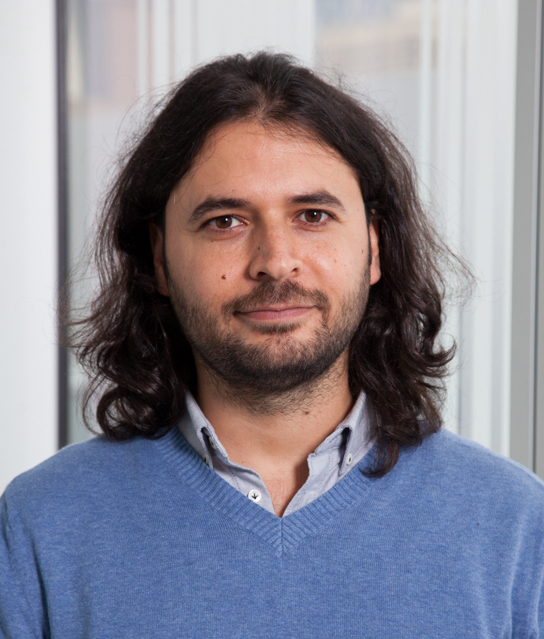
Samuel Svensson is an Adjunct Professor at Linköping University's Department of Physics, Chemistry and Biology (IFM). His research focuses on neurodegenerative diseases, advanced imaging techniques (PET/SPECT), and biomarker development. Key areas include tauopathies, Parkinsonian syndromes, and melanoma imaging. He collaborates internationally on radiotracer development and neuroimaging applications. Recent work includes groundbreaking studies on 4R-tauopathies and corticobasal syndrome diagnostics. He also contributed to UAV-based 3D terrain reconstruction research, showcasing interdisciplinary interests. Education details are not explicitly provided in available texts. His academic career includes sustained contributions to neuroscience and biomedical imaging from 2015 to present. Awards and grants remain unspecified in the provided information.
Joaquim Agullo Batlle is a Professor at the Universitat Politècnica de Catalunya (UPC), affiliated with the Department of Mechanical Engineering at the Barcelona School of Industrial Engineering (ETSEIB). His research focuses on musical acoustics, percussive dynamics, automatic guidance systems, and omnidirectional wheel design. He has authored numerous publications and collaborated on projects related to multibody dynamics, robotics, and vibration analysis. His academic career includes over 295 documented activities, spanning research articles, book chapters, and contributions to conferences. Notable works include studies on rigid body dynamics, impact scenarios in mechanical systems, and acoustic analysis of musical instruments. He has also contributed to educational materials, such as textbooks on mechanical engineering and vibration theory. Agullo Batlle’s research has addressed practical applications like robot calibration, mobile localization, and the design of orthotic devices for spinal injury patients. His work frequently intersects engineering mechanics with interdisciplinary fields like acoustics and mechatronics.
Roles and Affiliations: Distinguished Professor Saeid Nahavandi is the inaugural Associate Deputy Vice-Chancellor (Research) and Chief of Defence Innovation at Swinburne University of Technology. He leads defence innovation and research strategy, with a focus on autonomous systems, robotics, and AI. Previously, he served as Pro Vice-Chancellor (Defence Technologies) at Deakin University and founded its Institute for Intelligent Systems Research and Innovation. Research Focus: Specializes in robotics, haptics, autonomous systems, AI, and advanced modelling/simulation. His work bridges academia and industry, with collaborations spanning Airbus, Boeing, NASA, and NATO. He has secured over $150M in funding and established three tech startups. Key research areas include motion simulation, teleoperation systems, and defence technologies. Articles Overview: Over 1,300 publications span AI, robotics, and control engineering. Recent work emphasizes autonomous navigation reviews, uncertainty-aware AI, and motion cueing algorithms. His research addresses real-world applications like driver distraction detection and robotic ultrasound. Awards and Recognition: Recipient of the 2022 Clunies Ross Entrepreneur of the Year Award, 2021 Australian Space Awards Researcher of the Year, and multiple engineering excellence accolades. A Fellow of ATSE, IEEE, and other leading institutions. Grants & Industry Impact: Led ARC Training Centres for automated vehicles and energy storage. Notable grants include a $15M ARC Training Centre for Automated Vehicles in Rural/Remote Regions (2024–2029). Collaborates globally on defence, aerospace, and smart transportation projects. Labs & Teams: Heads Swinburne’s Defence Innovation Group and collaborates with Harvard University (as an Associate) and the University of Windsor (adjunct professor). Advises governments and industries on technology strategy and innovation.
Nico Bohlinger is a PhD researcher at TU Darmstadt specializing in Intelligent Autonomous Systems . He employs Deep Reinforcement Learning (DRL) for advanced robot locomotion across diverse morphologies. Current focus on multi-embodiment learning Developing neural architectures for scalable DRL Experienced in humanoid and quadrupedal robots (Unitree H1, A1, Go2) Research contributions include: Unified Robot Morphology Architecture (URMA) Zero-shot policy transfer between simulated and real-world environments Vertical ground perturbation analysis for locomotion robustness His 8 publications since 2022 demonstrate expertise in cross-morphology policy learning and morphology-aware value function scaling . Nico actively supervises master's theses and teaches Robot Learning courses while leading the RL-X research framework development.
Friedrich Fraundorfer is a Professor at Graz University of Technology, specializing in 3D Computer Vision and Autonomous Systems at the Institute of Computer Graphics and Vision (ICG). He has held academic positions at institutions including ETH Zurich, University of North Carolina at Chapel Hill, and Technische Universität München, where he served as Deputy Director of the Chair of Remote Sensing Technology. Research : Focuses on Micro Aerial Vehicle (MAV) autonomy, Visual-Inertial Fusion, and Multi-View Geometry. Projects : Led EU-funded SFly (autonomous MAVs for search-and-rescue), SNF MAV (camera-only 3D mapping), and VCharge (vision-based self-driving cars). Teaching : Offers courses like 'Camera Drones' and 'Mathematical Principles in Vision.' His Pixhawk project created open-source MAV platforms adopted globally. Key Collaborations : With NVIDIA, Volkswagen AG, University of Zurich, and German Space and Aerospace Center (DLR). His students (e.g., Dominik Hirner, Rafael Weilharter) have published on lightweight CNNs for stereo vision and self-supervised 3D reconstruction.
Sahar Abolhasani is a doctoral researcher at the Institute of Engineering Geodesy within the Faculty of Aerospace Engineering and Geodesy at the University of Stuttgart . Her work focuses on integrating computational design and robotics for advanced construction processes, particularly in the context of biomimetic structures and timber building automation. Role: Research Associate Cluster: Cluster of Excellence IntCDC Location: Geschwister-Scholl-Str. 24D, Stuttgart, Germany Contact: +49 711 685 4065 Her research explores the application of AI and sensor technologies (e.g., SLAM, point cloud analysis) to optimize real-time geodetic measurements and improve automation in construction workflows. Projects include the development of robotic systems for assembling high-payload timber components and integrating BIM models with feedback control mechanisms. Recent publications highlight advancements in point cloud datasets for biomimetic shell construction, SLAM-based geodetic measurement optimization, and semi-automated timber assembly processes. These works emphasize error compensation strategies, BIM-robotics integration, and the potential of mobile manipulators in construction.
Cédric Buche is a Professor at the National Engineering School of Brest (ENIB) in France and serves as the R&D Director at Naval Group Pacific in Australia. He holds honorary adjunct professorships at the University of Adelaide and Flinders University, contributing to international research collaborations through his work at CNRS's International Research Lab "CROSSING" in Australia. His research spans artificial intelligence, robotics, and virtual reality, with a focus on adaptive systems and human-robot interaction. He has led projects like RoboCup@Soccer and CHAMELEON2, integrating machine learning with real-world applications in navigation, perception, and decision-making. Buche teaches interactive machine learning at ENIB, emphasizing robot programming via hands-on projects using ROS 2. Students engage in coding exercises involving sensory-motor control, SLAM, and line-following algorithms, applying principles of PID control and computer vision with OpenCV.
Adam Leon Kleppe is an Associate Professor at the Norwegian University of Science and Technology (NTNU) , affiliated with the Department of ICT and Natural Sciences. He works extensively with MANULAB , focusing on robotic welding labs and Industry 4.0 labs , handling procurement, planning, installation, and maintenance. His research spans robotics, geometric algebra, point cloud processing, and automation technologies. Education : Master in Engineering Cybernetics with a specialization in robotics from NTNU (2013); Ph.D. (2018) on Point Cloud Registration for Assembly using Conformal Geometric Algebra. Research Interests revolve around robotics, including inverse kinematics, point cloud alignment, obstacle detection, and geometric algebra applications. He also explores automation in manufacturing and aquaculture, such as deformable body modeling for salmon equipment testing and machine vision for fish bin picking. Publication Trends show a consistent focus on geometric algebra-based solutions for robotic tasks, with recent work extending into biomechanical simulation and aquaculture automation. Teaching includes courses like Mechatronics and Systems Integration , Automation and Mechatronics , and Industrial Control Systems . He also contributes to outreach via program management for AI videos on platforms like YouTube and LinkedIn.
Djordje Obradovic is a researcher at Singidunum University with a focus on artificial intelligence, fuzzy logic, and geospatial analysis. He holds a Ph.D. in Electrical Engineering and Computer Science from the University of Novi Sad (2011). Education: B.Sc., M.Sc., Ph.D. in Electrical Engineering and Computing, University of Novi Sad (1992–2011) His research spans machine learning, neural networks, and fuzzy systems applied to diverse domains including medical imaging, environmental monitoring, and social media analysis. Recent publications highlight his work on air quality modeling and panoramic image processing in GIS applications. Key contributions include intelligent systems for scoliosis screening using low-cost sensors and innovative approaches to big data management through fuzzy sets and graph theory. He actively participates in international conferences like ICIST and Sinteza, often collaborating with multidisciplinary teams. At Singidunum University, Obradovic contributes to postgraduate studies while developing software architectures for geospatial data processing, educational technology, and inspection management systems. Notable projects include SCORM-compatible e-learning platforms, anthropomorphic gait simulation systems, and web-based tools for topographical symbol detection.
Armin Alaghi serves as a Research Scientist at Oculus Research (Redmond, WA) and holds an Affiliate Assistant Professor position at the University of Washington. His dual affiliation enables valuable knowledge transfer between cutting-edge industrial research and academic pursuits in computer systems engineering. Dr. Alaghi's research spans the intersection of embedded systems, digital circuits, and mathematics. His primary focus involves building low-power augmented reality (AR) and virtual reality (VR) systems while developing novel computation methods for unreliable beyond-CMOS technologies. His previous research contributions include significant work in stochastic computing (where he developed the STRAUSS synthesis methodology), reliable Network on chip (NoC) design, FPGA testing methodologies, NoC testing techniques, artificial neural networks implementations, asynchronous circuit design, and multi-valued logic systems. He has made his spectral-transform-based synthesis tool publicly available on GitHub, demonstrating commitment to open research. Analysis of Dr. Alaghi's publication record reveals a clear research trajectory from foundational circuit-level work toward practical applications in AR/VR systems. His publications from 2020-2025 demonstrate expertise spanning computer architecture, security for immersive technologies, neural network compression techniques, and homomorphic encryption methods. A recurring theme throughout his work is the exploration of quality-energy tradeoffs and error-resilient computing approaches, with increasing focus on security aspects of AR/VR systems in his most recent work. Dr. Alaghi maintains active connections with the broader research community, as evidenced by his Erdős number of 3 (Armin Alaghi John P. Hayes Frank Harary Paul Erdős) and his ongoing contributions to open-source research tools. His GitHub repository for stochastic computing synthesis shows community engagement with multiple contributors. At Oculus Research, Dr. Alaghi applies his theoretical expertise to practical challenges in next-generation AR/VR system development. His work bridges academic research with real-world product development, particularly in addressing energy efficiency challenges for wearable computing platforms through innovative circuit design approaches.
Robin Dietrich is a Researcher at the Department of Informatics 6 - Chair of Robotics, Artificial Intelligence and Real-time Systems at the Technical University of Munich . His work bridges computational neuroscience and robotics, focusing on translating neural mechanisms from mammalian brains into algorithms for mobile robot navigation. B.Sc. and M.Sc. in Computer Science Research on hippocampal temporal dynamics for neuromorphic SLAM Specializes in spiking neural networks for navigation and radar processing Research Interests : Robin's research explores the intersection of robotics, artificial intelligence, and computational neuroscience . His work specifically investigates spiking neural networks, FMCW radar data processing, and neuromorphic algorithms for autonomous systems. Recent projects focus on uncertainty quantification, evolutionary optimization, and multi-robot exploration using biologically inspired models. Publication Trends : Robin's publications (2019-2025) demonstrate a consistent focus on neuromorphic computing for robotic perception , with increasing specialization in spiking neural networks for radar processing and biologically inspired navigation algorithms . Key collaborations include contributions to multi-robot exploration metrics and hardware acceleration frameworks. Teaching Contributions : Robin has taught Digital Signal Processing and Real-Time Systems lectures since 2019, co-led seminars on Bio-inspired Data Processing , and supervised practical courses on Intelligent Mobile Robots using ROS.
Ömür Arslan is an assistant professor in the Department of Mechanical Engineering at the Eindhoven University of Technology (TU/e) , affiliated with the Robotics Group and the EAISI Mobility and EAISI High Tech Systems institutes. His research focuses on the algorithmic foundations of robotics, particularly safe adaptive motion planning algorithms for robots operating around humans. Education: PhD in Electrical and Systems Engineering (2016), University of Pennsylvania MSc in Electrical Engineering (2012), University of Pennsylvania MSc in Electrical & Electronics Engineering (2009), Bilkent University BSc in Electrical & Electronics Engineering (2007), Middle East Technical University His research interests span robotics, motion planning, control theory, sensor networks, dynamical systems, optimization, machine learning , and machine perception . Recent work includes safe unicycle control, probabilistically safe corridors, and statistical coverage control of mobile sensor networks. He has received nominations for best paper awards at ICRA 2018 and WAFR 2016 . Ömür has supervised student projects such as Hancheng Min's MSc thesis on statistical coverage control and Vincent Pacelli's work on local geometry in motion planning .
Wolfram Burgard is a Professor of Computer Science at the University of Freiburg (Germany) and Vice President for Automated Driving Technology at the Toyota Research Institute in Los Altos, USA. He leads the Autonomous Intelligent Systems research lab and has authored over 350 publications in robotics and artificial intelligence, including two seminal books: "Principles of Robot Motion – Theory, Algorithms, and Implementations" and "Probabilistic Robotics". Research focuses on robust and adaptive probabilistic techniques for robot navigation, control, localization, SLAM, and path-planning. Key affiliations: University of Freiburg, Toyota Research Institute, and Freiburg Institute for Advanced Studies (FRIAS). Scientific Recognition Fellowships: EurAI, AAAI, IEEE Academic memberships: German Academy of Sciences Leopoldina, Heidelberg Academy of Sciences and Humanities His work has significantly advanced autonomous systems and probabilistic robotics, shaping modern approaches to mobile robot state estimation and exploration.
Pascual Campoy Cervera is a Full Professor at the Universidad Politécnica de Madrid (UPM) and holds visiting professor positions at Delft University of Technology, Tongji University, and Queensland University of Technology. His work focuses on Control Systems , Machine Learning , and Computer Vision for Unmanned Aerial Vehicles (UAVs) . As Principal Investigator of the Computer Vision and Aerial Robotics group at UPM's Center for Automation and Robotics (CAR), he has led over 40 R&D projects with European, national, and industrial funding. Current affiliations: UPM, TU Delft, CAR-UPM Research themes: UAV autonomy, swarm robotics, embedded vision systems His research integrates cutting-edge technologies in image processing, control theory, and artificial intelligence to enhance UAV capabilities in unstructured environments. Recent projects include: Autonomous firefighting systems High-speed drone racing frameworks Swarm-based solar farm inspection Thrust vectoring for heavy UAVs Notable scientific awards include multiple international prizes at UAV competitions (IMAV12–17). His team has developed the Aerostack and Aerostack2 frameworks for aerial robotics, which address execution control, mission planning, and sensor fusion challenges.
Guillaume Bourmaud is an Associate Professor at the University of Bordeaux , affiliated with the Bordeaux Institute of Technology and the Signal and Image Processing department. He is a member of the MOTIVE research team within the IMS Bordeaux laboratory. Research Interests : His work focuses on Signal processing and image matching algorithms Computer vision and Transformer-based architectures Statistical learning for geospatial and atmospheric data SLAM (Simultaneous Localization and Mapping) with probabilistic models Publications Trends : Recent work spans computer vision (2024), geospatial navigation (2023), and atmospheric measurement techniques (2022), with emphasis on kriging, Gaussian processes, and feature correspondence evaluation.