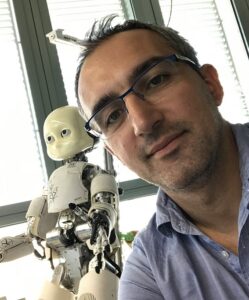
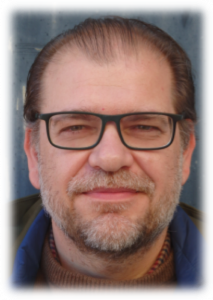
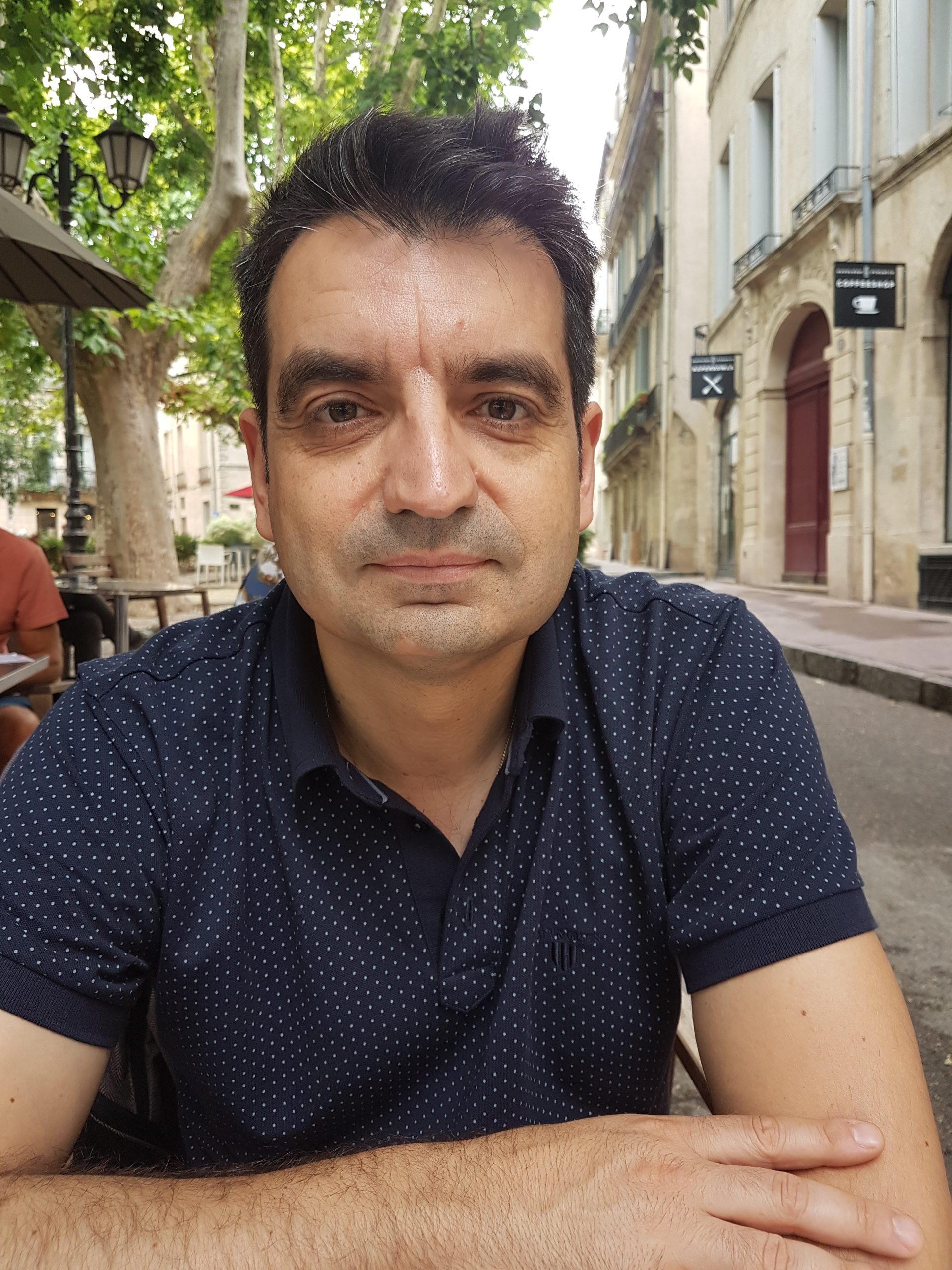
Amalia Foka is an Assistant Professor in Computer Science Applications for the Arts at the Department of Fine Arts & Art Sciences , School of Fine Arts , University of Ioannina , Greece. She has held academic positions at the University of Patras (2005-2013), University of Ioannina (2005-2008), and Computer Technology Institute & Press "Diophantus" (2014-2015). Her research bridges Artificial Intelligence with Digital Art , focusing on Generative AI , Social Media Mining , and Human-Computer Interaction within artistic contexts. Education: BEng in Computer Systems Engineering (1998) from the University of Manchester Institute of Science & Technology (UMIST) , UK MSc in Advanced Control (1999) from UMIST PhD in Robotics (2005) from the Department of Computer Science , University of Crete Her artistic research includes projects like Bushwalking (StyleGAN2 landscape generation), Breaking the Silence (NLP analysis of taboo topics), and The Invisible Structures of the Artworld (social media-driven network visualization). She leads the Multimedia Lab at the University of Ioannina, focusing on AI in Creative Processes and Digital Interaction methodologies.
Evangelos Boukas is an Assistant Professor at Aalborg University Copenhagen and a former PhD Candidate in Robotics Vision at the Democritus University of Thrace. He is affiliated with the Group of Robotics & Cognitive Systems (Gryphon Lab) and ESA's Automation and Robotics Laboratory (ESTEC). His research focuses on robotic vision, autonomous systems, and space exploration technologies. He has contributed to projects like SPARTAN and ESA-funded localization initiatives. Boukas has co-taught courses in Robotics, Mechantronics, and Robotics Vision, and co-supervised diploma theses in areas like 3D object recognition and robot navigation. His work employs open-source frameworks (ROS/ROCK) and tools like MATLAB. Education: PhD Candidate (2012-current): Robotics Vision, Democritus University of Thrace MSc (2010-2012): Electrical and Computer Engineering, Democritus University of Thrace Diploma (2005-2010): Production & Management Engineering, Democritus University of Thrace Research Highlights: Designed robots like the Heavy Duty Planetary Rover (HDRP) and MAGGIE, developed algorithms for planetary rover localization, and worked on ESA-funded projects. His interests include modular robotics systems and probabilistic approaches in autonomous systems. Labs/Teams: Gryphon Lab, ESA's Automation and Robotics Laboratory (ARL).
Emmanouil Z. Psarakis is an Associate Professor at the Department of Computer Engineering & Informatics , University of Patras, Greece. Born in 1963, he has been affiliated with the university since 2005 and is a member of the Signal Processing and Communications Lab . His academic journey includes teaching courses such as Signals and Systems Theory , Digital Signal Processing , and Computer Vision and Graphics . PhD in Computer Engineering and Informatics, University of Patras (1991) Dr. Psarakis is renowned for his research in image processing , computer vision , and signal processing , with applications in biomedical imaging , seismology , and robotics . His work spans deep learning , filter design , and 3D reconstruction , reflecting a multidisciplinary approach. His 15 most recent publications (2020–2025) focus on sign language recognition , adversarial defense , 3D shape analysis , and medical imaging . These works integrate machine learning , stochastic modeling , and computer vision to address challenges in video summarization , image inpainting , and seismic signal analysis . Dr. Psarakis has supervised over 10 PhD students , including Fotini Fotopoulou (2016–2019) and Panagiotis Georgantopoulos (2020–2023). He has participated in EU-funded , Hellenic , and bilateral R&D projects related to biomedical signal processing , robot vision , and forest fire monitoring . He leads the Signal Processing and Communications Lab , which collaborates with institutions like the Computer Technology Institute and international universities. His contributions include filter design , image alignment , and stereopsis techniques , with a focus on practical implementations in telecommunications and medical diagnostics .
Ioannis Andreadis is a Professor in the Department of Electrical and Computer Engineering at the School of Engineering, Democritus University of Thrace. He has been a faculty member since 1993, following his appointment as a Visiting Professor at the School of Technological Applications of TEI Kavala (1991-1992). His academic journey began with a Diploma in Electrical Engineering from Democritus University of Thrace (1983), followed by an M.Sc. in Electrical Engineering & Electronics (1985) and a Ph.D. in Instrumentation & Analytical Science (1989), both from the University of Manchester. Professor Andreadis's research spans the Design and Implementation of Electronic Systems with particular emphasis on Intelligent Systems and Machine Vision . His work has resulted in over 230 publications in international journals, book chapters, and conference proceedings. He has made significant contributions to image processing, particularly in mathematical morphology, color image processing, and real-time implementation of image processing algorithms. His research has practical applications in seismic signal processing, crowd management systems, and 3D reconstruction technologies. The analysis of his recent publications reveals a strong focus on advanced image processing techniques, with increasing integration of deep learning approaches. His work spans both theoretical foundations (such as entropy estimation and moment calculations) and practical applications (including image stabilization, multi-focus image fusion, and crowd management systems). The interdisciplinary nature of his research connects electrical engineering, computer vision, and signal processing with applications in safety engineering, structural analysis, and robotics. Among his notable achievements are the IET Image Processing Premium Award (2009) , Best Paper Award at PSVIT 2007 , and Best Paper Award at EUREKA 2009 . He was elected Fellow of the Institute of Engineering & Technology (IET) in 2006 and Fellow of the Institute of Measurement & Control (InstMC) in 2021. He has also served as Subject Editor of the IET Electronics Letters and as Guest Editor for special issues of Pattern Recognition journal. Professor Andreadis has supervised 14 PhD theses , 21 Master's theses , and 88 Diploma works , demonstrating his commitment to academic mentoring. His research has been supported by significant grants including the EDUnet project (€280,000), wireless network implementation (€37,000), laboratory infrastructure development (€120,000), school information systems support (€478,000), the RESCUER project (€350,000 as Deputy P.I.), and the EDUSAFE project (Marie Curie Actions). He leads the Electronics Laboratory at Democritus University of Thrace, which has undergone significant infrastructure development through multiple funding sources. His work on the RESCUER project demonstrates collaboration with European partners on emergency risk management systems, while his EDUSAFE involvement shows commitment to advanced AR/VR safety systems development. His research group applies computational intelligence techniques to diverse challenges from seismic analysis to pedestrian evacuation modeling.
Konstantinos G. Arvanitis is a Professor in the Department of Natural Resources Management & Agricultural Engineering at the Agricultural University of Athens, affiliated with the Agricultural Engineering Laboratory. He holds a PhD in Electrical and Computer Engineering from the National Technical University of Athens and has held diverse research and teaching roles across Greek institutions. Teaches courses on electrical engineering, sensors, automation, and AI in agriculture Supervised 2 PhD, 9 MSc theses, and guides 6 ongoing PhD projects Member of FEANI, EurAgEng, and IFAC Technical Committee (2000-2017) His research integrates IoT, machine learning, and cyber-physical systems into agricultural practices, focusing on precision agriculture and sustainability. He contributes to editorial boards of journals like Sensors and Energy , and has published over 342 technical works with significant citation metrics. His recent work explores quantum technologies, edge computing, and 3D printing in agricultural systems, emphasizing energy efficiency and educational innovation. He actively reviews for 130+ journals and conferences.
George Papadopoulos is an Assistant Professor in the Department of Informatics and Telematics at Harokopio University of Athens, Greece. His research focuses on computer graphics, computational vision, artificial intelligence, and machine/deep learning, with emphasis on self-supervised learning, visual captioning, and X-ray image analysis. He holds a Diploma and Ph.D. in electrical and computer engineering from Aristotle University of Thessaloniki (AUTH). Education: Diploma in Electrical and Computer Engineering (AUTH) Ph.D. in Electrical and Computer Engineering (AUTH) He has over 20 years of experience in EU-funded research projects, currently serving as Principal Investigator (PI) for projects such as Ceasefire (Technical Manager), ONELAB, KLEPTOTRACE, TRIFFID (Coordinator), GANNDALF, ARMADILLO, and TORNADO (Deputy Coordinator). No scientific awards explicitly mentioned in the text. His advisory roles and grants are tied to his EU project leadership and coordination roles. His work is centered around interdisciplinary teams collaborating on ICT, security, and robotics initiatives.
Dr. Eleftherios Doitsidis is an Associate Professor at the School of Production Engineering & Management of the Technical University of Crete (TUC) and a member of the Intelligent Systems & Robotics Laboratory. Previously, he served as faculty at the Department of Electronic Engineering at Hellenic Mediterranean University. His expertise spans multirobot systems, autonomous vehicle control, and computational intelligence. He holds a robust record of EU and national research project involvement. Research Interests: Specializes in multirobot team coordination, autonomous navigation systems for UAVs/AUVs, control systems design, and computational intelligence applications. Recent work focuses on energy-efficient path-planning for swarms, educational robotics frameworks like HYDRA, and digital twin integration in autonomous systems. Publications Trends: His 150+ publications address cutting-edge topics including: Autonomous vehicle control architectures Modular robotics for STEM education Optimization algorithms for multirobot systems Energy efficiency in manufacturing systems Advising & Projects: Lead researcher on numerous funded projects involving UAV/AUV missions, swarm robotics, and educational technology. Active in collaborative research with institutions like the University of South Florida. Labs & Groups: Leads the Intelligent Systems & Robotics Lab at TUC, developing advanced robotic platforms and educational tools. Maintains an open-access research portal at doitsidis.tuc.gr .
Lefteris Doitsidis is an Associate Professor at the School of Production Engineering and Management, Technical University of Crete. He holds a PhD in Production and Management Engineering from the same institution (2008), with prior academic positions at the Department of Electronics, Hellenic Mediterranean University. His professional journey includes visiting scholar roles at the University of South Florida, USA. Research focuses on robotic systems, including autonomous navigation of UAVs/AUVs, multirobot teams, computational intelligence, and educational robotics. He leads the Intelligent Systems and Robotics Laboratory, developing tools like HYDRA for STEM education and frameworks for industry 4.0 applications such as bin-picking and precision agriculture. His work integrates control systems optimization, energy efficiency in manufacturing, and digital twin technologies. Over 65 publications span journals, conferences, and books, emphasizing practical implementations like ROS-based autonomous vehicle testbeds and energy management systems for electric vehicles. Key contributions include UAV path planning algorithms, swarm robotics coordination, and sensor fusion techniques. Current research trends emphasize sustainability in manufacturing, educational robotics platforms, and autonomous systems validation through advanced algorithms like Deep Deterministic Policy Gradient.
Dr. Sotirios Kontogiannis is a Researcher and Director of the Distributed MicroComputer Systems Laboratory (MCSL) at the Department of Mathematics, University of Ioannina. He holds a PhD in Software Engineering from Democritus University of Thrace (2012), with a focus on load balancing algorithms for distributed systems. His career spans academic and private sector roles, including software development, research in FP7 projects, and technical leadership at TEKMON Geomatics. He currently teaches courses on Database Systems, Parallel Algorithms, and Educational Technologies at the University of Ioannina. Education: 5-year Engineering Diploma (DUTH, 2003), MSc in Microelectronics and Information Systems (DUTH, 2006), PhD in Load Balancing Algorithms (DUTH, 2012). Research Focus: Distributed systems, IoT protocols, sensor networks, big data, and smart agriculture technologies (e.g., beekeeping monitoring systems, wine fermentation frameworks). His work integrates IoT, AI, and edge computing to address challenges in agriculture, accessibility, and environmental monitoring. Notable inventions include patented smart beehive systems and tactile navigation tools for visually impaired individuals.
Kostas Vlachos is an Assistant Professor in the Department of Computer Science and Engineering at the University of Ioannina, Greece. He has been in this position since 2014, following prior teaching roles at the University of Thessaly (2007–2013). He is a member of the Information Processing and Analysis (I.P.AN.) research group and actively supervises PhD, MSc, and diploma students in robotics and control systems. PhD, School of Mechanical Engineering, National Technical University of Athens, 2004 MSc, Interdepartmental Postgraduate Program in Automation Systems, National Technical University of Athens, 2000 Diploma in Electrical Engineering, Technical University of Dresden, Germany, 1993 His research focuses on robotics and control, with emphasis on microrobotics , haptic mechanisms , medical simulators , and autonomous navigation . He has made significant contributions to over-actuated marine platforms, reinforcement learning for navigation, and tactile robotic systems. His work bridges mechanical engineering and computer science, particularly in intelligent robotic control. The 15 most recent publications highlight a strong trend in autonomous marine robotics , multi-agent reinforcement learning , and intelligent control systems . Key themes include energy-efficient control, obstacle avoidance, sensor fusion, and learning-based navigation. The research spans from theoretical control design to real-world implementation in unmanned surface vehicles and microrobots. Best Student Paper Award, 9th Hellenic Conference on AI (SETN 2016) Vlachos has supervised over 30 students at various levels and has participated in multiple national and European research projects in robotics and automatic control. His teaching includes courses such as Computational Mathematics, Robotics, and Robotic Systems. He collaborates extensively with researchers like E. Papadopoulos and K. Blekas. He leads research within the Information Processing and Analysis (I.P.AN.) group, focusing on intelligent perception and control of robotic systems. His lab works on mobile manipulators, haptic devices, mini-robots, and marine platforms, integrating simulation (ROS/Gazebo) with real-world experimentation.
Zervakis Michalis is a full Professor at the Technical University of Crete (TUC), serving as Rector and Director of the Digital Image and Signal Processing Laboratory (DISPLAY). He holds a Ph.D. in Electrical Engineering from the University of Toronto (1990) and has been a faculty member at TUC since 1995. His expertise spans Digital Image/Signal Processing, biomedical applications, and neural network implementations in automation. Education: Ph.D., Electrical Engineering, University of Toronto (1990) M.Sc., Electrical Engineering, University of Toronto (1985) B.Sc., Electrical Engineering, Aristotle University of Thessaloniki (1983) Research Interests: Signal/image processing for biomedical applications Machine learning for healthcare diagnostics EEG/ECG analysis and seizure detection Neural network architectures for automation Multi-sensor systems and aerial surveillance His research emphasizes clinical applications like epilepsy monitoring and cardiovascular diagnostics, leveraging deep learning and multimodal data fusion. He has led over 20 international projects and published >90 papers in image/signal processing. Current work focuses on AI-driven medical systems and UAV-based infrastructure monitoring. Labs/Teams: Director of the DISPLAY Lab, collaborating on projects like the BorderUAS semiautonomous surveillance platform and the Pulsense cardiovascular monitoring system. Grants/Contributions: Extensive involvement in EU-funded initiatives and industry partnerships, advancing smart farming, power line inspection, and emergency response systems.
Konstantinos A. Tsintotas is an Assistant Professor at the Department of Information and Electronic Engineering, International Hellenic University. His research focuses on artificial intelligence, robotics, computer vision, and their applications in smart cities, healthcare, and manufacturing. He is actively involved in advancing AI-driven systems for critical infrastructure management, robotic vision, and embedded device technologies. His work spans theoretical advancements and practical implementations, including projects like SLAM algorithms for autonomous navigation, deep learning models for medical diagnosis, and IoT-integrated smart supply chains. Tsintotas also explores ethical implications of AI in human action recognition and contributes to neuromorphic computing through spiking neural networks. Key technical contributions include ReJSHand (real-time hand pose estimation), fall detection systems for embedded devices, and visual place recognition frameworks. His interdisciplinary approach bridges computer science, electrical engineering, and biomedical applications, reflecting a strong commitment to innovation at the hardware-software interface. Notable trends in his publications emphasize AI ethics, multimodal perception for robotics, and low-power embedded solutions. Ongoing work includes advancing digital twin technologies for supply chains and refining bio-inspired neural architectures for robotics applications.
Konstantinos Blekas is a Professor at the Department of Computer Engineering and Informatics, University of Ioannina, Greece. He is affiliated with the Polytechnic School and teaches advanced courses such as 'Machine Learning' (MYE002) and 'Probability and Statistics' (MYY304). His research focuses on Machine Learning, Intelligent Agents, Computer Vision, and Bioinformatics, with particular expertise in Reinforcement Learning, Deep Learning, and their applications in autonomous systems, traffic management, and aerospace engineering. Education: Ph.D. in Electrical and Computer Engineering, National Technical University of Athens (1997) Diploma in Electrical Engineering, National Technical University of Athens (1993) Research Interests: Dr. Blekas explores cutting-edge topics in machine learning, including generative adversarial networks (GANs), multi-agent systems, and reinforcement learning for autonomous navigation. His work spans domains such as unmanned surface vehicles, air traffic management, and medical informatics. Notable contributions include advanced frameworks for flight trajectory modeling, urban traffic optimization, and brain functional network analysis. Awards and Recognition: While specific awards are not explicitly listed, his extensive publications and contributions to AI and robotics reflect significant academic impact. Advising and Grants: He supervises research in machine learning applications, though specific student names or grant details are not provided in the texts. His courses emphasize practical implementation, with resources available on e-learning platforms like e-course.uoi.gr. Labs and Teams: Engaged in collaborative projects involving robotics and AI, though no specific lab names are mentioned. His work integrates interdisciplinary approaches across computer science, engineering, and biomedical fields.
Foundation for research and technology-hellasGreece
Panos Trahanias is Professor and Vice Chair in the Department of Computer Science at the University of Crete, and heads the Computational Vision and Robotics Laboratory (CVRL) at Foundation for Research and Technology - Hellas (FORTH). His research bridges computational vision, robotics, and embedded systems, with specific focus on humanoid robot navigation, real-time SLAM implementations, and adaptive control systems. Recent investigations include developing climbing quadruped robots, robust grip-lifting mechanisms, and probabilistic contact estimation methods for dynamically challenging terrains. Medical applications feature prominently through neural network approaches for ventilator waveform analysis in critical care settings. Hardware innovation is demonstrated through FPGA-accelerated visual SLAM architectures and reconfigurable embedded systems designed for resource-constrained robotic platforms. His work consistently advances the integration of probabilistic methods, deep learning, and adaptive control in autonomous systems.
Spyros Fountas is a Professor of Precision Agriculture at the Agricultural University of Athens (AUA), affiliated with the School of Environment and Agricultural Engineering. As Editor-in-Chief of the journal Smart Agricultural Technology (2021–present) and former Editor-in-Chief of Computers and Electronics in Agriculture (2014–2021), he leads academic discourse in digital agriculture. He holds a Master's in Informatics from Cranfield University (UK) and a PhD in System Analysis in Precision Agriculture from the University of Copenhagen (Denmark), with visiting scholar experience at Purdue University (USA). Education MSc in Informatics, Cranfield University (1998) PhD in System Analysis in Precision Agriculture, University of Copenhagen (2004) His research spans Precision Agriculture , Agroecology , and Agricultural Robotics , focusing on UAVs, hyperspectral imaging, and AI-driven systems. He has coordinated 9 research projects, including 3 Horizon2020 initiatives, and participated in 28+ projects. His work addresses climate-smart practices, data privacy, and yield prediction through technologies like AutoML and remote sensing. Recent publications (2025–2024) highlight his expertise in Digital Agriculture and Environmental Sustainability , covering topics from drone-based spraying in viticulture to federated learning for data privacy. He has 82 journal publications, 250+ total papers, and 7800+ citations (Google Scholar, 2024). As head of the Smart Farming Technology Group (SFTGroup), he drives innovation in agricultural IoT and edge-AI systems. His projects include the OliveGROW information system for olive cultivation and contributions to EU Smart Villages initiatives.