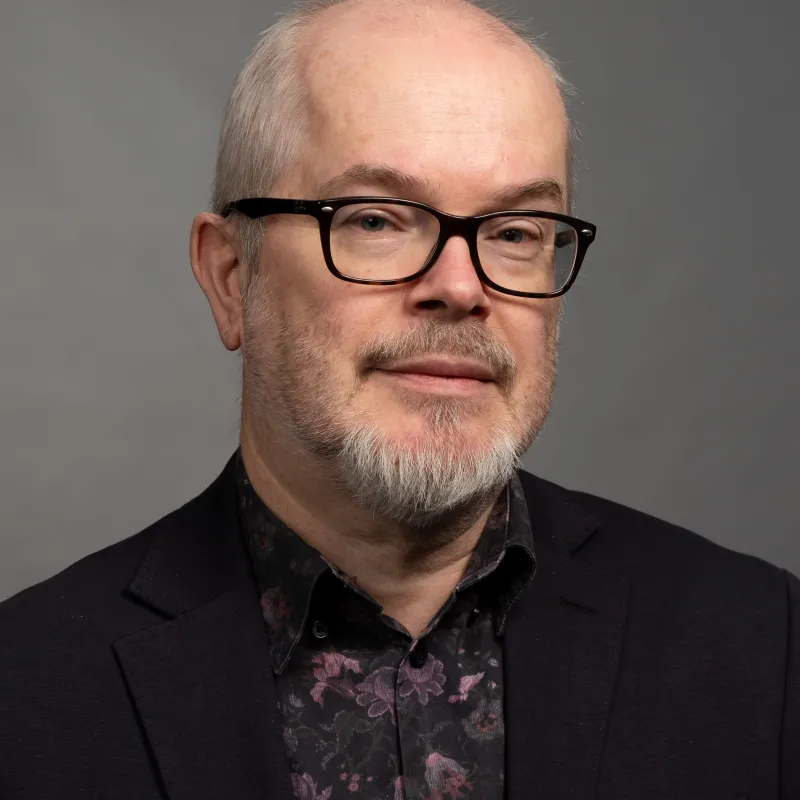
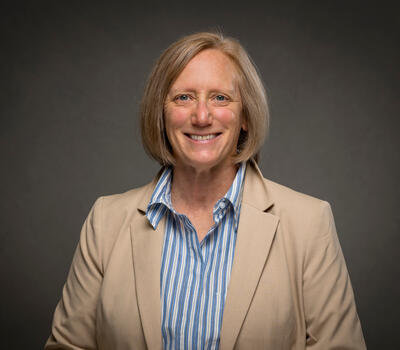
Christena Nippert-Eng is Professor of Informatics at Indiana University's Luddy School with adjunct appointment in Sociology. She directs the Animal Computer Interaction Track and researches cognition, privacy, ethnography, and human-animal interaction. Her work combines sociological frameworks with technology design. Nippert-Eng has authored influential books on boundary negotiation and ethnographic methods. Her current research examines privacy negotiations with domestic robots and human-animal-computer interaction. She has consulted for major technology companies including HP, Motorola, and Steelcase. Her publications demonstrate sustained interdisciplinary examination of privacy practices across contexts including homes, workplaces, online gaming, and social media, increasingly focusing on technology-mediated interactions and ethical considerations.
Dr. Bill Hamilton is an Assistant Professor in the Department of Computer Science at New Mexico State University. His research focuses on live media design, online communities, and digital game culture. He holds a Ph.D. in Human Computer Interaction from Texas A&M University (2018), and has collaborated with industry partners like Microsoft Research and Motorola Mobility. Education: Ph.D. in Human Computer Interaction, Texas A&M University (2018) Bachelor’s degree in Computer Science, Texas A&M University Research Interests: Bill explores how live media supports societal participation in education, politics, work, and play. His work employs qualitative methods like ethnographic inquiry to study collaborative digital environments. Recent projects include designing wearable interfaces for human-drone teams and analyzing YouTube’s content policies' impact on free speech. Awards: 2018 Texas A&M Distinguished Graduate Research Award 2016 Best Paper at ACM Interactive Experiences for TV/Online Video Advising & Grants: Mentors students like Preeti De Maurya and Cassandra Palmer, with a focus on inclusive education technologies and collaborative tools for emergency response. Active in conference organization including ACM CHI’s Games and Play Subcommittee (2019). Labs: His research is conducted through the PlexLab, exploring playful interactions and live media systems.
Heikki Handroos is a Full Professor of Mechanical Engineering at LUT University, leading the Laboratory of Intelligent Machines since 1993. He holds a DSc (Technology) from Tampere University of Technology and has served as Vice-Dean of the Faculty of Technology (2007-2009) and currently chairs the Collegiate Body of LUT University. His research focuses on mechatronics, robotics, control systems, and fluid power, with over 300 publications and 2,400+ citations. He has supervised 34 doctoral theses and 150+ MSc projects, managed R&D projects exceeding €20M, and co-founded four tech startups. His work spans industrial collaborations, digital twin applications, and innovative robotics for nuclear energy (e.g., DEMO reactor maintenance systems). He has held visiting professorships in the U.S., Japan, and Russia, and actively contributes to academic editorial roles and professional societies like ASME and IEEE.
Andres Kwasinski is a Professor in the Department of Computer Engineering at Rochester Institute of Technology (RIT), part of the Kate Gleason College of Engineering. He serves as Graduate Program Director for the Ph.D. in Electrical and Computer Engineering and M.Sc. in Computer Engineering. He co-directs the Networking and Information Processing (NetIP) Lab and holds editorial roles with IEEE publications, including Chief Editor of the IEEE Signal Processing Repository and Associate Editor of IEEE Signal Processing Magazine. Education: Ph.D. and M.Sc. in Electrical and Computer Engineering from the University of Maryland, College Park (2004 and 2000), and B.Sc. in Electrical Engineering from the Buenos Aires Institute of Technology (1992). Prior to RIT, he worked at Texas Instruments, Lucent Technologies, and the University of Maryland. Research Interests: Cognitive radios, machine learning for dynamic spectrum access, 5G/6G networks, VR communications, cross-layer resource allocation, smart infrastructures, and signal processing. His work emphasizes sustainable and resilient communication systems, integrating renewable energy and AI-driven solutions. Notable Contributions: Authored/co-authored books on cooperative communications and 3D visual communications. Over 70 peer-reviewed publications, including works on energy-efficient wireless networks, microgrid integration for base stations, and deep reinforcement learning in cognitive radio. His research is funded by the NSF, Harris Corporation, and the Air Force Research Laboratory. Grants & Awards: Supported by grants from NSF and industry partners. Recognized for contributions to IEEE standards and technical leadership in signal processing and communications. Labs & Teams: Co-director of the NetIP Lab, focusing on networking, signal processing, and smart infrastructure. Collaborates on interdisciplinary projects in robotics, warehouse automation, and 5G/B5G systems.
Lars Hanson is a Professor of Product Design Engineering at the University of Skövde's School of Engineering Science. His research focuses on ergonomics, digital human modeling, and optimizing manufacturing systems with a strong emphasis on human well-being and sustainable production. He leads projects like LITMUS (Industry 4.0 to 5.0 transition) and has contributed to developing tools such as IPS IMMA for ergonomic simulations. Active in virtual verification of human-robot collaboration and smart textile systems for workplace safety Published extensively in journals like International Journal of Human Factors Modelling and Simulation and IEEE Access Editor of conference proceedings and contributor to industry standards in automotive and healthcare sectors Research interests include multi-objective optimization of factory layouts, musculoskeletal risk assessment, and integrating ergonomic evaluations into product design processes. Current projects address Industry 5.0 sustainability challenges through digital twin technologies and smart manufacturing solutions.
Simon Yang is a Professor in the School of Engineering at the University of Guelph, part of the College of Engineering and Physical Sciences. His research focuses on artificial intelligence, robotics, sensors, control systems, and bio-inspired intelligence. He has contributed to advanced robotics applications, including mobile robot navigation, underwater vehicle control, and agricultural automation. Dr. Yang holds editorial roles for journals such as the International Journal of Robotics and Automation and IEEE Transactions on Cybernetics . His work bridges theoretical advancements with practical implementations in areas like sensor networks, machine learning, and multi-agent systems. Recent projects include developing robust control frameworks for autonomous systems, digital twin applications, and bio-inspired neural network algorithms. His research emphasizes real-world challenges in robotics, environmental monitoring, and precision agriculture, with a focus on integrating AI-driven solutions for enhanced decision-making and system reliability. Professional contributions include advisory roles in multiple journals and conference committees, reflecting his leadership in the field.
Alireza Ramezani is an Associate Professor of Electrical and Computer Engineering at Northeastern University, leading the SiliconSynapse Lab. He focuses on bio-inspired robotics, nonlinear systems, and robot locomotion, with a particular emphasis on morphological design and control inspired by biological systems. His work integrates control theory and experimental robotics to develop robots capable of navigating confined spaces, such as caves and ducts, using mechanisms derived from bat movements. Education : PhD, Mechanical Engineering, University of Michigan (2014) MS, Mechanical Engineering, ETH Zurich (2010) BSc, Mechanical Engineering, Iran University of Science and Technology (2007) Research Interests : Design of robots with non-traditional morphologies Nonlinear feedback control systems Legged and fluidic-based locomotion Bio-inspired robotics and biology-driven engineering Awards : 2024 ASME Rising Star Award 2024 NSF CAREER Award 2022 NASA Game Changing Program Award Science Magazine Top 5% Research Output (2020) Advising & Labs : Ramezani mentors students in projects like the NASA-funded “Crater Observing Bio-inspired Rolling Articulator” and oversees the SiliconSynapse Lab, which develops robots for space exploration and confined environments. Notable advisees include Henry Noyes, a NASA Space Technology Fellow. Labs/Teams : His lab collaborates with institutions like NASA’s Jet Propulsion Lab (JPL) on projects such as the Mars Multi-modal Morphing (M4) Rover and bio-inspired snake robots for lunar crater exploration.
Nils Wilde is an Assistant Professor in the Faculty of Computer Science at Dalhousie University, Halifax, Canada. He specializes in robotics, AI, and human-computer interaction, with a focus on cognitive robotics, multi-robot systems, and human-robot interaction. His research integrates planning, optimization, control, and machine learning to develop interactive and adaptive robotic systems. His educational background includes: BSc and MSc in Computer Science or related field from Technical University Berlin (2012, 2016) PhD in Electrical and Computer Engineering from the University of Waterloo (2016–2020), co-supervised by Dana Kulić and Stephen L. Smith Postdoctoral Fellow at TU Delft (2021–2024) in the Autonomous Multi-Robots Lab with Javier Alonso-Mora Postdoctoral Fellow at the University of Waterloo’s Autonomous Systems Lab (until August 2021) Nils Wilde's research centers on enabling robots to learn from human feedback and adapt to user preferences in dynamic environments. His work spans preference learning , multi-objective planning , motion planning , task assignment in multi-robot systems , and human-robot interaction . He develops algorithms that allow robotic systems to balance competing objectives such as efficiency, safety, and user comfort, particularly in service robotics applications like hospitals and industrial facilities. His recent publications (2020–2024) demonstrate a strong trajectory in top robotics venues (T-RO, RA-L, ICRA, IROS, CoRL, CDC, WAFR), with a focus on multi-objective optimization, dynamic vehicle routing, sensor scheduling, and learning user preferences. A key theme is improving the quality of service in robotic systems by optimizing metrics like waiting times, statistical distinctness of plans, and user satisfaction, often through novel cost functions and learning frameworks. Nils is actively building a new robotics lab at Dalhousie University, with funded PhD positions and an interdisciplinary research environment. He is involved in organizing academic workshops, such as the upcoming 2025 RSS workshop on Multi-Objective Optimization and Planning in Robotics. He mentors prospective students and encourages applications from diverse backgrounds.
Vidar Hepsø is a Professor at the Department of Computer Technology and Informatics, Faculty of Information Technology and Electrical Engineering, Norwegian University of Science and Technology (NTNU). His work bridges anthropology of science and technology with practical challenges in digitalization, energy transition, and remote operations. Research focuses on digital infrastructures, socio-technical systems, and human factors in oil and gas industries Active in NTNU Applied Information Technology and NTNU Energy Transition Initiative Publications emphasize open-source ecosystems, autonomous systems, and environmental monitoring His scholarly output spans computer-supported collaborative work, IT infrastructure governance, and risk-informed anomaly detection in subsea systems. He leads projects connecting digital innovation with offshore wind and petroleum geoscience.
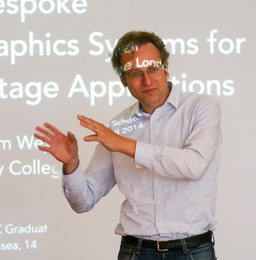
Tim Weyrich is Professor of Visual Computing (part-time) at University College London and Professor of Digital Reality at Friedrich-Alexander University Erlangen-Nürnberg. He leads the Digital Reality Lab and has affiliations with the Virtual Environments and Computer Graphics group at UCL, Eurographics, and the EPSRC Doctoral Training Centre (SEAHA). Previously, he held a Postdoctoral Teaching Fellowship at Princeton University. Research Interests: Content creation and computational photography Appearance modeling and fabrication Point-based graphics and cultural heritage analysis Digital humanities and 3D printing Article Trends: Recent work focuses on neural radiance fields (FruitNeRF++), 3D Gaussian splatting, mmWave radar inverse rendering, and texture anomaly detection. Applications span autonomous systems, cultural heritage, and medical imaging. Scientific Awards: Best Paper Honourable Mention (BMVC 2022) Best Student Paper Award (EG Workshop on GCH 2014) Honorable Mention (Eurographics 2011) Best Student Paper Honourable Mention (BMVC 2018) ACM SIGCHI Best Paper Honourable Mention (CHI 2013)
Lingxi Li is a Professor at the Elmore Family School of Electrical and Computer Engineering at Purdue University's Indianapolis campus. His research focuses on modeling complex systems, connected and automated vehicles, intelligent transportation systems, and parallel intelligence. He holds a Ph.D. from the University of Illinois at Urbana-Champaign (2008), and master's and bachelor's degrees from the Chinese Academy of Sciences (2003) and Tsinghua University (2000). Research Interests: Dr. Li's work bridges control systems, transportation engineering, and AI, with emphasis on human-machine interaction, autonomous vehicle systems, and scenario-based traffic modeling. His projects include developing frameworks for Industry 5.0 collaboration, enhancing traffic flow prediction through parallel learning, and advancing safety in micro-mobility systems like e-scooters. Recent Publications: Over 15+ articles (2023-2025) explore topics such as game-theoretic vehicle interaction modeling, vision-language systems for autonomous driving, and acoustic SLAM technologies. These studies reflect a focus on real-world validation and system integration in smart transportation. Labs & Initiatives: Leads research in autonomous mining systems and scenario engineering for intelligent vehicles, leveraging parallel intelligence concepts. Collaborates on projects like ParallelWorkforce (Industry 5.0 frameworks) and SceNDD++ (naturalistic driving datasets).
Stefan Riezler is a full professor of Statistical Natural Language Processing at Heidelberg University's Department of Computational Linguistics (since 2010), affiliated with the Faculty of Mathematics and Computer Science. Prior to this, he worked in Silicon Valley at Xerox PARC and Google Research. He holds a PhD in Computational Linguistics from the University of Tübingen (1998) and conducted postdoctoral research at Brown University (1999). His research spans machine learning, NLP, and medical informatics, focusing on interactive statistical learning. He co-leads the Interdisciplinary Center for Scientific Computing (IWR) and serves on the editorial boards of Computational Linguistics and Transactions of the Association for Computational Linguistics . Key research areas include neural machine translation, healthcare AI (e.g., sepsis prediction), data augmentation, and reproducibility in ML. He develops tools like JoeyNMT and explores ethical challenges in clinical machine learning. Notable recent work includes advancements in time series analysis, multimodal interfaces (e.g., NLMaps for OpenStreetMap), and ethical frameworks addressing validity in healthcare ML. His publications emphasize practical applications of NLP in healthcare, speech translation, and cross-lingual systems. Grants and collaborations include interdisciplinary projects on medical data science and training next-gen NLP researchers. He actively contributes to open-source toolkits and reproducible research practices.
Julie A. Adams is a Professor of Computer Science at Oregon State University's School of Electrical Engineering and Computer Science, with a courtesy appointment in Mechanical and Industrial Engineering. She serves as the CoRIS Associate Director for Research in the Collaborative Robotics and Intelligent Systems Institute. Her research focuses on human-machine teaming, unmanned systems, and swarm robotics, with over 25 years of experience in the field. Education: Ph.D., Computer and Information Systems, University of Pennsylvania (1995) M.S.E., Computer and Information Systems, University of Pennsylvania (1993) B.S., Computer Science & B.B.A., Accounting, Siena College (1989-1990) Research Interests: Human interaction with unmanned systems, swarm robotics, drone technology, and human-AI collaboration. Her work has been highlighted in National Geographic, Scientific American Podcast, and BBC Online. She leads the Human-Machine Teaming Laboratory and is the principal investigator for the FAA Center of Excellence (ASSURE). Awards: 2007 NSF CAREER Award, DARPA Computer Science Study Panel member, contributor to National Academies reports on UUVs and UAV countermeasures. Grants & Labs: Primary investigator for ASSURE (FAA-funded). Her lab explores adaptive systems for human-robot interaction, including swarm supervision and unmanned aerial system safety. Past industry roles include Honeywell and Eastman Kodak. Labs/Teams: Human-Machine Teaming Laboratory (founded at Vanderbilt University, relocated to Oregon State).
Wooram Park is an Associate Professor in the Department of Mechanical Engineering at the University of Texas at Dallas (UT Dallas), affiliated with the Erik Jonsson School of Engineering and Computer Science. He leads the Robotics and Intelligent Systems Laboratory (ROBINS Lab) and holds a PhD from Johns Hopkins University (2008), along with MS and BS degrees from Seoul National University (2003 and 1999). His research focuses on robotics, biomedical robotics, computational structural biology, and image processing. Key projects include flexible needle steering for medical applications, haptic feedback systems, and advanced algorithms for motion planning and image reconstruction. He has received notable awards such as the Creel Fellowship (2007) and Critics’ Choice Award in ArtBot Design (2004). His work spans theoretical contributions in stochastic systems and practical innovations like vibratory magnetic robots (Vimbot) and wearable haptic devices. The ROBINS Lab emphasizes interdisciplinary research at the intersection of mechanical engineering, computer science, and biomedical applications.
Waldemar Karwowski is a Pegasus Professor and Chairman of the Department of Industrial Engineering and Management Systems at the University of Central Florida, USA. He also serves as Executive Director of the Institute for Advanced Systems Engineering. His affiliations include the College of Engineering and Computer Science and multiple international academic roles. He holds a Doctor of Science (dr hab.) in Management Science from Poland, a Ph.D. in Industrial Engineering from Texas Tech University, and three honorary doctorates from universities in Ukraine, Slovakia, and Russia. His research focuses on neuroergonomics, human systems integration, safety engineering, nonlinear dynamics in human-machine systems, and applications of soft computing. He co-edits leading journals including Human Factors and Ergonomics in Manufacturing and Theoretical Issues in Ergonomics Science . Key achievements include Fellowships from HFES, IEA, and the UK's Institute of Ergonomics, and past presidencies of HFES (2007) and the International Ergonomics Association (2000-2003). His work addresses grand challenges in human factors, AI ethics, and healthcare safety culture. Recent research explores EEG-based neuroergonomic metrics, graph neural networks for brain connectivity analysis, and pandemic modeling with nonlinear dynamics. Awards include the Handbook of Human Factors and Ergonomics (5th ed., 2022) co-edited with Gavriel Salvendy. His advisory roles span industry and government, emphasizing systems engineering and human-centered AI integration.