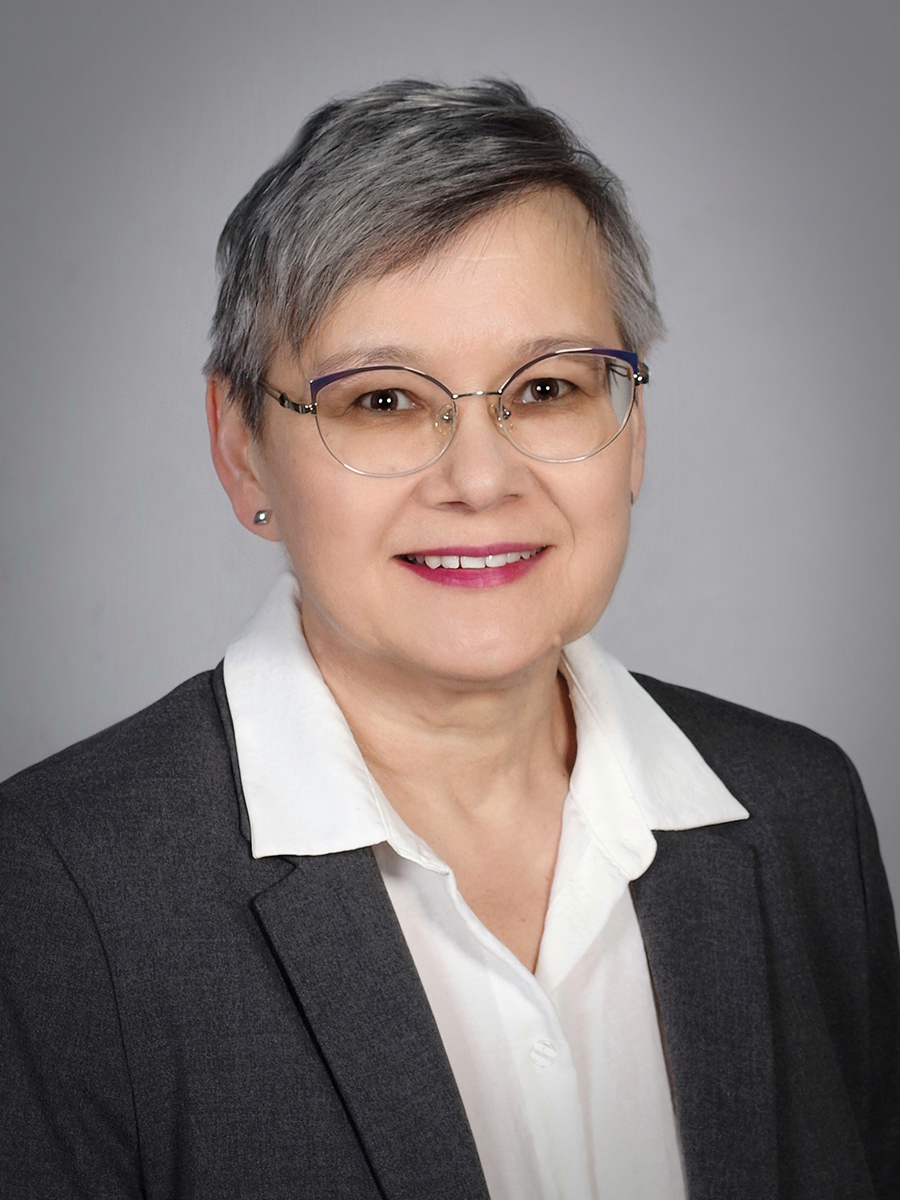
Monika Gabryś-Sławińska is a Professor at the Department of Polish Literary History , part of the Faculty of Languages, Literatures and Cultures at the University of Maria Curie-Skłodowska (UMCS). Her research spans 19th- and 20th-century Polish literature , focusing on Stefan Żeromski , historical journalism , text editing , voice emission , and museology . MA in Polish Philology (1998, UMCS) PhD in Literary Studies (2007, UMCS) Habilitation in Literary Studies (2016, UMCS) Her research interests include political commentary in historical press , media's role in cultural identity , and sociolinguistic trends . She has edited over 29 academic volumes and authored 5 monographs. Scientific awards: Bronze Cross of Merit KEN Medals (Bronze, Silver) 8 Rector's Awards (UMCS) Lublin Mayor's Medal (2019) She has participated in 5 research grants , organized 35 academic conferences , and contributed extensively to Annales UMCS as a scientific editor.
Joanna Grela is a Professor at the Department of Comparative Civilization Studies within the Faculty of Philosophy at Jagiellonian University (UJ) in Kraków, Poland. She holds habilitation in cultural studies (2016, SWPS University, Warsaw), a doctorate in religious studies (2004, Jagiellonian University), and is a certified Tibetologist (2000, INALCO, Paris). Her academic credentials also include an MA in philosophy (1996, Jagiellonian University) and postgraduate studies in gender (2009, Jagiellonian University). Her educational background includes: 2004: PhD in Humanities in religious studies, Jagiellonian University 2000: Diplôme Unilingue de Langue et Civilization Orientales de Tibétain, Institut National des Langues et Civilizations Orientales (INALCO), Paris 1996: Master of Philosophy, Jagiellonian University 2009: Postgraduate studies in gender, Jagiellonian University Professor Grela's research focuses on Tibetan, Himalayan, and Mongolian cultures, with particular emphasis on pre-Buddhist cults and their contemporary representations in popular culture, societal transformations, Tibetan ethnic and cultural identity, cultural stereotypes, and the comparative anthropology of Buddhism. Her work bridges religious studies, cultural anthropology, and Tibetan studies, examining both historical traditions and their modern adaptations. She has made significant contributions to understanding how traditional Buddhist practices interact with contemporary social contexts, digital technologies, and global cultural flows. Her scholarly output reveals consistent engagement with Tibetan religious culture, Buddhist textual traditions, and the adaptation of Buddhist practices in modern contexts. She has extensively explored the relationship between pre-Buddhist traditions and contemporary religious practices, the role of deities in Tibetan Buddhism, and the transformation of Buddhist thought in different cultural settings including Thailand and Poland. Her more recent work addresses how Buddhism is adapting to digital environments and contemporary social challenges. Her notable achievements include: 2017: Pro Arte Docendi Award from the Rector of Jagiellonian University Multiple teaching awards (2011/12, 2012/13, 2014/15) Membership in the International Association of Buddhist Universities (IABU) Collaboration with the Centre d'Etudes Himalayennes CNRS Professor Grela has led significant research projects including 'The impact of secularization and schooling on socio-religious relations between ritual specialists and the lay community in the Rebkong region' (2018-2020) and 'The Common Buddhist Text Project' (2009-2016). Her work demonstrates a strong commitment to both scholarly research and teaching excellence, with numerous publications spanning academic journals, edited volumes, and encyclopedia entries. She maintains active international collaboration and has presented her research at conferences across Europe and Asia.
Przemysław Kordos is a Professor at the University of Warsaw , affiliated with the Faculty of Liberal Arts , where he serves as Coordinator for the Development of the Modern Greek Philology Program . He holds two PhDs in Humanities (2007, 2019) and was awarded the Loukis Papaphilippou Seat of Advancement in Modern Greek scholarship. Education: MA in Ethnology and Cultural Anthropology (University of Warsaw, 2001) MS in Sociology (University of Warsaw, 2002) PhD in Humanities (University of Warsaw, 2007) Second PhD in Humanities (University of Warsaw, 2019) His research interests span: Contemporary Modern Greek and Cypriot literature Polish-Greek cultural relations (philhellenism) Social and ethnographic issues in Greece and Cyprus Travel literature analysis Fantasy literature's cultural implications His scientific work reveals a focus on linguistic assimilation in foreign language learning (via fMRI studies), historical parallels between Polish and Greek independence movements, and critical analyses of Cypriot folk culture's politicization. Key scientific awards include: Loukis Papaphilippou Seat (University of Warsaw) Internships at EKPA and IKY (Greece) Scholarships at IMXA (Greece) and MUNI (Czech Republic) His academic contributions include cataloging 60+ Polish travel accounts to Greece, analyzing the shift from travel literature to tourism discourse, and examining the Hellene-Romios dichotomy's role in modern Greek identity construction.
Dr. Monika Dacka is an Assistant Professor at the Department of Developmental Psychology, Faculty of Social Sciences, John Paul II Catholic University of Lublin. Her research focuses on personality development, procrastination behaviors, moral intelligence, and psychosocial challenges across life stages. Academic Rank: Assistant Professor Institution: John Paul II Catholic University of Lublin Key Research Areas: Developmental Psychology, Personality Psychology, Adolescent Risk Behaviors Her recent work examines time perception in digital contexts, the quarter-life crisis, and moral development in young adults. She actively reviews for journals like Annales Universitatis Mariae Curie-Skłodowska and Seminare. Poszukiwania naukowe . Dr. Dacka supervises master's theses on topics spanning adolescent procrastination, helicopter parenting, and social media challenges. She contributes to educational workshops on judicial mediation, forensic psychology, and pandemic-era coping strategies. Notable projects include the adaptation of the Developmental Crisis Questionnaire (DCQ-12) and participation in international conferences on Kazimierz Dąbrowski's psychological theories. Her publications address chronic fatigue in adolescents, sexual abuse prevention, and health behavior transformations.
Katarzyna Wrońska is a Professor at the Institute of Pedagogy, Jagiellonian University in Kraków , where she also serves as an Erasmus+ Programme Coordinator . Her academic work spans pedagogical theory, educational philosophy, and historical analyses of learning systems. She teaches courses including History of Pedagogical Thought and Practice , Philosophy of Education , and Contemporary Pedagogical Trends , primarily for graduate students. Her research focuses on intersections between liberalism and education, historical pedagogical models (notably John Locke's theories), Christian humanism in curriculum development, and ethical dimensions of self-instruction. She examines autonomy in universities, competition dynamics in learning environments, and civility as an absent pedagogical discourse. The 15 most recent publications reveal trends in three domains: (1) Liberal Educational Philosophy (2012-2024), analyzing autonomy, competition, and state roles; (2) Historical Pedagogy (2011-2021), particularly Polish Enlightenment-era reforms; and (3) Educational Ethics (2005-2023), covering Christian values, civil society, and moral instruction during authoritarian regimes. She supervises doctoral and master's students in pedagogy, though specific advisees aren't named. Consultations for students occur weekly at Batorego Street 12, room 15, during academic year 2024/25, with appointments required via email.
Rev. Dr. hab. Waldemar Żurek, Professor at the John Paul II Catholic University of Lublin, serves at the Center of Ecclesiastical Archives, Libraries and Museums (ABMK) within the Faculty of Theology. His academic career spans decades of dedicated research and publication in church history, particularly focusing on Eastern European Catholicism and the Salesian Order. As an active scholar, he continues to contribute significantly to ecclesiastical documentation and historical research. Professor Żurek's research interests center on ecclesiastical archives, parish documentation, and the history of religious orders, with particular emphasis on the Salesian Order's activities in Poland and Eastern Europe. His work explores the intersection of religious life with historical events, particularly during challenging periods like the communist era in Poland. He has developed expertise in analyzing parish inventories, visitation records, and chronicles to reconstruct religious life and administration across different historical periods. His extensive publication record demonstrates a consistent focus on documenting church history through meticulous examination of primary sources. The most recent works reveal trends toward comprehensive chronicles of religious institutions, detailed parish records analysis, and biographical studies of clergy members. His research spans multiple disciplines including religious studies, historical documentation, and Eastern European studies, with particular attention to regions like Pinsk, Lutsk, and Volhynia that have complex religious histories across changing political borders. Scientific Awards: Gold Medal for Long Service Professor Żurek has supervised numerous diploma theses including master's work on topics such as 'Social activities of Bishop Adolf Piotr Szelążek.' His editorial work includes significant publications like 'Kult Matki Bożej Ostrobramskiej w historii narodu polskiego' (The Cult of Our Lady of the Gate of Dawn in the History of the Polish Nation) and 'Ojciec Profesor Henryk Damian Wojtyska 1933-2009. Pasjonista, historyk Kościoła i dydaktyk' (Father Professor Henryk Damian Wojtyska 1933-2009. Passionist, Church Historian and Educator). He serves on the Scientific Council of the biannual journal 'Archives, Libraries and Church Museums' and is a member of the Theological Society of Józef Bilczewski in Ukraine. His work with the Center of Ecclesiastical Archives, Libraries and Museums represents a significant contribution to preserving and analyzing religious heritage. Through his leadership and scholarship, Professor Żurek has helped establish important methodologies for working with ecclesiastical documentation and has fostered international collaboration in church historical studies, particularly between Polish and Ukrainian scholars.
Dr. Grzegorz Kotłowski serves as an Assistant Professor at the University of Gdańsk's Faculty of Languages within the Institute of Classical and Slavonic Studies, Division of Classical Philology. He concurrently holds the significant administrative position of Deputy Dean for Students Affairs at the Faculty of Languages, demonstrating dual expertise in academic scholarship and institutional leadership. His research centers on Classical Philology with intense specialization in Latin epigraphy, particularly the documentation and analysis of Neo-Latin inscriptions in historical churches of Gdańsk (notably St. Mary's Church) and Warmia (Frombork Cathedral). Dr. Kotłowski's work bridges philological rigor with historical contextualization, examining epitaphs, sepulchral plates, and commemorative texts from the early modern period to reconstruct social hierarchies, religious practices, and cultural identities within Gdańsk's multicultural urban landscape. His methodological contributions extend to digital approaches in Neo-Latin studies, addressing data acquisition and dataset creation challenges. Recent publications (2020-2022) reveal a highly focused epigraphic output, with over twenty articles detailing specific monuments while collectively forming a comprehensive corpus of Gdańsk's Latin funerary heritage. His collaborative multi-volume series with Elżbieta Starek— Łacińskie inskrypcje w kościołach Gdańska (covering Mariacka Basilica, Śródmieście, and Oliwa) and Łacińskie inskrypcje w kościołach Warmii (Frombork)—establishes foundational references for regional epigraphic studies. No scientific awards are documented in available sources. Administrative responsibilities as Deputy Dean for Students Affairs indicate active engagement in academic governance, though specific advising roles or grant funding remain unreported in current materials. The absence of laboratory or team descriptions suggests individual or small-collaboration research models centered on archival and field-based epigraphy.
Dr. Bartosz Bojarczyk is a Lecturer at the Department of International Political Relations within the Faculty of Political Science and Journalism at Maria Curie-Skłodowska University (UMCS) in Lublin. He specializes in international relations with regional expertise in the Middle East, Central Asia, and Caucasus regions. Education: PhD in Political Science (UMCS, 2006) - Dissertation on Iran's international political adaptation MA in Contemporary Iranian Studies (School of International Relations, Tehran, 2003) MA in International Relations (UMCS, 2001) Research Focus: His work centers on geopolitical dynamics in transitional regions, particularly: International security frameworks and threat analysis Iranian foreign policy formulation and implementation Regional integration mechanisms in the Persian Gulf Terrorism as a transnational security challenge Energy security and nuclear policy intersections Publication Trends: Bojarczyk's scholarly output demonstrates consistent focus on evolving security architectures in post-Soviet spaces and the Middle East. His 15 most recent works (2007-2016) analyze power projection, regional organizations, and energy politics through geopolitical and institutional lenses, with particular emphasis on Iran's strategic positioning.
Jerzy Gorzelik is an Associate Professor at the Institute of Arts Studies within the Faculty of Humanities at the University of Silesia in Katowice. He holds a doctorate from the University of Wrocław and graduated from Jagiellonian University. His academic work centers on art history with a focus on Central European art, particularly in Upper Silesia from the 16th to the 20th centuries. His research explores the intersections of art, national and confessional identities, cultural heritage, and collective memory. He investigates how artistic expressions have been used in the discursive construction of imagined communities, especially in contested borderlands like Upper Silesia. His interests include wooden and industrial architecture, sacred art, museum practices, and the role of art in nationalist narratives. The recent publications highlight a consistent focus on heritage discourse, national identity formation, and the symbolic use of architecture and sculpture in Central Europe. His work analyzes how nationalisms—Polish, German, and Silesian—have instrumentalized art and heritage to legitimize political claims and shape regional identity. Themes such as the postcolonial critique of museum curation, the historiography of art history, and the interplay between Catholicism and nationalism recur across his scholarly output. Jerzy Gorzelik is actively engaged in public outreach, having conducted lectures, workshops, and educational projects on Silesian art history in collaboration with institutions such as the House of Polish-German Cooperation and the Foundation Dom Modernisty. He has also contributed to academic discourse through platforms like ResearchGate, Academia.edu, and Google Scholar, and maintains an ORCID profile (0000-0001-6405-9835).
Stanislaw Moniuszko Academy of Music in GdańskPoland
Sylwia Janiak-Kobylińska is a Polish conductor, educator, and artistic leader currently serving as the Dean of the Faculty of Conducting, Composition, and Music Theory at the Stanisław Moniuszko Academy of Music in Gdańsk. She is President of the SAJ Foundation Supporting Young Artists, founder of the Baltic Philharmonic Orchestra of the Youth, and an active participant in international music competitions and festivals. Her work spans symphonic and opera conducting, artistic direction of multidisciplinary projects, and pedagogical leadership. Her research interests focus on Orchestral Conducting Contemporary Music Interpretation Artistic Education for Youth Symphonic and Opera Collaboration Cultural Management in Music Interdisciplinary Art Projects Her recent artistic projects, such as the inUnity. Contemporary Music from Gdańsk album and the Homage to Szymborska concert series, highlight collaborations between classical and jazz composers, youth orchestras, and interdisciplinary teams. These works emphasize themes of unity, cultural heritage, and innovation in music education. Scientific awards and recognitions include Meritorious for Polish Culture badge (2023) Antoni Wit Award at the G. Fitelberg Conducting Competition Multiple Rector’s Awards at the Academy of Music in Gdańsk Pomeranian Artistic Award in 'Artistic Hope' category As an educator, she leads orchestral workshops, mentors students across multiple faculties, and pioneered the 4C’s in Music Art program (Creativity, Collaboration, Critical Thinking, Communication). Her leadership in the SAJ Foundation and Baltic Philharmonic Orchestra of the Youth has fostered over 1000 young musicians since 2011.
Grazyna and Kiejstut Bacewicz Academy of Music in ŁódźPoland
Ewa Kowalska-Zając is a Professor of Musical Arts at the Academy of Music in Łódź, where she has been employed since 1989. She served as Dean of the Faculty of Composition, Music Theory, Conducting, Rhythmics, and Music Education from 2008 to 2016 and has been Head of the Department of Music Theory since 2018. A graduate of the Academy of Music in Łódź, her work focuses on avant-garde composition, string quartets, and the intersection of music and visual art. Education: Diploma in Music Theory and Composition from the Academy of Music in Łódź. Her research explores the evolution of Polish composers' approaches to genres like the string quartet, sacred music, and sonorism, with a particular emphasis on avant-garde experimentation and intermedia tendencies. She has authored several books, including Seeing Music. Notation of the Polish Contemporary Score (2019), and over 50 biographical entries in collective monographs. Her publications analyze themes such as musical archetypes, postmodern reinterpretations of traditional forms, and the impact of intermedia practices in 20th-century scores. Notable works include studies on Olivier Messiaen, Paweł Klecki, and Bogusław Schaeffer. Scientific Awards Silver Cross of Merit (2002) Gold Cross of Merit (2022) Kowalska-Zając is a member of the Polish Composers' Union and the Polish Music Society, contributing extensively to musicological discourse through her academic leadership and editorial work.
Gabriela Jarzębowska-Lipińska is an Assistant Professor at the School of Liberal Arts, University of Warsaw, specializing in Critical Animal Studies and Environmental Humanities. Her work examines interspecies relations through historical, cultural, and sociological lenses. Education: PhD in Cultural and Religious Studies (2020, University of Warsaw) International Experience: Fulbright Junior Fellow (2018–2019), visiting scholar at Linköping University (2016) and UC Santa Cruz (2019) Research focuses on animal representation in culture, environmental conflict rhetoric, and modernity's impact on human-animal relations. She explores topics like rat extermination as cultural practice, interspecies ethics in state socialism, and posthumanist collectives. Her recent publications address factory farming as capitalist imagination failure, animal biographies, and urban rodent media narratives. Key scientific contributions include the concept of "species cleansing" and critical analysis of sanitary discourse in totalitarian regimes. She advocates for animal welfare frameworks that challenge anthropocentric policies.
Rev. Dr. hab. Antoni Nadbrzeżny serves as Professor at John Paul II Catholic University of Lublin (KUL) within the Faculty of Theology, specifically in the Department of Pneumatology, Ecclesiology and Mariology. His scholarly work centers on advanced theological research with particular emphasis on Mariology, Ecclesiology, and the theological contributions of Edward Schillebeeckx. Nadbrzeżny's research interests demonstrate deep engagement with contemporary theological challenges. His work explores dialogical ecclesiology as a response to Vatican II, examining how the Church can navigate modern secular contexts while maintaining theological integrity. Significant focus is given to Schillebeeckx's hermeneutic theology, Mariological developments from 'Mother of Redemption' to 'Mother of All Believers,' and the existential dimensions of faith in contemporary culture. His publications consistently address the intersection of personalist anthropology with soteriology and pneumatology. His recent scholarly output reveals a clear trajectory toward dialogical theology that bridges historical tradition and contemporary challenges. The 2025 monograph on Schillebeeckx's Mariology represents culmination of decades examining pneumatological and ecclesiological themes through phenomenological lenses. Articles consistently explore tension points between faith and modernity, particularly regarding religious freedom, anthropological concepts, and the Church's role as sacrament of dialogue. Bronze Medal for Long Service (2016) Rector's Award of KUL (4th degree team award, 2011) Rector's Award of KUL (3rd degree team award, 2006) Nadbrzeżny actively supervises doctoral candidates at KUL's Doctoral School since 2019 and serves as Consultant and Secretary of the Polish Episcopal Conference's Faith Science Commission. His current research includes the Ministry of Education-funded project 'The Church as a Space for Dialogue: The Second Vatican Council Reread.' He regularly presents to clergy formations, including the Sandomierz Diocese's ongoing program, and contributes to international theological discourse through publications and conferences.
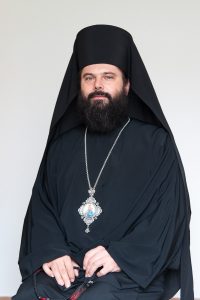
His Excellency Bishop Andrzej Borkowski (born 1974) is a Polish Orthodox hierarch, theologian, and historian. He serves as Bishop of Supraśl and Vicar of the Białystok-Gdańsk Diocese since 2017. Since 2012, he has been an Assistant Professor at the Department of Orthodox Theology, University of Białystok, where he teaches courses on Byzantine civilization, monasticism, and liturgical history. Education: Habilitacja (2017), University of Białystok PhD in Theological Sciences (2009), University of Athens Master of Theology (2005, University of Athens; 2001, Christian Theological Academy in Warsaw) Greek language studies (2001-2002), University of Athens Research Interests: Specializes in the history of Eastern patriarchates in post-Byzantine Poland-Lithuania, Orthodox autocephaly movements (1919-1927), Union of Brest controversies, monasticism, canon law, and Byzantine-Balkan cultural influences in Poland. His work examines liturgical reforms, interfaith dialogues, and diplomatic exchanges between Orthodox churches and European powers. Academic Contributions: Authored three monographs and over 40 articles on Orthodox Church-state relations, including Patriarchaty Wschodu w dziejach Rzeczypospolitej (2014) and Między Konstantynopolem a Moskwą (2015). His research spans 16th-20th century Orthodox history in Poland, Ukraine, and the Balkans. Scientific Awards: Rektor's Award (2013), University of Białystok Leadership Roles: Promotes Orthodox theological education through international conferences, expert teams for heritage restoration, and supervision of theological licentiate theses. Currently chairs expert commissions for monastery renovations and participates in Pan-Orthodox Council initiatives.
Stanislaw Moniuszko Academy of Music in GdańskPoland
Sławomir Bronk is a Professor at the Stanisław Moniuszko Academy of Music in Gdańsk, specializing in choral conducting, church music, and early music performance. He holds a doctorate from the Academy of Music in Kraków (2011) and a postdoctoral degree from Gdańsk (2019). He founded the Discantus Chamber Choir (2006), which has achieved international acclaim, and directs the Schola Cantorum ensemble at his institution. His research focuses on Kashubian folklore, Gregorian chant semiology (studied in Italy), and early music interpretation. Notable achievements include winning the Gregorian chant category at the 65th Concorso Polifonico Guido d'Arezzo and the Malta International Choir Festival (2017). He has premiered works such as Anna Rocławska-Musiałczyk's Kashubian Stabat Mater and performed in major festivals like the International Bach Festival in Świdnica. As a countertenor, he specializes in Baroque oratorios with ensembles like the Wrocław Baroque Orchestra and the Early Music Ensemble Diletto. His compositions often blend traditional Kashubian texts with contemporary choral techniques.