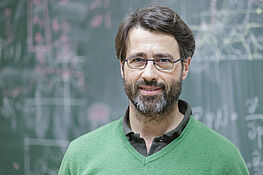
Maurits Haverkort is a Professor at the Institute for Theoretical Physics, Heidelberg University (Germany). His research focuses on quantum many-body systems , strongly correlated electrons , and X-ray spectroscopy of complex materials under strong fields. University of Cologne (PhD in Physics, 2005) University of Groningen (M.Sc. in Physics, 2002) Research Interests : He investigates orbital and magnetic properties in heavy fermion systems , actinide materials , and correlated oxides using resonant inelastic X-ray scattering (RIXS) , ARPES , and computational tools like Quanty . His work spans crystal field theory , spin-orbit coupling , and ultrafast electron dynamics . Scientific Awards & Activities : 2018 – Editorial Board Member, Physical Review Letters 2017 – Beam Time Allocation Panel, ESRF Grenoble 2016–2018 – Swedish Research Council Panel NT-4 2012–2016 – Scientific Selection Panel, Helmholtz-Zentrum Berlin Recent Publications highlight 5f electron counting , photon-modulated bonding , and precision neutrino mass experiments , reflecting his expertise in quantum materials and advanced spectroscopy .
David Del Rey Fernandez is an Assistant Professor in the Department of Applied Mathematics at the University of Waterloo. He holds the Pratt & Whitney Canada Research Chair in Industrial Artificial Intelligence, serves as Associate Director of the Waterloo Institute for Sustainable Aeronautics, and is a Research Cluster Lead (Modelling) for the Future Cities Institute. He also acts as Graduate Officer for the Computational Mathematics Program. Education: PhD from University of Toronto Institute for Aerospace Studies Postdoctoral fellowship at NASA Langley Research Center Research interests focus on numerical methods for partial differential equations, including: Machine learning integration for simulations Quantum numerical methods Summation-by-parts and finite-element/discontinuous Galerkin/flux reconstruction methods Efficient computation technologies like mesh adaptation Awards & Recognition Canadian Applied and Industrial Mathematics Society Early Career Award (2024)
Jonathan Voersaa Wenshøj is an academic researcher at the Department of Computer Science, University of Copenhagen. He contributes to the Machine Learning section's activities spanning theoretical foundations and applications in diverse domains like information retrieval, medical data analysis, remote sensing, sustainability, and biological modeling. The section participates in the SCIENCE AI Centre and collaborates with initiatives like TreeSense for global tree resource analysis. His research intersects machine learning with quantum computing, medical informatics, and sustainability. Recent publications highlight applications in environmental monitoring, healthcare diagnostics, and energy-efficient AI systems. The department provides advanced compute resources including a powerful cluster for intensive machine learning tasks. This researcher's work appears in diverse machine learning domains, with recent publications addressing quantum-inspired architectures, explainable AI in medical imaging, and sustainable computing practices. The section actively hosts events including seminars, conferences, and PhD defences related to machine learning advancements.
Sophia Natasha Wilson is a Research Fellow in the Department of Computer Science (DIKU) at the University of Copenhagen, specializing in machine learning applications across interdisciplinary domains. She is affiliated with the SCIENCE AI Centre and holds a cross-departmental position at the Niels Bohr Institute . Her research bridges theoretical machine learning with practical implementations in healthcare, quantum computing, and environmental sustainability. University of Copenhagen Department of Computer Science (DIKU) Niels Bohr Institute SCIENCE AI Centre Her research focuses include: Quantum-enhanced machine learning algorithms Explainable AI for healthcare applications Environmental sustainability in computing Emotion-aware language models Quantum computing hardware optimization Public health risk modeling Her recent publications demonstrate cross-disciplinary work in quantum machine learning (hybrid optical processors, qubit stabilization), health informatics (hypothyroidism analysis, nursing values evaluation), and ethical AI (sustainable AI, fairness in recommender systems). Technical work also appears in non-Euclidean generative models and real-time adaptive systems . Current projects include quantum dot array simulation (QDarts platform) and federated learning for personalized medicine . She contributes to the TreeSense center for remote sensing of global tree resources and works on climate-aware AI frameworks.
Christoph Dellago is a full Professor of Computational Physics at the Faculty of Physics of the University of Vienna, where he has been a faculty member since 2003. He currently serves as Director of the Erwin Schrödinger Institute for Mathematics and Physics, Head of the Computational and Soft Matter Physics Group, and Project lead of EuroCC Austria - National Competence Centre for Supercomputing. Previously, he served as Dean of the Faculty of Physics (2009-2012) and Coordinator of the Doctoral College Advanced Functional Materials (DCAFM). Full Professor, Faculty of Physics, University of Vienna (2003-present) Director, Erwin Schrödinger Institute for Mathematics and Physics (2017-present) Head, Computational Physics and Soft Matter Group (2024-present) Coordinator, Doctoral College Advanced Functional Materials (DCAFM) Austrian Representative, Council of CECAM Dellago received his PhD in Physics from the University of Vienna in 1996, followed by postdoctoral research at UC Berkeley as a Schrödinger Fellow of the Austrian Science Foundation. His research focuses on developing computational methods to study rare events in condensed matter systems, particularly transition path sampling methodology for simulating nucleation, chemical reactions, and biomolecular reorganizations. He has pioneered the application of machine learning to molecular structure recognition and potential energy surfaces. Recent work examines self-assembly of nanocrystals, biopolymer folding, aqueous interfaces, phase separation in alloys, thermo-polarization, cavitation, and freezing phenomena. Analysis of Dellago's recent publications (2023-2025) reveals a strong emphasis on machine learning applications in computational physics, particularly neural network potentials for simulating water interfaces, crystal defects, and phase transitions. His work bridges traditional statistical mechanics with modern computational techniques, creating powerful tools for studying complex dynamical processes that occur on timescales far beyond conventional molecular dynamics simulations. The publications demonstrate increasing integration of machine learning with rare event sampling methods, reflecting the cutting-edge direction of computational statistical mechanics. Förderpreis der Stiftung Futura zur Förderung junger Südtiroler im Ausland (1997) The Raymond and Beverly Sackler Prize in the Physical Sciences (2005) UNIVIE Teaching Award of the University of Vienna (2014) Dellago leads an active research group with multiple PhD students and postdocs, focusing on computational statistical mechanics. His group develops trajectory-based sampling methods and machine learning approaches for molecular simulation. He has secured significant funding through EuroCC Austria and various research platforms including the Research Platform Accelerating Photoreaction Discovery and the Research Platform Erwin Schrödinger International Institute for Mathematics and Physics. His research has been supported by numerous grants enabling advanced computational infrastructure for high-performance simulations. The Dellago Group operates within the Computational and Soft Matter Physics division at the University of Vienna, with strong connections to the Research Network Data Science. The group collaborates extensively with international research institutions and maintains close ties with the Erwin Schrödinger Institute, which Dellago directs. Their research environment combines theoretical physics, computational chemistry, and machine learning expertise to tackle fundamental questions in condensed matter physics and soft matter systems.
Nicole L. Beebe is a Professor at the Alvarez College of Business, The University of Texas at San Antonio , specializing in cybersecurity, cyber analytics, and digital forensics. With over two decades of experience spanning academia, government, and industry, she has contributed extensively to research on insider threats, IoT security, and threat hunting. Ph.D. in Business Administration (Information Technology), UTSA MS in Criminal Justice, Georgia State University BS in Electrical Engineering, Michigan Technological University Her research explores cybersecurity challenges in emerging technologies, including quantum computing, IoT, and large language models. She has pioneered studies on cyberbullying dynamics, forensic automation, and AI-driven threat detection. Recent publications focus on adversarial image obfuscation , VR for security operations , IoT forensic methodologies , and deepfake detection frameworks , reflecting interdisciplinary work at the intersection of security, AI, and digital evidence. 2022 Best Paper Award, Journal of Network & Computer Applications Senior Member, IEEE and ACM Senior Fellow, Information Systems Security Association As an Associate Editor for Computers & Security , she shapes the field through peer review. Her $14M+ in funding from NSF, DHS, and DoD underscores her impact on advancing cybersecurity research and education.
Philip Johnson is a Professor and Chair of the Department of Physics at American University (AU), where he has been since 2006. He also serves as Director of the Integrated Space Science and Technology Institute (ISSTI), supporting over 20 AU faculty and external partners like NASA's Goddard Space Flight Center. His research focuses on quantum computing, superconducting qubits, ultracold atoms, and effective interactions in few-body systems. He holds a PhD in Theoretical Physics from the University of Maryland and completed postdoctoral work at NIST and the University of Maryland's superconducting quantum computing group. His academic leadership roles include Associate Dean of Research for AU's College of Arts and Sciences and service on the American Physical Society's council. His research explores quantum control, nonequilibrium dynamics, and applications in quantum sensing and metrology. Key areas include ultracold bosons in optical lattices, nonlocal interactions, and hybrid machine learning approaches for quantum systems. He collaborates with institutions like the Joint Quantum Institute and Johns Hopkins Applied Physics Laboratory. Johnson's recent work advances theoretical frameworks for few-atom systems and superconducting qubits, with publications addressing topics like topological properties of interactions and correlations in quantum systems. His contributions span experimental and theoretical physics, emphasizing interdisciplinary applications in space science and technology through ISSTI.
Michael DeWeese is an Associate Professor of Physics and Neuroscience at the University of California, Berkeley. His research spans nonequilibrium statistical mechanics, machine learning theory, and systems neuroscience. He holds a BA in Physics from UC Santa Cruz (1988) and a PhD in Physics from Princeton (1995). Before joining UC Berkeley in 2007, he held postdoctoral positions at the Salk Institute and Cold Spring Harbor Laboratory. His work integrates principles from physics, neuroscience, and machine learning to address fundamental questions in theoretical and experimental biology, computation, and statistical mechanics. DeWeese Lab Website provides further details on ongoing projects and collaborations. Education: BA in Physics, UC Santa Cruz (1988) PhD in Physics, Princeton University (1995) Research Interests: Nonequilibrium Statistical Mechanics: Focuses on thermodynamic optimization, active matter, and non-equilibrium processes. Machine Learning Theory: Develops first-principles models to explain neural network performance and efficient algorithms for probabilistic models. Systems Neuroscience: Uses biologically inspired models to understand neural coding, sensory processing, and computational roles of neural networks. Advising & Grants: While no formal student advisees are listed, his lab actively collaborates across disciplines. Funding sources are not explicitly mentioned but likely involve NSF, NIH, or DOE grants based on research themes. His work on quantum control and neural networks suggests potential ties to interdisciplinary funding initiatives. Labs & Teams: Directs the DeWeese Lab, which bridges physics, neuroscience, and machine learning. Collaborations include institutions like the Helen Wills Neuroscience Institute (UC Berkeley).
Fernando Manuel da Silva Nogueira is an Associate Professor at the Department of Physics, Faculty of Sciences and Technology, University of Coimbra. He holds a PhD in Theoretical Physics from the same institution (1999) and has been a faculty member since 1990. His research focuses on materials discovery using ab-initio methods , computational physics, and development of scientific software tools like Octopus and APE . He leads the Condensed Matter Physics group at CFisUC (Centro de Física da Universidade de Coimbra) and has been Director of the Portuguese Physics Olympiad (2007-2018). Education: PhD in Theoretical Physics (1999), University of Coimbra MSc in Theoretical Physics (1993), University of Coimbra BSc in Physics (1990), University of Coimbra Research interests include computational materials science , nonlinear optics , density functional theory , and electronic structure calculations . He has authored 40+ peer-reviewed articles, 3 books, and directed over 25 research projects. His work spans topics like carbon nanotube properties, firefly bioluminescence mechanisms, and high-throughput materials discovery. He has organized 25+ conferences, advised 3 PhD students and 17 MSc students, and contributed extensively to open-source computational physics software. His ORCID is 0000-0003-3125-3660 .
Dr. Weilu Gao is an Assistant Professor in the Department of Electrical & Computer Engineering at the University of Utah. He holds a B.S. from Shanghai Jiao Tong University (2011) and a Ph.D. from Rice University (2016), followed by postdoctoral research there until 2019. Before joining Utah, he worked as a Photonics Designer at Lightmatter Inc. (2019–2020). His research focuses on photonics/optoelectronics of nanomaterials, including carbon nanotubes and 2D materials, with applications in computing, sensing, and energy. He has over 90 publications and 5,800+ citations. Research interests include reconfigurable photonics for machine learning, chiral photonic materials, and scientific computing using optical neural networks. Key projects involve developing diffractive optical neural networks (DONNs) for PDE-solving and energy-efficient computing, programmable chiral heterostructures, and wafer-scale aligned carbon nanotube architectures. His work bridges nanomaterial science with optical engineering, emphasizing scalable fabrication and cross-disciplinary applications. Notable achievements include publishing in Nature Communications , Advanced Photonics Research , and ACS Photonics . He leads the Weilu Gao Lab, which actively collaborates on NSF-funded projects (e.g., 2022 NSF award for carbon nanotube-based semiconductors). Professional activities include organizing workshops on chiral photonics and presenting at conferences like ECS Meetings. Grants include NSF funding for semiconductor research and collaborations with institutions like the University at Buffalo and Tokyo Metropolitan University. His lab recruits students and postdocs in scientific computing, photonics, and nanomaterials.
Distinguished Professor of Physics at the University of California Davis College of Letters and Science since 1989. Primary affiliation with the Department of Physics, with significant cross-disciplinary collaborations in Applied Mathematics and Computer Science through NSF and DOE grants. Research focuses on quantum many-body phenomena in condensed matter systems and ultracold atomic gases. Expertise spans magnetism, superconductivity, metal-insulator transitions, and quantum phase transitions. Pioneers advanced Quantum Monte Carlo simulation techniques, particularly determinant quantum Monte Carlo for Hubbard and electron-phonon models. Current work investigates spatial inhomogeneities in quantum phases and strong interparticle interactions. Recent publications reveal growing integration of machine learning with quantum simulation. Research trends indicate deepening exploration of SU(N) symmetric systems, flat-band quasicrystals, photonic quantum simulators, and neural quantum states. Increasing emphasis on interdisciplinary approaches combining condensed matter theory, quantum information science, and computational mathematics. Key methodological focus remains on overcoming fermionic sign problems and developing scalable numerical algorithms. Principal investigator for major grants from the National Science Foundation (NSF), Department of Energy (DOE), Office of Naval Research (ONR), and Defense Advanced Research Projects Agency (DARPA). Significant funding through NSF Information Technology Research and DOE Scientific Discovery through Advanced Computing Programs for quantum simulation algorithm development.
Sjoerd van der Heide is a University Researcher at Eindhoven University of Technology, affiliated with the Electrical Engineering department and the Electro-Optical Communication group. His work focuses on advanced optical communication systems, with expertise in quantum key distribution, digital signal processing, and space-division multiplexing. Education: MSc in Optical Communication Systems (2017), thesis titled Low-complexity pre-compensation and advanced modulation techniques for high capacity intensity-modulated direct detection systems , supervised by Prof. C.M. Okonkwo. Research interests include: Quantum cryptography over free-space and fiber links GPU-accelerated real-time optical receivers Mode-division multiplexing techniques Holography-based fiber device characterization Atmospheric turbulence compensation Statistical modeling of mode-dependent loss Recent publications demonstrate trends in Continuous-variable QKD integration Co-propagation of classical and quantum signals Neural network applications for transmission High-capacity SDM systems Real-time GPU-based signal processing Off-axis digital holography techniques Scientific awards include: ECOC 2018 Student Paper Award Optica Student Paper Award (2022) OECC 2019 Best Paper Award Active in experimental validation of transmission systems, with collaborations on multi-core fiber implementations, turbulence generators, and software-defined optical receivers. Currently involved in the Zwaartekracht ECO project for integrated nanophotonics research.
Alan Edelman is a Professor at the Massachusetts Institute of Technology (MIT), renowned for his work in high-performance computing, linear algebra, and random matrix theory. He is a co-creator of the Julia programming language, which emphasizes efficiency and versatility for scientific computing. His research integrates mathematics and computer science, focusing on numerical methods, parallel computing, and applications in fields like quantum control and climate modeling. Edelman leads projects such as Oceananigans.jl for geophysical fluid dynamics and Circuitscape for connectivity analysis in conservation biology. His academic contributions span theoretical advancements in matrix theory and practical implementations of computational tools. Edelman collaborates across disciplines, bridging scientific computing with machine learning and quantum physics. His work on differentiable programming frameworks and GPU acceleration has impacted both academic research and industry applications. Key Projects: Julia programming language, Oceananigans.jl, Circuitscape Research Themes: High-performance computing, numerical linear algebra, random matrices, scientific machine learning Affiliations: MIT’s Theory of Computation Community of Research, PI of multiple NSF-funded projects Edelman’s recent work emphasizes interdisciplinary applications, including climate policy modeling and automated materials discovery. His publications reflect a blend of foundational mathematics and cutting-edge computational techniques.
SHEN Lei is a researcher at the National University of Singapore (NUS), affiliated with the Department of Physics. With a PhD in Physics from NUS, he specializes in Multiscale Modeling and Simulation and Materials Informatics , leveraging machine learning and computational methods for advanced materials discovery. Research Focus: Density functional theory, molecular dynamics, finite element analysis, and data-driven design of materials. Teaching: Modules include Mechanics and Waves (PC1433), Applied Quantum Mechanics (PC2130B), and Mechanical Properties of Materials (ESP2109). His work spans spintronics, ferroelectricity, and energy storage materials, with recent publications on interatomic potentials, sliding heterostructures, and battery anodes. He has received the Teaching Commendation Award and declined the Lee Kuan Yew Postdoctoral Fellowship . Notable Trends: Recent articles emphasize machine learning in materials science, van der Waals heterostructures, quantum transport, and medical image analysis. Subfields include Rashba spin-orbit coupling, piezoelectric tensor modeling, and defect-informed neural networks. Scientific Awards: Teaching Commendation Award (AY15/16; AY16/17) Lee Kuan Yew Postdoctoral Fellowship (2014) (declined)
Mehdi Sadi is an Assistant Professor of Electrical and Computer Engineering at Auburn University's College of Engineering. He holds a Ph.D. from the University of Florida, an M.S. from the University of California-Riverside, and a B.S. from Bangladesh University of Engineering and Technology. His research focuses on secure and reliable system-on-chip design, AI/ML-driven VLSI CAD/EDA, neuromorphic hardware, and emerging post-CMOS computing technologies. Notable achievements include earning the NSF CAREER Award for chiplet-based design optimization and a $175k NSF grant for magnetic RAM research. His work integrates machine learning with hardware co-design to enhance AI accelerators' performance, energy efficiency, and security. Recent projects include adversarial attack mitigation on AI hardware and reliability analysis of neuromorphic systems. Dr. Sadi's contributions span chiplet architecture, memory systems (e.g., STT-MRAM/SOT-MRAM), and fault-tolerant computing. He actively publishes on topics like skyrmion logic gates and TRNG implementations using MRAM. His work bridges theoretical machine learning advancements with practical hardware implementations, addressing critical challenges in next-generation computing systems.