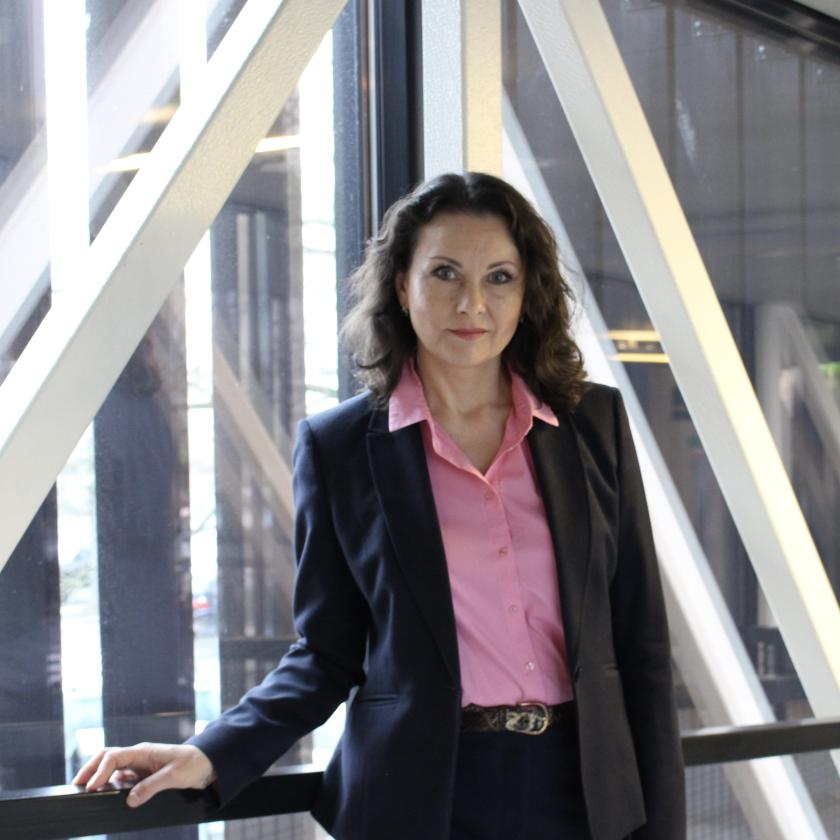
Anneli Kaasa is a Professor of Social and Cultural Studies in Economics at the University of Tartu, Faculty of Social Sciences. She holds a PhD in Economics and has been affiliated with the University of Tartu since 1998, progressing through roles such as Lecturer, Associate Professor, and Head of Chair. Her research focuses on the interplay between culture, social capital, governance, and economic development. She has led projects like 'Up-to-date measures of culture at the country and regional level' (2019–2023) and has served on numerous academic councils, including the Estonian Council of the European Social Survey. Her teaching includes courses on cultural context in economics, advanced mathematical methods for economics, and microeconomics. Kaasa has supervised over 20 graduate students and has published extensively on cultural dimensions, innovation, and entrepreneurship. Notable awards include the 2023 Mihhail Bronšteini Award and nomination to AcademiaNet in 2020. Her work integrates cross-cultural psychology, sociology, and economics to explore societal dynamics and their economic implications.
Thomas Hoffmann is an Associate Professor (Full Tenure) at the Law Institute of Tallinn University of Technology (TalTech), part of the Faculty of Economics and Business. His academic career includes visiting professorships at Martin-Luther-University Halle-Wittenberg and the Al-Farabi Kazakh National University. He holds a PhD in Law from Heidelberg University and an LL.M. in Polish Business Law from Jagiellonian University. Education: PhD in Law, Heidelberg University (2006) LL.M. in Polish Business Law, Jagiellonian University (2009) State Examinations in Germany (2005–2007) His research focuses on comparative law, digital governance, AI ethics, and blockchain technology. He has advised on EU directives regarding consumer rights, insolvency, and intellectual property. Key interests include the legal implications of Estonia’s e-state, GDPR compliance, and smart contracts. His international engagements include over 100 lectures at institutions like Riga Graduate School of Law and Ho Chi Minh-City University of Law, and keynote speeches at conferences on AI, digital justice, and Baltic legal systems. Awards include DAAD fellowships (2003, 2005, 2022). Grants & Projects: EU-funded studies on Blue Card Directive compliance, digital economy contracting, and consumer over-indebtedness Expert for European Parliament evaluations and AI policy frameworks Research Groups: Leads TalTech’s Private Law Research Group and participates in the Estonian Intellectual Property Law Codification Group.
Tanel Kerikmäe is a Full Professor of European Legal Policy and Law & Technology at TalTech School of Business and Governance. He serves as Director of the Law School and holds affiliations including foreign membership at the Ukrainian Academy of Legal Sciences and academic fellowships at NUS Law School's TRAIL Centre. His career spans over three decades, with tenures at institutions like the University of Cambridge, Nagoya University, and Paññāsāstra University of Cambodia. Education includes a PhD in European Legal Systems (2009) and advanced qualifications from Universities of Helsinki, Oxford, and Tartu. His research focuses on governance with new technologies, AI regulation, and EU Digital Market Law, with contributions to over 596 publications. Research interests emphasize future governance frameworks, legal challenges of AI, and e-governance innovations. Recent articles address disinformation in the metaverse, EU-Vietnam trade strategies, and digital sovereignty mechanisms. Awards include Doctor Honoris Causa from Jaroslav Mudryi National Law University and recognition from the Turkish Association of Law & Technology. He advises governments on digital policy, including Estonia’s AI strategy and space law. Editorial roles include Chief Editor of TalTech Journal of European Studies (Scopus-indexed). Active in 60+ international networks, he coordinates doctoral programs in Law and Digital Technologies.
Roomet Jakapi is an Associate Professor of History of Philosophy at the University of Tartu's Faculty of Arts and Humanities. He holds a Doctorate in Philosophy (2002) and has held academic positions since 2001, including Senior Research Fellow (2007–2017) and Head of the Chair of History of Philosophy (2010–present). His research focuses on Early Modern Philosophy, Philosophy of Religion, and the Philosophy of Imagination, with particular expertise in George Berkeley and related theological debates. Education: PhD from University of Tartu (2002), MA from University of Tartu (1997), visiting scholar at University of Oxford (2000–2001). Administrative roles: Editor-in-Chief of Studia Philosophica Estonica , Coordinator of Erasmus+ programs, and organizer of international workshops on Early Modern Philosophy and Philosophy of Religion. Research interests emphasize the intersection of religion and philosophy in historical contexts, particularly Berkeley's metaphysics, debates on revealed religion vs. natural philosophy, and the role of imagination in faith. Key publications include works on Berkeley's non-cognitivist interpretation, Plantinga's religious epistemology, and Boyle/Whiston's apologetics. Recipient of the University of Tartu Badge of Distinction (2022) and the Akadeemia Award (2002). Active in academic governance, including membership in the Nordic Network for History of Philosophy and the Nordic Society for Philosophy of Religion.
Lauri Lihtmaa is a Researcher at the Department of Civil Engineering and Architecture , University of Tallinn College of Engineering . His work spans energy efficiency in building stock renovation , urban sustainability , and policy-driven environmental economics , with a focus on Estonian housing dynamics and modernist district revitalization . Education : Research Master's in Maakorraldus (2004) from Estonian University of Life Sciences; PhD studies in Renovation Patterns (ongoing at Tallinn University of Technology, and Sustainability Assessment (interrupted at Estonian University of Life Sciences). His research interests center on: Energy-efficient building renovation (particularly multifamily structures) Climate-resilient urban development for post-WWII districts Policy analysis of subsidy distribution in environmental economics Strategic environmental assessment in local governance Current projects include leading roles in: European Commission-funded Collaborative Pre-Fabricated District Reinvention (2024-2027) CINEA-supported Heritage Home Renovation Services (2023-2026) Ministry of Education-backed Energy Efficiency Center of Excellence (2024-2030)
Tiina Randma-Liiv is a Tenured Full Professor at Tallinn University of Technology's Ragnar Nurkse Department of Innovation and Governance. Her research examines public administration, crisis management, e-governance, and small states governance. Recent publications analyze hybrid governance models during crises, institutionalization of e-participation, and comparative governance in small states. Her work frequently addresses public sector reforms and fiscal consolidation strategies across European governments.
Eva Rein is a Lecturer in English Language and Canadian Literature at the University of Tartu, Faculty of Arts and Humanities, Institute of Foreign Languages and Cultures. She has maintained continuous affiliation with the University of Tartu since 1996, beginning in the Faculty of Philosophy, College of Foreign Languages and Cultures, and later transitioning to her current position in the Faculty of Arts and Humanities since 2021. Dr. Rein holds a Specialist's Diploma in English Philology and as a teacher of English language and literature from Tartu State University (1989), equivalent to a Master's degree. She is currently pursuing her PhD under Tiina Ann Kirss with her dissertation focusing on 'Trauma, Memory and Narrative in Joy Kogawa's Obasan and Ene Mihkelson's Ahasveeruse uni.' Her educational foundation was established at Fr. R. Kreutzwald Võru Secondary School No. 1 (1973-1984). Her research explores the intersection of Canadian literature, comparative literature, and narrative theory, with particular emphasis on trauma narratives, memory studies, and cultural identity formation. Analysis of her publication record reveals consistent engagement with literary representations of historical trauma, particularly in works by Joy Kogawa and Ene Mihkelson, examining how narrative structures convey intergenerational trauma and cultural memory across different national contexts. Her work bridges North American and Estonian literary traditions, creating valuable cross-cultural dialogues. Dr. Rein has received significant recognition through multiple grants from the Department of Foreign Affairs and International Trade Canada for projects including 'Forgetting and Remembering' (2010), 'The World in Canada, Canada in the World' (2007), and 'Home and Exile' (2004). She also received the Medal of the Scientific Society of Students for her diploma thesis in 1989. She has supervised numerous master's students on diverse topics ranging from literary analysis to language teaching methodologies, demonstrating her dual commitment to research and pedagogy. Her administrative contributions include organizing the International Tartu Conferences on Canadian Studies since 1998 and serving as Canadian Studies coordinator at the University of Tartu since 1998. She is an active member of both the Canadian Comparative Literature Association (since 2006) and the Estonian Comparative Literature Association (since 1999).
Sten Hansson is an Associate Professor of Communication Studies at the University of Tartu's Faculty of Social Sciences, Institute of Social Studies. He holds a Doctor's Degree (2016) and Research Master's Degree (2012) from Lancaster University, where he was supervised by Ruth Wodak. His academic career includes positions as Research Fellow (2017-2020), Senior Research Fellow (2020), Associate Professor (2021-2022 at 0.35 FTE, and 2022-present at 1.00 FTE), as well as a Marie Skłodowska-Curie Fellowship at the University of Birmingham (2020-2022). Hansson's research focuses on political communication, crisis and risk communication, critical discourse analysis, and political blame games. His work examines government communication strategies, particularly how politicians avoid blame and construct narratives during crises. He has published extensively on social media communication, disaster management, and hostile information influence. His research bridges communication studies, political science, and sociology, with a specific emphasis on risk and crisis sociology. Hansson's recent publications demonstrate a strong trend toward interdisciplinary research connecting communication studies with disaster management and security studies. His work increasingly focuses on European crisis management systems, social vulnerability assessment, and the role of social media in emergency response. He has developed methodological approaches for analyzing government communication through corpus-assisted discourse analysis and experimental frameworks for studying blame strategies. Member of the Editorial Board, Journal of Language and Politics (2024-present) Associate Fellow of The Higher Education Academy (2015-present) Management Committee member of the European Network for Argumentation and Public Policy Analysis (2018-2023) Extensive reviewer for leading journals in political science, communication, and linguistics Hansson actively supervises doctoral and master's students, with current PhD supervision focusing on disaster communication, genetic information in health behavior, and foresight in disaster risk management. His research is supported by multiple projects funded by the Estonian Research Council, European Commission, Estonian Defence Forces, and other institutions, with a strong emphasis on practical applications for crisis management and security policy.
Sirje Kupp-Sazonov is a faculty member at the University of Tartu, currently serving as Head of the Department of Translation and Interpretation Studies and Programme Director within the Faculty of Arts and Humanities. She holds a Doctorate in Philology from the University of Tartu (2015) and a Master's in Russian and Slavic Philology (2007). Her primary affiliation is the Institute of Foreign Languages and Cultures, where she focuses on translation studies, Russian-Estonian linguistic comparisons, and historical text analysis. Education includes a PhD specialization in Russian language (2009–2015), MA in Russian and Slavic Philology (2005–2007), and a BA from the University of Tartu (2002–2005). She completed secondary studies at Lycée Descartes de Tartu. Research interests center on the role of grammar in translation, particularly between Russian and Estonian, with emphasis on temporal forms and comparative linguistics. She has led projects including the Estonian-Russian-Estonian Legal Terminology Base and contributed to initiatives like the Annotated Bibliography of Estonian Translation Studies. Key awards include two Silver Awards of Akadeemia (2020, 2018) for articles analyzing Ivan the Terrible’s diplomatic letters. Her administrative roles include leadership in terminology projects and membership in the European Society for Translation Studies and the Estonian Association of Applied Linguistics. Recent work examines historical narratives in Kremlin propaganda and the socio-political nuances of Russian influence activities. She actively participates in international conferences, delivering talks on topics ranging from Bulgakov’s literary symbolism to Putin’s rhetorical strategies.
Kristiina Tõnnisson is a Lecturer in Public Management at the Johan Skytte Institute of Political Studies, University of Tartu. She has held leadership roles including Head of the Institute (2016–2018) and Director of EuroCollege (2014–2015). Her research focuses on public sector management, local governance, and New Public Management principles in transitional economies. She has extensive administrative experience in academic governance and international cooperation, including leading projects on good governance in Eastern Partnership countries. Tõnnisson holds a PhD from the University of Tartu and has taught courses such as 'Public Administration and Multi-Level Governance' and 'Project Management in the EU.' She has received multiple awards including the University of Tartu Medal (2024) and the Estonian Government's Citizen’s Day certificate (2017). Education: PhD in Public Administration (2006), University of Tartu MSc in Public Management (2000), New York University MA in Public Administration (1999), University of Tartu Bachelor of Arts in Public Administration (1997), University of Tartu Research Interests: Her work examines governance reforms in post-Soviet contexts, public sector marketing, and the implementation challenges of New Public Management principles in local governments. She has published extensively on regional policy, EU pre-accession strategies, and civic engagement mechanisms. Publications: Recent works include annual reports on Estonian regional policy (2020–2024) and studies on post-Soviet urban governance. Her 2006 doctoral thesis analyzed NPM applicability in Estonian local government. Awards & Recognition: University of Tartu Medal (2024) Citizen’s Day certificate of honour (2017) Merit Badge of the University of Tartu (2015) Advisory & Grants: Led teams in EU-funded projects like EU-PREACC (2013–2017) and served as an evaluator for the Estonian Research Council. Her grants include Volkswagen Foundation support (2002) and Muskie Fellowship (1999). Labs/Teams: Active in COST Action networks on local governance reforms and disaster bioethics. Member of the Johan Skytte Institute Board and the Faculty of Social Sciences Council.
Eiki Berg is a Professor of International Relations Theory at the Johan Skytte Institute of Political Studies, University of Tartu. He has held this position since 2016 and previously served in various academic and administrative roles, including Dean of Social Sciences (2006–2009) and as a Member of the Estonian Parliament (2003–2004). His research focuses on de facto states, geopolitical conflicts, border regions, and Baltic-Russian relations. He has authored over 100 publications and led major projects like the 'De Facto States Research Unit.' Education: PhD in Political Geography (1999), MA in Geography (1995), both from University of Tartu. Awards: Honorary Doctorate (2014), Estonian National Science Award (2012). Research interests include geopolitics, ethnic minorities, and international engagement strategies. His recent work examines de facto states' responses to crises like COVID-19 and territorial negotiation dynamics. He serves on advisory boards for institutions like the Finnish Institute of International Affairs and the European Humanities University.
David Ramiro Troitiño is a Senior Lecturer and Jean Monnet Chair in Digital Development of the European Union at Tallinn University of Technology (TalTech). He is Deputy Director of the Jean Monnet Network on E-Governance and Digital Development, and a European Union specialist at the University of Turku (Finland). His research focuses on EU integration, digital policies, and e-governance. He holds a PhD in History from the University of Salamanca (2005) and has held visiting professorships at universities in the US, Argentina, the Philippines, and across Europe. Key roles: Member of the European Commission’s Joint Research Centre (2024–present), Coordinator of 8 international projects, and Reviewer for leading publishers like Springer and Routledge. Education: PhD in History (Salamanca, 2005), multiple postgraduate qualifications in EU studies, and a Master’s in E-Governance Technologies from TalTech. Research Interests: European Union digital transformation, e-governance strategies, EU institutional dynamics, and geopolitical challenges. He has published 185+ articles and 8 books, including "Digital Development of the European Union: An Interdisciplinary Perspective" (Springer, 2023). Recent Projects: Leading initiatives like "Legal and Regulatory Governance of Artificial Intelligence Systems" (EU-funded) and "Digital Europe and Future Integration" (Jean Monnet Chair). His work emphasizes EU digital sovereignty, citizen engagement, and cross-border governance. Awards: 2024 TalTech Best Article Award, 2005 Top 3 PhD Thesis (Salamanca). Grants: Over €1.5M secured, including Horizon and Jean Monnet programs. Labs/Teams: Collaborates with the Jean Monnet Community, Tallinn’s E-Governance Academy, and international think tanks. Active in policy advisory roles for the EU Commission and national governments.
Julia Kuznetski is a Professor of English at the School of Humanities, Tallinn University. Her research focuses on literary theory, ecocriticism, gender studies, postcolonial theory, and diasporic literature. She teaches at all academic levels (BA, MA, PhD), supervises theses, and contributes to curriculum development. Her administrative roles include Head of English Studies and membership in the School of Humanities Research Council. Her research explores transcorporeality, ecofeminist philosophy, and crisis narratives in contemporary works by women authors. Key themes include environmental ethics, posthumanism, and diasporic identities. She is an active member of scholarly organizations such as ESSE, FINSSE, and ASLE. Prof. Kuznetski has published widely in Routledge, Palgrave Macmillan, and Taylor & Francis journals, focusing on women’s writing, ecological crises, and postcolonial narratives. Her recent work examines bodily agency in dystopian fiction and eco-apocalyptic narratives. Her administrative contributions include strategic work group memberships and organizing research seminars in English studies.
Archil Chochia is a Senior Research Fellow at the Department of Law , Tallinn University of Technology , actively contributing to European Law , Artificial Intelligence Regulation , and Cybersecurity . He serves on the Academic Ethics Committee and is a visiting lecturer at Lille Catholic University . He was a Weinstein JAMS fellow in 2018 and an International Mediator for the Kyrgyz Republic’s court. His academic journey includes a Doctoral Degree (2013) and Master’s Degree (2025) from TalTech, with studies at Harvard , Pepperdine , and University of California Hastings College of Law . Research Interests : His work spans European Union Law , Digital Governance , AI Ethics , and Political Geography , often intersecting with Geopolitics and Human Rights . Projects like Digital Europe and Future Integration and Legal and Regulatory Governance of Artificial Intelligence Systems highlight his focus on technology’s legal implications. Scientific Awards : Recognized with Letters of Appreciation from institutions such as NATO Cooperative Cyber Defence Centre of Excellence , Supreme Court of Georgia , and Vilnius Gediminas Technical University , alongside the Weinstein JAMS Fellowship . Teaching & Administrative Roles : Courses include Human Rights, Ethics and Technology and EU External Relations Law . He has coordinated academic programs, directed TalTech’s Doctoral School , and served on editorial boards for journals like TalTech Journal of European Studies and TSU Law Review .
Tim Maran is a Professor of Ecosemiotics and Environmental Humanities at the University of Tartu's Institute of Philosophy and Semiotics. He holds a Doctorate in Semiotics from the University of Tartu and has been a leading figure in ecosemiotics, zoosemiotics, and environmental humanities. His research integrates biosemiotic theory with cultural studies, focusing on semiotic relations between humans and nature, biological mimicry, and sustainability transitions. He has held administrative roles including Head of the Semiotics Department and membership in international academic societies like the International Society for Biosemiotic Studies. Education : PhD in Semiotics (2005), MA in Semiotics (2000), BSc in Zoology (1998), University of Tartu Research Focus : Ecosemiotics, zoosemiotics, environmental communication, cultural aspects of degrowth Recipient of multiple accolades including nominations for the National Science Award and the University of Tartu's Small Badge of Honour. He teaches courses on ecosemiotics, environmental humanities, and zoosemiotics in both Estonian and English.