Michael Engelhardt is a Professor in the Department of Physics at New Mexico State University, specializing in theoretical physics research focused on the low-energy sector of Quantum Chromodynamics (QCD). His work examines non-perturbative phenomena including quark confinement and chiral symmetry breaking, with current emphasis on lattice QCD studies of hadron structure and the center vortex vacuum model. His research explores transverse momentum-dependent parton distributions, generalized parton distributions, and hadron polarizabilities using advanced computational methods. Recent publications analyze quark orbital angular momentum dynamics and develop new theoretical frameworks connecting parton distributions to nucleon structure.
Timothy Hobbs is a Research Assistant Professor of Physics at the Lewis College of Science and Letters, Illinois Institute of Technology. His research focuses on particle and nuclear theory, particularly quantum chromodynamics (QCD), nonperturbative hadronic systems, and their implications for collider phenomenology, neutrino scattering, and beyond Standard Model (BSM) physics. He is actively involved in planning for the Electron-Ion Collider (EIC) and leverages advanced computation, machine learning, and quantum information techniques in his work. Education: B.A., Physics and Mathematics, The University of Chicago M.S., Physics, Indiana University Ph.D., Physics, Indiana University Research Interests: Dr. Hobbs explores QCD's nonperturbative structure, nuclear physics, and the interplay between theory and emerging technologies like AI. His work supports the EIC's goals to study proton/nuclei structure and BSM physics. Key topics include parton distribution functions (PDFs), neutrino scattering, and quantum entanglement in QCD. Awards: Fellow, EIC Center at Jefferson Lab (2018–2020) Advising & Collaboration: His contributions include theoretical tools for neutrino experiments, EIC planning, and global QCD analyses (e.g., CTEQ-TEA framework). He collaborates on event generators and uncertainty quantification in high-energy physics. Labs & Affiliations: Member of the American Physical Society (APS) and APS Group on Hadronic Physics.
D.S. Armstrong is the Chancellor Professor of Physics at the College of William & Mary , where he leads a research group focused on experimental nuclear and particle physics. He conducts major experiments at Jefferson Lab, including Qweak, PREx, CREx, and the upcoming MOLLER experiment, all aimed at precision tests of the Standard Model through parity-violating electron scattering. Chancellor Professor of Physics, College of William & Mary Primary research site: Jefferson Lab, Newport News, VA Research group leads in precision weak interaction measurements and hadronic structure Education B.Sc., McGill University, 1981 M.Sc., Queen's University, 1984 Ph.D., University of British Columbia, 1988 Armstrong's research centers on experimental nuclear and particle physics , particularly precision measurements of the proton's weak charge and the neutron skin in nuclei. His group uses polarized electron beams to probe parity-violating asymmetries in electron-nucleus scattering, providing stringent tests of the Standard Model and insights into quark contributions to nucleon structure. His work on the G0 experiment explored strange quark effects, while Qweak delivered the first direct measurement of the proton’s weak charge, published in Nature (2018). Current efforts focus on the MOLLER experiment , which will achieve even higher precision in weak mixing angle measurements. The recent publications reflect a strong trend toward precision electroweak physics , with increasing focus on detector calibration , tracking efficiency , and background suppression in next-generation experiments like MOLLER. The subfields span parity violation, hadronic structure, strange quark contributions, and advanced simulation techniques using GEANT4. Scientific Awards: Monica Potkay Advisor of the Year, 2022 Armstrong has advised over 30 PhD and senior thesis students, many of whom have pursued academic and research careers at institutions like MIT, Stanford, Jefferson Lab, and NASA. His research is supported by the National Science Foundation (NSF) and Department of Energy (DOE), including recent funding for the MOLLER experiment from NSF and the Canadian Foundation for Innovation (CFI). He also contributes to broader scientific service, including faculty governance and development of open-source educational resources like the Virginia Physics Flexbook. His team collaborates extensively with national laboratories, particularly Jefferson Lab, and includes active graduate students such as Ezekiel Wertz, Kate Evans, and Tasneem Raza. The group emphasizes both experimental hardware development and advanced data analysis, including machine learning applications for particle identification and track reconstruction.
Frank Petriello is a Professor of Physics at Northwestern University, specializing in precision QCD calculations and collider phenomenology. He holds a PhD from Stanford University (2003) and focuses on improving Standard Model predictions for hadron collider observables and developing strategies for new physics searches at the Large Hadron Collider (LHC) and future colliders. His work emphasizes ultra-precise theoretical comparisons with experimental data, particularly in Drell-Yan processes, Higgs boson production, and Standard Model Effective Field Theory (SMEFT) applications. Key research areas include precision QCD calculations, electroweak physics, and the development of novel techniques for analyzing collider data. Petriello has contributed to studies of the Future Circular Collider (FCC), Electron-Ion Collider (EIC), and high-luminosity LHC upgrades. His theoretical frameworks address challenges in proton structure, parton distribution functions, and dimension-8 SMEFT operators. Education: PhD in Physics, Stanford University, 2003 His recent work explores renormalization-group running of four-fermion operators in SMEFT, transverse spin asymmetries at FCC-ee, and the impact of Drell-Yan data on BSM model fits. He has co-authored influential papers on W/Z boson production, Higgs+jet processes, and jet substructure at NNLO accuracy. Awards: U.S. Department of Energy Outstanding Junior Investigator Award Alfred P. Sloan Foundation Research Fellowship Fellow of the American Physical Society Petriello collaborates on major international initiatives like the Future Circular Collider conceptual design and the Electron-Ion Collider theory alliance. His research bridges theoretical predictions with experimental capabilities, emphasizing precision measurements to uncover physics beyond the Standard Model.
Susan Blessing is a Professor of Physics at Florida State University's College of Arts and Sciences, Department of Physics. She specializes in experimental high-energy particle physics with research focusing on electroweak interactions, top quark studies, and quantum chromodynamics. Her work primarily utilizes proton-antiproton collision data from the DØ experiment at Fermilab. Her research examines fundamental particle interactions including W boson asymmetry, quark structure analysis, and searches for beyond-Standard-Model physics. Recent investigations explore exotic hadronic states and precision measurements of electroweak parameters. Honors include the First Year Assistant Professor Award (1995), Dr. Martha Roberts Award (2000), and Developing Scholar Award (2001). She actively contributes to Fermilab's DØ Collaboration and mentors students in particle physics research methodologies.
Sean Fleming is a Professor of Physics at the University of Arizona's Department of Physics, part of the College of Science. He holds a Ph.D. from Northwestern University (1995) and specializes in theoretical nuclear physics and quantum chromodynamics (QCD). His research focuses on effective field theories to disentangle multi-scale phenomena in QCD, with applications to quarkonium production and collider physics. Notable contributions include work on Soft Collinear Effective Theory (SCET) and non-relativistic QCD (NRQCD). He received the OJI award in 2005. Education: Ph.D., Physics, Northwestern University, 1995 Research Interests: His work systematically addresses multi-scale QCD challenges using effective field theories. Key areas include: Effective field theory applications to quarkonium systems and heavy-ion collisions Rapidity divergences and factorization in endpoint regions Phenomenological studies of heavy quark fragmentation Collaborations on experimental analyses at Jefferson Lab and the LHC Recent Research Trends (2017–2024): Advancements in TMD (Transverse Momentum Dependent) physics and its experimental validation Interdisciplinary work applying satellite remote sensing to climate-ecosystem interactions Renormalization and scale evolution in QCD effective theories Awards: OJI award (2005) Advising & Grants: While specific students/grants are unlisted, his research has been supported by grants tied to his OJI award. Collaborations involve international teams in high-energy physics experiments and environmental remote sensing. Labs/Teams: Engaged in theoretical physics collaborations at CERN, Jefferson Lab, and interdisciplinary environmental science groups.
Gerrit Van Onsem is a postdoctoral researcher in High Energy Physics at the Department of Physics within the Faculty of Science and Bio-engineering Sciences at Vrije Universiteit Brussel (VUB). With a substantial research output of 549 publications and an impressive h-index of 100 based on over 44,197 citations, he is an active contributor to the CMS Collaboration at CERN. His research interests span High Energy Physics, Particle Physics, Collider Physics, and the CMS Experiment, with specialized focus on Higgs Boson Physics, Quark Physics, Lepton Physics, Quantum Chromodynamics, and Beyond Standard Model Physics. The fingerprint analysis of his work shows dominant activity in collisions (100%), protons (43%), luminosity (37%), quarks (37%), leptons (34%), bosons (31%), cross sections (29%), and transverse momentum (27%). His recent publications (2024-2025) demonstrate significant contributions to Higgs boson measurements, heavy ion physics, searches for new physics beyond the Standard Model, and precision measurements of fundamental particles. His work primarily involves analyzing data from the Large Hadron Collider, with particular emphasis on proton-proton and heavy ion collisions at various energy levels. Dr. Van Onsem has participated in numerous CMS-related activities including the CMS Physics Week (2015), CMS detector Control and Safety shifts, and specialized workshops on top quark physics and vector-like quarks. His research collaborations span international institutions as evidenced by the global nature of the CMS Collaboration.
You Zhou is an Associate Professor at the Niels Bohr Institute , University of Copenhagen, leading the Experimental Subatomic Physics group. With a focus on Quark-Gluon Plasma (QGP) studies via the ALICE collaboration at CERN since 2010, his work leverages anisotropic particle expansion to probe QGP properties, including shear viscosity and thermalization. Principal Investigator of Villum Young Investigator project (2019–2024) on creating the "smallest droplet of early universe" Over 450 publications in experimental nuclear/particle physics Organized major international conferences including Initial Stages 2023 and Quark Matter workshops His research bridges high-energy nuclear physics , particle correlations , and collective flow , supported by grants from the Carlsberg Foundation , DFF-Sapere Aude , and Villum Foundation . He supervises students from bachelor projects to PhDs, including award-winning theses from Katarina Gajdosova and Vojtech Pacik . Key awards include the Villum Young Investigator (2019) and Carlsberg Postdoctoral Fellowship (2016). Recent lectures span the Nordic Winter School and Peking University . His work on femtoscopy, hypernuclei, and photon production has advanced understanding of early universe conditions and matter formation.
Haiyan Gao is the Henry W. Newson Distinguished Professor of Physics at Duke University's Trinity College of Arts & Sciences , with a focus on quantum chromodynamics (QCD), nucleon structure, and fundamental symmetry studies. She has held these positions since 2008 and 2012 respectively, conducting experiments at Jefferson Lab and Duke's Triangle Universities Nuclear Laboratory (TUNL). Current Appointments: Henry W. Newson Distinguished Professor of Physics (2012–Present), Professor of Physics (2008–Present) Education: Ph.D. in Physics (1994) from Caltech, B.S. in Physics (1988) from Tsinghua University Her research interests span the structure of nucleons in terms of quarks and gluons, the search for QCD exotics, and fundamental symmetry studies to explore physics beyond the Standard Model. Recent work includes precision measurements of proton and deuteron properties, spin-density matrix elements , and the development of advanced detectors like the Solenoidal Large Intensity Device (SoLID) for 12 GeV CEBAF upgrades. She investigates the proton charge radius puzzle through electron scattering experiments and studies axion-like particles via photoproduction. Analysis of her 15 most recent publications (2023–2025) reveals a focus on J/ψ meson photoproduction , spin structure functions , and QCD-based nucleon imaging . These works employ facilities like GlueX and Jefferson Lab to probe fundamental symmetries , gluonic gravitational form factors , and low-energy QCD dynamics , often through precision cross-section measurements and Monte-Carlo simulations . Her grants include leadership of Duke's Medium Energy Physics Program (2002–2025), the Natalia Escobar Fellowship (2021–2022), and Jefferson Lab Graduate Fellowships (2021–2022). Her laboratory work involves the GlueX experiment at Jefferson Lab's Hall D and Duke's High Intensity γ-ray Source (HIγS) facility.
Carl R Schmidt is an Associate Professor in the Department of Physics & Astronomy at Michigan State University, where he conducts theoretical research in high-energy particle physics with a focus on quantum chromodynamics and proton structure. His work is central to advancing precision predictions for collider experiments worldwide. Education: Ph.D. in Physics, Harvard University (1990) Dr. Schmidt's research program revolves around parton distribution functions (PDFs) and their applications in high-energy collisions. As a key member of the CTEQ collaboration, he develops global QCD analyses (including CT10, CT14, and CT18 PDF sets) that incorporate data from the LHC, HERA, and fixed-target experiments. His expertise spans Higgs boson production mechanisms, electroweak symmetry breaking in beyond-Standard-Model scenarios (particularly little Higgs models), top quark physics, and photon-induced processes. His theoretical frameworks directly enable precision tests of the Standard Model and searches for new physics at energy frontiers. Analysis of his 15 most recent publications (2019-2024) reveals a dominant focus on reducing PDF uncertainties through novel methodologies and incorporation of high-precision LHC data. Key themes include the determination of photon content within the proton, NNLO corrections to global fits, and applications to critical measurements like the weak mixing angle and Higgs cross-sections. His work bridges theoretical developments with experimental requirements, particularly for ATLAS and CMS collaborations. Scientific awards: No awards or fellowships were documented in available sources While specific student mentorship details are absent from current records, his active role in the CTEQ collaboration—which involves extensive international collaboration and training—suggests significant contribution to graduate education. Research funding is inferred through CTEQ's institutional support from the U.S. Department of Energy and National Science Foundation, though specific grants aren't itemized in the source material. Dr. Schmidt operates within the CTEQ framework, a major international consortium connecting theorists and experimentalists to refine QCD understanding. This collaboration maintains vital links with LHC experiments and drives community-wide efforts in PDF development through regular workshops and shared computational frameworks.
Name: Yamandu Hilbert Affiliation: Department of Palaeoanthropology, Faculty of Science, Eberhard Karls University of Tübingen Research Focus: Palaeolithic and Neolithic archaeology, raw material exploitation, use-wear analysis, human-environmental interactions, lithic technology, experimental archaeology, spatial distribution of stone tools in prehistoric sites across the Near East and beyond. Education: PhD, Doctor of Philosophy (REVIVE 2013) B.A., Ur- und Frühgeschichtliche Archäologie und Archäologie des Mittelalters, Eberhard Karls Universität Tübingen (2008) Research Trends: Analysis of Nubian Complex and bidirectional blade technology Studies on glacial refugia and human dispersals Woodworking tool functionality in South Arabia Geospatial methods for site discovery in Arabian deserts Collaborations: Co-authorships with Rose, Crassard, Parton, et al. Participation in Saudi-French Archaeological Mission Contributions to La Trobe Archaeological Research in Oman
Stefan Groote is an Associate Professor in Theoretical Physics at the Institute of Physics, Faculty of Science and Technology, University of Tartu, Estonia. He has held this position since February 2024, having previously served as an Associate Professor from January 2021 to February 2024 and as a Senior Research Fellow from 2016 to 2020. Before joining the University of Tartu, he held positions at Johannes Gutenberg University in Mainz, Germany, where he completed his habilitation in 2003, and at Cornell University as a Post-Doc from 1998-1999. Dr. Groote received his Doctor's Degree in 1997 from the University of Mainz under the supervision of Jürgen Körner, with his dissertation focusing on "QCD-Strahlungskorrekturen in der Physik schwerer Quarks und Baryonen" (QCD radiation corrections in the physics of heavy quarks and baryons). He completed his habilitation (Dr. habil.) at the University of Mainz in 2003, qualifying him for a professorship in Germany. Dr. Groote's research focuses on theoretical particle physics, particularly in the areas of Quantum Chromodynamics (QCD) and quantum field theory. His work spans perturbative and non-perturbative aspects of QCD, including spin in QCD perturbation theory, correlation functions and sum rules, lattice-QCD gauge theories, and the determination of standard model parameters using stochastic methods. His recent research has increasingly focused on non-perturbative approaches to Yang-Mills theories using Dyson-Schwinger equations, finite temperature QCD, and confinement mechanisms. He has published extensively in leading physics journals including Physical Review D, Nuclear Physics B, and Symmetry. An analysis of Dr. Groote's recent publications (2023-2025) reveals a strong focus on non-perturbative methods in quantum field theory, particularly the application of Dyson-Schwinger equations to problems in QCD and Yang-Mills theories. His work spans multiple subfields including finite temperature QCD, confinement mechanisms, electroweak theory, and mathematical aspects of field theory. Collaborations with researchers like Marco Frasca and Anish Ghoshal are prominent in his recent work, indicating strong international research connections in theoretical particle physics. Member of the German Physical Society (since 1995) Member of the AMBER collaboration (since 2025) Member of the management committee of the COST action CaLISTA (since 2022) Associated member of the COMPASS collaboration (since 2018) Dr. Groote serves as a referee for numerous prestigious journals including Physical Review D (since 2003), Letters in Mathematical Physics (since 2006), Annals of Physics (since 2010), and Physical Review Letters (since 2018), demonstrating his standing in the theoretical physics community. He has taught advanced courses at the University of Tartu including Quantum Field Theory, Renormalization Methods in Quantum Field Theory, and Gauge Theory for the Interaction of Elementary Particles, contributing significantly to graduate education in theoretical physics. His research is characterized by rigorous mathematical approaches to fundamental problems in particle physics, with particular emphasis on non-perturbative phenomena that cannot be addressed through conventional perturbative methods.
Berndt Mueller serves as the J. B. Duke Professor of Physics at Duke University, specializing in Theoretical Nuclear and Particle Physics. He leads the Hot and Dense QCD Matter research group as part of the Duke QCD Theory program. His research primarily focuses on nuclear matter at extreme energy density, investigating how Quantum Chromodynamics (QCD) predicts the dissolution of nuclear matter into quarks and gluons when critical energy density thresholds are exceeded. Professor Mueller develops theoretical frameworks for quark-gluon plasma formation, particularly addressing thermalization problems and detection methods in high-energy nuclear collisions. His recent publications reveal significant trends across multiple subfields of theoretical nuclear physics, including QCD phase transitions, quarkonium behavior in extreme conditions, and the search for the QCD critical point. These works connect fundamental theoretical concepts with experimental approaches at facilities like RHIC and CERN. His 2022 overview article provides a comprehensive introduction to relativistic heavy-ion physics His research on the hadrochemical horizon explores connections between chemical freeze-out and QCD phase boundaries His work on critical point search addresses challenges in identifying signatures of the QCD critical point Professor Mueller has mentored numerous graduate students who have gone on to successful careers in academia and industry, including Michael T. Strickland at Texas Tech University, Xiaojun Yao at MIT, and Chris Coleman-Smith. His teaching responsibilities include General Physics I and II courses. He maintains active connections with major research facilities including the Relativistic Heavy Ion Collider (RHIC), CERN, and the DOE/NSF Nuclear Science Advisory Committee, contributing to the broader nuclear physics community through the Triangle Nuclear Theory colloquium series.
Prof. Amy L. Connolly is a Professor of Physics at The Ohio State University (OSU), affiliated with the Department of Physics and the Center for Cosmology and Astro-Particle Physics (CCAPP). She specializes in ultra-high-energy neutrino experiments, focusing on detecting cosmic neutrinos and their astrophysical implications. Her research emphasizes radio Cherenkov techniques for neutrino observatories, including contributions to ANITA, ARA, and EVA experiments. Connolly holds a Ph.D. from the University of California, Berkeley (2003), and has held roles such as UCL Advanced Fellow (2007–2010) and Post-Doctoral Researcher at UCLA (2003–2010). Her work bridges particle physics and astrophysics, exploring neutrino interactions as probes of new physics beyond the Standard Model. She has developed critical simulation tools used by major radio Cherenkov collaborations and pioneered attenuation measurements in ice and rock salt. Her group at OSU drives data analysis for the world’s leading ultra-high-energy neutrino searches. Connolly’s awards include the NSF CAREER Award (2013). She mentors graduate students like Eugene Hong and Brian Dailey, supervises undergraduate researchers, and leads service roles in OSU’s physics department and international workshops. Her outreach activities include initiatives like GRASP camps and blogs for women in physics. Teaching spans undergraduate courses (e.g., Physics 132) and a graduate-level experimental methods course.
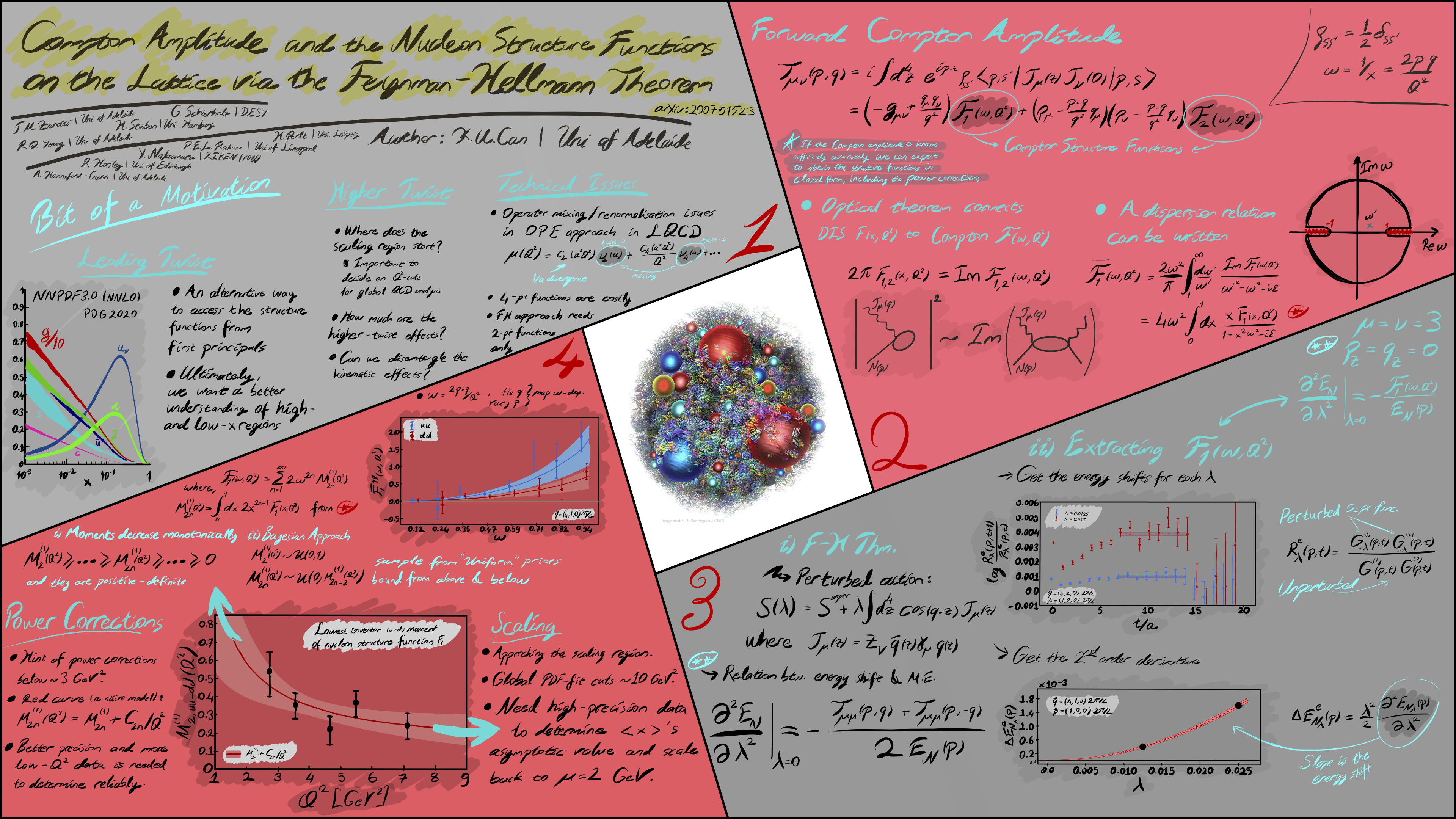
Dr. Kadir Utku Can is a Researcher at the University of Adelaide, affiliated with the School of Physics, Chemistry and Earth Sciences within the Faculty of Sciences, Engineering and Technology. His primary research focus is investigating the nature of strong interactions using lattice Quantum Chromodynamics (QCD), particularly studying hadron structure functions, form factors, and spectra through computer simulations. Current research interests include nucleon structure via Compton amplitudes, charmed baryon spectra, and generalized parton distributions. His work emphasizes computational methods to explore quark-gluon dynamics, with recent studies focusing on nucleon structure functions, parity-odd interactions, and transition matrix elements. He is eligible to supervise Masters and PhD students in theoretical and computational particle physics. Key contributions include lattice QCD calculations of charmed baryon spectra and Compton amplitude analyses, published in high-impact journals and conference proceedings. Recent publications (2022–2025) highlight advancements in lattice techniques for parton distribution functions, Feynmann-Hellmann theorem applications, and renormalization group equations. His research bridges computational simulations with experimental data, contributing to fundamental particle physics understanding.