
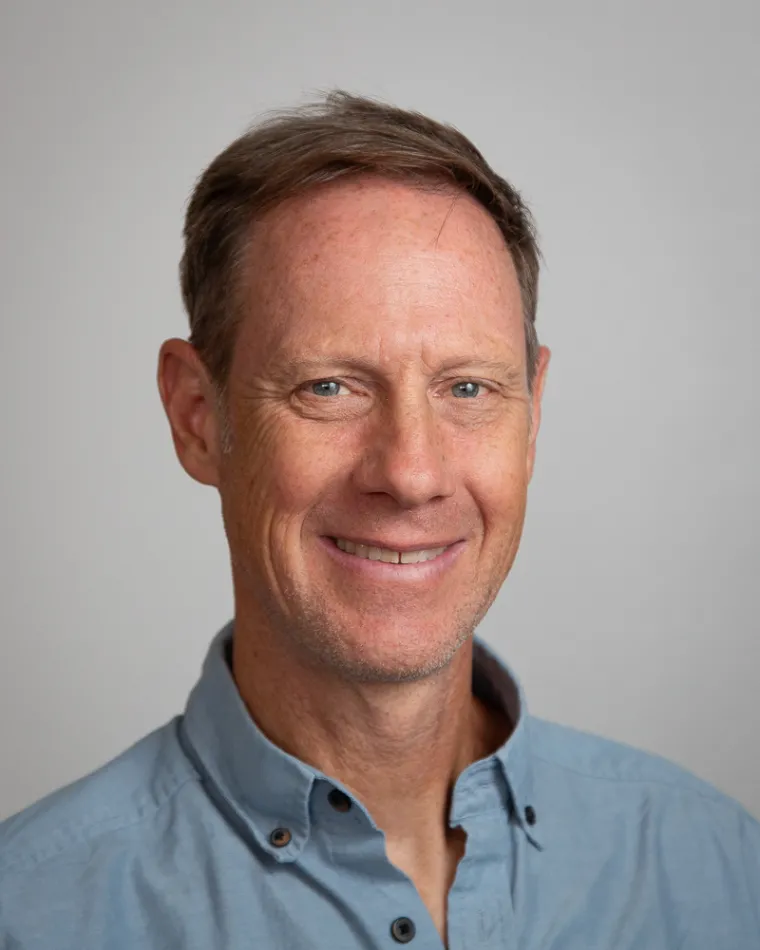
About
Sean Fleming is a Professor of Physics at the University of Arizona's Department of Physics, part of the College of Science. He holds a Ph.D. from Northwestern University (1995) and specializes in theoretical nuclear physics and quantum chromodynamics (QCD). His research focuses on effective field theories to disentangle multi-scale phenomena in QCD, with applications to quarkonium production and collider physics. Notable contributions include work on Soft Collinear Effective Theory (SCET) and non-relativistic QCD (NRQCD). He received the OJI award in 2005.
Education:
- Ph.D., Physics, Northwestern University, 1995
Research Interests: His work systematically addresses multi-scale QCD challenges using effective field theories. Key areas include:
- Effective field theory applications to quarkonium systems and heavy-ion collisions
- Rapidity divergences and factorization in endpoint regions
- Phenomenological studies of heavy quark fragmentation
- Collaborations on experimental analyses at Jefferson Lab and the LHC
Recent Research Trends (2017–2024):
- Advancements in TMD (Transverse Momentum Dependent) physics and its experimental validation
- Interdisciplinary work applying satellite remote sensing to climate-ecosystem interactions
- Renormalization and scale evolution in QCD effective theories
Awards:
- OJI award (2005)
Advising & Grants: While specific students/grants are unlisted, his research has been supported by grants tied to his OJI award. Collaborations involve international teams in high-energy physics experiments and environmental remote sensing.
Labs/Teams: Engaged in theoretical physics collaborations at CERN, Jefferson Lab, and interdisciplinary environmental science groups.
Find Sean Fleming elsewhere
Related Searches
You Might Also Like
- XXiaohui LiuUniversity of Pittsburgh · Part-Time Lecturer
 Iain W. StewartMassachusetts Institute of Technology · Professor
- RRonald Raymond HorganUniversity of Cambridge · Professor
 Sean DobbsFlorida State University · Associate Professor
- AAntonio VairoTechnical University of Munich · Professor
 Alexander PeninUniversity of Alberta · Professor