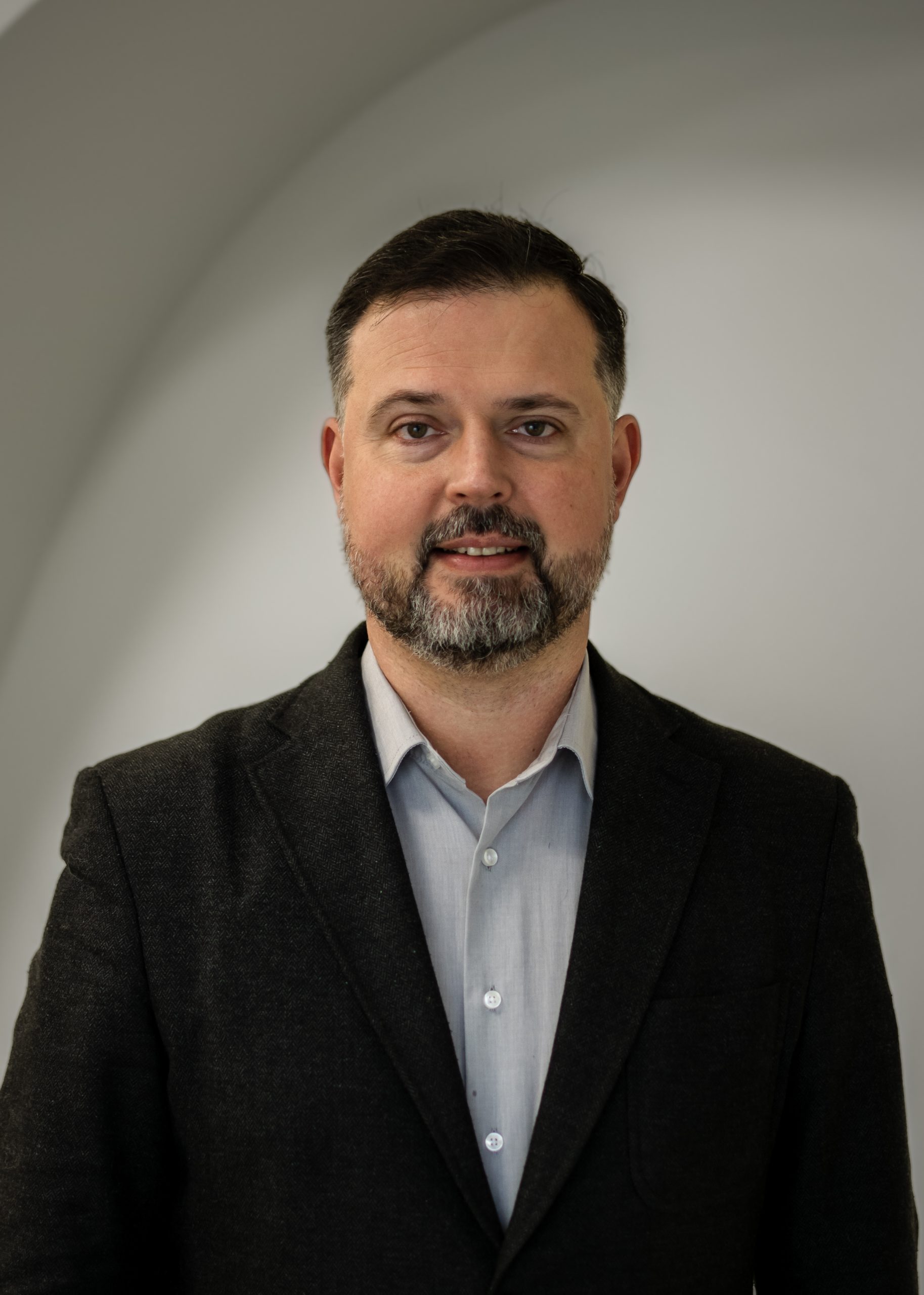
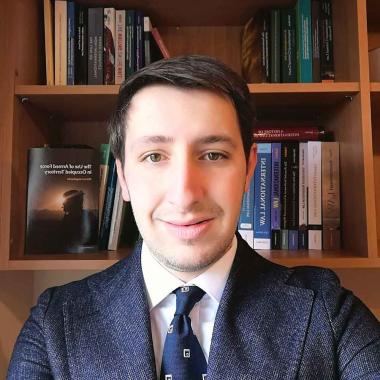
Dr Rod Thornton is a Senior Lecturer in Russian Defence and Security Studies at King’s College London, affiliated with the Defence Studies Department and School of Security Studies. He specializes in the Russian military's kinetic and sub-threshold warfare, with a focus on cyber capabilities, space warfare, and UK homeland resilience. His research includes recent British Academy-funded work on UK civil defense capacity during the pandemic, advocating for dedicated civil defense organizations. He has published extensively on Russian military tactics in Ukraine, AI-cyber integration, and space-based deterrence. Russian military cyber operations Space warfare dynamics UK resilience capacity gaps Scientific awards include a British Academy grant (2020). His students focus on asymmetric warfare, AI, cyber, and regional security issues. He teaches at the UK Defence Academy and has collaborated with institutions in Finland, South Korea, and the Freeman Air and Space Institute.
Keir A. Lieber is a Professor at Georgetown University, holding dual appointments in the Edmund A. Walsh School of Foreign Service and the Department of Government. His research focuses on nuclear strategy, deterrence, technology’s role in warfare, and U.S. national security policy. He co-authored The Myth of the Nuclear Revolution and authored War and the Engineers , exploring how political decisions outweigh technological determinism. Lieber’s work appears in International Security , Foreign Affairs , and other leading journals. He has received major fellowships from institutions like the Brookings Institution and the Council on Foreign Relations. Education: Ph.D. and M.A. in Political Science from the University of Chicago; B.A. in Political Science and International Relations from the University of Wisconsin-Madison. A proud alumnus of D.C. public schools, Lieber emphasizes interdisciplinary approaches to security studies. His research interests span nuclear deterrence theory, the impact of emerging technologies on conflict, and the evolution of U.S. defense strategies. Recent work addresses nuclear tripolarity and the challenges of escalation control in modern conflicts. Awards include recognition for his contributions to international relations scholarship and policy analysis. Lieber’s academic contributions include co-editing volumes on realism and advising on national security policy. Grants and fellowships have supported his exploration of topics like cyber warfare and nuclear non-proliferation.
Peter Henderson is an Assistant Professor at Princeton University with joint appointments in the Department of Computer Science and the School of Public and International Affairs. He is affiliated with the Center for Information Technology Policy (CITP), Princeton Language and Intelligence Initiative (PLI), Center for Statistics and Machine Learning (CSML), and Program in Law & Public Policy (PLAW). J.D./Ph.D., Stanford University, 2023 M.Sc., McGill University and Montréal Institute for Learning Algorithms Henderson's research focuses on the critical intersection of artificial intelligence and law, with particular emphasis on AI safety, methods to improve reasoning in foundation models, interdisciplinary approaches to law and AI, and AI governance. His work spans language-grounded reinforcement learning, alignment techniques, strategic decision-making in legal contexts, and public interest artificial intelligence. He investigates how legal frameworks can guide the development of AI systems that benefit society while addressing potential harms. Henderson's recent publications reveal a strong trajectory toward addressing the safety, governance, and legal implications of foundation models. His work combines rigorous technical AI research with deep legal analysis, particularly examining how intellectual property law interacts with AI development, regulatory pathways that balance innovation with harm prevention, and the role of law in shaping responsible AI deployment. A significant thread throughout his research is the development of better evaluation methodologies for AI systems, especially in critical domains like law. SEAS Excellence in Teaching Award (2025) Henderson leads the Princeton Law+Language, AI, & Society (POLARIS) Lab, where he advises students and researchers working at the intersection of AI and legal studies. His research has been supported through collaborations with government agencies, including work with the IRS on audit selection algorithms. His findings have informed practical applications in government efficiency and equity, as well as legal system improvements. Henderson runs the POLARIS Lab at Princeton, which focuses on developing AI systems that work for the public interest, particularly in legal contexts. His team develops sequential decision-making systems for government efficiency, foundation models capable of reasoning about law, and improved safety evaluation frameworks for AI systems. The lab maintains strong connections with legal practitioners and policymakers to ensure research has real-world impact.
Dr. Herb Lin is the Hank J. Holland Fellow in Cyber Policy and Security at the Hoover Institution and Senior Research Scholar for Cyber Policy and Security at the Center for International Security and Cooperation (CISAC), both at Stanford University. He also serves as Chief Scientist, Emeritus for the Computer Science and Telecommunications Board of the National Academies, where he worked from 1990 to 2014, and as Adjunct Senior Research Scholar and Senior Fellow in Cybersecurity at Columbia University's Saltzman Institute for War and Peace Studies. Dr. Lin received his doctorate in physics from MIT, providing him with a strong technical foundation that informs his policy work at the intersection of technology and national security. His academic background bridges the gap between deep technical understanding and policy application in the cybersecurity domain. Dr. Lin's research focuses on the policy dimensions of cybersecurity and cyberspace, with particular emphasis on offensive cyber operations as instruments of national policy, information warfare, and influence operations affecting national security. His work addresses critical challenges at the intersection of emerging technologies like artificial intelligence, quantum computing, and their implications for nuclear security, election integrity, and democratic processes. He has been instrumental in analyzing how cyber capabilities are transforming traditional security paradigms and how policy frameworks must adapt to these changes. His extensive publication record reveals a consistent focus on the evolving relationship between cyber capabilities and national security strategy. Lin's work demonstrates increasing attention to the implications of artificial intelligence for warfare, the vulnerabilities created by quantum computing for current cryptographic systems, and the growing threat of cyber-enabled information warfare to democratic institutions. His research trajectory shows a progression from traditional cybersecurity issues toward the broader implications of digital technologies for national and international security. Member of Science and Security Board of Bulletin of the Atomic Scientists Served on President Obama's Commission on Enhancing National Cybersecurity (2016) Regular congressional testimony on cybersecurity matters Contributor to Stanford Emerging Technology Review As a mentor and collaborator, Dr. Lin works extensively with policymakers, military officials, and technology experts to translate complex cybersecurity concepts into actionable policy recommendations. His approach emphasizes practical solutions to emerging threats while recognizing the technical limitations and policy constraints that shape real-world security outcomes. Dr. Lin is associated with multiple research initiatives including Stanford's Center for International Security and Cooperation and the Stanford Emerging Technology Review, which aim to connect technological advances with policy considerations for national security decision-makers.
Danielle T. Cooper is an Associate Professor at the University of New Haven , affiliated with the Henry C. Lee College of Criminal Justice and Forensic Sciences and the Criminal Justice Department . She also serves as the Director of Research for the Tow Youth Justice Institute and Chair of the Criminal Justice Undergraduate Committee . Education Ph.D. in Criminology, Law, & Society, University of Florida, 2015 M.A. in Criminology, Law, & Society, University of Florida, 2011 B.S. in Justice Systems, Truman State University, 2009 Dr. Cooper’s research focuses on youths and young adults , juvenile justice policy reform , sex offender registration policies , and police-community dynamics . Her work emphasizes restorative justice , systemic equity , and prevention strategies for marginalized communities. Recent publications explore diversion programs , economic impacts of sex offender registries , and media narratives in criminal justice . Her awards highlight contributions to diversity, equity, and inclusion , as well as leadership development . Scientific Awards 2019 Faculty of the Year Award 2021 MO-KAN-NE TRIO Achiever Alumni Award 2021 Faculty Excellence in DEI 2022 Martin Luther King, Jr. Vision Faculty Award 2024 RAND Pardee Fellowship She has secured grants for diversionary services and youth-police relations , and her media commentary addresses youth violence , census participation , and social justice .
Richard Jochelson serves as Dean of Law at the Faculty of Law, University of Manitoba (Robson Hall), a position he has held since July 1, 2016. Previously, he taught criminal law for 10 years at the University of Winnipeg. Dr. Jochelson holds a Ph.D. in Law from Osgoode Hall Law School at York University, an LLM from the University of Toronto Faculty of Law, an LL.B. with Gold Medal from the University of Calgary Faculty of Law, and a B.Sc. in Zoology with Distinction from the same institution. He completed his legal training as a clerk at the Alberta Court of Appeal and Court of Queen's Bench before working at a major Canadian law firm. Dr. Jochelson's research program centers on critical issues in criminal justice and constitutional law, with primary interests in police powers jurisprudence, sexual regulation (particularly obscenity and indecency law), jury systems and representativeness, and legal pedagogy. His interdisciplinary approach bridges law with sociology and psychology, bringing empirical and theoretical rigor to legal scholarship. His work consistently addresses social justice concerns, examining how vulnerable populations interact with the justice system and how concepts like risk, precaution, and visibility shape legal decision-making. He has developed a distinctive methodology combining doctrinal analysis with empirical research on judicial behavior and jury decision-making. His recent publications reveal evolving scholarly priorities that respond to contemporary legal challenges. The 2025 article "Morbid Matters" addresses medical assistance in dying within federal corrections, while his 2024 works on youth terrorism cases and agnotology demonstrate expansion into new interdisciplinary territories. His longstanding commitment to police powers scholarship continues with "Ancillary Police Powers in Canada" (2024). The pandemic period saw significant contributions to understanding digital justice, mental health in legal education, and remote court proceedings. His criminal law scholarship maintains focus on jury representativeness, particularly regarding Indigenous inclusion following Bill C-75's elimination of peremptory challenges. Students' Teacher Recognition Award (CATL) - 2018 Dr. Jochelson has secured multiple SSHRC Insight Grants as both Principal and Co-investigator, demonstrating his ability to lead interdisciplinary research teams. His mentorship extends to junior academics and students, with several publications co-authored with emerging scholars. He has built significant research infrastructure, notably assembling nearly 40 interdisciplinary scholars across Canada for Robsoncrim.com, which has elevated the Criminal Law Edition of the Manitoba Law Journal to prominence as one of Canada's preeminent criminal law publications. As Dean of Law, Dr. Jochelson provides leadership in academic governance and legal education innovation. His service includes extensive committee work on academic affairs, workload policy, and hiring/tenure committees. His commitment to universal design principles informs both his teaching approach and administrative leadership, emphasizing accessibility and student-centered pedagogy that allows flexible evaluation methods tailored to individual learning preferences.
Dr. Marina Miron is a post-doctoral researcher at King’s College London’s Department of War Studies and Honorary Research Fellow at the Centre for Military Ethics. Her work focuses on military strategy, cybersecurity, and ethical education in conflict contexts. She holds a PhD from the University of New South Wales (Australian Defence Force Academy) and has taught at institutions like the NATO School and Colombian War College. Current projects include analyzing Russia/China’s information warfare strategies and developing country-specific military ethics programs for Colombia’s armed forces. She also advises on cyber defense, AI in military contexts, and drone technology impacts. Research interests span counterinsurgency, hybrid warfare, cyber operations, and ethical dilemmas in modern conflict. She co-leads a British Academy-funded project on Western countermeasures against information warfare and contributed to NATO’s counterterrorism training programs. Her work bridges technological advancements with ethical considerations, particularly in unmanned systems and medical ethics. Publications analyze Russian cyber capabilities, drone public perception, and historical conflict resolution cases like Peru. She frequently appears in media discussions on Ukraine and cybersecurity threats. Professional networks include King’s Cybersecurity Centre and Freeman Air & Space Institute.
Jonathan Kirshner Jonathan Kirshner is a Professor of Political Science at Boston College and Emeritus Stephen and Barbara Friedman Professor of International Political Economy at Cornell University. His expertise spans International Relations, Political Economy (focusing on macroeconomics and money), and Politics and Film. He has held leadership roles, including director of the Reppy Institute for Peace and Conflict Studies (2007–2015), and received prestigious awards like the Provost’s Award for Distinguished Scholarship and the Stephen and Margery Russell Distinguished Teaching Award. Education: B.A. (Johns Hopkins University), M.A. and Ph.D. (Princeton University). Research Interests: Classical Realism, financial crisis implications, mid-century cinema politics, and Keynesian economics. Key works include An Unwritten Future: Realism, Uncertainty, and World Politics (2022), American Power After the Financial Crisis (2014), and When the Movies Mattered: The New Hollywood Revisited (2019). Recent Publications: Focus on US foreign policy trajectory, economic theory applications, and film analyses of 1970s America. His articles in Foreign Affairs , Security Studies , and Cineaste blend geopolitical analysis with cultural critique. Awards: Celebrated for scholarship and teaching, including recognition from the International Studies Association for Appeasing Bankers .
Dr. Nerijus Maliukevičius serves as an Assistant Professor at Vilnius University's Institute of International Relations and Political Science, where he conducts research and teaching within the Department of Political Behavior and Institutional Studies. His expertise centers on information warfare, strategic communication, and Russian geopolitical strategies, with extensive publications analyzing disinformation campaigns targeting Baltic and European states. Maliukevičius' research interests focus on Information Warfare , Russian Studies , and Propaganda Countermeasures , examining how technological advances reshape conflict dynamics. His work investigates Kremlin influence operations across media ecosystems, emphasizing social resilience frameworks and psychological defense mechanisms against hybrid threats. Key contributions include foundational studies on Russian information geopolitics and contemporary analyses of operations like Ghostwriter that exploit digital vulnerabilities in democratic societies. His publication trajectory reveals a strategic evolution from theoretical frameworks (2002-2008) toward actionable counter-strategies, with recent work prioritizing social resilience metrics and Nordic-Baltic defense coordination. This shift reflects escalating geopolitical tensions following Crimea's annexation and Ukraine's invasion, where his analyses of Russian media tactics have gained critical policy relevance across NATO and EU institutions. Maliukevičius has secured major research funding including the IARPA-funded SAGE project (2016-2019) for geopolitical forecasting and Lithuania's national disinformation study (2021). He regularly advises governments through high-impact presentations at NATO StratCom CoE, NED forums, and Lublin Triangle initiatives, translating academic insights into operational countermeasures against active measures. As co-leader of Vilnius University's Politics of Technology Research Group and Belarus Research Group, he directs collaborative investigations into AI-driven disinformation and authoritarian influence networks. His teams develop early-warning systems for hybrid threats while training next-generation analysts through specialized courses like Information Warfare and Strategic Political Communication.
Gang Wang is an Associate Professor in the Department of Computer Science at the University of Illinois at Urbana-Champaign (UIUC), affiliated with the Siebel School of Computing and Data Science. He also holds affiliate roles in the Department of Electrical and Computer Engineering, the Informatics Program (School of Information Sciences), and the Coordinated Science Laboratory (CSL). He joined UIUC in 2019, previously serving as an Assistant Professor at Virginia Tech. Education: Ph.D. in Computer Science from UC Santa Barbara (2016), advised by Ben Y. Zhao and Heather Zheng; B.E. from Tsinghua University (2010). Awards include the NSF CAREER Award (2018), Amazon Research Award (2021), and multiple best paper awards in top conferences like USENIX Security and ACM CCS. Research focuses on Security and Privacy, Internet Measurement, and Data Mining. Key areas include email spoofing vulnerabilities, adversarial machine learning, and AI-driven security tools. Recent projects involve explainable AI for phishing detection, benchmark contamination in LLMs, and mitigating deepfake disinformation. Publications span top venues like USENIX Security, IEEE S&P, ACM CCS, and IMC. He collaborates with industry partners and researchers in HCI and AI. Current roles include Associate Director of the Capital One Illinois Center for Generative AI Safety (ASKS) and leadership in NSF-funded initiatives like the ACTION AI Institute.
Dr. Marco Longobardo is a Reader in International Law (equivalent to Associate Professor) at the University of Westminster's School of Law. He holds a master's degree from the University of Messina (2012) and a PhD from Sapienza University of Rome (2016). In 2023, he served as a Visiting Professor at the University of Trento, University of Messina, and Université Libre de Bruxelles. He is a Fellow of the Higher Education Academy. His research specializes in Public International Law , with emphasis on International Humanitarian Law, International Criminal Law, Law of Armed Conflict, and Peacekeeping. Current projects examine military occupation, ICC jurisdiction, and ICJ procedures for community interests. His work is cited by the ICC Prosecutor, UN Special Rapporteurs, and national courts. Longobardo has published monographs with Cambridge University Press and articles in leading journals including the American Journal of International Law and European Journal of International Law . His scholarship analyzes trends in occupation law, IHL compliance, peacekeeping legitimacy, and human rights in conflict zones. Awards & Honors: Paul Reuter Prize (ICRC, 2021) Lieber Prize Honorable Mention (ASIL, 2023) Italian Society of International Law Prize (2021) Rosalyn Higgins Prize (Third Place, 2020) He mentors PhD students in international law topics and serves on editorial boards for the Journal of International Humanitarian Legal Studies and International Community Law Review . He is a member of the European Society of International Law and International Law Association.
Franziska Boenisch is a tenure-track faculty member at the CISPA Helmholtz Center for Information Security , where she co-leads the SprintML lab for Secure, Private, Robust, Interpretable, and Trustworthy Machine Learning. Her research lies at the intersection of privacy-preserving machine learning and trustworthy ML , with a focus on differential privacy , model inversion attacks , and privacy risks in federated learning . She completed her PhD at Freie Universität Berlin and was a postdoctoral fellow at the Vector Institute for Artificial Intelligence under Prof. Nicolas Papernot. Her work has been recognized with awards such as the Academics Rising Start Award (3rd Prize) and the GI Junior-Fellow honor. Her research spans a wide range of topics including memorization in diffusion models , watermarking generative models , membership inference attacks , and privacy-preserving federated learning . She has published extensively in top-tier venues like ICML , NeurIPS , ICLR , and CVPR . She is actively involved in the academic community, serving as an Area Chair for NeurIPS , Track Chair for ACM AsiaCCS , and co-organizing workshops at ICML . She is currently hiring PhDs, postdocs, and research interns for her group.
Keir Lieber is a Professor at Georgetown University, holding dual appointments in the Edmund A. Walsh School of Foreign Service and the Department of Government. His work focuses on nuclear strategy, deterrence, and international relations theory. He co-authored The Myth of the Nuclear Revolution and authored War and the Engineers . Lieber holds a Ph.D. and M.A. from the University of Chicago and a B.A. from the University of Wisconsin-Madison. He has received major fellowships from institutions like the Brookings Institution and Carnegie Corporation. His research explores how technological change and power politics shape modern conflict, particularly in the nuclear realm. Education: Ph.D. and M.A. in Political Science, University of Chicago B.A. in Political Science and International Relations, University of Wisconsin-Madison Proud alumnus of D.C. public schools Research Interests: Lieber examines nuclear weapons policy, deterrence dynamics, and the interplay of technology with conflict causation. His work critiques assumptions about nuclear stability and emphasizes the enduring role of political choices over technological determinism. Article Trends: Recent publications address nuclear tripolarity, escalation management, and the evolving role of technology in deterrence. Key themes include the fragility of strategic stability and the risks posed by modernizing arsenals. Awards: Fellowships from Brookings Institution, Carnegie Corporation, Council on Foreign Relations, and Smith Richardson Foundation Advising & Grants: While no formal advisees are listed, Lieber’s mentorship is reflected in collaborative research on nuclear strategy. His grants fund studies on U.S. nuclear modernization and arms control.
Gavin Oxburgh is a Professor of Police Science at Northumbria University and an HCPC-registered Consultant Forensic Psychologist. He holds Chartered Psychologist and Chartered Scientist statuses, and serves as Assistant Director of The Northern Hub for Veteran and Military Families Research. With 22 years in the Royal Air Force Police as a senior detective specializing in child protection and sexual offenses, he now advises globally on legal psychology and human rights. His work includes collaboration with the International Criminal Court (ICC) and contributions to the UN-led Mendez Principles on Effective Interviewing. Research focuses on legal/criminological psychology, including international human rights, non-coercive interviewing, false memories, and veterans' issues. He has secured over £5M in grants from ESRC, EPSRC, and defense-related funds. Key roles include editorial positions for Journal of Investigative Psychology and Torture Journal , and Associate Investigator status with EPSRC/GCHQ's Academic Centre of Excellence in Cyber Security Research (ACE-CSR). Professional activities include founding ETICA (Global) for ethical investigative practices and co-founding the International Investigative Interviewing Research Group (iIIRG). He trains investigators worldwide, including UN agencies, European institutions, and South African law enforcement. His qualifications include a PhD in Psychology (2011), PGCLTHE (2008), and Fellow of the British Psychological Society (FBPsS). Notable projects include studies on remote forensic interviewing during the pandemic, veteran suicide prevention, and capacity-building in counter-wildlife crime. His work emphasizes ethical interviewing techniques, cross-cultural challenges, and technology's role in modern investigations.
Dr. Bo Liu is an Associate Professor in the School of Computer Science at the University of Technology Sydney (UTS), where he serves as a core member and director of the AI Security and Privacy (AISP) Research Lab at the Australian Artificial Intelligence Institute (AAII). With expertise spanning cybersecurity, privacy protection, AI and machine learning, and wireless communications, Dr. Liu has established himself as a leading researcher in the field of AI security and privacy. Dr. Liu earned his PhD from the Department of Electronic Engineering at Shanghai Jiao Tong University in 2010. His academic journey at UTS has progressed from Senior Lecturer (November 2019-December 2022) to his current position as Associate Professor (January 2023-present). Dr. Liu's research focuses on the critical intersection of artificial intelligence and security, particularly addressing emerging threats in the age of advanced AI systems. His work spans multiple dimensions of security and privacy, including deepfake detection, privacy-preserving data synthesis, AI model security, and fair machine learning. He has pioneered approaches to detect AI-generated content, protect visual privacy through de-identification techniques, and address the complex relationship between algorithmic fairness and privacy preservation. His publication record demonstrates significant contributions across multiple cutting-edge research areas, with particular emphasis on detecting and mitigating threats from generative AI systems. His recent work reveals a strong focus on deepfake detection across multiple modalities (images, video, and audio), privacy-preserving techniques for sensitive data, and the security implications of emerging AI architectures like Retrieval-Augmented Generation systems. Dr. Liu has secured substantial research funding, including as Lead Chief Investigator on multiple ARC Discovery and Linkage Projects, totaling over $3.5 million AUD. His industry collaborations include partnerships with the NSW Department of Planning and the Reserve Bank of Australia, demonstrating the practical applicability of his research. As an academic leader, Dr. Liu serves as Associate Editor for IEEE Transactions on Broadcasting and actively contributes to the academic community through conference organization, peer review for top-tier venues, and assessment for ARC grant schemes. He also teaches courses including Penetration Testing, Ethical Hacking and Offensive Security, and supervises Masters and PhD students in cybersecurity and privacy research.