Peter Aronow is a Professor at Yale School of Public Health , with appointments in the Department of Statistics and Data Science , Economics Department , and the Institute for Social and Policy Studies . His interdisciplinary work bridges political science, biostatistics, and epidemiology. Professor of Public Health (Biostatistics) Secondary appointments in Political Science and Economics Associate Professor in the Institute for Social and Policy Studies Dr. Aronow specializes in causal inference and statistical methodology, particularly in non-traditional field research contexts. His research encompasses: Design-based approaches to causal inference Complex experimental designs Social network analysis Survey methodology with incomplete data His recent publications focus on spatial experiments under unknown interference, bias correction in RCTs, and temporal validity challenges. While no formal awards are listed, his work is cited across disciplines including: Political Analysis Econometrics Biostatistical Modeling Observational Study Design
Zach Shahn is an Assistant Professor in the Department of Epidemiology and Biostatistics at the CUNY School of Public Health. He holds a PhD in Statistics from Columbia University and a BA in Mathematics from Stanford University. His research focuses on causal inference methods applied to healthcare data, particularly time-varying treatment effects and critical care applications. He has conducted postdoctoral work at Harvard School of Public Health and previously worked at IBM Research in Healthcare and Life Sciences. Education: PhD in Statistics and Probability, Columbia University BA in Mathematics, Stanford University Research interests include developing causal inference frameworks for evaluating treatment efficacy in dynamic healthcare settings, with a focus on critical care outcomes and methodological innovations. Recent work explores applications of causal diagrams, instrumental variables, and machine learning in healthcare decision-making. His studies often involve large-scale healthcare datasets to assess interventions' real-world impacts. Key trends in his articles include advancements in causal effect estimation under complex treatment regimes, bias analysis in observational studies, and methodological contributions to difference-in-differences and N-of-1 trial designs. His work bridges statistical theory with practical healthcare challenges, emphasizing reproducibility and policy relevance. No scientific awards are listed, though his contributions to causal inference methodologies are notable in academic circles. He has advised on healthcare data projects and published extensively without explicitly listed grants. His professional network includes collaborations with institutions like Harvard and IBM. He is affiliated with CUNY's public health programs and actively engages in academic discourse via Twitter and LinkedIn. His lab or team details are not explicitly mentioned in available materials.
Carlos Cinelli is an Assistant Professor in the Department of Statistics at the University of Washington, where he conducts research at the intersection of causal inference, statistical methodology, machine learning, and artificial intelligence. He is also a data science fellow at the eScience Institute and affiliate faculty of the Center for Statistics and the Social Sciences, demonstrating his interdisciplinary approach to causal methodology. Dr. Cinelli received his Ph.D. in Statistics from the University of California, Los Angeles, advised by Chad Hazlett and Judea Pearl, two prominent figures in causal inference. His research focuses on developing new causal and statistical methods for transparent and robust causal claims in empirical sciences, with particular attention to challenges faced by social and health scientists. His work spans theoretical developments in causal identification, sensitivity analysis frameworks, and practical software implementations that enable researchers to assess the robustness of their causal conclusions. Cinelli's research program addresses fundamental questions about how unobserved confounding affects causal estimates and develops tools to quantify how sensitive findings are to potential violations of causal assumptions. His work on omitted variable bias frameworks has been particularly influential across multiple disciplines. Through his publications, Cinelli has established himself as a leading researcher in causal inference methodology, with papers appearing in top journals across statistics, machine learning, epidemiology, and social sciences. His work demonstrates both theoretical rigor and practical relevance, often accompanied by open-source software implementations that make his methods accessible to applied researchers. Best paper award at SBE 2024 in Econometrics Royalty Research Fund (RRF) Award recipient NSF/MMS research support As an advisor, Cinelli has successfully guided PhD students like Nick Irons to dissertation completion. He actively seeks new students with strong interests in causal inference. His research is supported by multiple funding sources including the National Science Foundation and the University of Washington's Royalty Research Fund. Cinelli contributes to the academic community through editorial work for the Journal of Causal Inference and by developing widely used software packages like sensemakr for sensitivity analysis.
Bryon Aragam is an Associate Professor of Econometrics and Statistics and Robert H. Topel Faculty Scholar at the University of Chicago Booth School of Business. His research focuses on the intersection of causality, statistical machine learning, and probabilistic modeling, with particular emphasis on applications to artificial intelligence systems including large language models like ChatGPT and generative models like DALL-E. Dr. Aragam completed his PhD in Statistics and a Masters in Applied Mathematics at UCLA, where he was an NSF graduate research fellow. Prior to joining the University of Chicago, he was a project scientist and postdoctoral researcher in the Machine Learning Department at Carnegie Mellon University. Research Focus: Causal structure learning in probabilistic generative models Key Areas: Causal machine learning, deep generative models, latent variable models, statistical learning theory Applications: AI interpretability, ethics, and fairness in artificial intelligence systems Teaching: Business Statistics, Econometrics and Statistics Colloquium His recent publications demonstrate a strong theoretical foundation combined with practical applications, particularly in understanding and improving AI systems. His work spans causal discovery, graphical models, deep learning, and latent variable modeling, with particular attention to the theoretical properties of these methods and their applications to real-world AI challenges. The research shows a progression toward increasingly complex problems in causal representation learning and AI interpretability. Scientific Awards: Robert H. Topel Faculty Scholar NSF Graduate Research Fellow Dr. Aragam's work has been published in top statistics and machine learning venues including the Annals of Statistics, Neural Information Processing Systems (NeurIPS), the International Conference on Machine Learning (ICML), and the Journal of Machine Learning Research (JMLR). His research group publishes broadly across both statistical and machine learning communities, demonstrating the interdisciplinary nature of his work at the intersection of statistics, machine learning, and causal inference. As a data science consultant for technology and marketing firms, Dr. Aragam has applied his expertise to problems in survey design, customer retention, logistics, and ranking, bridging the gap between theoretical research and practical applications.
Armando Rungi is a Professor of Economics at IMT School for Advanced Studies in Lucca, Italy. He teaches econometrics, international economics, and macroeconomics to PhD students. In addition to his academic role, he serves as a research fellow at the Observatory on Foreign Firms in Italy and has consulted for the European Commission, OECD, and UNCTAD on international trade and investment issues. His research focuses on international economics, industrial organization, applied econometrics, and statistical learning. Recent work emphasizes the organization of multinational enterprises, global value chains, labor markets, cyber-resilience of supply chains, and the integration of econometric and machine learning tools for policy evaluation and predictive analysis. His recent publications explore topics such as the impact of trade agreements, multinational enterprises' strategies, and the application of machine learning in predicting firm behaviors and evaluating economic policies. A common theme is the analysis of supply chain resilience, corporate ownership structures, and the effects of globalization on firms' competitiveness and productivity. No scientific awards are mentioned in the provided information. No advisees or grant details are listed in the text. His professional activities include consulting roles and research collaborations. He is affiliated with the Observatory on Foreign Firms in Italy, which evaluates the impact of multinational companies and strategies to attract foreign investment in Italy.
Piotr Zwiernik is an Associate Professor in the Department of Statistical Sciences at the University of Toronto's Faculty of Arts and Science, with a cross-appointment in the Department of Mathematics. Currently on leave from the University of Toronto, he is based in Barcelona following his return in July 2025. His academic journey includes a PhD in Statistics from the University of Warwick (2011), research positions at prestigious institutions including Mittag Leffler Institute, IPAM, TU Eindhoven, UC Berkeley, and the University of Genoa, and an Assistant Professorship at Universitat Pompeu Fabra in Barcelona (2016-2021). His research spans the intersection of statistics, mathematics, and computational methods, with particular emphasis on graphical models, covariance matrix estimation, convex analysis, tensors, and algebraic and combinatorial methods in statistics. Zwiernik's work demonstrates a consistent focus on high-dimensional statistics, mathematical statistics, and elegant theoretical frameworks that bridge abstract mathematics with practical statistical applications. His recent publications reveal a deepening exploration of tensor analysis, algebraic statistics, and the geometric properties of statistical models. Zwiernik serves as an associate editor for leading journals including Biometrika, Scandinavian Journal of Statistics, and Algebraic Statistics. His research program includes the development of the GOLAZO R package for asymmetric regularization of log-likelihood in Gaussian graphical models. As an academic leader, he has served as Associate Chair for Research in his department and actively participates in numerous international conferences and workshops, reflecting his significant standing in the statistical community. His recent publications show a strong trend toward algebraic and geometric approaches to statistical problems, with increasing focus on tensor methods, positivity constraints in statistical models, and the theoretical foundations of graphical models. The work demonstrates remarkable continuity in exploring the mathematical structures underlying statistical models while adapting to emerging challenges in high-dimensional data analysis. Zwiernik is committed to mathematical accessibility and education, guided by Federico Ardila's four axioms which emphasize equitable distribution of mathematical potential, joyful mathematical experiences, mathematics as a malleable tool, and treating every student with dignity and respect. He actively seeks PhD students with strong mathematical backgrounds for research at UPF or the Institute of Mathematics of UPC.
Bruce E. Hansen is the Mary Claire Aschenbrener Phipps Distinguished Chair and Trygve Haavelmo Professor of Economics at the University of Wisconsin-Madison, Department of Economics. He maintains an active research program with publications extending through 2025, demonstrating his continued prominence in econometric methodology. His research interests include: Econometric theory and methodology Time series analysis and forecasting Model selection, averaging, and shrinkage techniques Threshold and structural change models Statistical inference for clustered and dependent data Hansen's recent work focuses on innovative approaches to model averaging, standard error estimation for complex data structures, and unit root testing. His publications demonstrate both theoretical rigor and practical applicability to economic data analysis, with particular attention to handling clustered data, serial correlation, and model uncertainty. His influential publications include 'Least Squares Model Averaging' in Econometrica (2007) which introduced Mallows Model Averaging, and 'A Modern Gauss-Markov Theorem' (2022), both representing significant theoretical contributions to econometrics. His two textbooks 'Probability and Statistics for Economists' and 'Econometrics' (Princeton University Press, 2022) reflect his commitment to teaching and disseminating econometric knowledge. Hansen's research has been supported by multiple National Science Foundation grants (SES-9022176, SES-9120576, SBR-9412339, and SBR-9807111), highlighting the significance and quality of his contributions to the field.
Dr. Sam Schreyer is a Professor of Economics at the Department of Economics, Finance & Accounting, Fort Hays State University. He holds a Ph.D. in Economics from Claremont Graduate University (2009), an M.A. in Economics (2004), and a B.M. in Music (2001), both from Wichita State University. His research focuses on applied macroeconomics, developing economies, financial crises, and inflation dynamics. Education: Ph.D. in Economics, Claremont Graduate University, 2009 M.A. in Economics, Wichita State University, 2004 B.M. in Music, Wichita State University, 2001 Research Interests: Dr. Schreyer examines macroeconomic policies in emerging markets, the impact of financial crises, and inflation dynamics. His work often integrates econometric models to analyze sudden stops, currency crises, and university contributions to local economies. Recent projects include annual economic impact reports for Fort Hays State University, emphasizing institutional roles in regional development. Collaborations & Grants: He frequently collaborates with Emily Breit and Tom Johansen on institutional impact studies and Docking Institute-funded projects. His research also explores educational policy through online vs. in-person learning outcomes, addressing retention strategies and selection bias. Labs/Teams: Affiliated with the Department of Economics, Finance & Accounting and the Docking Institute of Public Affairs. Office: McCartney Hall 203D.
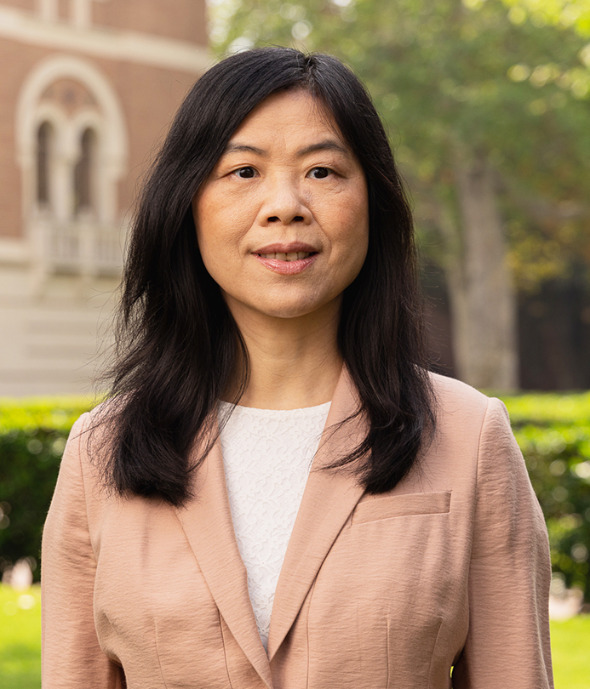
Sha Yang serves as the Ernest Hahn Professor of Marketing at the Marshall School of Business, University of Southern California, where she has held full-time faculty positions since 2017 after progressing from Assistant to Associate Professor roles at New York University and UC-Riverside. Her research examines interdependencies in consumer preferences, social influences on decision-making, and competitive dynamics in advertising, pricing, and platform growth. Her educational background includes a PhD in Marketing (2000) and MA in Statistics (1998) from Ohio State University, complemented by an MA in Economics (1995) and BA in International Economics (1994) from Renmin University of China. Her methodological expertise spans Bayesian methods, structural modeling, and data analytics applied to consumer behavior. Yang's research portfolio reveals consistent focus on digital marketing phenomena, with recent work analyzing cross-category spillovers in advertising, review impacts under negotiated pricing, and psychological pricing effects in luxury markets. Her publications in Journal of Marketing , Management Science , and Marketing Science demonstrate interdisciplinary approaches bridging econometrics and behavioral insights. Among her recognitions is the Marketing Science Institute Young Scholar award. She has served as Associate Editor for Journal of Marketing (2017-present) and Marketing Science (2017-2024), reflecting her scholarly impact. Marketing Science Institute Young Scholar Associate Editor, Journal of Marketing (2017-present) Associate Editor, Marketing Science (2017-2024) VP, INFORMS Society for Marketing Science Administratively, Yang served as Vice Dean and Senior Vice Dean for Faculty and Academic Affairs at Marshall School of Business (2020-2023), overseeing faculty development and academic strategy. Her current research integrates causal inference methods with media and entertainment industry applications, supported by grants from marketing research institutions.
David S. Matteson is a Professor and Associate Department Chair in the Department of Statistics and Data Science at Cornell University. He holds affiliations with the Bowers College of Computing and Information Science, the ILR School, the Center for Applied Mathematics, and the Program in Financial Engineering. His research focuses on developing statistical and machine learning methodologies for complex systems, with applications in finance, environmental science, healthcare, and nanotechnology. He received his PhD in Statistics from the University of Chicago and a BSB in Finance, Mathematics, and Statistics from the University of Minnesota. His awards include the NSF CAREER Award (2015), SUNY Chancellor’s Award (2022), and Fellowships from the Institute of Mathematical Statistics and American Statistical Association (2024). Research interests span theoretical methods like changepoint analysis, high-dimensional time series, and functional data, alongside applied domains such as systemic risk, climate change, and medical imaging. He leads major NSF-funded initiatives including the PRISM Institute for Trans-domain Systemic Risk and the TRIPODS Greater Data Science Cooperative Institute (GDSC). Editorial Roles: Founding Editor-in-Chief of Data Science in Science , Associate Editor for Journal of Econometrics , and former editor for multiple statistical journals. Leadership: Chair of the ASA’s Business and Economic Statistics Section (2024), Director of the National Institute of Statistical Sciences (NISS). Grants: PI/Co-PI on NSF and USAID projects addressing systemic risk, energy systems, and poverty estimation.
John Leahy is the Allen Sinai Professor of Macroeconomics and Public Policy at the University of Michigan, holding dual appointments in the Department of Economics (College of Literature, Science, and the Arts) and the Gerald R. Ford School of Public Policy. As Chair of the Economics Department, he focuses on macroeconomic theory, monetary policy, and behavioral economics, particularly rational inattention models. His research emphasizes how cognitive limitations and information processing affect economic decisions, contrasting classical economic assumptions. Leahy has held positions at Harvard, NYU, and Boston University, and served as Coeditor of the American Economic Review and Editor of the American Economic Journal: Macroeconomics. He consults with Federal Reserve Banks, advocating for data-driven, question-first research methodologies. His work bridges theoretical rigor and practical applications, influencing policy analysis and academic discourse. Education: PhD in Macroeconomics from Princeton University; MSFS from Georgetown University; BA in Math and History. His research spans macroeconomic policy, structural change, and behavioral models of decision-making, with recent focus on wishful thinking and imperfect information processing. He collaborates widely, emphasizing interdisciplinary approaches and creative problem-solving. Key contributions include modeling rational inattention, analyzing age structure impacts on monetary policy, and exploring North-South economic disparities. His editorial leadership and academic mentorship reflect his commitment to advancing innovative economic inquiry.
Ivan Canay is a Professor of Economics and Director of the Mathematical Methods in the Social Sciences Program at Northwestern University’s Weinberg College of Arts & Sciences. He holds a PhD from the University of Wisconsin, Madison (2008). His research focuses on econometric theory, particularly developing statistical methods for assessing partially identified models, including tests for moment inequalities and randomization-based inference techniques. Recent work addresses challenges in clustered data analysis, covariate-adaptive randomization, and regression discontinuity designs. Canay’s academic contributions include advancing methodologies for handling non-ignorable cluster sizes and improving the robustness of inference in settings with limited data. He serves as an associate editor for the Journal of Econometrics , Journal of Business and Economic Statistics , and Econometrics Journal . His work bridges theoretical econometrics with practical applications in policy evaluation and causal inference. Key research themes include: Partially identified models and moment inequality frameworks Bootstrap methods for clustered data Covariate-adaptive randomization in clinical trials Statistical software development (e.g., Stata modules) His publications emphasize methodological rigor while addressing real-world complexities in economic data. Current projects likely expand his work on inference under structural constraints and improving accessibility of econometric tools for applied researchers.
Asu Ozdaglar is the EECS Department Head and MathWorks Professor at MIT, serving as Deputy Dean of Academics in the MIT Schwarzman College of Computing. Her research bridges optimization theory, machine learning, and network science with societal implications, focusing on AI ethics, data-driven decision systems, and strategic interactions in networked environments. Her technical contributions include foundational work on large-scale optimization algorithms (e.g., distributed methods, first-order methods), game-theoretic models for network systems, and federated learning frameworks. Recent work addresses critical societal challenges like misinformation dynamics, data market inefficiencies, and algorithmic fairness in AI systems. Publications from 2023-2025 highlight advancements in graphon-based network game analysis, privacy-preserving data mechanisms, and multi-agent learning dynamics. She co-leads initiatives in MIT's AI+D program, emphasizing interdisciplinary education and ethical AI development. Notable institutional roles include oversight of MIT's computing education strategy and contributions to pandemic-related research on infection control through testing optimization. Her work integrates technical rigor with policy-relevant insights, influencing both academic and real-world systems.
Tao Zou is an Associate Professor at the Research School of Finance, Actuarial Studies and Statistics, Australian National University. His research spans covariance regression modeling, network data analysis, and applications in financial and environmental statistics. He earned a Ph.D. in Statistics in 2016. Ph.D. in Statistics, 2016 Dr. Zou’s work pioneers covariance regression, where covariances are modeled as functions of covariiates. Key contributions include robust estimation techniques, spatio-temporal modeling, missing data imputation via semi-supervised learning, and distributed data aggregation. His methods address challenges in high-dimensional and non-Euclidean data analysis. Recent publications (2025–2023) explore quasi-score matching for spatial autoregressive models, regularization in network regression, functional principal component analysis for complex data, and environmental applications like PM2.5 pollution studies. These works emphasize robustness, scalability, and interdisciplinary relevance in economics, finance, and environmental science. Dr. Zou collaborates on projects like the 2023 Data Analysis App to Empower Assessment of Immunogenicity of Biologics (Co-Investigator). While his student supervision list isn’t explicitly provided, his methodological advancements influence big data and spatial statistics. He contributes to open-access software and continues expanding covariance regression for non-normal and functional data.
Prof. Jalal Etesami is an Assistant Professor in the Department of Computer Science at Technical University of Munich (TUM), leading the Decision Sciences & Systems group. He holds a Ph.D. in Industrial and Systems Engineering from the University of Illinois at Urbana-Champaign and was a Postdoctoral Fellow at EPFL in Switzerland. His research focuses on machine learning, causal inference, multi-agent systems, and game theory, with applications to systemic risk modeling and market design. He teaches advanced courses such as Causal Inference in Time Series , Algorithmic Game Theory , and Optimization, Learning, and Market Design . Notable contributions include work on causal structure learning, stochastic optimization, and non-Gaussian causal models. Recent research explores causal effect identification under confounding, neural networks for market analysis, and optimal experiment design. Prof. Etesami’s work appears in top venues like NeurIPS, AAAI, and IEEE journals. He actively contributes to the academic community, organizing seminars and workshops on topics ranging from causal reasoning to computational social choice.