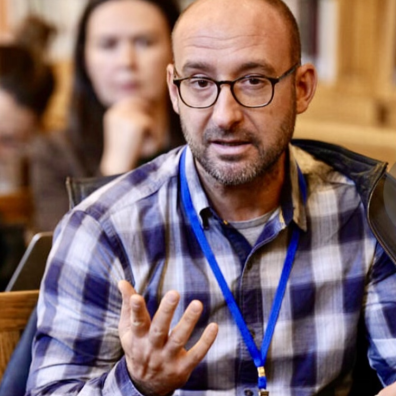
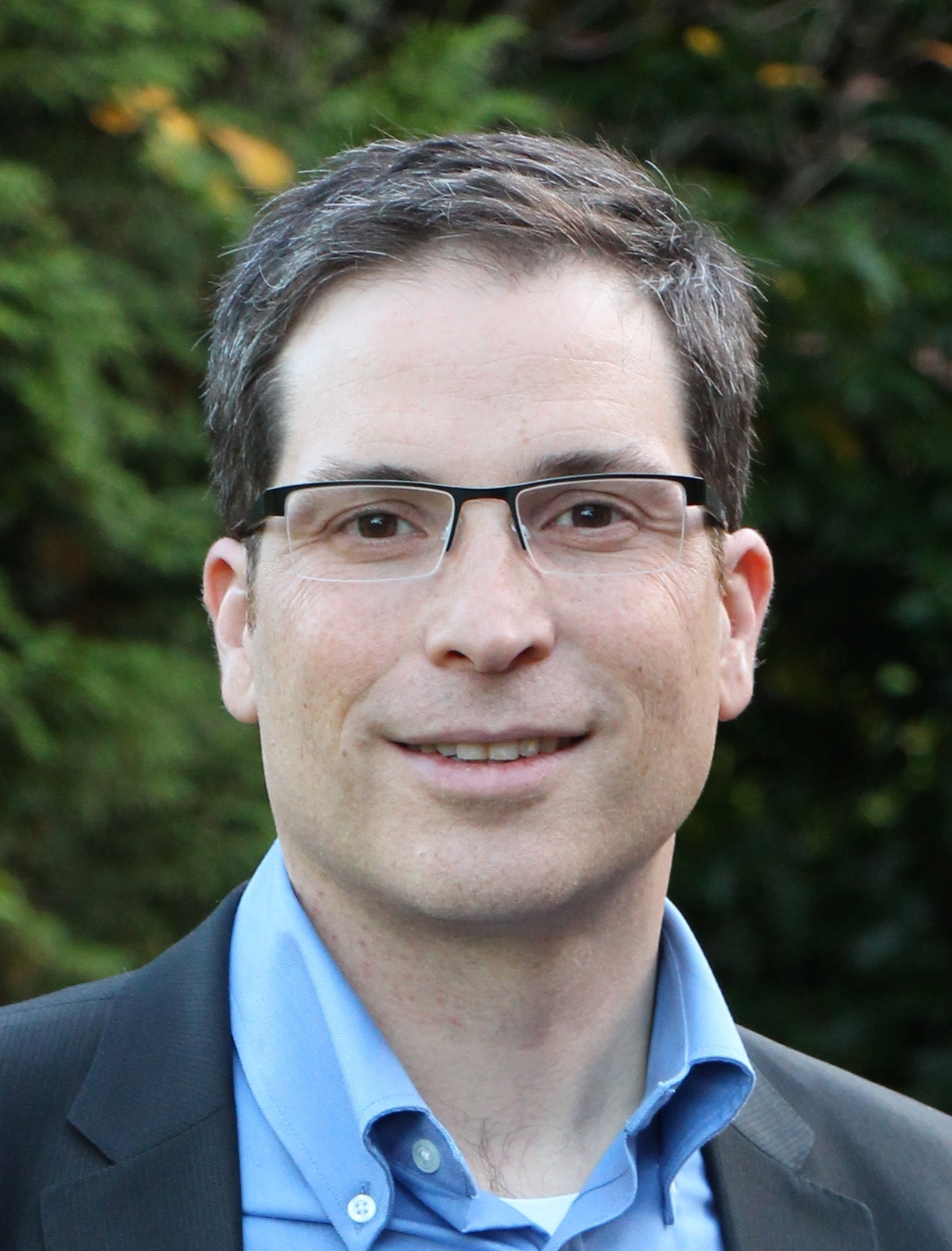
Manuel Mucientes Molina is a Full Professor at the Research Center on Intelligent Technologies (CiTIUS) within the University of Santiago de Compostela . His research focuses on Artificial Intelligence , particularly in Computer Vision and Machine Learning , with applications in object detection, process mining, and healthcare diagnostics. Research Areas : Machine learning, Computer vision, Process mining, Deep learning, AI for healthcare. Projects : Protonterap-IA (2025), AZOR (2024), RAI4P (2021), eXplica-IA (2018), DronePlan (2014), SoftLearn (2012). Publications highlight advancements in few-shot object detection, small object tracking, and AI-driven conformance checking. Notable collaborations include work on X-ray vision systems and medical mask detection in operating rooms. Awards : Best Student Paper Nomination (2015), Runner-up best industry-oriented paper award (2008). Teaching includes courses on Statistical Learning, Deep Learning, and Automata Theory at the M.Sc. and B.Sc. levels.
Mardale Alexandru is a University Professor at Inalco , affiliated with the Europe Department and the SeDyL research center. His work focuses on the syntax–semantics–discourse interface, particularly in heritage Romanian contexts, differential object marking, and the grammaticalization of prepositions in Romance languages. Research Interests: His expertise spans heritage language acquisition, linguistic expression of displacement, and modality in Romanian. He examines how language contact and reduced input affect syntactic structures, with a strong emphasis on grammaticalization processes and case-preposition interactions. 2024-2023 publications highlight his work on heritage Romanian in France, differential object marking, and clitic doubling. 2022-2003 contributions explore complex prepositions, animacy effects, and diachronic changes in Romanian syntax. Administrative Roles: He serves as Head of Romanian Studies and Educational Manager of the cross-disciplinary Linguistics course (LGE) at Inalco. He holds key positions in institutional governance, including membership in the Scientific Council and Research Commission.
Saint-Joanis Olena is a Lecturer at INALCO's Department of Slavic Languages and Literature, specializing in Ukrainian language processing and pedagogy. She coordinates the Erasmus+ project EUkraine Forum and co-organizes the Rencontres des linguistes du CREE conference. Her work involves developing online pedagogical tools for Ukrainian through the Erasmus+ Lesser-Used Languages Classroom project. Her research focuses on formalizing Ukrainian language structures within the NooJ framework, including verb aspect relations, morphological grammars, and language variant formalization. She has presented at multiple international NooJ conferences and TALN-RECITAL, with publications in edited volumes and conference proceedings. She teaches Ukrainian language courses at all undergraduate and master's levels, including written practice, grammar exercises, and media language, while also developing continuing education programs. Her technical contributions include Ukrainian dictionary creation and disambiguation grammar implementations for NLP applications.
Li Lan is a distinguished Chair Professor at Southern University of Science and Technology (SUSTech), serving as Director of the Language Competence and Language Recognition Center and President of Shuli Academy. Previously, he held significant positions at the Chinese Academy of Social Sciences, including Vice Director (2003-2012) and Director (2013-2016) of the Dialect Studies Program. His research interests span Chinese dialectology, phonology, dialect grammar, history of Chinese language, and international phonetic alphabet. Professor Li specializes in dialect survey methodology and has led numerous major research projects, including the "Demonstrative dialectal survey and research of the crucial dialectal regions in China" (2013-2019) and "The collection and digitalization of the dialectal data in local records" (2015-2020). His extensive publication record reveals a consistent focus on Chinese dialect classification, historical phonology, and linguistic documentation. His most recent work addresses critical issues in dialect preservation, phonological analysis, and language policy, with particular attention to regional variations across China's diverse linguistic landscape. Second Prize of Wang Li Linguistics Award from Peking University (2005) Wu Yuzhang Award for Excellence in Humanities and Social Sciences (2002) National Dictionary Award First Prize (2003) China Publishing Government Award nomination (2013) Professor Li actively mentors doctoral students and has served on the Academic Committee of the Chinese Academy of Social Sciences since 2015. His research has received substantial funding from National Social Sciences Grants and Chinese Academy of Social Sciences Innovation Projects. Beyond pure academic research, he has established significant connections between linguistic scholarship and practical language policy through his work with government bodies. His scholarly work is complemented by leadership in major research platforms including the Bulletin of Chinese Linguistics (as associate editor-in-chief since 2007) and various national dialect documentation initiatives.
Abraham Bernstein is a Full Professor of Informatics at the University of Zurich (UZH), where he serves as Head of the Dynamic and Distributed Information Systems Group and Director of the UZH Digital Society Initiative. He leads a university-wide initiative with over 180 faculty members investigating the interplay between society and digitalization. His work bridges social science foundations (organizational psychology/sociology/economics) and technical disciplines (computer science, artificial intelligence), creating a unique interdisciplinary approach to digital transformation challenges. Education: Diploma in Computer Science from ETH Zurich Ph.D. in Management with concentration in Information Technologies from MIT's Sloan School of Management Professor Bernstein's research spans the Semantic Web, data mining/machine learning, recommender systems, crowd computing, and collective intelligence. His work uniquely integrates social science perspectives with technical computer science approaches, examining how social and technical elements interact in digital systems. Recent work focuses on explainable AI, ethical decision-making with AI systems, and the societal implications of digital transformation, reflecting his commitment to addressing both technical challenges and their broader societal context. His publication record shows a strong trajectory in multimodal information retrieval, knowledge representation, and human-AI collaboration, with increasing focus on ethical considerations and societal impact of AI technologies. The research demonstrates consistent innovation in bridging technical AI capabilities with human-centered design principles, particularly in areas like explainable recommender systems and democratic applications of AI. Scientific Recognition: Nominated Digital Shaper by Bilanz magazine (2017) Professor Bernstein has supervised over 30 PhD students whose work spans semantic technologies, data mining, recommender systems, and human-AI interaction. His research group has secured significant funding for projects related to digital society, knowledge representation, and AI ethics. As Director of the Digital Society Initiative, he coordinates cross-disciplinary research across UZH's faculties, bringing together scholars from humanities, social sciences, law, economics, and STEM fields to address complex digital transformation challenges. He leads the Dynamic and Distributed Information Systems Group at UZH, which maintains strong international collaborations and contributes significantly to both theoretical advances and practical applications in information systems. The group's work has influenced standards in semantic web technologies and continues to shape discourse on responsible AI development and deployment in society.
Céline Vaguer is a Lecturer at Université Toulouse - Jean Jaurès, affiliated with the Cognition, Languages, Ergonomics (CLLE) school. Her academic work focuses on French syntax, lexical & grammatical semantics, and discourse analysis. Syntactic Constructions Lexical Semantics Discourse Markers Phraseology Translation Studies Her research explores how linguistic forms interface with meaning, particularly through prepositions, adverbial phrases, and discourse markers. She has extensively analyzed expressions like en même temps and genre in spoken French, revealing their enunciative and argumentative roles. Recent publications (2022-2024) highlight her work on synonymy (vélo/bicyclette), discursive categorization (genre), and syntactic constructions. She serves as an editorial manager for journals like Langages and Langue française , contributing to academic discourse through Varia issues.
Professor Irina Nikolaeva is affiliated with the School of Languages, Cultures and Linguistics (LAC) at SOAS University of London . Her research focuses on linguistic typology, morphosyntax, and endangered languages, particularly in Siberian and Uralic language families. Primary Affiliation: School of Languages, Cultures and Linguistics, SOAS University of London Email: in3@soas.ac.uk Her work explores: possessive constructions and switch-reference systems mixed categories in noun modification morphosyntactic features in Tundra Nenets and Yukaghir polarity focus and finiteness in typological frameworks Recent publications analyze vowel harmony in Yukaghir, contact-induced morphosyntactic changes in Siberia, and the morphosyntactic properties of internal possessors across diverse languages. Her scholarship bridges theoretical linguistics with fieldwork on endangered languages.
Vince Lyzinski is an Associate Professor in the Department of Mathematics at the University of Maryland, College Park, with additional affiliations in the Applied Mathematics, Statistics, and Scientific Computation (AMSC) program. His work spans statistical network inference, graph matching algorithms, and machine learning applications to complex networks. Ph.D. in Applied Mathematics and Statistics (2013), M.S.E. (2011), and M.A. (2007) from Johns Hopkins University B.S. in Mathematics from University of Notre Dame (2006) His research focuses on statistical network inference , particularly graph matching and vertex nomination , with applications to connectomics and adversarial activity analytics. Supported by DARPA MAA , AFOSR , and JHU HLTCOE , he develops algorithms like iGraphMatch for graph alignment and analysis. Recent publications (2025-2023) explore vertex label error impacts, network trimming for robustness, and stochastic blockmodel extensions. Key papers include "Asymptotically Perfect Seeded Graph Matching" and "ACRONYM: Augmented Degree-Corrected Network Models" . Scientific Awards : Best Paper Award at GTA3 2018 Workshop He has advised 13 Ph.D. students and 1 postdoc across UMD , JHU , and Texas A&M , including Keith Levin (now at UW-Madison) and Jesus Arroyo (now at Texas A&M). His DARPA-funded team includes researchers from UMass, UMD, BU, and JHU.
Dr Kyla Hudson is a Research Fellow at the School of Health and Rehabilitation Sciences, The University of Queensland. She works within the Centre for Clinical Research Excellence (CCRE) in Aphasia Rehabilitation and the Communication Disability Centre, focusing on aphasia rehabilitation and the application of the International Classification of Functioning, Disability and Health (ICF) framework, particularly participation and environmental factors. PhD in Speech Pathology, The University of Queensland Master of Speech Pathology, The University of Queensland Active in research supervision and grant-funded studies Her research spans qualitative analysis of aphasia recovery, telepractice communication training, and interventions for healthcare professionals. She has led studies on preventing post-stroke depression, peer-led aphasia support, and cultural adaptation of rehabilitation strategies in Vietnam. Grants include NHMRC and National Stroke Foundation funding. Recent publications highlight trends in telepractice , communication partner training , and ICF-based rehabilitation . She emphasizes participatory approaches and environmental factors in aphasia management. Dr Hudson is available for supervision and collaborates with multidisciplinary teams across healthcare , education , and clinical research domains.
Jan Schymik is an Acting Professor of Economics (W3 fix-term) at the University of Mannheim and an affiliated member of the Bonn-Mannheim Center for Collaborative Research CRC TR 224. His research focuses on International Economics, Macroeconomics, and Organizational Economics, with significant contributions to understanding trade policy, firm organization, and macroeconomic spillovers in currency unions since joining the university in 2018. His educational background includes: PhD in Economics from Ludwig Maximilian University of Munich Diploma in Business Economics from University of Mannheim Schymik's research agenda bridges theoretical modeling and empirical analysis across three core domains. In international economics, he examines how trade policies reshape global supply chains and industrial structures, particularly through directed technological change in critical resources. His macroeconomic work analyzes structural reforms in currency unions and pandemic-era labor market dynamics. Organizational economics research investigates how managerial incentives affect capital allocation and firm structure under globalization. Recent projects integrate these threads to study industrial policy in global value chains. Analysis of his 15 most recent publications reveals accelerating focus on supply chain resilience (2025), with rare earth elements research demonstrating how export restrictions spur global innovation. Earlier work establishes foundational links between trade liberalization, corporate governance, and income inequality. Methodologically, he combines structural modeling with novel datasets including patent classifications, administrative records, and input-output tables. His scientific recognition includes: FIW International Economics Conference Best Paper Award Walther-Rathenau Best Paper Award Schymik actively supervises Bachelor and Master theses on International Trade, Macroeconomics, and Firm Organization, with all Spring 2025 slots filled. He secured German Research Foundation (DFG) funding for his 2025 project 'The New Economics of Industrial Policy in a Global Economy'. Additional support includes a 2022 Fulbright fellowship for visiting research at Harvard Business School. His teaching portfolio spans graduate-level International Macroeconomics and undergraduate Organizational Economics. He contributes to the Bonn-Mannheim Center for Collaborative Research CRC TR 224, focusing on competition microstructure, and maintains active collaborations with institutions including the World Bank, ECB, and Banque de France as evidenced by recent speaking engagements.
Dr. Lara Kobilke is a Visiting Professor at the Hanover University of Music, Drama and Media (HMTMH) from October 2025 to April 2026, working under Prof. Helmut Scherer in the Institute of Communication Science. Simultaneously, she holds a PostDoc position in Computational Communication Research at LMU Munich under Prof. Mario Haim since April 2024. Her academic journey includes previous PostDoc positions in Political Communication Research and media effects research at LMU Munich, and research roles at the University of Zurich. Dr. Kobilke's research centers on psychological reactance and resistance communication, examining how people respond when they perceive their freedom is being restricted. She investigates these mechanisms particularly in social and global crisis contexts, combining psychological, communicative, and socio-theoretical perspectives. Her work extends into political communication and deliberation, health communication with focus on social media challenges (especially TikTok), AI-supported communication, and computational communication research using advanced data analysis methods. Her recent publications reveal a strong focus on understanding resistance to climate communication, developing measurement tools for psychological reactance, analyzing social media challenges' impact on youth, and exploring cross-cutting exposure effects on political participation. Dr. Kobilke's work bridges theoretical development with practical applications in crisis communication and digital media environments. ICA Top Student Paper Award of the Environmental Communication Division (2025) ICA Top Student Paper Award of the LGBTQ+ Interest Group (2020) Nominated for Ars Legendi Prize for Excellence in University Teaching (2025) Multiple teaching awards at LMU Munich for innovative courses on TikTok challenges and AI in electoral decisions Faculty Award performance bonus (€3000, 2020) Dr. Kobilke actively supervises students and develops methodological tools through her role as coordinator of the R-Curriculum at LMU Munich. Her research is supported by grants from the Bavarian Research Institute for Digital Transformation and LMU Munich's Sustainability Fund. She serves as Speaker of the Early Career Network for Political Communication (NapoKo) and regularly reviews for leading international communication journals.
Professor Tim Straub serves as Professor for General Business Studies, particularly Management of Digital Technologies at Hochschule Reutlingen's ESB Business School since 2023. He also holds the position of Programme Director for the BSc International Management Double Degree (IMX) and Programme Leader for the German-Mexican Double Degree program. His academic journey includes previous roles as Interim Professor for Information Systems and Business Analytics (2021-2023), Department Lead at FZI Forschungszentrum Informatik (2019-2021), and research positions at Karlsruhe Institute for Technology. His educational background includes: Doctorate (Dr. rer. pol.) from Karlsruhe Institute for Technology (2017) Master of Science in Information Engineering and Management from Karlsruhe Institute for Technology (2010-2013) Bachelor of Science in Information Engineering and Management from Karlsruhe Institute for Technology (2006-2010) Professor Straub's research spans Management Information Systems, Platform Economics, and Business Analytics with a recent strong focus on industrial applications of artificial intelligence. His work bridges theoretical frameworks with practical manufacturing applications, particularly in explainable AI for root cause analysis, production optimization, and quality control in industrial settings. He has developed frameworks that combine machine learning with traditional quality management approaches like the Ishikawa model, making AI more accessible to shopfloor workers. Analyzing his 15 most recent publications (2022-2025), a clear trend emerges toward applied AI research in manufacturing contexts. Approximately 75% of his recent work focuses on AI applications in industrial production, particularly CNC tool manufacturing, gear production, and quality control systems. His research consistently emphasizes explainability, ensuring AI systems provide transparent reasoning that industrial workers can understand and trust. The interdisciplinary nature of his work combines information systems theory with mechanical engineering applications. Professor Straub maintains an active research agenda with consistent publication output across top conferences and journals in information systems and manufacturing. His collaborative approach is evident in his extensive co-authorship network, particularly with researchers like Daniel Kiefer, Günter Bitsch, and Clemens van Dinther. While specific funding sources aren't detailed in the provided information, his applied research focus suggests strong industry partnerships and potential involvement in German government-funded digitalization initiatives, as indicated by publications in the 'Projektatlas Künstliche Intelligenz in der Produktion' supported by the Federal Ministry of Education and Research. Students working with Professor Straub would engage with cutting-edge research at the intersection of business administration and digital technologies, with particular opportunities in AI applications for manufacturing industries. His role as program director for international double degree programs indicates a commitment to global educational experiences and cross-cultural business perspectives.
Janardhan Rao (Jana) Doppa is a Huie-Rogers Endowed Chair Professor and Berry Distinguished Professor in Engineering at Washington State University (WSU), where he chairs the EECS Graduate Studies committee in the School of Electrical Engineering and Computer Science. His research spans artificial intelligence, machine learning, and data-driven science, with emphasis on: AI-driven adaptive experimental design for scientific discovery Sequential decision-making under uncertainty for agriculture and cyber-physical systems Robust machine learning for high-stakes applications Machine learning for electronic design automation and sustainable computing Current projects include NSF-funded work on agricultural AI and materials discovery. Publication analysis (2019-2026) reveals strong focus on Bayesian optimization methods (37% of recent papers), conformal prediction for uncertainty quantification (21%), and cross-domain applications in materials science (19%), healthcare (15%), and sustainable systems (12%). Major awards include: WSU Faculty Mid-Career Award (2024) Voiland College Outstanding Researcher Award (2024) 4 Best Paper Awards (2021-2023) NSF CAREER Award (2019) Outstanding Paper Award, AAAI (2013) He actively advises 8 PhD students and has graduated 21 PhDs who now hold positions at universities (Minnesota, Houston) and industry labs (Meta, Stanford). Research is supported by NSF, USDA, and industry grants exceeding $5M. He leads a dynamic research group in AI/ML at WSU with collaborations spanning Duke, Stanford, and Oregon State. Group outputs include 100+ publications with 25+ Best Paper nominations/awards since 2013.
Roland Barthel serves as Professor in the Department of Geosciences at the University of Gothenburg's Faculty of Science and concurrently holds the position of Vice-Dean for the Faculty Office of Natural Sciences and Technology. Previously Head of Department (2018-2022), he specializes in groundwater resources within the context of climate change impacts across Sweden and Europe. His research integrates hydrological science with socioeconomic factors to address critical water challenges including drought, scarcity, and extreme weather events. Barthel emphasizes the societal dimensions of water management, particularly regarding unregulated private wells that constitute a significant portion of Sweden's drinking water supply. His interdisciplinary approach bridges natural and social sciences to develop implementable solutions requiring consideration of economic, political, and social frameworks alongside physical system understanding. Analysis of his publication record reveals a dominant focus on data-driven methodologies for groundwater dynamics assessment, drought propagation analysis, and climate adaptation strategies. His work consistently emphasizes regional-scale studies in temperate and high-latitude environments, with increasing attention to interdisciplinary collaboration frameworks. Scientific recognition includes: Student Union's Pedagogical Award (2014) Student Union's Pedagogical Award (2016) As an educator, Barthel pioneered hydrology instruction at the university by developing the master's course Applied Hydrology (GVG460) and undergraduate Hydrology and Hydrogeology (GV2002). He leads Earth Sciences thesis supervision, chairs the program committee, and contributes to multiple geoscience courses. His teaching excellence earned three consecutive pedagogical award nominations with wins in 2014 and 2016. He currently participates in an EU Erasmus+ project developing digital teaching tools with European partners, addressing high market demand for groundwater specialists in Swedish infrastructure and environmental sectors.
Dr. Yunfang Zheng serves as Professor and Director of the Audiology Division within the Department of Communication Sciences & Disorders at Central Michigan University's Herbert H. & Grace A Dow College of Health Professions. With dual credentials as an MD (Suzhou Medical College) and ScD in Audiology (Montclair State University), she bridges clinical medicine and audiological science. Previously, she led the Audiology Department at Saint Peter's University Hospital and served as Adjunct Professor at Montclair State University. Her research program centers on diagnostic audiology, amplification systems, cochlear implants, and aural rehabilitation. The Zheng Psychoacoustics Lab, established in 2014, investigates critical challenges including: Sound localization in noise/reverberation for cochlear implant users OTC hearing aid self-fitting versus professional protocols 3D ear scanning clinical implementation Hidden hearing loss diagnostics Recent publications demonstrate increasing industry collaboration, with 2023-2025 work focusing on real-world validation of emerging hearing technologies. Dr. Zheng's scientific contributions are recognized through: Nomination for CMU President Award for Outstanding Research (2020) Multiple AAA conference poster awards including 2024 Professional Poster Award nomination Sustained external funding including $93,395 hearing aid research grant Mentorship of award-winning doctoral students As an active educator, she teaches advanced audiology courses while directing the AuD program. Her lab maintains strong clinical partnerships and emphasizes student-led research with direct pathways to industry implementation. Current projects address FDA regulatory needs for OTC hearing devices and improved cochlear implant rehabilitation protocols.