Eng-Jon Ong is a Research Fellow at the University of Surrey's Centre for Vision, Speech and Signal Processing (CVSSP) within the Faculty of Engineering and Physical Sciences. His work spans computer vision, machine learning, and human-computer interaction, with a focus on facial feature tracking, lip reading, sign language recognition, and biomedical applications of deep learning. University: University of Surrey Department: Centre for Vision, Speech and Signal Processing (CVSSP) Affiliations: CVSSP research group Research Interests: Ong specializes in advanced computer vision techniques, including real-time 3D reconstruction, facial expression analysis, and automated lip-reading systems. His work bridges theoretical machine learning with practical applications like medical imaging (protein localization) and media production (virtual studios). Notable contributions include: Development of robust facial feature tracking algorithms using linear predictors and AAMs Pioneering methods for sign language recognition via sub-unit analysis Deep learning architectures for single-cell protein localization (HCPL system) Real-time lip-reading systems with state-of-the-art accuracy Publications reflect a strong focus on temporal pattern recognition, ensemble learning, and cross-modal interaction analysis. Recent work emphasizes biomedical applications, such as improving protein localization accuracy through novel deep learning ensembles. Labs/Teams: Active contributor to CVSSP's multidisciplinary research projects in computer vision and machine learning.
Randall C. Wetzel, MD, is Professor and Chairman of Anesthesiology Critical Care Medicine at Children's Hospital Los Angeles and Keck School of Medicine, University of Southern California. He directs the Laura P. and Leland K. Whittier Virtual Pediatric Intensive Care Unit (VPICU) – a telemedicine network advancing critical care delivery. Trained at St. Bartholomew's Hospital (MD) and Johns Hopkins (MS Business), his career spans over 40 years with $18M+ in research funding. His pioneering work fuses critical care medicine with informatics innovations: Founded VPS, LLC managing quality/data for 120+ hospitals Developed big data infrastructure for granular PICU analytics Created the VPICU telemedicine network transforming regional critical care Research focuses on advanced analytics in pediatric critical care, including machine learning models for: Real-time mortality prediction Ventilator weaning optimization Cardiac death forecasting post-extubation BiPAP/HFNC failure anticipation With 94 peer-reviewed articles, 45 book chapters, and editorship of "Critical Heart Disease in Infants and Children," he has shaped pediatric intensive care standards. Current work examines multi-institutional data ecosystems through the PICU Data Collaborative and acute kidney injury prediction models.
Dr. Stuart Cunningham is a Senior Lecturer in Computer Science at the University of Chester, where he also serves as Programme Leader for the MSc Advanced Computer Science, REF Unit of Assessment 11 co-ordinator, and Senior Postgraduate Research Tutor. Previously, he held roles at Manchester Metropolitan University (Visiting Research Fellow and Senior Lecturer) and Glyndwr University (Reader in Audio and Affective Computing, Head of Department, and Lecturer/Senior Lecturer). With 20+ years in higher education, his expertise spans academic leadership, teaching, and research in computing and creative technology hybrids. He holds a PhD in Computer Science from the University of Wales (2009), an MSc in Multimedia Communications from the University of Paisley (2003), and a BSc in Computer Networks (2001). Cunningham’s research focuses on affective technologies, audio compression (e.g., ACER codec), and interdisciplinary applications of sound design in fields like healthcare, gaming, and film. He chairs the Audio Mostly steering committee and contributed to the MPEG-SMR working group developing ISO/IEC 14496-23:2008. His work bridges technical and creative domains, exploring biofeedback sensors for emotional state analysis, Foley artistry in 3D animation, and auditory alerts in safety systems. He advocates for practice-led research methodologies that combine creative outputs with empirical validation. Cunningham has authored numerous publications, including research articles, book chapters, and creative works, and actively participates in peer reviewing for journals like IEEE Transactions and Personal and Ubiquitous Computing . In teaching, he emphasizes interactive/collaborative learning and portfolio-based assessment across undergraduate and postgraduate courses. He has designed and delivered degree apprenticeship programs, particularly during the pandemic, and teaches courses like Web Systems, Software Development, and User Experience Design. His research also extends to UX education, esports analytics, and assistive technologies for dementia care.
Hua Fang is an Adjunct Professor in the Department of Population and Quantitative Health Sciences at UMass Chan Medical School and the T.H. Chan School of Medicine. She serves as Principal Investigator of the Computational Statistics and Data Science (CSDS) lab, which focuses on developing computational methods for health and behavior studies through the integration of statistics and computer science. Her educational background includes: BA in Business English from Sichuan International Studies University, China MA in Financial Economics from Ohio University, United States PhD in Statistics from Ohio University, United States Dr. Fang's research spans multiple domains at the intersection of computational statistics, data science, and healthcare. Her work primarily focuses on developing advanced methods for analyzing longitudinal data, particularly in the context of behavioral interventions and health monitoring. She has pioneered the Multiple-imputation based Fuzzy Clustering (MIFuzzy) approach for trajectory pattern recognition in incomplete longitudinal data, which has been applied across various health domains including substance use, dietary patterns, and mental health. Her research integrates statistical theory with computational approaches to address challenges in missing data, pattern recognition, and real-time monitoring through wearable biosensors. She leads multiple NIH and NSF-funded projects exploring computational methods for health applications, with a particular emphasis on digital health interventions and precision medicine. Her recent publications demonstrate a strong trend toward digital twin technology, federated learning approaches for healthcare data, and advanced neural network architectures for medical applications. There's a clear progression from traditional statistical methods to more sophisticated AI-driven approaches, with increasing focus on privacy-preserving techniques like federated learning for multi-site clinical data analysis. Her work bridges computational statistics with practical healthcare applications, particularly in substance use detection, dietary pattern analysis, and real-time health monitoring. Dr. Fang's scientific recognition includes: Patent "System and methods for trajectory pattern recognition" (US20160358040A1), issued June 1, 2021 Best Paper Award for "Deep Learning-based adaptive beam forming for 5G mmWave Wireless body area network" at GLOBECOM2020 Abstract Citation Award from the Society of Behavioral Medicine As an advisor, Dr. Fang has mentored numerous graduate students and researchers who have gone on to positions at prestigious institutions including Harvard, Stanford, MIT, and faculty positions at universities. Her research is supported by multiple NIH grants including R01, R56, and P30 awards, as well as NSF funding for projects related to wireless body area networks and connected vehicle technology. Current major projects include iPAT (NIH/NIDDK R01), VIP (NIH/NIDDK R56), and several NSF-funded initiatives in wireless communication and machine learning. The Computational Statistics and Data Science (CSDS) lab, led by Dr. Fang, collaborates with researchers across multiple disciplines including psychiatry, behavior medicine, emergency medicine, immunology, infectious diseases, and healthcare systems. The lab works closely with the IoT and Data Engineering Lab and the UConn Center for mHealth and Social Media, creating an interdisciplinary research environment that bridges computational methods with real-world health applications. Current research focuses on developing computational tools for adaptive interventions, pragmatic clinical trials, causal inference, and risk prediction using longitudinal data from diverse health domains.
Andrew Kolarik is a Lecturer in Psychology at the School of Psychology, University of East Anglia, and a member of the Auditory Perception Group at Cambridge University. His research focuses on auditory perception, particularly how sensory impairment affects spatial awareness and how blind individuals develop enhanced auditory abilities. Dr. Kolarik earned his BA in Psychology from Cardiff University in 2003 and completed his PhD in 'Binaural Resolution' at the same institution in 2006. His academic career includes postdoctoral positions at Cardiff University (studying vision science and eye movements in aging populations), Anglia Ruskin University (Vision and Eye Research Unit), Cambridge University (working with Professor Brian Moore), and the Centre for the Study of the Senses at the University of London (with Sir Colin Blakemore). His research examines how sensory impairment affects spatial awareness, particularly investigating whether supra-normal performance for auditory spatial tasks among blind listeners can be explained by cross-modal cortical reorganization. He uses virtualization techniques and self-report methodologies to determine whether accurate internal representations of auditory space are formed without visual input and under what conditions blind individuals demonstrate enhanced hearing abilities. His work also explores spatial awareness, speech perception among hearing impaired and blind listeners, and how echolocation can guide locomotion. Dr. Kolarik has published extensively in top journals including Psychological Review, PLoS One, Attention, Perception & Psychophysics, and Hearing Research. His publications have accumulated hundreds of citations and significant attention across academic and popular media platforms. His professional recognitions include: Chartered Psychologist (CPsychol), 2019 Chartered Scientist (CSci), 2019 Fellow of the British Society of Audiology (FBSA), 2022 Fellow of the Higher Education Academy (FHEA), 2018 Dr. Kolarik is an active member of the academic community, serving as a peer reviewer for journals like Attention, Perception & Psychophysics, and regularly participating in academic events including invited talks at institutions such as Durham University, Manchester Centre for Audiology and Deafness, and Johannes Gutenberg University of Mainz. He is currently accepting PhD students and continues to advance research in auditory perception and sensory impairment.
Gary Schwartzbauer is an Associate Professor in the Department of Neurosurgery at the University of Maryland School of Medicine , with secondary appointments in Orthopaedics and Surgical Critical Care . He serves as the Director of the Neurotrauma Critical Care Unit (NTCC) at the R Adams Cowley Shock Trauma Center and holds clinical responsibilities in operating rooms and intensive care units. B.S. in Biophysics and Biochemistry from the University of Pittsburgh (1990, Summa Cum Laude) Ph.D. in Molecular, Cellular, and Developmental Biology from the University of Pittsburgh (1997) M.D. from the University of Maryland School of Medicine (2007) Postdoctoral fellowships at Children's Hospital of Pittsburgh (1997-1999) and Cincinnati Children's Hospital (1999-2003) Dr. Schwartzbauer specializes in traumatic and degenerative spine disease , traumatic brain injury , and brain tumors , with research focused on microvascular dysfunction in CNS injuries. His work explores therapies for cerebral edema in conditions like TBI, SCI, and cerebral malaria, emphasizing small molecule interventions. Recent publications highlight applications of augmented reality in neurosurgery and medical imaging for outcome prediction. His 15 most recent articles span neurotrauma , neurocritical care , spine surgery , and medical technology , including studies on glymphatic system changes after mTBI , AR-guided surgical tools , and trauma-induced thrombosis . Collaborative work with J. Marc Simard, M.D., Ph.D., and others dominates his publications. Co-valedictorian , University of Maryland School of Medicine President of AOA national medical honor society Clinically, Dr. Schwartzbauer integrates augmented reality for preoperative planning, combining his expertise in neurosurgery and critical care . His research bridges pre-clinical models and clinical investigations , aiming to reduce secondary injury in neurotrauma patients.
Professor Zoran Cvetkovic is currently based at the Faculty of Natural, Mathematical & Engineering Sciences at King's College London , where he serves as Professor of Digital Signal Processing and Deputy Head of Department (Research) . He is affiliated with the Centre for Telecommunications Research , Engineering Security Hub , and Music Computing Lab . Education: PhD (University of California, Berkeley, 1995), MPhil (Columbia University, 1998), MSc (University of Belgrade, 1992), BSc (University of Belgrade, 1989) Previous Positions: Principal Member of Technical Staff at AT&T Labs (1997-2022), Research Fellow at Harvard University (2002-2003), Research Associate at EPFL (1996-1997) and UCSF (1994), Research/Teaching Assistant at University of Belgrade (1989-1992) Professor Cvetkovic's research spans signal processing theory , wavelets , time-frequency analysis , and their applications in neurophysiology , audio/spoken language technology , and biomedical systems . His recent work focuses on immersive audio technology , real-time acoustic simulation , superdirective beamforming , and multimodal speech recognition . With over 146 research outputs, his publications demonstrate expertise in machine learning for speech processing , acoustic environments , and information theory . His academic activities include organizing IEEE conferences , editorial roles at IEEE Transactions on Signal Processing , and collaborations with institutions like Stanford University , University of California, Berkeley , and SRI International . He supervises 7 research projects totaling over £3.5 million in funding from EPSRC , Leverhulme Trust , and Royal Academy of Engineering . His work contributes to UN Sustainable Development Goals related to education and technological innovation .
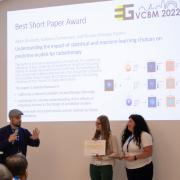
Renata Raidou is an Associate Professor in Biomedical Visualization and Visual Analytics at the Research Unit of Computer Graphics, Institute of Visual Computing & Human-Centered Technology, TU Wien, Austria. She previously held positions at the University of Groningen and TU Wien as a postdoc. Her research focuses on medical visualization, uncertainty visualization, and data physicalization for healthcare applications. Raidou has received prestigious awards including the Dirk Bartz Prize (2017) and EuroVis Young Researcher Award (2022). She coordinates TU Wien's BSc in Digital Health and MSc in Medical Informatics. Education: PhD in Medical Visualization (Eindhoven University of Technology, 2017), MSc in Biomedical Engineering (TU Delft), Diploma in Electrical and Computer Engineering (NTUA). Professional Roles: Editorial Board member of Computer & Graphics , Steering Committee member of EG VCBM, and member of EASAC's AI in Healthcare working group. Research Interests: Medical visualization strategies for P4 medicine, anatomical edutainment through physicalization, and uncertainty-aware visual analytics in radiotherapy. Her work bridges visual computing, machine learning, and medical applications, emphasizing clinical decision support and public health education. Awards: Over 10 awards including Best Paper recognitions at IEEE Vis and EuroVis, and the EuroVis Best PhD Award. Her contributions span visualizing anatomical variability, ensemble data exploration, and interactive medical training tools. Grants & Projects: Leads the Health Virtual Twins project (2024–2028) for personalized stroke management. Active in interdisciplinary collaborations, including the Shonan Meeting on Formalizing Biological Visualization. Labs/Teams: Head of the Visualization Group at TU Wien, developing tools like Vologram (holographic medical data physicalization) and Slice and Dice anatomical crafts. Collaborates on edutainment systems and AI-driven healthcare visualization.
Ivona Brandic is a Full Professor of High Performance Computing Systems at TU Wien's Institute of Information Systems Engineering, leading the HPC Research Group. She specializes in Computational Sustainability, Cloud/Edge Computing, and Quantum-Classical Systems. Her roles include Head of the Computational Sustainability Research Unit and membership in TU Wien's Faculty Council. She teaches courses such as AI/ML in Climate Change and Hybrid Quantum-Classical Systems. Her research focuses on sustainable IT, energy-efficient systems, and hybrid quantum-classical workflows. Projects include computational sustainability initiatives funded by the Austrian Science Fund (FWF) and industry partnerships like the Virtual Shepherd project. She has contributed to over 50 publications, emphasizing edge computing, quantum algorithms, and HPC optimization. Notable contributions include developing frameworks like RIGOLETTO for hybrid scientific workflows and FRESCO for edge offloading. Her work bridges theoretical advancements with practical applications in environmental monitoring and energy efficiency.
Renata Georgia Raidou is an Associate Professor in Biomedical Visualization and Visual Analytics at TU Wien's Institute of Visual Computing & Human-Centered Technology. She leads the Research Unit of Computer Graphics and serves as Curriculum Coordinator for the Bachelor in Informatics (Specialization Digital Health) and Master in Medical Informatics programs. She holds prestigious awards including the EuroVis Young Researcher Award (2022), Best PhD Award (2018), and Dirk Bartz Prize (2017). Her research focuses on medical applications of Visual Analytics, with emphasis on uncertainty visualization, comparative visualization, and anatomical edutainment through physicalizations. She explores how visual tools can enhance decision-making in precision medicine, particularly in radiotherapy and cancer treatment. Her work bridges visualization, machine learning, and image processing to address clinical challenges. Raidou's recent projects include developing predictive visual analytics systems for radiotherapy planning and creating tactile physicalizations for anatomy education. She actively contributes to the field through editorial roles (Associate Editor of Computer & Graphics ) and policy advising via EASAC's 'AI in Healthcare' initiatives. Key Projects: Health Virtual Twins for Stroke Management, PREVIS for Radiotherapy Decision Support, Pelvis Runner for Anatomical Variability Analysis Teaching: Courses on Medical Visualization, Data Analytics in Health Sciences, and Visual Computing Grants: European Commission-funded projects (2024–2028) Her lab develops interdisciplinary tools for clinicians, researchers, and educators, emphasizing both technical innovation and real-world impact.
Prof Zhen (Jeff) Luo is a Professor at the School of Mechanical and Mechatronic Engineering at the University of Technology Sydney (UTS). Since 2012, he has led the Advanced Metamaterials & Metastructures (AMM) and Engineering Computation and Optimisation (ECO) research groups, focusing on multi-disciplinary engineering innovations. Expertise : Advanced materials design, topology optimization algorithms, additive manufacturing, and computational mechanics. Education : PhD in Mechanical Engineering from Huazhong University of Science and Technology (2005). His research bridges Mechanical, Structural, Aerospace, and Biomechanical Engineering , developing cutting-edge metamaterials and computational methods. Recent work includes two-scale lattice optimization , stochastic bandgap analysis , and machine learning-aided virtual modeling for structural reliability. Key contributions span 3D-printed heat sinks , frequency-selective surfaces , and hydrogen storage systems . As a World’s Top 2% Scientist (Stanford, 2019–present), he has secured over AUD $7 million in grants, including from the Australian Research Council (ARC) and National Intelligence Discovery Research Grants (NI220100074). Awards : IAAM Scientist Award, IAAM Fellow. Leadership : Editorial roles in Structural and Multidisciplinary Optimization , Frontiers in Bioengineering and Biotechnology , and organizing roles in 21 international conferences.
Prof. Dr.-Ing. Alexander Verl is a leading academic at the University of Stuttgart , serving as Principal Investigator at the Institute for Control Engineering of Machine Tools and Manufacturing Units (ISW) . His work bridges control engineering , industrial robotics , and digital twin technologies to enhance precision in manufacturing systems. Research Interests : Improving positioning accuracy of industrial robots through transmission error modeling and compliance compensation. Developing adaptive preload control mechanisms for cable-driven parallel robots and rack-and-pinion systems. Advancing IT/OT convergence via Time-Sensitive Networking (TSN) and cloud-edge integration. Creating digital twin platforms for real-time simulation and quality monitoring in CNC machining. Exploring deep learning applications for perception of deformable linear objects in automation. Recent Work Trends show expertise in: smart manufacturing , Industry 4.0 , and data-driven control systems . Publications emphasize practical validation through industrial testbeds (e.g., KUKA KR210–2 robotics, CNC machine simulations) and theoretical contributions to elastokinematic models and nonlinear dynamics . Advising & Grants : Collaborates extensively with researchers like Armin Lechler and Michael Neubauer. Projects funded through academic-industry partnerships in automotive production, precision engineering, and Gaia-X-based data ecosystems.
Volker Dürr is a Professor of Biological Cybernetics at Bielefeld University , Faculty of Biology, and a member of the Center for Cognitive Interaction Technology (CITEC) . His work focuses on sensory control of locomotion , active tactile sensing in insects , and biomimetic modeling of movement systems. Education : Habilitation in Zoology (University of Cologne, 2008; Bielefeld, 2005), PhD in Biology (Bielefeld, 1998), Diploma in Biology (Tübingen, 1994) Academic Career : Professor at Bielefeld (2009-present), Junior Research Group Leader (University of Cologne, 2007-2009), Research Assistant (Bielefeld, 1998-2006) His research investigates how insects use antennal mechanosensory systems and proprioception to control locomotion in complex environments. Key themes include goal-directed movements , sensorimotor integration , and biomimetic robotics . Publications emphasize tactile sensing (15/23 articles), neural control of movement (9/23), biomechanical modeling (7/23), and cross-species locomotion analysis (4/23). Recent work explores virtual reality paradigms for locomotion studies and spiking neural networks for proprioceptive modeling.
Mario Baldi is an Associate Professor (on leave) of Information Processing Systems at the Department of Control and Computer Engineering , Politecnico di Torino , and concurrently a Fellow in the Office of the CTO, Adaptive and Embedded Computing Group, at AMD, San Jose, CA. His career blends deep academic research with extensive industry R&D leadership. Education M.Sc. (Summa Cum Laude) in Electrical Engineering, Politecnico di Torino, 1993 Ph.D. in Computer and System Engineering, Politecnico di Torino, 1998 Research Focus Baldi’s research spans programmable data planes, software-defined networking, big-data analytics for network management, network security, high-performance switching architectures, optical networking, QoS mechanisms, and multimedia/voice-over-IP systems . He is especially known for pioneering work on P4 -based programmable networks and SmartNIC architectures. Publication & Patent Impact Across 150+ refereed papers and 35+ US patents (plus European filings), his recent output concentrates on machine-learning-driven network data-plane functions , disaggregated stateful network services , and cloud-grade DPUs . The 2021–2024 articles emphasize real-time inference directly in the network data plane and modular SDN programming. Awards & Honors Best Paper Award, IEEE ICC 2007 Best Paper Award, IEEE ISCC 2008 Best Paper Award, IEEE GreenComm 2009 Best Paper Award, ACM/IEEE WI/IAT 2014 Grants & Projects Baldi has served as Principal Investigator or Scientific Coordinator on numerous EU Framework and Italian national projects (PRIN, FAR), leading consortia on energy-efficient packet networks, trusted software execution, wireless mesh architectures, and streaming media delivery. Teaching & Mentoring He has taught graduate courses on Enterprise Network Technologies, Computer Network Technologies and Services, Networks/Cloud/Application Security at Politecnico di Torino since 2003. He has also supervised PhD collegi for the Computer and Systems Engineering doctoral program (cycles 19–23) and held visiting/adjunct positions across four continents. Labs & Teams Previously headed the NetGroup (Computer Networks Group) at Politecnico di Torino (2001–2007) and co-chairs the p4.org Architecture Workgroup , driving open standards for programmable networking.
Dr. Charles Markham is an Associate Professor in the Department of Computer Science at Maynooth University's Faculty of Science & Engineering. He graduated with a degree in Applied Physics from Dublin City University and earned his PhD in element specific imaging in computerised tomography. His research spans novel imaging systems, biomedical instrumentation, and human-computer interaction with a strong focus on brain-computer interfaces and motion capture technologies. Research Affiliations: Hamilton Institute, ALL Institute Teaching: Robotics, Computer Graphics, Advanced Computer Architecture Professor Markham's research interests center on novel imaging technologies including coded aperture imaging and wide-baseline stereo systems, motion capture and wearable computing with applications in rehabilitation, and mobile machine vision for driving simulation and augmented reality. His work with the Mathematics and Statistics Ecology group demonstrates interdisciplinary interests in ecological modelling . His publication record shows consistent contributions to brain-computer interfaces (2007-2011), driver behavior analysis (2014-2021), motion capture systems (2006-2009), and optical imaging techniques (2001-2008). The research spans multiple disciplines including neuroscience, biomedical engineering, and ecological mathematics. He has supervised several graduate students including D. Kelly (2009 thesis on sign language recognition) and J. Foody (2007 thesis on motion capture biofeedback systems). His collaborations extend across institutions with partnerships at TU Dublin and University College Dublin.