Cicek Cavdar is an Associate Professor at the School of Electrical Engineering and Computer Science (EECS) at KTH Royal Institute of Technology , Sweden. She leads the Intelligent Network Systems research group and specializes in Telecommunication Networks , with a focus on Beyond 5G/6G Mobile Networks , Energy Efficiency , and AI-Assisted Network Management . PhD in Computer Science (2009) from University of California, Davis and Istanbul Technical University Her research spans Cell-Free Massive MIMO , Reconfigurable Intelligent Surfaces (RIS) , UAV Communication Systems , and Green Network Technologies . She actively contributes to 6G Network Architecture and Non-Terrestrial Networks , including satellite and aerial systems. Recent publications highlight AI-driven network optimization for handover management, energy-aware resource allocation , and multi-agent reinforcement learning in complex communication environments. She teaches advanced courses in Communication Systems , Machine Learning , and Software Engineering at KTH.
Henrik Sandberg is a Professor at the Division of Decision and Control Systems , KTH Royal Institute of Technology , Stockholm, Sweden. He holds the title of Deputy Head of Division and is affiliated with the School of Electrical Engineering and Computer Science . Education: MSc in Engineering Physics (1999) PhD in Automatic Control (2004) from Lund University Postdoctoral position at Caltech (pre-2007) Research Interests: Focus on cyber-physical systems security , power systems , model reduction , and fundamental limitations of control systems . Key sub-areas include attack detection , networked control , privacy-preserving estimation , and resilient control architectures . Publications: Over 150 papers across IEEE Transactions and Automatica , covering topics like stealthy attacks , distributed control , LQG optimization , and thermodynamic costs in filtering . Recent work includes LWE-based encrypted control and Bayesian deception mechanisms . Scientific Awards: Best Student Paper Award Finalist at IEEE CASE 2014; Best Student-Paper Award at IEEE CDC 2004. Grants & Projects: Leads the DYNACON project (WASP Cybersec cluster) and collaborates on CERCES (critical infrastructure resilience). Serves as examiner for multiple advanced courses in cybersecurity and control systems. Contact: Email: hsan@kth.se Phone: +46 (0)8 790 7294 Room: A:607, Malvinas Väg 10, Stockholm
Karl Gustafsson is a Professor at Stockholm University within the Department of Economic History and International Relations. His work bridges security studies , collective memory , and digital research methods in international relations. Current Role: Professor of International Relations, Stockholm University Previous Positions: Post-Doc at Lund University, Researcher at Swedish Institute of International Affairs Visiting Appointments: University of Tokyo, Osaka University, Keio University, Academia Sinica, Nordic Institute of Asian Studies Research Focus: Karl specializes in memory politics , ontological security , and anxiety-driven international dynamics , particularly in Sino-Japanese relations and digital platforms . His studies explore how historical narratives and online memory construction influence state identity and policy. Awards & Grants: Recipient of the Wang Gungwu Prize (2014) and Stockholm University Association’s award (2011). Holds Swedish Research Council and Marianne & Marcus Wallenberg Foundation grants for projects on apologies in international politics and digital memory in East Asia . Publications: His work appears in journals such as International Studies Quarterly , European Journal of International Relations , and Memory Studies , addressing topics like narrative power in East Asia, anxiety’s role in policy change , and digital humanities applications in IR.
Lisbeth Aggestam is an associate professor at the Department of Political Science and an associate researcher at the Center for European Research (CERGU) at the University of Gothenburg. She serves as the editor-in-chief of the international journal Foreign Policy Analysis , published by the International Studies Association (ISA) and Oxford University Press. Aggestam's research focuses on several interconnected areas: Political leadership and foreign policy Diaspora and foreign policy Foreign policy role theory The European Union as a global actor Her scholarly work demonstrates a consistent focus on leadership dynamics within European foreign policy, particularly examining how the EU navigates its role as a global actor amid shifting geopolitical landscapes. She has developed significant theoretical contributions to role theory in foreign policy analysis, creating frameworks for understanding how states and international organizations perform specific roles on the global stage. Aggestam's publication record reveals several important trends in contemporary foreign policy studies. Her work increasingly examines the intersection of domestic politics and international relations, particularly how diaspora communities influence state foreign policies. Her recent research addresses European strategic autonomy in the context of US foreign policy shifts and the implications of Sweden's NATO membership decision, reflecting her ability to connect theoretical frameworks with pressing real-world issues. As an educator, Aggestam serves as course manager and instructor for several key programs: EU2215: Europe in the World (MA, 15 hec) SK1136: Foreign Policy Analysis (BA, 7.5 hec) EU1145: The European Union in International Affairs (BA, 7.5 hec) Through her leadership of the Swedish Research Council project 'Transnational civil society and foreign policy' (2022-2025) and her editorial role at Foreign Policy Analysis , Aggestam plays a significant role in shaping contemporary discourse on international relations and European foreign policy.
Tony Mickelsson Blomqvist is a Lecturer at the Department of Police Work , Södertörn University. He holds a PhD in Social Work (2023) and serves as a research coordinator for the Institute for Policing. Additionally, he is the coordinator of the European Policing Research and Education Network (EPREN) and will become associate editor of the Nordic Journal of Studies in Policing in 2025. PhD in Social Work (2023) Lecturer in Policing Research coordinator and network leader His research focuses on police collaboration with civil society and social services , local crime prevention , and organized crime dynamics , with a unique interest in the intersection between internal security and hybrid warfare . He also explores the role of sports clubs in social inclusion and community development. Tony leads an EU-funded project on Strategic Enforcement for Undermining Criminal Networks (2024–2027) and contributes to initiatives like ‘Martial Arts as a Crime Prevention Tool’ (2024–2026). His recent publications analyze Ukrainian refugee experiences, martial arts’ socialization effects, and sports clubs’ role in vulnerable areas. He has no listed scientific awards but holds editorial and coordination roles in policing research.
Mariano Scazzariello is a Lecturer at KTH Royal Institute of Technology, Sweden, affiliated with the School of Electrical Engineering and Computer Science and the Department of Network and Systems Engineering. He teaches the course 'Network Systems with Edge or Cloud Datacenters (IK2227)'. His research focuses on advanced networking topics including machine learning in networks, high-speed packet processing, network emulation, and software-defined networking innovations. His work spans contributions to network emulation tools like Kathará and Megalos, stateful packet processing at terabit scales, and leveraging large language models (LLMs) for network configuration and vulnerability detection. Recent research emphasizes low-latency protocols (e.g., SRv6/DetNet integration) and GPU-centric networking on commodity hardware. Mariano’s publications (2020–2025) highlight expertise in network function virtualization, ASIC-based switching, and optimizing network configurations through AI-driven approaches. He has pioneered frameworks for evaluating routing protocols and virtualizing large network scenarios at scale.
Zhonghai Lu is a Professor of Electronic Systems Design (specializing in Dependable and Autonomous Systems) at KTH Royal Institute of Technology, part of the Department of Electrical Engineering in the School of Electrical Engineering and Computer Science (EECS). He serves as Program Director for KTH's Embedded Systems master's program and Director of Studies at the Division of Electronics and Embedded Systems. His research focuses on Network-on-Chip (NoC), computer architecture, embedded systems, and Prognostics and Health Management (PHM) of power electronics. He leads a research group exploring in-network processing and embedded intelligence, transforming passive networks into active computational frameworks. Lu holds a BSc from Beijing Normal University (1989), MSc and PhD from KTH (2002, 2007), and an MBA in Innovation and Growth from the University of Turku (2012). He has authored over 240 scientific papers, including journal articles and peer-reviewed conferences, with notable recognitions such as Best Paper Awards at NOCS’2015 and EU HiPEAC, and a Featured Paper in IEEE Transactions on Computers (2020). He serves as Associate Editor for ACM Transactions on Architecture and Code Optimization (TACO) and has chaired major conferences like HiPEAC’2017 and NOCS’2018. His research group’s recent work includes integrating AI into hardware acceleration, fault-tolerant neural networks, and RUL estimation for power electronics using recurrent neural networks. Lu has secured grants from the Swedish Research Council and Intel Corporation and developed courses like IL2230 (Hardware Architectures for Deep Learning) and IL2233 (Embedded Intelligence), pioneering embedded AI education at KTH. Education: BSc (Beijing Normal University), MSc/PhD (KTH), MBA (University of Turku) Awards: Best Paper Awards (NOCS, EU HiPEAC), Swedish Research Council Grants, Intel Research Gifts Labs/Teams: Research Group on In-Network Processing and Embedded Intelligence
Pan Xu is a tenure-track assistant professor with joint appointments in the Department of Biostatistics & Bioinformatics, Department of Computer Science, and Department of Electrical & Computer Engineering at Duke University. Previously, Xu was a Postdoctoral Scholar Research Associate at Caltech's Department of Computing and Mathematical Science and earned a Ph.D. in Computer Science from UCLA. Xu's research focuses on developing computationally- and data-efficient machine learning algorithms with strong empirical performance and theoretical guarantees. Xu's research interests center around Machine Learning with broad applications in Artificial Intelligence, Data Science, Optimization, Reinforcement Learning, and High Dimensional Statistics. The research specifically targets real-world problems in Bioinformatics and Healthcare, with recent work emphasizing distributionally robust decision making, efficient exploration strategies, and multi-agent systems. Xu has developed novel algorithms that address the challenges of exploration in sequential decision making and robustness to distributional shifts between training and deployment environments. Xu's recent publications demonstrate a strong trend toward developing theoretically grounded yet practical algorithms for reinforcement learning and bandit problems, with particular emphasis on distributionally robust methods, efficient exploration techniques, and applications to healthcare. The work spans both theoretical analysis (providing minimax optimal regret bounds) and practical implementations (validated on benchmarks like Atari games and real healthcare datasets). Whitehead Scholar award from Duke University School of Medicine (2023) Best Paper Award at ACM FAccT 2023 for Queer In AI paper PIMCO Postdoctoral Fellowship in Data Science (2022) TMLR Featured Certification (2023) NSF award on approximate sampling based exploration (2023) Xu actively mentors multiple Ph.D. students across Duke's Biostatistics & Bioinformatics, Computer Science, and Electrical & Computer Engineering programs, with several alumni now pursuing doctoral studies at top institutions. The research group has secured competitive funding including an NSF award for approximate sampling based exploration for sequential decision making. Xu serves as an action editor for TMLR and as an area chair for major conferences including ICML, NeurIPS, AAAI, ICLR, and AISTATS. Xu leads a dynamic research group focused on sequential decision making, with projects spanning theoretical algorithm development, implementation of practical systems, and applications to healthcare and bioinformatics. The group maintains active collaborations across Duke's medical and engineering schools, with recent work applying machine learning to epidemic forecasting during the pandemic.
Dean B. Carson is a researcher at Umeå University , affiliated with the Faculty of Medicine, Department of Epidemiology and Global Health , and the Arctic Research Centre . His work focuses on rural health systems, social care workforce challenges, sustainable rural development, and community-based approaches to healthcare and food security. Rural Health : Explores capacity-building in rural health research and medical education reform. Public Health : Analyzes service delivery models and co-creation frameworks for elderly care. Geography : Investigates spatial dynamics in northern peripheries, including food production networks and micro-urbanization. Recent publications (2024-2025) examine topics such as rural health research capacity frameworks , hospital-to-home transfer systems , and non-commercial food distribution networks . His studies often integrate theoretical models like Rural Nursing Theory and Beyond Periphery while emphasizing stakeholder engagement and policy translation. Grants and Collaborations : Funded by the Swedish Research Council Formas, American National Science Foundation (NSF), and Riksbankens Jubileumsfond. Collaborates with Arctic-FROST networks and Lifestyle Migration Hub researchers.
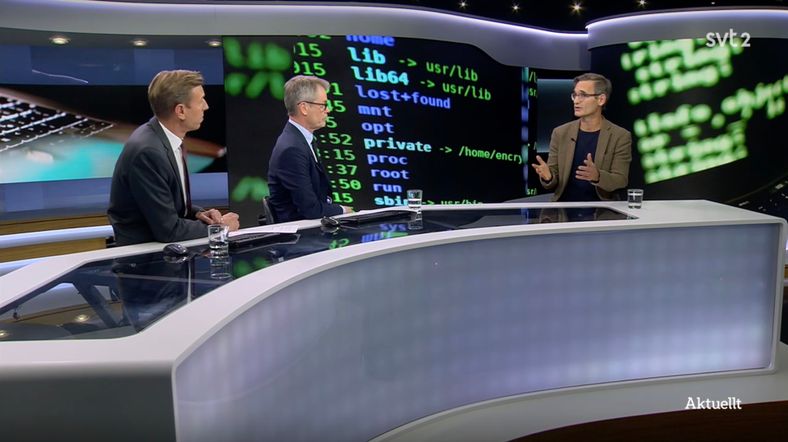
Pontus Johnson is a Professor at the KTH Royal Institute of Technology in Stockholm, Sweden. He leads the Center for Cyber Defense and Information Security (collaborating with Swedish Armed Forces, FRA, MSB, FOI, FHS) and serves as vice director of Cybercampus Sweden since 2024. His research focuses on cybersecurity , enterprise architecture analysis , and probabilistic threat modeling , particularly through his development of the Meta Attack Language (MAL) for simulating cyber attacks on networked systems. Education: MSc in Computer Science, Lund Institute of Technology (1997) PhD in Computer Science, KTH (2002) Docent title, KTH (2007) Leadership Roles: Director, Center for Cyber Defense and Information Security (2013–present) Vice Director, Cybercampus Sweden (2024–present) Board Member, Swedish Research Council (2025–present) Deputy Chair, Swedish Royal Academy of Engineering Sciences (IVA) Board (2024–present) His work spans cybersecurity research , attack simulation methodologies , and enterprise architecture frameworks . He has developed tools like securiCAD (acquired by Google) and pwnPr3d for probabilistic threat modeling. His 15 most recent publications highlight advancements in graph-based attack simulations , automated security assessments , and AI applications in cyber defense . Scientific recognition includes: Listed among Tech Awards Sweden's 50 Most Influential People in Swedish Tech (2022, 2023) Discovery of vulnerability in the Universal Turing Machine (2021) He supervises 16 PhD students and alumni (2005–2024), including Simon Gökstorp , Jakob Nyberg , and Sotirios Katsikeas . His academic service includes over 50 program committee roles and leadership positions in international conferences. He contributes to both academic and public domains through media appearances (SVT, Aftonbladet), courses in ethical hacking , and industry collaboration via his role at Google (20% of his time). His research group Software Systems Architecture and Security (SSAS) focuses on predictive security frameworks and system-of-systems analysis.
Peo Hansen is a Professor of Political Science at Linköping University's REMESO research institute, part of the Department of Culture and Society (IKOS) within the Faculty of Arts and Sciences (FILFAK). He serves as Director of the PhD Programme in Ethnic and Migration Studies and the Swedish Research Council’s Graduate School in Migration and Integration. His work critically examines European integration, colonialism, and EU migration policy through a geopolitical lens. Research Interests: Hansen specializes in the colonial origins of EU integration, modern migration theory, and the political economy of migration. He challenges orthodox economic assumptions about migration's fiscal impact, advocating for Modern Monetary Theory (MMT) as a transformative framework. Key themes include Eurafrica's historical role in shaping post-war European expansion and the EU's current 'geopolitical turn' amid declining global influence. Awards: Received the 2023 EUSA Honorable Mention for his book *A Modern Migration Theory*, which redefines migration's economic contributions to welfare states. His work has been published in journals such as *Journal of Common Market Studies*, *European Political Science*, and *History of the Present*. Visiting Roles: Senior Fellow at NYU's Remarque Institute (2006), Visiting Professor at the Max Planck Sciences Po Center (2018), and Simone Veil Fellow at the European University Institute (2023, 2025). He co-authored *Eurafrica: The Untold History of European Integration and Colonialism* with Stefan Jonsson. Labs/Teams: Active in the Institute for Research on Migration, Ethnicity and Society (REMESO), focusing on transnational migration, ethnicity, and citizenship. His research integrates historical analysis with contemporary policy critique, emphasizing decolonial perspectives in EU studies.
Xiaoming Hu is a Professor at the Division of Numerical Analysis, Optimization and Systems Theory within the Department of Mathematics at KTH Royal Institute of Technology (Kungliga Tekniska Högskolan) in Stockholm, Sweden. Born in Chengdu, China, he received his B.S. degree from University of Science and Technology of China in 1983, followed by M.S. and Ph.D. degrees from Arizona State University in 1986 and 1989 respectively. After serving as a research assistant at the Institute of Automation, Chinese Academy of Sciences (1983-1984), he was a Gustafsson Postdoctoral Fellow at KTH (1989-1990) before becoming a faculty member. His educational background includes: B.S. in Engineering, University of Science and Technology of China, 1983 M.S. in Engineering, Arizona State University, 1986 Ph.D. in Engineering, Arizona State University, 1989 Xiaoming Hu's research primarily focuses on multi-agent systems, nonlinear feedback stabilization, nonlinear observer design, and sensing and active perception. His work bridges theoretical control theory with practical applications in robotics and autonomous systems. He has made significant contributions to geometric control theory, mathematical systems theory, and nonlinear systems analysis and control. His research often involves developing theoretical frameworks for distributed control, formation control, and cooperative behavior in multi-robot systems. Professor Hu's publication record shows a consistent research trajectory with numerous high-impact publications in top-tier journals like Automatica, IEEE Transactions on Automatic Control, and Systems & Control Letters. His research has evolved from fundamental control theory to more applied problems in robotics and multi-agent systems, while maintaining strong mathematical foundations. Recent work shows increasing focus on safety-critical control, inverse problems in estimation, and networked systems. His scientific contributions include: Development of theoretical frameworks for multi-agent coordination and formation control Advances in nonlinear observer design for robotic systems Contributions to geometric control theory and systems theory Research on distributed estimation and control algorithms Applications of control theory to robotics and autonomous systems Professor Hu teaches several advanced courses including Mathematical Systems Theory, Geometric Control Theory, and Nonlinear Systems: Analysis and Control. He has supervised numerous degree projects at both undergraduate and graduate levels in mathematics, optimization, systems theory, and scientific computing. His teaching reflects his research expertise, providing students with both theoretical foundations and practical applications of control theory.
Lars Nordström is a Professor at the Division of Electric Power and Energy Systems within KTH Royal Institute of Technology, Stockholm, Sweden. His work bridges control systems , communication networks , and power systems , with a focus on future architectures, functionality, and quality aspects of ICT for power grid operations. He has led initiatives such as the Swedish Centre of Electric Power Engineering and served as Thematic Leader for Smartgrids in KIC InnoEnergy. In 2014, he was a Visiting Professor at Washington State University. Education : Ph.D., MSc.EE Nordström's research explores the intersection of smart grids , machine learning , and cybersecurity for power systems. Key areas include: Wide-Area Monitoring and Control (WAMC) systems Decentralized control strategies for DC microgrids Impedance modeling using neural networks Data-driven methods for islanding detection ICT reliability and protocol design for grid operations His recent publications emphasize machine learning applications in power systems, including LSTM networks for EV charging management, graph attention networks for stability monitoring, and digital twin approaches for cyber-attack mitigation. These works span disciplines such as Smart Grids, Power Electronics, and Data Science. Scientific Recognitions : Senior Member, IEEE Senior Member, CIRED Senior Member, Cigre Past Chairman, Swedish IEC TC57 Mirror Committee Nordström actively teaches and examines graduate courses like Communication and Control in Electric Power Systems and Computer Applications and Machine Learning in Electric Power Systems . His work influences industry practices through collaborations on digital substations, energy market analysis, and resilience strategies.
Zhibo Pang is an Adjunct Professor at KTH Royal Institute of Technology's Department of Intelligent Systems (EECS) and Senior Principal Scientist at ABB Corporate Research Sweden. His work focuses on digital transformation in industry and healthcare, spanning robotics, AI, control systems, and wireless communication. He leads projects in embodied intelligence, Industry 4.0, and Healthcare 4.0, with 23 granted patents and over 120 journal papers. Education: PhD in Electronic and Computer Systems (KTH, 2013), MBA in Innovation & Growth (University of Turku, 2012). Key Roles: IEEE Technical Committee Chair, Editor of 6 IEEE journals, ABB Inventor of the Year (2016, 2018, 2021). Research Interests: Robotics safety, wireless automation, federated learning, digital twins, and IoT security. Recent Projects: Cloud-fog automation frameworks, robot skin systems for healthcare, and latency-aware industrial control. His work bridges academia and industry through cross-functional collaborations.
Saurabh Amin is a Professor in the Department of Civil and Environmental Engineering at the Massachusetts Institute of Technology (MIT), where he also serves as the Edmund K. Turner Professor and Undergraduate Officer. He is a Principal Investigator at the Laboratory of Information and Decision Systems and holds affiliations with the Operations Research Center and the Center for Computational Science and Engineering. His educational background includes: B.Tech. 2002, Indian Institute of Technology (IIT) Roorkee M.S. 2004, University of Texas (UT) Austin Ph.D. 2011, University of California (UC) Berkeley Saurabh Amin's research focuses on the design and control of infrastructure systems using game theory and optimization in networks. His work spans three main areas: resilient network control, information systems and incentive design, and optimal resource allocation in large-scale infrastructure systems. By concentrating on critical infrastructure domains including highway transportation, electric power distribution, and urban water networks, his research develops innovative theory and tools to enhance system performance against both stochastic and adversarial disruptions. His approach involves modeling cyber-physical interactions in infrastructures to assess vulnerabilities, developing detection and response tools for failures at various scales, and designing economic incentive schemes that improve aggregate public good while accounting for dependencies and private information among strategic entities. Amin's work bridges mathematical systems theory with practical civil engineering applications, creating a rigorous theoretical foundation for infrastructure resilience that addresses diverse failure mechanisms from natural disasters to deliberate malicious actions. His recent publications demonstrate a strong focus on decarbonization of energy systems, resilient infrastructure planning under climate uncertainty, optimization methods for complex networked systems, and game-theoretic approaches to sustainable infrastructure management. His work increasingly integrates artificial intelligence and machine learning techniques with traditional control theory to address contemporary challenges in infrastructure resilience and sustainability. The research shows a clear trajectory toward addressing climate change impacts on infrastructure systems while maintaining economic efficiency and operational reliability. Professor Amin has received numerous prestigious awards and honors: Common Ground Excellence in Teaching Award, 2025 HSCC Test-of-Time Award, 2024 MIT CEE, Distinguished Service and Leadership Award, 2023 Samuel M. Seegal Prize (SoE) – inspiring students in pursuing and achieving excellence, 2022 Earll M. Murman for Excellence in Undergraduate Advising, 2022 C3.ai Digital Transformation Institute Research Award, 2020 MIT, Ole Madsen Mentoring Award, 2020 MIT, Energy Initiative Research Award, 2020 National Academy of Engineering, China-America Frontiers of Engineering Symposium speaker, 2019 MIT, Robert N. Noyce Career Development Professor, 2015-2018 Google Faculty Research Award, 2015 National Science Foundation CAREER Award, 2015 Siebel Energy Institute Research Award, 2015 MIT, Solomon Buchsbaum AT&T Research Fund Award, 2012 Professor Amin has been actively involved in significant research projects including the C3.ai DTI project on Causal Reasoning for Real-Time Attack Identification in Cyber-Physical Systems and another on Learning in Routing Games for Sustainable Electromobility. He serves as the chief scientist on multi-institutional NSF grants, including the $9 million Foundations of Resilient Cyber-Physical Systems (CPS) project. His teaching portfolio includes courses such as 1.008 Engineering for a Sustainable World, 1.104 Sensing and Intelligent Systems, 1.020 Engineering Sustainability: Analysis and Design, and 1.208 Resilient Networks. As Undergraduate Officer, he plays a key role in shaping the educational experience for civil and environmental engineering students at MIT. Professor Amin leads the Resilient Infrastructure Networks Lab at MIT, where his team develops theoretical foundations and practical tools for infrastructure resilience. The lab focuses on the intersection of control theory, game theory, and optimization applied to cyber-physical infrastructure systems. Current research directions include pandemic-resilient urban mobility and hurricane-resilient smart grid operations, reflecting the lab's commitment to addressing pressing societal challenges through rigorous systems engineering approaches.