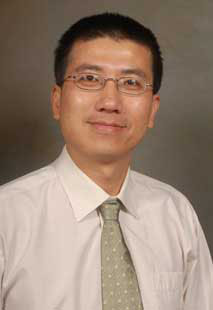
Dr. Xiangchun (Schwann) Xuan is a Professor in the Department of Mechanical Engineering at Clemson University. He joined in December 2006 and specializes in thermal/fluid sciences with a focus on microfluidic devices and Lab-on-a-chip technology. His research explores electrokinetic phenomena, viscoelastic fluid dynamics, and particle manipulation in micro/nano-scale systems. Education: Ph.D., University of Toronto, 2006 DENG, Shanghai Institute of Technical Physics, 2000 B.S., University of Science and Technology of China, 1995 Research Interests: Dr. Xuan's work centers on micro- and nano-fluidics, including electroosmotic flow, dielectrophoresis, and the effects of viscoelasticity on particle behavior. He investigates applications in lab-on-a-chip devices, separation techniques, and fluid rheology in confined geometries. Publications: His recent work emphasizes nonlinear electrokinetic flows, shear-thinning fluid dynamics, and particle focusing in non-Newtonian systems. Key topics include electroosmotic instabilities, dielectrophoretic separation, and the interplay between fluid elasticity and microscale transport. Awards & Grants: No specific awards are listed, but his contributions are reflected in his extensive publication record and academic roles. He is a member of ASME, APS, and AES. Labs/Teams: His research is conducted within Clemson’s Mechanical Engineering facilities, focusing on experimental and analytical studies of microfluidic systems and electrokinetic phenomena.
Sushanta Mitra is a Professor in the Department of Mechanical and Mechatronics Engineering and the Executive Director of the Waterloo Institute of Nanotechnology at the University of Waterloo. He holds cross-appointments in multiple research groups and leads the Micro-Nano Scale Transport Lab. His research focuses on nanotechnology, microfluidics, biosensors, and fluid dynamics, with applications in energy systems, biomedical engineering, and soft matter physics. Key research interests include liquid-liquid encapsulation, droplet dynamics, and advanced material characterization. His work spans interdisciplinary areas such as graphene physics, catalysis for fuel cells, and sensor development for medical diagnostics. He has pioneered techniques like magnetic manipulation of hydrogels and multilayer liquid encapsulation, with applications in drug delivery and environmental monitoring. Recent publications highlight innovations in biosensing platforms, including SERS-based systems for tuberculosis and glioma detection. His studies on soft interfaces, droplet adhesion, and magnetic actuation contribute to advancements in soft robotics and biomedical devices. Mitra’s lab emphasizes practical applications of nanotechnology to address global challenges in health, energy, and sustainability. No scientific awards are explicitly mentioned in the provided texts. His advising and grants involve collaborations in interdisciplinary projects, though specific details on grants or student advisement are not documented here. The Micro-Nano Scale Transport Lab serves as a hub for cutting-edge research in nanoscale transport phenomena and material science.
Professor Benu Adhikari is a faculty member in the School of Science at RMIT University, Australia. He holds honorary positions including Visiting Professor at Jiangnan University (China), Adjunct Professor at Soochow University (China), and Adjunct Distinguished Professor at the China Academy of Agricultural Sciences (Beijing). His research focuses on food engineering, emulsions, encapsulation technologies, biodegradable packaging, and food drying processes. Key projects include developing plant-based dairy alternatives, biodegradable films from agricultural waste, and texture-modified foods for the elderly. He supervises numerous research projects on topics like 3D-printed food from mushroom waste, sodium reduction in food systems, and encapsulation of bioactive compounds. His work integrates advanced materials science, sustainable processing, and food innovation. Professor Adhikari is an editorial board member of Sustainable Food Technology and Drying Technology . Research interests span food engineering fundamentals (rheology, thermal processing), emulsion stability mechanisms, micro/nano encapsulation of heat-sensitive ingredients, and biodegradable packaging development. His lab explores novel applications of plant and algal proteins, lignin-based materials, and AI-driven food supply chains. Over 400+ research outputs highlight contributions to food science, materials engineering, and sustainable technologies. Collaborations with industry and global institutions drive applied research in food safety, nutrition, and circular economy practices. Recent innovations include hemp protein-curcumin conjugates, AI-optimized fresh food logistics systems, and 3D-printed texture-modified foods for dysphagia management. His work addresses global challenges in food security, sustainability, and aging population nutrition through interdisciplinary approaches.
Professor Zhijian Pei holds the Mike and Sugar Barnes Professor II position in Industrial & Systems Engineering at Texas A&M University's College of Engineering. His research focuses on additive and subtractive manufacturing, with notable work in ceramic and bioprinting processes. He received his Ph.D. in Mechanical Engineering from the University of Illinois at Urbana-Champaign (1995). Pei is a Fellow of IISE (2022), SME (2016), and ASME (Swanson Fellow, 2016). He has led NSF programs and received prestigious awards, including the NSF CAREER Award (2004). His research explores sustainable materials, biodegradable composites, and advanced manufacturing techniques. Key interests include binder jetting, powder metallurgy, and bioprinting applications. He has contributed to over 100 publications, focusing on material characterization, process optimization, and environmental sustainability in manufacturing.
Sheng C. Dai is an Associate Professor and group coordinator in Geosystems Engineering at the Georgia Institute of Technology, holding the Georgia Mining Association Early Career Professorship in the School of Civil and Environmental Engineering with courtesy appointments in Ocean Science and Engineering and the School of Earth and Atmospheric Sciences. Dr. Dai earned his Ph.D. from Georgia Tech in 2013 following ORISE postdoctoral fellowships at the National Energy Technology Laboratory (2013-2015). His educational background includes specialized training in geosystems engineering and energy-related subsurface processes. His research focuses on energy geotechnics and nature-inspired engineering, addressing critical challenges in energy sustainability and environmental protection through studies of geomechanics, granular dynamics, and porous media flow. Key applications include gas hydrate systems for energy recovery, waste-to-fuel conversion, and biomimetic solutions inspired by natural processes like rock-boring clams. Analysis of Dr. Dai's 2023-2025 publications reveals strong interdisciplinary integration of computational modeling (DEM, SPH), machine learning, and experimental techniques across energy geotechnics, granular material flow, and bio-inspired mechanisms. His work bridges petroleum engineering, environmental sustainability, and space exploration contexts. Dr. Dai has received numerous accolades recognizing his research, teaching, and service contributions: 2025: Early Career Researcher Award (USUCGER) 2024: Emerging Leaders Program (EVPR/Georgia Tech) 2023: Interdisciplinary Research Award and Woodruff Academic Leadership Fellows 2022: NSF Game Changer Academies and CREATE-X Faculty Fellowship 2020: NSF CAREER Award 2017: Bill Schutz Teaching Award and NETL Research Spotlight His Subsurface Processes Laboratory secures funding from DOE, NSF, NASA, and DOT for projects including $1M awards for waste-to-fuel conversion and methane clathrate research. Dr. Dai serves as Associate Editor for Journal of Geophysical Research: Solid Earth and leads ISSMGE's TC308 Energy Geotechnics Task Force while advising USGS and NETL programs. The laboratory conducts cutting-edge experimental and computational research on hydrate-bearing sediments, granular biomass flow, and bio-inspired geotechnical solutions, maintaining strong industry partnerships for real-world application of subsurface engineering innovations.
Pablo D. Zavattieri is the Jerry M. and Lynda T. Engelhardt Professor in Civil Engineering at the Lyles School of Civil Engineering, College of Engineering, Purdue University. His research focuses on solid mechanics applied to the multiscale modeling of advanced and innovative engineering materials, with emphasis on bridging between atomistics to continuum-based models and combining computational tools with experimental validation. Education: B.S./M.S., Instituto Balseiro, Argentina, 1995 Ph.D., Purdue University, 2000 Professor Zavattieri's research spans solid mechanics applied to multiscale analysis and design of advanced architectured materials, interfaces, and complex structures. His work lies at the intersection of Solid Mechanics and Materials Engineering, focusing on developing novel materials with exceptional properties inspired by natural systems. His contributions include micromechanical models for polycrystalline materials, new fracture models for thin-walled structures, and pioneering work on biomimetic materials using 3D printing technology. Current projects investigate the multiscale modeling of heterogeneous and hierarchical materials, micro and nanomechanics of biological materials, bioinspired materials, architectured materials, micropatterned interfaces, and smart materials. His publication record demonstrates a strong focus on understanding natural materials like chiton radular teeth, nacre, and mantis shrimp structures, translating these biological designs into engineered solutions. His recent work spans biological materials characterization, phase-transforming cellular materials, cellulose nanocrystal composites, and 3D printing of cementitious materials, consistently combining computational modeling with experimental validation across multiple length scales. Scientific Awards and Recognitions: NSF CAREER award (2013) Roy E. & Myrna G. Wansik Research Award (2013) Purdue University Faculty Scholar (2015-2020) Kavli Frontier of Science Fellow of the National Academy of Science (2015) National Academy of Engineering US Frontier of Engineering Symposium attendee (2014) Engineering Fracture Mechanics Journal Most Cited Articles award (2005-2009 period) Second Most Cited Journal of the Mechanics and Physics of Solids Article (2007-2012) Cover page of Cellulose journal (2013) Cover page of Advanced Functional Materials journal (2014) Professor Zavattieri has mentored numerous graduate students who have received prestigious awards including William and Mary Goetz Graduate Scholarships, William L. Dolch Graduate Scholarships, Purdue Doctoral Fellowships, and SURF Research Symposium awards. His research has been supported by NSF, AFOSR, INDOT/JTRP, Forest Product Laboratory, General Motors, Velcro, and the Purdue Research Foundation. Notable projects include a $7.5M DoD/MURI award for 'Convergent Evolution to Engineering: Multiscale Structures and Mechanics in Damage Tolerant Functional Bio-Composite and Biomimetic Materials' and multiple NSF grants focusing on biomimetic materials and 3D printing of civil infrastructure. He directs the Multi-Scale Mechanics and Materials by Design Lab at Purdue University, which maintains a strong collaborative network with institutions including UC Riverside (David Kisailus' group), UC San Diego, Northwestern University, and UC Berkeley. The lab has produced significant research on biological materials like chiton radular teeth, mantis shrimp structures, and nacre, translating these natural designs into engineered solutions for applications in infrastructure, lightweight structural materials, and energy absorption systems.
Matilda Backholm is an Assistant Professor in the Department of Applied Physics at Aalto University, specializing in soft matter physics, fluid dynamics, and surface science. Her research focuses on fundamental interactions between liquids and structured surfaces, with applications in materials science and biophysics. Her primary research areas include soft matter mechanics, droplet dynamics on superhydrophobic surfaces, wetting phenomena across multiple scales, and the biophysics of cellular systems. She investigates how surface topography and chemical properties govern liquid behavior at micro/nanoscales, with particular emphasis on friction reduction, droplet mobility, and immune cell mechanics. Her work bridges experimental physics with practical applications in microfluidics, nanomedicine, and advanced materials. Analysis of her recent publications (2017-2025) reveals consistent focus on interfacial phenomena, with major themes including: superhydrophobic surface engineering, ferrofluid manipulation, viscosity effects in confined systems, and mechanical properties of biological aggregates. Her research demonstrates sophisticated experimental techniques combined with theoretical modeling to address fundamental questions in fluid-surface interactions. She has received significant recognition including: Academy of Finland Postdoctoral Grant (2017) Ruth and Nils-Erik Stenbäck Prize for career accomplishments (2017) Finnish Academy of Science and Letters Väisälä Starting Grant (2023) Jane and Aatos Erkko Foundation grant (2023) Research Council of Finland Research Fellowship (2023) ERC Starting Grant (2023) Dr. Backholm leads the “Living, Fluid, & Soft Matter” research group and has secured substantial funding including multiple personal grants from Finnish national bodies and European competitive programs. Her collaborative work spans physics, materials science, and biomedical engineering, with publications in high-impact journals such as Nature Materials, PNAS, and Science Advances. Her laboratory develops advanced experimental platforms for studying liquid-solid interactions at micro/nanoscales, including custom micropipette force sensors and high-precision droplet manipulation systems. Current research directions integrate magnetic field control with soft matter systems and explore biological implications of surface physics.
Andreas Carlson is a Professor at the University of Oslo's Department of Mechanics. His research focuses on fluid dynamics, interfacial flows, and biophysics, with particular emphasis on elastohydrodynamics, membrane adhesion, and numerical modeling. He holds a PhD from the Royal Institute of Technology (2012) and was a Post-Doctoral Fellow at Harvard University (2012-2015). Key awards include the Silver Medal ERCOFTAC Leonardo Da Vinci competition (2012) and the Sigvardt Eklund's Award (2008). His work spans academic staff roles and active participation in projects like LUBRIBOT (sustainable soft robotics) and DyWeSS (dynamic wetting on soft materials). Carlson's research explores fluid dynamics in complex systems, including droplet behavior, soft matter physics, and biomembrane mechanics. His recent studies investigate phenomena like viscoelastic film spreading, fiber-based droplet control, and biomembrane stability. He contributes to courses such as MEK3230 - Fluid Mechanics and collaborates internationally on projects involving fluid-structure interactions and environmental engineering. Education: PhD in Mechanics, Royal Institute of Technology (2007-2012) Post-Doctoral Fellow at Harvard University (2012-2015) Key Projects: A sustainable soft robot (LUBRIBOT) Dynamic wetting on soft solids (DyWeSS) Nano- and micro-poro-elastic fog nets Research Groups: Interface Dynamics in Geophysical Flows (EarthFlows) Mechanics
Vanessa Magnanimo is a Full Professor at the MESA+ Institute, University of Twente, specializing in the micromechanics of granular materials and clays using advanced Discrete Element Method (DEM) simulations . Her research bridges micro- and macro-scale behavior of soils, focusing on computational modeling , small-strain stiffness , and material stabilization . She has led 107 research outputs and 2 datasets , including studies on wet granular systems , bio-cemented soils , and vegetated soil mechanics . Recent work includes 2025 publications on coarse-grained DEM and mixing indices in industrial processes. Notable activities include keynote talks at international events (2018–2020), visiting researcher appointments at institutions like 3SR Laboratory (2017) and Politecnico di Bari (2020), and editorial contributions. Her research spans geotechnical engineering , powder technology , and multi-scale modeling , with applications in soil stabilization , industrial powder handling , and eco-mechanical systems .
Leonardo Orazi is a Full Professor at the University of Modena and Reggio Emilia's Department of Engineering Sciences and Methods. He specializes in advanced manufacturing technologies, particularly laser processing, polymer engineering, and biomedical surface functionalization. His teaching roles include courses on Smart Manufacturing, Injection Molding, and Additive Manufacturing in Digital Automation and Mechatronic Engineering programs. Research focuses on laser-induced periodic surface structures (LIPSS), material characterization, and micro/nanostructuring for biomedical and industrial applications. Develops innovative manufacturing processes for antibacterial surfaces, microfluidic devices, and enhanced material properties. Research Interests: Laser texturing, polymer processing, surface engineering, additive manufacturing, and simulation-driven design. Labs/Teams: Active in laser-matter interaction research and collaborative projects on biomaterial functionalization. His work bridges computational modeling (e.g., Moldflow simulations) with experimental validation. Publications: Over 40 peer-reviewed articles since 2010, emphasizing laser-based manufacturing advancements, polymer molding optimization, and biomedical material surface treatments. Recent work includes antibiofouling polymer functionalization via ultrafast lasers and fiber orientation modeling in composites.
Dr. Srikanthan Ramesh serves as an Assistant Professor in the School of Industrial Engineering and Management within Oklahoma State University's College of Engineering, Architecture and Technology. Since establishing the Advanced Materials and Additive Manufacturing Laboratory in August 2022, he has led interdisciplinary research at the intersection of materials science, physical phenomena, and advanced manufacturing technologies, with applications spanning healthcare, aerospace, and electronics sectors. His educational foundation includes a Ph.D. in Mechanical and Industrial Engineering from Rochester Institute of Technology (2022) and an M.S. in Industrial and Manufacturing Systems Engineering from Iowa State University (2017). This academic background enables his innovative approach to manufacturing science. Dr. Ramesh's research program focuses on biological and micro-scale additive manufacturing (bio-AM), specializing in biomaterial development for tissue engineering and regenerative medicine. His work integrates computational fluid dynamics, machine learning, and real-time process monitoring to achieve precise control over mechanical, biological, and electrical properties of manufactured structures. He develops experimental tools and process frameworks for droplet-based and extrusion-based AM systems, with particular emphasis on wound healing applications and space-compatible microelectronics. Analysis of his 14 publications from 2020-2025 reveals a strong trajectory toward AI-driven manufacturing solutions, with increasing emphasis on multi-objective Bayesian optimization for bioink design, aerosol jet printing process refinement, and bioprinted tissue construct development. His recent work demonstrates sophisticated integration of machine learning with physical manufacturing processes to solve complex biomedical challenges. His scientific recognition includes: Doctoral Dissertation Pitch Competition (Runner-up), IISE, 2021 Best Oral Presentation, Graduate Showcase, Rochester Institute of Technology, 2019 Gilbreth Memorial Fellowship, IISE, 2018-2019 Wakonse College Teaching Fellowship, Iowa State University, 2018-2019 Graduate Research Excellence Award, Iowa State University, 2017 Best Overall Oral Presentation, Nano@IAstate, Iowa State University, 2017 Dr. Ramesh currently leads significant research initiatives including as Principal Investigator for an NSF REU Site on Additive Manufacturing and Cybersecurity ($464,606, 2025-2028) and a NASA EPSCoR Travel Grant for aerosol jet printing in space missions (2024-2025). As Co-PI on an NSF grant for Privacy-aware Collaborative Design in additive biofabrication ($599,981, 2025-2028), he develops frameworks for mass personalization in medical applications while addressing data security challenges. These projects support his lab's mission to advance manufacturing science through rigorous experimentation and computational innovation. The Advanced Materials and Additive Manufacturing Laboratory operates as a collaborative hub where Dr. Ramesh directs research teams in developing novel biomaterials, optimizing printing processes, and creating functional prototypes for wound dressings, liver tissue models, and space-rated microelectronics. The lab's interdisciplinary approach combines expertise in materials characterization, computational modeling, and machine learning to push the boundaries of what's possible in additive manufacturing for critical applications.
Anand Yethiraj is a Professor and Canada Research Chair at the University of Guelph, specializing in soft matter physics and colloidal self-assembly. His research focuses on understanding structure, dynamics, and phase behavior in complex systems such as colloids, polymers, and liquid crystals using advanced techniques like fluorescence microscopy and NMR spectroscopy. Education: B.Sc. (Chemistry), St. Xavier's College, Bombay M.Sc., University of Houston Ph.D., Simon Fraser University Research Interests: Self-assembly in soft matter and nanostructures Colloidal phase transitions and external field control Macromolecular crowding effects in biological systems Electrohydrodynamics and microfluidic systems His work bridges fundamental physics with applications in materials science and biophysics. Recent Trends in Publications: Recent studies emphasize tunable colloids, field-responsive materials, and the interplay between confinement and dynamics in crowded environments. Articles often explore experimental techniques like NMR and confocal microscopy to probe structural and kinetic phenomena at microscopic scales. Awards: Canada Research Chair Grants & Advising: No explicit grants listed. Prospective students are encouraged to contact him directly, referencing his publications to align with his research directions. Labs/Teams: Research conducted in University of Guelph labs focused on soft matter and colloidal systems, though specific lab names are not specified in the provided texts.
Andrew Wessman is an Assistant Professor in the Department of Materials Science and Engineering at the University of Arizona, where he has served since August 2019. His expertise bridges industrial and academic domains, with a prior 14-year tenure at GE Aviation/GE Additive focused on high-temperature alloys and additive manufacturing (AM) processes. Education: PhD in Materials Science and Engineering, University of Cincinnati MS in Metallurgical Engineering, University of Utah BS in Metallurgical Engineering, University of Utah Wessman’s research centers on physical metallurgy, mechanical behavior of materials, and AM alloy/process design. His work emphasizes high-temperature alloys for aviation, computational modeling, and process optimization in additive manufacturing. Recent publications highlight his focus on AM technologies, including Ti-6Al-4V and Ni-based superalloys, with advancements in microstructural stability, defect mitigation, and machine learning-based process monitoring. His 2023–2025 studies explore fatigue mechanisms, interfacial stability, and thermal treatments. Scientific Awards: Recognized as “Most Supportive Junior Faculty” for MSE Faculty Core Faculty (2019–2020) Wessman’s scholarship includes 1 book chapter, 18 refereed publications, and 8 issued patents. His teaching interests span metal additive manufacturing, solid-state chemistry, and alloy design.
Prof. Anja Schlömerkemper holds the Chair of Mathematics in the Sciences at the University of Würzburg since 2011 and serves as Vice President responsible for Equal Opportunities, Career Planning, and Sustainability. She earned her PhD in Mathematics from the University of Leipzig (2002) and held postdoctoral positions at institutions including the University of Oxford and the Max Planck Institute for Mathematics in the Sciences. Her research focuses on mathematical analysis, particularly partial differential equations and calculus of variations, with applications to materials science and physics. She investigates mathematical methods to model material behavior at micro and macro scales, including elastic and magnetic materials. Her work bridges theoretical analysis and practical applications in continuum mechanics. She has contributed to fluid-rigid body interactions, magnetoelastic materials, and phase transitions. As Vice President, she promotes gender equality, supports early-career researchers, and advances sustainability across the university's research, teaching, and administration. Education: PhD in Mathematics (Leipzig, 2002) and Diploma in Physics (Göttingen, 1998). Professional Experience includes roles at the Universities of Bonn, Erlangen-Nuremberg, and Stuttgart, as well as the Max Planck Institute. Research interests also encompass homogenization theory, dislocation dynamics, and stochastic discrete systems. She leads interdisciplinary projects, collaborates internationally, and advises on academic policies.
Jonathan J.L. Higdon is Dennis and Cathy Houston Professor in Chemical and Biomolecular Engineering at University of Illinois. His research investigates geophysical fluid dynamics of meandering rivers, simulations for petroleum reservoirs, and micro-scale dynamics of complex fluids. Research expertise includes computational algorithms for multiphase flows in porous media and rheology of colloidal suspensions. Has developed novel simulations for microstructure and dynamics of colloidal gels.