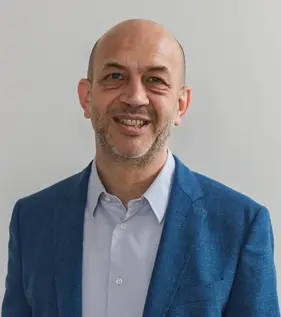
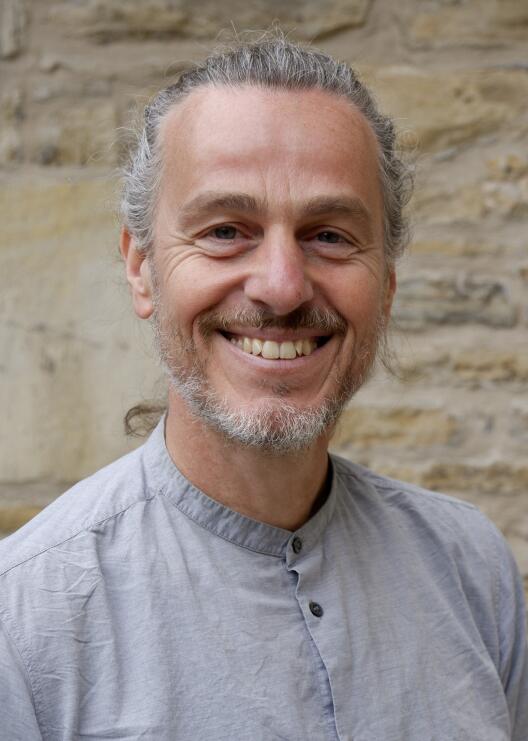
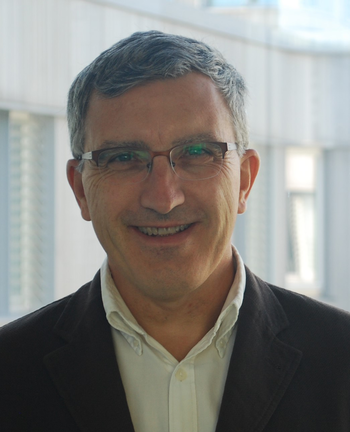
Prof. Dr. Claudine Moulin is a Full Professor of Historical Linguistics at the Department of German Studies, University of Trier. She co-directs the Trier Center for Digital Humanities and serves as Vertrauensdozentin der Deutschen Forschungsgemeinschaft. With academic roots in Brussels and Bamberg, she completed her PhD in 1990 and Habilitation in 1999 at the University of Bamberg. Her research spans medieval and early modern languages, manuscript studies, digital humanities, and Luxembourgish linguistics. As a leading scholar in historical linguistics, Moulin's work explores urban language history, phraseology, and cultural knowledge transmission through manuscripts. She has directed major digital humanities projects like LexicoLux and Cartul@rium, while pioneering digital codicology methods for medieval texts. Her research combines traditional philology with computational approaches. Her academic accolades include the Akademiepreis Rheinland-Pfalz (2010), Landesverdienstorden (2014), and the Verdienstkreuz am Bande (2025). She has held visiting professorships at Sorbonne, EHESS Paris, and EPHE, and received fellowships from the Humboldt Foundation and European Science Foundation. Notable Academic Roles: Co-founder and Chair of DHd (Digital Humanities in German-speaking countries) Founding member of Trier Center for Language and Communication Member of German Historical Institute Paris scientific board Advisory positions at Austrian Center for Digital Humanities and Herzog August Bibliothek Her editorial leadership includes chief editorship of Sprachwissenschaft journal and co-editorship of Germanistische Bibliothek monograph series. She has mentored over 40 graduate students in topics ranging from medieval marginalia to urban language studies.
Professor Max Deeg is a leading scholar in Buddhist Studies at Cardiff University , holding a personal chair since 2009. With a career spanning institutions in Germany, Austria, and the UK, his research focuses on transcultural Buddhist history from India to East Asia, Chinese Buddhist travelogues , and interreligious encounters in medieval China. He has held visiting positions at universities in Japan, Nepal, the US, and Germany, and currently directs the Centre for the History of Religion in Asia (CHRA) . PhD from University of Würzburg (1990) Dr. phil. habil. in Religious Studies (1998) Full Professor at University of Vienna (2002-2006) His research explores Buddhist narratives as tools for constructing religious identity, foundation myths in trans-Himalayan contexts, and terminology evolution in Chinese Buddhist translations. Recent publications analyze Indian Buddhist monasticism through Chinese sources and religious concepts like xin (trust) across Buddhist, Manichaean, and Christian traditions. Awarded the KHK Visiting Research Fellowship (2016) and a DAAD Scholarship (1986-87) , Prof Deeg contributes to editorial boards of major journals. He supervises PhD students and teaches Buddhist Studies , Life of the Buddha , and Chinese Buddhist Texts .
Albrecht Fuess is a Professor of Islamic Studies at Philipps University of Marburg since 2010, specializing in Middle Eastern History (13th–17th centuries), Mamluk socio-cultural dynamics, and contemporary European Islamic discourses. His research spans historical continuity in Ottoman-Mamluk-Safavid interactions, Islamic youth cultures, and Mediterranean geopolitics. Research Focus: Medieval Islamic history, Transottomanica mobility studies, Islam in Europe, and cultural integration of Muslim migrants. Awards: Le Studium Fellowship (2007–2009) at Université de Tours. His publications emphasize military-economy interplay, legitimacy through religious narratives, and resource management in empires, with a focus on Mamluk and Ottoman transformations. He has advised on doctoral projects covering topics like Islamic welfare, Arabic ʾAmālī literature, and Cypriot-Ottoman relations. Leadership: Co-coordinator of Transottomanica (DFG-SPP 1981), member of ANR and DAAD committees, and liaison professor for the German National Academic Foundation. Editorial Roles: Co-editor of 'Transottomanica' and 'Muslim Worlds' series, and advisory board member for journals in Cairo, Paris, and Leuven.
Rhenish Friedrich Wilhelm University of BonnGermany
Stephan Conermann serves as Professor of Islamic Studies and Dean of the Faculty of Arts and Humanities at the University of Bonn, where he has held continuous academic appointments since 2003. His institutional leadership includes directorship of the Annemarie Schimmel Kolleg (2010-2022), Bonn Center for Transcultural Narratology, and significant administrative roles culminating in his current deanship since 2023. Academic Background: Doctorate in Oriental Philology/Islamic Studies (Kiel University, 1996, magna cum laude) Magisterstudium in Asian History, Oriental and Slavic Philology (Kiel University, 1992) Conermann's research examines pre-modern Islamic societies through narrative strategies in historiography, with specialized focus on Mamluk Sultanate governance (1250-1517), Delhi Sultanate/Mughal transitions, and Transottomanica mobility dynamics. His work uniquely connects asymmetrical dependencies (particularly slavery systems), power structures, and global entanglements across South Asia, Middle East, and Eastern Europe. His extensive publication portfolio shows consistent thematic evolution toward comparative frameworks analyzing slavery beyond Eurocentric models, narrative construction of power across cultures, and mobility as historical catalyst. Recent scholarship increasingly integrates transcultural methodology with digital humanities approaches. Academic Leadership: Supervised 290+ theses (59 PhD, 96 Magister, 47 Master, 88 Bachelor) Acquired ~9 million euros in third-party funding (DFG, BMBF, DAAD) Editor of 15+ publication series including Mamluk Studies and Dependency and Slavery Studies Conermann directs the Bonn Center for Transcultural Narratology and co-leads the EXC 2036 'Beyond Slavery and Freedom' cluster, fostering interdisciplinary research on pre-modern dependency systems through international collaborations across Europe, Asia, and the Americas.
Prof. Dr. Christoph U. Werner is the Chair of Iranian Studies at Otto-Friedrich-University Bamberg since 2019, following his 12-year professorship at Marburg University (2007-2019) and previous academic roles. He specializes in Iranian Studies with focus areas in social history , legal institutions , Shiite religious structures , and Persophone literary history . As a Research Dean of Humanities and Cultural Studies (2023-2025) Managing Director of the Institute of Oriental Studies (2021-2025) President of Societas Iranologica Europaea (2019-2023) , he leads major academic initiatives. His research spans Qajar-era legal contracts Waqf (endowment) systems Persian-Ottoman-Georgian historical interconnections Manuscript studies of Persian documents , often combining archival analysis with interdisciplinary approaches. Recent publications focus on 20th-century Persian cultural politics, early modern Persian-Ottoman interactions, and legal epigraphy. He collaborates extensively with institutions like the University of Oxford's Invisible East and DFG Priority Programme Transottomanica . His editorial work includes Orientalistische Literaturzeitung (2022-) Persimone blog (2022-) Bamberg University Press publications and multiple Iranian academic journals.
Judith Lange is a Researcher in German Studies at the Faculty of Humanities, University of Duisburg-Essen. Her work focuses on medieval literature and historical linguistics, contributing to the academic exploration of German cultural heritage. University: University of Duisburg-Essen Faculty: Faculty of Humanities Department: German Studies Email: judith.lange@uni-due.de
Ruggero Vimercati Sanseverino is a Full Professor of Hadith Studies and Prophetic Tradition at the Center for Islamic Theology, University of Tübingen. His research spans Hadith transmission in Sunni and Shiite traditions Prophetic worship and Islamic imitation piety Dynamics of tradition and renewal in Islam Islamic spirituality and religious practices His academic journey includes a PhD from Aix-Marseille University (2012) and a Master’s from IREMAM/CNRS (2007). He has led projects like The Presence of the Prophet (DFG-ANR) and contributed to interdisciplinary dialogues on multireligious societies. The 15 most recent articles reflect his expertise in Hadith methodology Sufi spiritual traditions Prophetic hermeneutics Comparative Islamic studies Key collaborative works address interfaith dynamics and Islamic responses to secularization. He supervises PhD candidates and contributes to editorial boards, including the Theologie, Bildung, Ethik und Recht des Islam series at Nomos Verlag. His work bridges classical Islamic scholarship with contemporary theological challenges.
Hakan Özkan is a Privatdozent and Research Associate at the Institute of Arabic and Islamic Studies, Department of Middle Eastern Studies, University of Münster, where he has been working since 2007 in various capacities. He was awarded his Venia Legendi (Habilitation) in November 2019 for Arabic and Islamic Studies with his thesis 'History of Eastern Zajal – Dialectal Arabic Verse Poetry from the East of the Arab World.' His academic background includes a Franco-German doctorate completed in 2006 from Université de Provence and University of Cologne, supervised by Claude Audebert and Monika Gronke, with external reviewers including Wolfhart P. Heinrichs from Harvard University. His educational background includes: 2019: Venia Legendi for Arabic and Islamic Studies, University of Münster 2002-2006: Franco-German Doctorate in Arabic Studies and Narratology (Université de Provence and University of Cologne) 1995-2000: Master of Arts in Islamic Studies, Oriental Languages and Literatures (University of Cologne) 2000-2001: Course program in Modern Standard Arabic and Syrian-Lebanese dialect at Institut Français d'Etudes Arabes de Damas Özkan's research focuses on premodern Arabic dialect poetry, particularly zajal and muwashshaḥ forms, narratology, prosimeter literature, socio-literary history, and diachronic dialectology. His interdisciplinary approach bridges linguistic analysis with literary criticism, examining how dialectal forms evolved within Arabic literary traditions across different historical periods and geographical regions. He has conducted extensive field research in Arab countries including Syria, Egypt, Lebanon, Tunisia, and Morocco, with particular emphasis on the historical development of poetic forms from the Mamluk through Ottoman periods. His publication history demonstrates consistent scholarly contributions to Arabic literary studies, with his 2020 monograph 'History of Eastern Zajal' representing a landmark study in the field. His recent work has expanded to include analyses of religious poetry praising the Prophet Muhammad in zajal form, wine poetry in Arabic literary traditions, and the integration of dialects into Arabic language teaching methodologies. His scholarly output spans monographs, critical editions, encyclopedia entries, journal articles, and book chapters across multiple languages including German, English, French, and Turkish. Among his academic recognitions: 2018: Second place on shortlist for W2 Professorship for Arabic Language and Translation Science, University of Leipzig 2008: Offered Junior Professorship at American University in Cairo (declined) 2007: Second place on shortlist for maître de conférence position at University of Nancy 2007: Official Qualification from National University Council (CNU) for positions as maître de conférence at French universities Özkan has served on numerous academic committees, including appointment committees for professorships in Sinology and Arabic and Islamic Studies at the University of Münster. He has been a juror for the Sheikh Hamad Award for Translation and International Understanding in Doha and has served on the steering committee for the 'Translation for Dialogue' program of the Anna Lindh Foundation. His editorial work includes reviewing for Mamluk Studies Review, Die Welt des Islams, and Middle Eastern Literatures since 2012. His scholarly activities extend to linguistic fieldwork on Pontic Greek dialects in Turkey and organizing significant academic conferences including 'The Race Course of Literature – An-Nawāǧī and His Contemporaries' in 2018 at the University of Münster. His multilingual capabilities (Arabic, Turkish, German, French, English, Persian, Ottoman Turkish, and knowledge of Modern Greek) enable his comparative work across multiple linguistic and cultural traditions in the Mediterranean region.
Prof. Dr. Ulrich Rebstock is a former full professor of Islamic Studies at the Albert Ludwig University of Freiburg, holding the position from 1993 to 2017. He specializes in Islamic history, Arabic studies, and African Islamic contexts, with a focus on Mauritania and North African intellectual traditions. His work bridges historical documentation, manuscript studies, and the analysis of administrative and legal practices in Islamic societies. Rebstock earned his doctorate in 1983 on Ibadi movements in the Maghrib and completed his habilitation in 1990 on computational practices in the Islamic Orient. Research interests include Islam in Africa, usul al-fiqh (Islamic legal theory), and Arabic mathematical history. He has led major projects such as the publication of the Mauritanian historical encyclopedia Kitāb Ḥayāt mūrītāniyā and the Moorish Literary History series. Current projects involve developing a collaborative web-based system for annotating Arabic texts to create complex indices. Key contributions include critical editions of historical manuscripts, studies on Moorish legal opinions, and analyses of reformist movements in Sudan. His work often emphasizes the intersection of textual analysis with socio-political contexts in Muslim-majority regions.
Prof. Dr. Eva von Contzen is a Professor of English Literature at the University of Freiburg, leading the ERC-funded project 'Lists in Literature and Culture'. She holds a PhD from Ruhr-University Bochum and has taught at institutions including the University of Toronto and Ruhr-University Bochum. She serves as Managing Director of the Mittelalterzentrum (MAZ) and Deputy Equal Opportunity Officer at the Faculty of Philology. Her research focuses on narrative theory, medieval literature, and cognitive approaches to literature. Notable projects include the 'Medieval Narratology' DFG network and the GRK 1767 research training group. She is co-editor of New Chaucer Studies: Pedagogy and Profession and contributes to blogs like Listology . Awards include the Phelan Prize and ERC Starting Grant. Her work bridges medieval and contemporary studies, with recent projects analyzing lists in literature from antiquity to postmodernism.
Corinna May Lhoir is a Lecturer of Yoga History and a doctoral researcher in Indology at the University of Hamburg's Faculty of Humanities, specifically within the Culture and History of India and Tibet department. She is affiliated with the Centre for the Study of Manuscript Cultures (Cluster of Excellence "Understanding Written Artefacts") and serves as Program Coordinator for the Yoga Studies research focus. Her educational background includes an M.A. in Oriental Languages and Cultures: India (Summa Cum Laude) from Ghent University (2023), an M.A. in Traditions of Yoga and Meditation (Distinction) from SOAS, University of London (2020), a B.A. in Languages and Cultures of India and Tibet from Universität Hamburg (2021), and an earlier M.A. in American, English and Slavonic Studies from Ruhr Universität Bochum (1997). Dr. Lhoir's research centers on Jain Yoga, medieval Indian philosophy, and manuscript cultures across multiple linguistic traditions. Her current doctoral project explores the Yogapradīpa, a 15th-century Jain Yoga compendium, analyzing its reception through multilingual manuscript commentaries (ṭabos and bālāvabodhas). She investigates textual transmission, philosophical adaptation, and the vernacularization of Yoga knowledge in Jain traditions through extensive philological work and field experience in India and Europe. Her publication record shows a clear progression from foundational studies on Yoga to increasingly specialized work on Jain Yoga texts. The recent articles (2024-2025) demonstrate deep engagement with specific Jain Yoga texts like the Yogapradīpa, Tattvārthasūtra, and works by Haribhadra and Hemacandra, while her upcoming 2026-2027 publications promise to make significant contributions to understanding Jain concepts of self and philosophical approaches to Yoga. Dr. Lhoir has been actively involved in teaching and knowledge dissemination, designing courses on Introduction to Jain Philosophy and Jain Yoga, Indian Intellectual History, and Origins of Yoga at both undergraduate and continuing education levels. Her teaching often combines hybrid formats with close textual analysis and broader cultural framing. She has taught master classes at Ghent University and SOAS, and developed the blended-learning course "Light on the Dark Age of Jain Yoga" for the Arihanta Institute. She maintains a strong public engagement presence through media interviews, expert commentary in national outlets like Deutschlandfunk, and participation in roundtables on topics including "Alternative Career Paths in Religious Studies" and "Social Responsibility as Yoga Teachers." Her Arihanta Institute blog series has been particularly influential in making academic research on Jain Yoga accessible to broader audiences.
Professor Martin Heimgartner is an Adjunct Professor of Church History at the Martin Luther University Halle-Wittenberg's Faculty of Theology, where he has served as a private lecturer since 2007 and as adjunct professor since 2014. He also works as a research associate at the Theological Seminary of the University of Zurich since 2009. His academic career spans multiple institutions including the Universities of Zurich and Basel where he completed his doctoral and habilitation work. Heimgartner's research focuses on Syriac Christianity, particularly the works of the East Syrian Patriarch Timotheus I (780-823), Christian-Muslim relations in early Islam, philosophy and theology of Syrian Christians, John Chrysostom, Greek and Syrian florilegia literature, and 2nd century Christian apologists. His scholarly work demonstrates deep engagement with primary sources through critical editions and translations of Syriac texts. His publication record shows consistent scholarly output with emphasis on Timotheus I's writings, with multiple monographs published through prestigious series like Corpus Scriptorum Christianorum Orientalium (CSCO). His work bridges historical theology, textual criticism, and interreligious studies, particularly examining early Christian-Muslim dialogue. The articles reveal a progression from textual editions toward more thematic studies on theological concepts like Trinitarian doctrine in interreligious contexts. His scholarly contributions include numerous encyclopedia entries in major reference works such as Religion in Geschichte und Gegenwart (RGG) and Der Neue Pauly, covering figures from early Christianity. He has also collaborated on editorial projects including a volume on Apollinarius. Notably, Heimgartner maintains a dual scholarly identity, combining theological research with musicology. His musicological editions, particularly for Cecilia Bartoli's Malibran project, demonstrate expertise in historical musical works from the 19th century, showing his interdisciplinary approach to historical scholarship across different cultural domains.
Alberto Cantera Glera is a Professor at the Institute of Iranian Studies within the Department of History and Cultural Studies at Freie Universität Berlin. His research focuses on Zoroastrian studies, Avestan language and literature, Iranian linguistics, and manuscript studies. He teaches courses on Young Avestan, Pahlavi, Zoroastrian rituals, and Iranian literature, with office hours held on Thursdays from 3-5 p.m. Professor Cantera Glera's research interests center on Zoroastrian religious practices, particularly the Long Liturgy, Avestan textual criticism, and the transmission of Zoroastrian texts through manuscript traditions. His work bridges linguistic analysis with religious studies, examining how ritual practices evolved from ancient to medieval Iran. He has made significant contributions to understanding the relationship between oral performance and written transmission in Zoroastrian traditions, as well as the linguistic features of Avestan and Middle Persian texts. His recent publications reveal a consistent focus on Zoroastrian ritual structures, particularly the Long Liturgy, with increasing attention to the relationship between textual manuscripts and ritual performance. The articles show progression from linguistic analysis of Avestan texts toward broader studies of ritual practice, sacred geography, and the historical development of Zoroastrian religious authority. His work demonstrates sophisticated integration of manuscript evidence with ritual theory and historical linguistics. PRIX ROMAN ET TANIA GHIRSHMAN 2021 Professor Cantera has supervised numerous PhD students including Nils Purwins, Stefan Härtel, Yusef Saadat, Jaime Porro, Soheil Delshad, and Xue Li. His research has been supported through various academic projects related to Zoroastrian manuscript studies and Avestan textual criticism, contributing significantly to the field of Iranian studies at Freie Universität Berlin.
Viktor Golinets is a Professor of Hebrew Linguistics at the Heidelberg University of Jewish Studies , where he has held the Chair of Hebrew Linguistics since 2018. Previously, he served as a Junior Professor at the same institution from 2012 to 2018. His academic journey includes a PhD in Ancient Near Eastern Studies from the University of Munich (2010) and a Magister degree in Semitics from Ludwig-Maximilians-Universität München (2004). Education: PhD (Altorientalistik, LMU Munich, 2010), Magister (Semitics, LMU Munich, 1997-2004) Professional Roles: Professor (Heidelberg University of Jewish Studies, since 2018), Junior Professor (Heidelberg University of Jewish Studies, 2012-2018), Scientific Assistant (University of Basel, 2007-2012) Golinets’ research focuses on the linguistic and textual history of the Hebrew Bible , ancient Bible translations , and historical grammar of Hebrew . He specializes in Masoretic studies, Semitic epigraphy, and comparative analysis of Northwest Semitic languages like Amorite, Aramaic, and Ugaritic. His work addresses textual criticism, biblical hermeneutics, and the evolution of Hebrew from Masoretic to modern usage. His publications and articles reveal a strong emphasis on Hebrew onomastics , epigraphic analysis , and the role of language in Jewish cultural identity . He has contributed to international colloquia on textual criticism and Semitic philology. Memberships: German Oriental Society, European Association of Biblical Studies, International Association for Comparative Semitics, Association of Judaists in Germany, and others Golinets serves as Deputy Rector at Heidelberg University of Jewish Studies and has collaborated on projects like the Hebrew-Greek Text-Critical Synopsis of the Book of Jeremiah and the Biblia Hebraica Transkripta. His expertise in Hebrew manuscripts and Semitic languages informs both his teaching and research.
Rhenish Friedrich Wilhelm University of BonnGermany
Christian Weigel serves as a Researcher at the Department of Ancient History within the Institute for Historical Science at the University of Bonn, a position he has held continuously since October 2016. His academic career includes prior roles as a lecturer (2014-2016) and research associate in the DFG-Graduiertenkolleg 1878 on pre-modern economic spaces (2013-2016), demonstrating deep institutional integration at Bonn. His educational foundation includes: Magister degree (2012) in Ancient History, Political Science, and Public Law from the University of Bonn Advanced studies (2005-2012) in Ancient History, Political Science, and Public Law Foundational studies (1999-2005) in Medieval/Modern History, Political Science, and Law Weigel's research interrogates Greek family structures through ancient novels while examining economic and social frameworks of antiquity. His focus on demographic patterns, ancient international law, and literary sources reveals innovative methodological approaches to social history. Recent work analyzes how ancient novels function as socioeconomic mirrors, particularly regarding slavery, migration, and gender dynamics in Greco-Roman societies. His publication trajectory (2015-2019) demonstrates consistent exploration of antiquity's socioeconomic textures through diverse lenses—from piracy in ancient fiction to Cold War-era science fiction's classical reception. This body of work establishes connections between ancient economic mentalities and modern cultural productions while maintaining rigorous historical analysis of demographic patterns and legal frameworks. As an active conference participant, Weigel has presented at major venues including the German Historians' Congress and German Sociological Association meetings. His teaching portfolio reveals substantive engagement with students through specialized courses on Homer's society, Roman slavery, Greek federalism, and ancient demographics, often incorporating field components like Adriatic coast excursions.