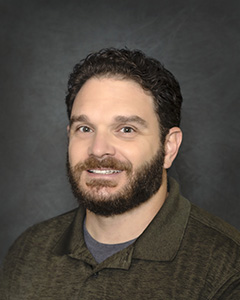
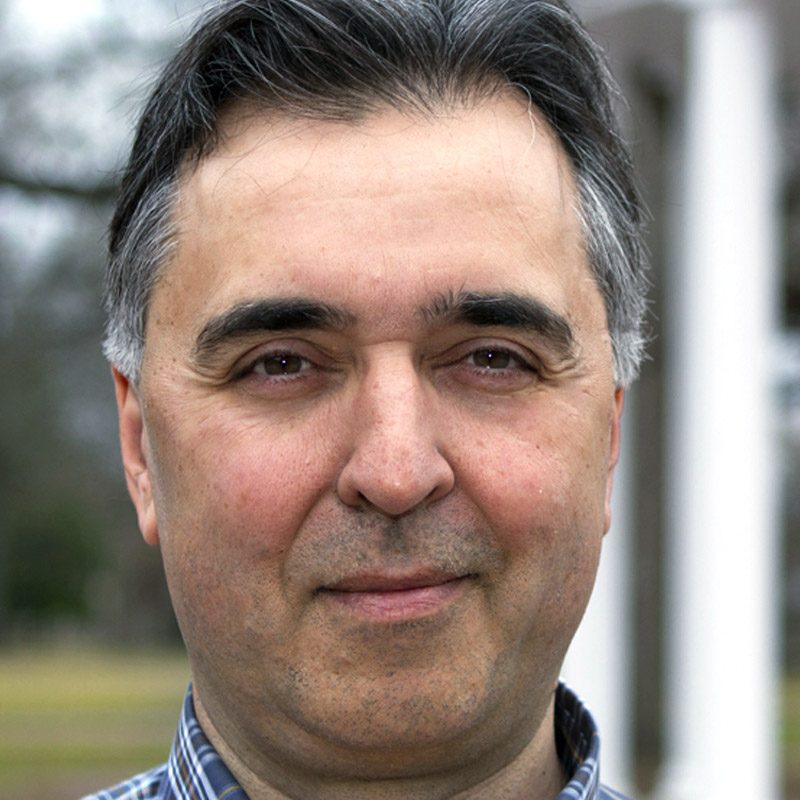
Jack Skinner is a Professor and Department Head of Mechanical Engineering at Montana Technological University's Lance College of Mines & Engineering. He is also Interim Dean of the college and a licensed professional engineer (WY/14963). Education: B.S. in General Engineering (Montana Tech, 2000), M.S. in Mechanical Engineering (Washington State University, 2002), Ph.D. in Mechanical Engineering (UC Davis, 2007) Professional Roles: Interim Dean, Department Head, Principal Member of Technical Staff at Sandia National Labs (2003-2012) His research focuses on nanotechnology and MEMS , with expertise in nanoscale devices, materials, and fabrication techniques. Key areas include: Nanofabrication and microfabrication Electrospinning methods for biomedical and energy applications Plasmonics in polymer composites Advanced materials for energy systems and environmental remediation Device characterization and integration He has taught courses such as: Introduction to Micro/Nanoelectromechanical Systems Heating, Ventilating, and Air Conditioning Engineering Mechanics - Dynamics
Luke N. Brewer is a Professor in the Department of Metallurgical and Materials Engineering at The University of Alabama, with an adjunct appointment in Mechanical Engineering. He serves as Associate Department Head for Graduate Studies and Director of the Center for Advanced Manufacturing and Materials Design Integration within the College of Engineering. His research focuses on advanced manufacturing technologies, particularly cold spray additive manufacturing and repair of metallic structures. His educational background includes a Ph.D. in Materials Science and Engineering from Northwestern University (2001), and dual B.S.E. degrees in Materials Science and Engineering and Applied Mathematics, also from Northwestern University (1996). Dr. Brewer's research interests center on processing-microstructure-mechanical property relationships in metallic alloys and ceramics. He actively investigates cold spray deposition, atomization of metallic powders, rapid solidification, friction stir welding, resistance welding, and materials characterization technique development. His work has significant applications in aerospace, automotive, and defense sectors. He has been involved in high-impact research initiatives, including a $3.8 million Department of Energy grant focused on jet biofuel solutions and research on 3D printing technologies for military applications. His leadership is recognized through roles in major research centers and contributions to the Capstone engineering program. Scientific Awards and Recognition: Featured in Alabama Innovation Fund award (2015) supporting advanced research at The University of Alabama Advising and Grants: Dr. Brewer advises graduate students in materials science and engineering, including Ph.D. graduate Dr. Pallavi Pant. He leads research funded by federal agencies such as the U.S. Department of Energy and collaborates on projects with military applications. His team receives support through institutional and state-level innovation funding. Labs and Research Teams: He leads research activities at the Center for Advanced Manufacturing and Materials Design Integration. His group conducts experimental work on cold spray deposition, welding technologies, and materials characterization. The team hosts regular group events, including an annual potluck, and provides student research opportunities in advanced manufacturing.
Anna Herring is an Assistant Professor in the Department of Civil and Environmental Engineering at the University of Tennessee, Knoxville, part of the College of Engineering. She joined the faculty in August 2022 after conducting postdoctoral research and holding an Australian Research Council Discovery Early Career Researcher Award (DECRA) at the Australian National University. Education: PhD in Environmental Engineering, Oregon State University, 2015 MS in Environmental Engineering, Oregon State University, 2012 BS in Environmental Engineering, University of Colorado, 2010 Her research centers on experimental investigation of fluid flow in porous media, particularly in the context of climate change mitigation. She specializes in carbon capture, utilization, and storage (CCUS), including geologic carbon storage and mineral carbonation. Using advanced 3D X-ray microtomography, she visualizes and analyzes multiphase fluid flows and reactive transport processes at the microscale, linking topology and structure to macro-scale engineering behavior. Her work integrates physics, chemistry, and engineering to optimize subsurface fluid management. The analysis of her recent publications reveals a consistent focus on pore-scale dynamics, fluid topology, wettability, and trapping mechanisms in porous media. Her studies employ micro-CT imaging, topological data analysis, and digital rock physics to understand multiphase flow, with direct applications to CO2 sequestration and reservoir engineering. The interdisciplinary nature of her work spans environmental engineering, materials science, fluid mechanics, and applied mathematics. Scientific Awards and Recognitions: Australian Research Council (ARC) Discovery Early Career Research Award (DECRA), 2018–2021 Editor’s Citation for Excellence in Refereeing, Water Resources Research , 2021 Anna Herring actively contributes to professional service, including serving on the Diversity, Equity, and Inclusion Committee of the International Society for Porous Media (InterPore) since 2022, and as a member of the American Geophysical Union. While specific grant details are not provided, her DECRA fellowship indicates competitive research funding. She has advised or collaborated with numerous researchers, though formal advisees are not listed. Her research is conducted in experimental and computational labs focused on digital rock physics and reactive transport.
Daniel G Georgiev is a Professor in the Department of Electrical Engineering and Computer Science at the University of Toledo's College of Engineering. He has been on faculty since Fall 2006, following prior roles as a research faculty member at Wayne State University's Center for Smart Sensors and Integrated Microsystems (SSIM). Education : M.S. in Engineering Physics (Quantum Electronics and Laser Equipment) from Sofia University (1994), Ph.D. in Electrical Engineering (Electronic Materials and Devices) from the University of Cincinnati (2003). Research Interests : Dr. Georgiev's work focuses on laser modification and micro-structuring of materials, thin films of semiconducting oxides/nitrides (e.g., NiO, Zn3N2), glassy materials, metal whiskers (Sn, Cu), wide bandgap semiconductors (GaN, Zn3N2), photovoltaics, and biomedical device applications. His expertise spans device fabrication, material characterization, and radiation effects. Article Trends : Recent publications emphasize GaN-based power electronics, hybrid edge termination structures, threshold switching in nanocircuitries, and material innovations via reactive sputtering. Subfields include laser microstructuring, whisker suppression in Sn films, and doping strategies for nitride semiconductors. Collaborations : Co-authorship with researchers across institutions, including contributions to biomedical implants, II-VI nanocrystals, and chalcogenide glasses.
Thomas Brunet is a researcher at the University of Bordeaux, specializing in physical acoustics and functional materials for acoustics. His work spans ultrasound physics, material characterization, and advanced modeling/simulation techniques. Key collaborations with research groups: APY (Physical Acoustics) , Functional Materials for Acoustics , and GCE (Civil and Environmental Engineering) . Focus areas: acoustic metamaterials , Anderson localization , contactless micromanipulation , and viscoelastic wave propagation . His publications (over 30 in the last decade) demonstrate expertise in ultrasonic imaging, nanophononics, and multiphysics problems involving mechanical, thermal, and fluid interactions. Collaborative projects include DuMAS (Sustainability of Materials) , IMC (Mechanical Engineering) , and MPI (Materials-Procedes-Interactions) initiatives. No formal awards or student advising details are publicly available in the provided data.
Naureen Ghafoor is an Associate Professor (Docent) at Linköping University, affiliated with the Department of Physics, Chemistry and Biology (IFM) and the Thin Film Physics Division. Her research focuses on advanced materials for neutron and X-ray optics, particularly multilayer structures and thin film physics. Dr. Ghafoor's research interests span thin film physics , nanomaterials science , and neutron optics . She specializes in the development and characterization of multilayer materials, particularly those involving iron-silicon structures with boron carbide interlayers for neutron optical applications. Her work combines advanced deposition techniques like magnetron sputtering with detailed materials characterization to optimize performance in neutron optics and related fields. A key innovation in her research involves the strategic use of isotope-enriched boron carbide (11B4C) to create atomically flat interfaces that enhance the optical properties of multilayer structures. Her recent publications demonstrate a strong focus on enhancing the performance of neutron optical components through innovative materials engineering. Key themes include the use of isotope-enriched boron carbide (11B4C) to improve interface quality in multilayer structures, the development of stress-free diaphragms for medical applications like inner ear implants, and the creation of superstructured materials with exceptional mechanical properties that combine metal-like ductility with high hardness. These advancements have significant implications for both scientific instrumentation and medical device technology. Postdoctoral scholarship in Thin Film Physics granted by Carl Tryggers Stiftelse (600,000 SEK) for studying "Stress-free Diaphragms for Long-lasting Inner Ear Implants" Dr. Ghafoor is actively involved in research commercialization and technology transfer. She is a co-founder of Quantum Beam Optics (QBO), a startup company that aims to bring advanced multilayer neutron optics technology to the international market. Her laboratory work is centered in the Thin Film Physics Division at IFM, where she leads research on nanomaterials science with applications spanning from fundamental neutron optics to practical medical devices. Her research group collaborates extensively with international partners and contributes significantly to advancing the field of neutron optical components.
Prof. Dr. rer. nat. Anna Mechler is a faculty member at RWTH Aachen University , specifically affiliated with the Aachen Process Engineering school under the Teaching and Research Area Electrochemical Reaction Engineering . Her research focuses on electrochemical reaction engineering, particularly in the development of advanced catalysts for energy conversion systems. Research Interests: Oxygen evolution reaction (OER) optimization, electrochemical catalyst synthesis, plasma-assisted electrode fabrication, and sustainable energy technologies like fuel cells and water electrolysis. Publications: Recent work highlights the development of Ni-Co-O anodes, mechanochemical activation of catalysts, and innovative methods for improving electrolyzer efficiency and reproducibility. Labs/Teams: Active in the NGP² group at Aachen Process Engineering, contributing to industrial-scale electrochemical process development.
Zhen He (HE Zhen) is an Assistant Professor in the Department of Materials Science and Engineering at Southern University of Science and Technology (SUSTech). He obtained his B.A. in Materials Science from Northwestern Polytechnical University (2013) and Ph.D. in Inorganic Chemistry from University of Science and Technology of China (USTC, 2018). His research focuses on bioinspired nanostructures, advanced characterization techniques, and structure-property relationships in nanosystems. Biomimetic Nanodesign: Inspired by natural microstructures for functional nanomaterials Characterization Expertise: Synchrotron-based SAXS, AFM, and dynamic monitoring Structure-Property Analysis: Relating microscopic order to macroscopic material behavior He has published 28 papers in top journals including Acc. Chem. Res. , J. Am. Chem. Soc. , Angew. Chem. Int. Ed. , Adv. Mater. , and Small . His work has been supported by multiple National Natural Science Foundation of China projects, including both general and youth programs. Scientific Awards: Principal Investigator of NSFC Youth Program Principal Investigator of three NSFC General Projects Principal Investigator of two NSFC Youth Projects Dr. He collaborates with the Hefei National Laboratory for Physical Sciences at Microscale and works within SUSTech's College of Engineering. His current research explores nanowire self-assembly principles, precise control of nanofilms, and structure-property relationships in ordered nanosystems.
Hans de Bresser is Professor of Teaching and Learning in the Earth Sciences Environment at Utrecht University's Faculty of Geosciences. Appointed as Dean of Regional Education effective September 1, 2022, he leads the university's initiative to strengthen partnerships with regional education providers in Utrecht. Previously, he served as Vice-Dean of Education at the Faculty of Geosciences, Director of Education for the Earth Sciences program, and Director of the Honours College in Geosciences. Professor de Bresser's research focuses on experimental rock deformation, structural geology, and tectonics. His work investigates the mechanical and transport properties of Earth materials under high temperature and pressure conditions, with applications to fault mechanics, reservoir compaction, and energy storage. He employs advanced materials testing techniques and microstructural analysis using light optical and electron microscopy. His research spans fundamental geomechanics to practical applications in resource extraction and geological storage. His recent publications demonstrate a strong focus on the mechanical behavior of rocks relevant to energy transition challenges, including hydrogen storage in salt caverns and understanding deformation processes in gas fields. His work bridges fundamental rock physics with practical engineering applications, contributing to both academic knowledge and industrial solutions. Scientific Awards: Best Poster Award at NAC15, the 15th Netherlands Earth Sciences Conferences 2019, for the poster Student- and Problem-Centered Approaches to Learning in the Field Professor de Bresser has supervised numerous Bachelor's and Master's theses and has been actively involved in educational innovation at Utrecht University. He served as Chair of the Utrecht University Teaching Career Task Force and is a member of the Advisory Board of the Centre for Academic Teaching. His educational leadership extends to directing the Honours College in Geosciences and developing student-centered learning approaches. He leads the Experimental Rock Deformation group (HPT laboratory), also known as the Earth Simulation Lab, where advanced rock mechanics experiments are conducted. The lab focuses on understanding rock behavior under various pressure and temperature conditions, with applications to geological processes and energy-related challenges.
Silke Glas is a Postdoctoral Researcher at the Institute of Numerical Mathematics, Ulm University, a position she has held since July 2018. Previously, she served as a Research Assistant at the same institute from April 2016 to July 2018 and at the Chair of Energy Trading and Finance, University of Duisburg-Essen (2012-2016), funded by the German Research Foundation's Priority Programme 1324. Her research visits include the Institut Henri-Poincaré in Paris and SISSA in Trieste. Her educational background features: Diploma in Mathematics and Economics from Ulm University (2006-2012), thesis on "Reduced Basis Method for Variational Inequalities" Master of Mathematics from the University of South Florida (2009-2010) Dr. Glas specializes in model reduction for nonlinear problems, with core expertise in reduced basis methods applied to variational inequalities, wave equations, Hamilton-Jacobi-Bellman equations, and space-time formulations. Her work bridges theoretical numerical analysis with practical applications in energy markets, particularly intraday electricity trading. She has developed novel approaches for noncoercive and parabolic systems, addressing challenges in error estimation and computational efficiency. Her publication trajectory reveals evolving sophistication in handling time-dependent nonlinear systems, with increasing emphasis on financial applications. Early work focused on theoretical foundations of variational inequalities, while recent publications integrate model reduction with optimal control for energy trading problems, demonstrating cross-disciplinary impact. Scientific recognition includes: No formal awards documented in source material Research funding has been secured through the German Research Foundation's Priority Programme 1324. No student advising activities are mentioned, though her collaborative work involves prominent researchers like K. Urban and Anthony T. Patera. Her primary research environment at Ulm University's Institute of Numerical Mathematics supports her focus on computational mathematics and real-world applications.
Prof. Dr. Wolfgang Lippmann is a Senior Scientist at the Institute of Process Engineering and Environmental Technology, Chair of Hydrogen and Nuclear Energy at Technical University of Dresden. He has maintained continuous affiliation with TU Dresden since 1974, progressing from student to professorial status, with his current role beginning in 2021 after decades as Scientific Staff member. From 2017-2020, he served as Substitute Chair for Prof. Antonio Hurtado during Hurtado's tenure as Vice-Rector for University Development. His academic journey includes: 1974-1978: Studies of energy technology at Technical University of Dresden 1978-1983: Scientific assistant at Chair of Nuclear Energy Technology 1984: PhD on reactor containment stress analysis during cooling loss scenarios 1989: Post-doctoral thesis on pressurized-water reactor containment stress Lippmann's research bridges nuclear engineering with hydrogen technologies through innovative laser-based applications. His work spans reactor safety analysis, high-temperature ceramic materials, and nuclear-hydrogen system integration. He has pioneered laser joining techniques for silicon carbide ceramics in nuclear applications, developed laser decontamination systems for nuclear decommissioning, and conducted safety analyses of hydrogen systems coupled with nuclear power plants. His research integrates fundamental materials science with practical engineering solutions for next-generation energy systems. Analysis of his recent publications reveals three dominant research thrusts: nuclear-hydrogen integration (particularly PEM electrolysis coupled with nuclear plants), laser-based nuclear technologies (decontamination and ceramic joining), and advanced safety analysis of energy systems. His work demonstrates increasing focus on cross-sector energy integration while maintaining strong foundations in nuclear materials and safety engineering. Lippmann leads multiple significant research initiatives including TE-Cer (ceramic composites for thermo-electrical systems), F-Bridge (GEN IV fuel design), MANOLA (laser ablation systems), eJoin and CeraJoin (ceramic joining technologies), DELTA (integrated electrolyzer-hydrocarbon systems), LaDECO (laser decontamination), TE-K-SYSTEM (thermoelectric modules), and SYNKOPE-flex (energy carrier coupling). His laboratory at George-Bähr-Straße 3b in Dresden houses specialized equipment for laser processing, materials characterization, and thermal testing of nuclear components.
Sorin Mitran is a Professor in the Department of Mathematics at the University of North Carolina at Chapel Hill. His research focuses on computational simulation of multiscale and multiphysics systems, data-driven constitutive relations for hyperelastic materials, and information geometry for reduced stochastic models. PhD in Aerospace Engineering from Politehnica University Bucharest (1995) Professional background includes fellowships at University of Tokyo (1993), Karlsruhe Institute of Technology (1998-1999), and University of Washington (1999-2002) His research develops numerical tools to predict macro-scale behavior from micro-scale interactions, such as plastic deformation of metals from lattice defect dynamics, microtubule mechanics from molecular dynamics, and protein folding from atomic-level simulations. Mathematical approaches include adaptive computation, machine learning for constitutive law prediction, and information geometry for stochastic process analysis. Recent publications (2023-2018) span computational biology, multiscale fluid dynamics, and medical applications of continuum mechanics. Articles frequently explore data-driven modeling, wave propagation in biological systems, and GPU-accelerated numerical methods like Lattice Boltzmann and Lattice Fokker-Planck formulations.
Prof. Dr. Myfanwy Evans is a Professor of Applied Geometry and Topology at the University of Potsdam . Her research focuses on geometric and topological modeling of soft and biological systems, with emphasis on analyzing complex microstructures through experimental and theoretical approaches. She is affiliated with the Institute of Mathematics, leading projects in geometric constraints in biological and synthetic materials. Current Position: Professor, University of Potsdam (2020–present) Previous Roles: Emmy Noether Research Group Leader (2015–2020), Humboldt Postdoctoral Fellow (2011–2014) Research Highlights: Evans investigates topological potentials in protein assembly, curvature in biological systems, and geometric optimization in tensegrity frameworks. Her work spans 3-periodic entanglements, network theory, and bicontinuous structures. Funding & Collaborations: Participates in Matters of Activity and MATH+ excellence clusters, collaborating across Berlin universities and Germany. She contributes to research on discretization in geometry and dynamical systems. Software Development: Co-created SPIRE , a tool for bicontinuous phase recognition applied to plastid cubic membranes and biological structures. Technical Expertise: Utilizes Riemannian optimization for geometric modeling, explores auxetic materials, and studies foam coarsening dynamics.
Dr. Saikat Jana is a Lecturer in Mechanical Engineering at the School of Engineering, Ulster University, Belfast. He holds a PhD in Engineering Mechanics from Virginia Tech (2013), an MSc in Mechanical Engineering from the University of Florida (2008), and a Bachelors in Technology from National Institute of Technology Durgapur (2007). His academic career includes postdoctoral roles at the University of Glasgow, Massachusetts Institute of Technology (Skoltech Initiative), Newcastle University, and the University of Leeds. PhD: Engineering Mechanics, Virginia Tech (2013) MSc: Mechanical Engineering, University of Florida (2008) BSc: Technology, National Institute of Technology Durgapur (2007) His research focuses on soft-active matter, particularly microbial behavior in bacterial biofilms, using advanced techniques such as microscopy, microfluidics, and rheology. He investigates length-scale transitions from single cells to biofilm collectives, aiming to control microbial interactions for human health and environmental solutions. Current projects include Pathogen Transport and Distribution (Royal Society, 2025-2027), Nanoparticle Transport in Cystic Fibrosis Biofilms (Department for the Economy, 2024), and Ultrafast Bacteria Detection with Acoustics (2023-2024). Key publication trends highlight his expertise in Biofilm Rheology , Marine Biofouling Prevention , and Microswimmer Dynamics . His work aligns with UN Sustainable Development Goals, particularly in health and environmental sustainability. Projects and grants include: Pathogen Transport and Distribution (Royal Society, 2025-2027) Transport of nanoparticles and nano swimmers in cystic fibrosis biofilms (Department for the Economy, 2024) Ultrafast detection of foodborne bacteria with acoustics (2023-2024)
Houman Zahedmanesh is an Associate Professor in the Department of Mechanical Engineering at KU Leuven's Faculty of Engineering Science. His work focuses on electromigration reliability in nano-interconnects, leveraging machine learning and AI to address thermal hotspots in semiconductor systems. He leads projects like the 2025-2029 BEOL thermal management initiative and contributes to computational materials science research. Current Affiliation: KU Leuven, Faculty of Engineering Science Department: Mechanical Engineering Research Focus: Electromigration, nano-interconnect reliability, AI-driven materials analysis Research Interests: Dr. Zahedmanesh's research bridges materials science and electrical engineering, with emphasis on: Electromigration-induced failure in copper interconnects Thermal gradient effects on electronic reliability Machine learning applications for predictive material modeling Microstructure-aware simulations in nanotechnology Hybrid physical-statistical frameworks for semiconductor reliability Publication Trends: Recent works demonstrate his expertise in AI-driven materials analysis (2025), microstructure modeling (2024), and multiphysics simulations of electromigration (2023). His research aligns with KU Leuven's focus on computational materials science and nanotechnology.