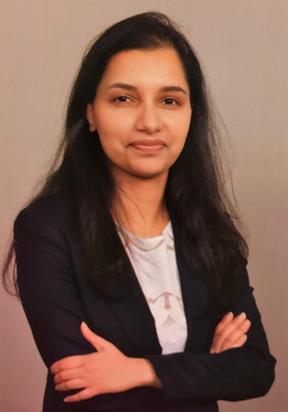
Anjali SandipView profile
Academic
Anjali Sandip is a Teaching Assistant Professor in the Mechanical Engineering Department at the University of North Dakota's College of Engineering and Mines. She holds a Ph.D. in Mechanical Engineering from the University of Kansas and maintains an active research program in computational mechanics, high-performance computing, and machine learning. Her educational background includes a Doctor of Philosophy and Master of Science in Mechanical Engineering from the University of Kansas, and a Bachelor of Engineering in Mechanical Engineering from Osmania University in Hyderabad, India. She previously served as a post-doctoral researcher at the University of Nebraska, where she developed patient-specific computational models for peripheral artery disease treatment. Dr. Sandip's research spans computational mechanics, high-performance computing, uncertainty quantification, physics-informed machine learning, and multi-physics modeling. Her work has significant applications in ice sheet dynamics, medical device modeling, and multi-phase flow simulations. She has developed open-source software frameworks that integrate finite element and finite volume methods with uncertainty quantification tools. Her recent publications demonstrate a strong focus on developing computational frameworks for multi-physics problems, with particular emphasis on GPU acceleration, uncertainty quantification, and machine learning integration. The research shows consistent application of these methods to challenging problems in earth sciences, biomedical engineering, and traditional mechanical engineering domains. Scientific Awards: NSF EPSCoR Research Fellow (2024-25) Dr. Sandip actively mentors both undergraduate and graduate researchers, and she is currently seeking Master's and Ph.D. students interested in computational mechanics, applied mathematics, scientific machine learning, and earth sciences. She serves as an active member of the Association of Computational Mechanics (USACM & IACM) and has delivered numerous presentations at professional conferences. Her research has received support from prestigious organizations including the National Science Foundation (NSF), Department of Energy (DOE), and NVIDIA. She teaches courses including Introduction to Mechanical Engineering, Thermodynamics, Machine Component Design Laboratory, Advanced Finite Element Methods, Modeling Glaciers and Ice Sheets, Statics, and Engineering Ethics, demonstrating her broad expertise across mechanical engineering disciplines.