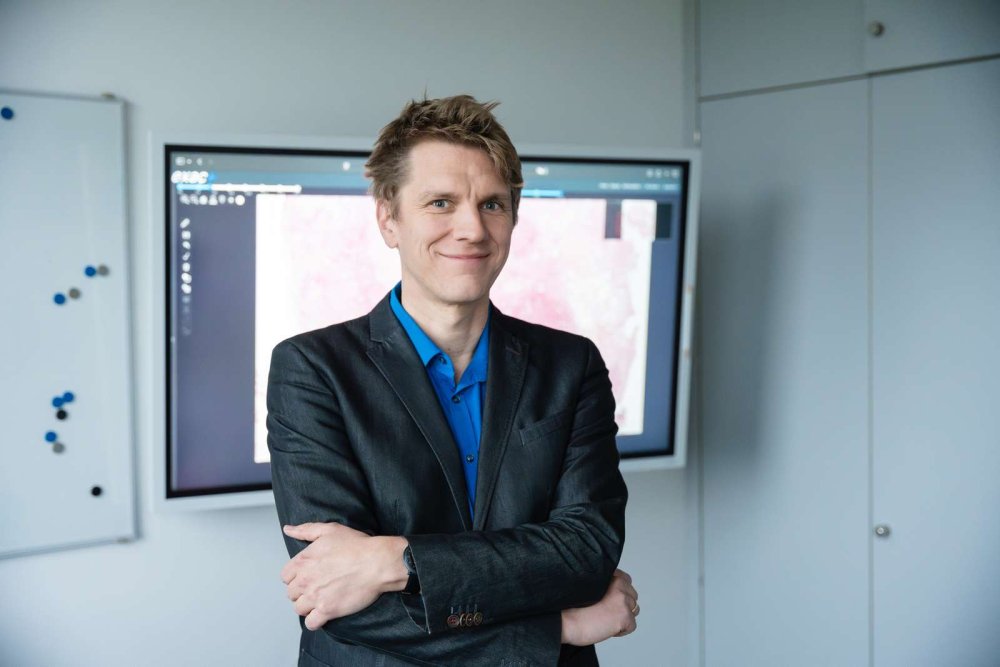
Ji ChenView profile
Associate Professor
Ji Chen is an Associate Professor with Tenure at the Institute of Condensed Matter Physics and Material Physics (ICMP), School of Physics, Peking University. His research focuses on developing and applying advanced computational and artificial intelligence methods to study the electronic structure, atomic structure and dynamics of condensed matter and materials. Dr. Chen received his PhD in Condensed Matter Physics from Peking University, following graduate studies at the Institute of Physics, Chinese Academy of Science, and an undergraduate degree in Physics from the University of Science and Technology of China. He completed postdoctoral training at University College London and the Max Planck Institute for Solid State Research. Dr. Chen's research interests span electronic structure theory, quantum Monte Carlo methods, deep learning applications in physics, strongly correlated systems, water and carbon structures & dynamics, and AI-assisted materials modeling. His group develops and applies advanced computational techniques to address challenging problems in condensed matter physics and materials science, with particular emphasis on neural network-based quantum Monte Carlo methods and their applications to complex physical systems. The research demonstrates significant advancements in computational methodologies that combine machine learning with quantum mechanical simulations, achieving unprecedented accuracy in modeling strongly correlated electrons and complex material properties. Dr. Chen leads the Chen Research Group at Peking University, which actively collaborates with researchers worldwide. The group maintains an active publication record in top-tier journals including Nature, Science, Physical Review Letters, and other leading physics and chemistry publications. Their work spans from fundamental method development to practical applications in quantum technologies, materials design, and energy-related research. Dr. Chen teaches undergraduate and graduate courses in computational physics at Peking University, including "Computational Physics" and "An Introduction to Computational Physics," sharing his expertise in molecular dynamics simulations, Monte Carlo calculations, and density functional theory with the next generation of physicists and materials scientists.