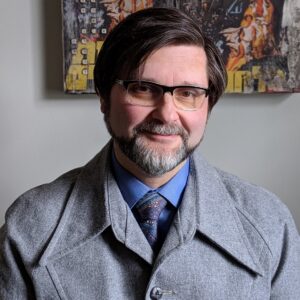
Kate Holland is an Associate Professor and Acting Associate Chair (Graduate) at the University of Toronto, specializing in 19th-century Russian literature and its cultural contexts. Her work focuses on the history of the novel, Russian literary theory, and the interplay between Russian and European literary traditions. She teaches courses such as 'The Golden Age of Russian Literature' and 'Dostoevsky in Literary Criticism and Theory.' Dr. Holland earned her PhD from Yale University (2004) and a BA/MA from the University of Cambridge (1998). Her research explores themes like genre evolution in Dostoevsky’s works, the publication culture of 19th-century Russian periodicals, and the theoretical frameworks of Historical Poetics. Her recent publications include A Dostoevskii Companion: Texts and Contexts (2018) and The Novel in the Age of Disintegration (2013), analyzing Dostoevsky’s engagement with genre and modernity. Her scholarship frequently examines narrative form, cultural history, and the intersection of literature with philosophical and religious thought.
Peter O’Brien is an Assistant Professor of Classics in the King’s-Dalhousie Joint Faculty, with formal affiliations at both Dalhousie University and the University of King’s College. Holding degrees from the University of Windsor (BA Hons), Dalhousie (MA), and Boston University (MA, PhD), he has been a faculty member since 2001 after teaching at a Boston private school. Roles: Graduate Coordinator, King’s-Dalhousie Carnegie Professor, Public Orator (2011-present), Vice-President (2017-2021) Editorial: Co-Editor of Mouseion: Journal of the Classical Association of Canada Teaching: Specializes in Virgil, Ovid, Catullus, and late Roman history Research Focus: Literary analysis of Ammianus Marcellinus’ historiography, Virgilian allusions in late antiquity, and Neo-Latin literature with Canadian themes. His work spans classical formation, emotional rhetoric in Jesuit texts, and classical tradition in Atlantic Canada. Publications Trends: 15 recent works (2006-2019) demonstrate expertise in Latin historiography, Virgilian intertextuality, and Neo-Latin studies. Key themes include rhetorical analysis of imperial speeches, classical reception in colonial contexts, and sacred/secular dynamics in historical narratives. Scientific Awards: Recognized for teaching excellence and graduate advising (2006, 2007, 2010). Holds leadership roles in the Classical Association of Canada (Vice-President 2022-2024). Advising & Outreach: Served as graduate coordinator, contributed to Halifax Humanities 101 and Halifax Thinks community programs, and coordinated the Foundation Year Programme at King’s College.
Pamela Klassen is Professor and Chair in the Department for the Study of Religion at the University of Toronto, cross-appointed to Anthropology. She is a Fellow of the Royal Society of Canada and has held distinguished positions including William Lyon Mackenzie King Chair at Harvard University and Distinguished Visiting Professor at the University of Tübingen. Professor Klassen's research focuses on the anthropology of religion with particular attention to: Colonialism, treaties, and public memory in North America and Turtle Island Global Christianities and their relationship to Indigenous lands Religion, ritual, and museum studies Digital humanities approaches to religious history Gender, spirituality, and religious authority Her scholarly work demonstrates a consistent engagement with how religion shapes and is shaped by colonial histories, public memory, and contemporary political struggles. Klassen's research bridges academic inquiry with public-facing projects that collaborate with Indigenous communities, particularly the Rainy River First Nations. Among her notable awards are the American Academy of Religion Award of Excellence (2012), the Northrop Frye Award of Excellence (2015), and the Anneliese Maier Research Award from the Humboldt Foundation (2015-2020). She was elected as a Fellow of the Royal Society of Canada in 2019. Professor Klassen actively mentors graduate students and has supervised numerous PhD candidates working at the intersection of religious studies, anthropology, and Indigenous studies. Her current research includes a book on the public memory of gold rushes in settler colonies and ongoing collaborative work with the Kay-Nah-Chi-Wah-Nung Historical Centre. She leads several major collaborative projects including "Kiinawin Kawindomowin Story Nations," a digital storytelling initiative focused on restorying colonial documents about Manidoo Ziibi (Rainy River), and "Treaty Conversations," an educational resource about treaty relationships in Ontario.
Dr. Kenneth MacKendrick serves as Professor and Department Head in the Department of Religion at the University of Manitoba's Faculty of Arts, where his work bridges critical social theory, the study of evil across religious traditions, and the psychological dimensions of religious imagination including imaginary companions and fantasy gaming practices like LARPing. His academic credentials include: PhD in Critical Theory, Ethics, Hermeneutics, and Psychoanalysis (University of Toronto, 2005) MA in Critical Theory and Religion with Feminist Ethics focus (University of Toronto, 1996) BA in Religious Studies (University of Windsor, 1994) MacKendrick's research interrogates how humans inhabit imagined realities through religious frameworks, examining phenomena from Dungeons & Dragons world-building to theological conceptualizations of evil. His scholarship consistently applies Habermasian critical theory to deconstruct metaphysical assumptions in religious discourse while exploring the cognitive foundations of religious experience. His publication trajectory reveals persistent engagement with interdisciplinary methodologies, evolving from early analyses of Habermas's critical theory (2008) toward contemporary investigations of fan cultures and imaginary world-building (2018-2023). The thematic through-line connects theoretical rigor with practical religious phenomena, particularly through his seminal work on evil and its manifestations across global traditions. Actively mentoring graduate students in Master's and PhD programs, MacKendrick maintains robust scholarly productivity as evidenced by his ongoing publications and departmental leadership, though specific research grants remain undocumented in available materials.
Joël Castonguay-Bélanger is an Associate Professor of French at the University of British Columbia, affiliated with the Faculty of Arts and the Department of French, Hispanic and Italian Studies. He joined UBC in 2009 after a postdoctoral fellowship at Stanford University, following a joint PhD from Université de Montréal and Université Paris IV-Sorbonne (2007) and an MA from McGill University (2002). His research focuses on 18th-century French literature, the intersection of literary and scientific discourses, the Enlightenment, and Québec literature. He is an associate member of the Centre de Recherche Interuniversitaire en Sociocritique des Textes (CRIST). Castonguay-Bélanger has published extensively in journals such as Études françaises , Papers on French Seventeenth Century Literature , and Eighteenth-Century Fiction , as well as edited volumes. His 2008 monograph Les écarts de l’imagination examines scientific representations in 18th-century novels. He co-edited Voltaire à la radio canadienne (2013) and served as co-editor of Lumen (2017). Current projects include a critical edition of Louis-Guillaume de La Folie’s Le Philosophe sans prétention and a study of Louis-Sébastien Mercier’s anti-Newtonian writings. His teaching focuses on French language and literature, including courses like FREN 101 and FREN 102 at UBC. His work bridges literary analysis with historical context, emphasizing how scientific ideas shaped cultural narratives during the Enlightenment. He received the Peter Wall Institute Early Career Scholar award (2010), reflecting his contributions to interdisciplinary scholarship.
J. Barton Scott is a Professor of Historical Studies with a focus on the History of Religions at the University of Toronto Mississauga . His research spans the global intellectual and cultural history of the 19th and early 20th centuries, with a particular emphasis on South Asia and its transnational connections. He teaches courses on social and cultural theory, religion in political thought, and media and material religion. Education: Ph.D., Duke University B.A., Swarthmore College Research Interests: Scott’s work explores the intersections of religion, law, and politics in colonial and postcolonial South Asia. He is especially interested in how modern Hindu thinkers engaged with and reshaped global discourses on secularism, blasphemy, and religious authority. His research also delves into the cultural history of the study of religion, affect theory, and the role of media and print culture in shaping religious identities and publics. Books and Major Projects: He is the author of Spiritual Despots: Modern Hinduism and the Genealogies of Self-Rule (2016) and Slandering the Sacred: Blasphemy Law and Religious Affect in Colonial India (2023), both published by the University of Chicago Press. He is also the co-editor of Imagining the Public in Modern South Asia (Routledge, 2016). Currently, he is working on two new book projects: one on guru culture in southern California around World War II, and a collaborative study on the powers of the image in South Asian religions. Scientific Awards: Honorable Mention, American Comparative Literature Association's Harry Levin Prize for an Outstanding First Book (for Spiritual Despots ) Public Engagement and Editorial Work: Scott has contributed essays and reviews to public-facing platforms such as The Immanent Frame , The Revealer , and the Journal of Religion & Film . His work bridges academic and public discourse, particularly in the areas of secularism, religious affect, and colonial legacies in South Asia.
Dr. Sarah Winters is an Associate Professor in the Department of English Studies at Nipissing University, within the Faculty of Arts and Science. She holds a full-time faculty position and specializes in Children's Literature, Fantasy, Fandom, and Theology and Literature. Her research critically examines representations of evil in British High Fantasy since 1950 and explores intersections between theology, culture, and narrative. Education: PhD, University of Toronto MA, University of Otago BA, University of Otago Research Interests: Winters focuses on analyzing evil in fantasy works, particularly through the lens of Christian theology, and its portrayal in authors like C.S. Lewis and J.K. Rowling. She also engages with pedagogical methods, co-teaching strategies, and the role of fandom in literary interpretation. Her work bridges cultural, religious, and narrative studies to address themes of morality, identity, and authorial intent. Recent Article Trends: Her publications span from 2001 to 2018, emphasizing children’s literature and fantasy, with a strong focus on evil’s literary and theological manifestations. She also addresses educational frameworks, such as using fan vidding for teaching and co-teaching dynamics in higher education. Awards: No scientific awards or fellowships are explicitly listed in the provided text. Advising and Grants: While no advisees or grants are documented here, her articles suggest active engagement in academic collaboration and mentorship, particularly in fantasy literature and pedagogy.
Dr. Scott McLaren is an Associate Librarian and faculty member in the Department of Humanities at York University's Faculty of Liberal Arts & Professional Studies. With a PhD in Cultural History from the University of Toronto, he serves as lead editor of the Historical Papers of the Canadian Society of Church History. His research intersects religion, print culture, and material culture, examining themes like religious values in literature and the nature of religious artifacts. His research interests span cultural history, religion, history of the book, and Canadian history. McLaren has authored significant works including Pulpit, Press, and Politics: Methodists and the Market for Books in Upper Canada (2019) and edited The Bible in the Age of Empire: A Cultural History (2024). McLaren's publications demonstrate consistent focus on print culture dynamics, religious textual production, and Methodist history. Recent works explore biblical interpretation in colonial contexts, denominational publishing networks, and transatlantic religious exchanges. His scholarship appears in prestigious references including the Cambridge History of the Bible and Oxford Dictionary of the Christian Church.
JD Fleming is a Professor in the Department of English at Simon Fraser University (SFU). His research focuses on the history and philosophy of Western science and technology in the early-modern period (1500-1700), exploring how modern intellectual norms emerged during this era. He co-founded the international conference series *Scientiae: Disciplines of Knowing in the Early Modern World* in 2011 and organized its inaugural event at SFU Vancouver (2012) and the 2019 conference at Queen's University, Belfast. Education: BA (University of British Columbia) MA (University of Toronto) PhD (Columbia University) His research interests include the conceptual history of 'discovery' and 'information', with a focus on figures like Timothie Bright and John Wilkins. He has published extensively on early modern science, literature, and epistemology. His recent work examines the intersection of melancholy, medicine, and information systems in early modern thought. He currently teaches courses on early modern literature and cultural studies. Fleming’s academic contributions extend to organizing major scholarly events and editing influential volumes in intellectual history.
John Harding is Professor of East Asian Religions in the Department of History and Religion at the University of Lethbridge, Canada. He has served multiple terms as department chair (2010-2013, 2015, 2018, 2022-2023) and was the founding coordinator of the Asian Studies minor (2013-2017, 2022). He currently teaches Zen Buddhism and World Religions and is a visiting scholar at Aarhus University, Denmark (April–May 2024). Education: BA, Asian Studies (minor Religion), University of Puget Sound, 1994 PhD, Religious Studies, University of Pennsylvania, 2003 Research stays in Japan and one year at the University of Cambridge, England Research Interests: Harding specializes in Japanese Buddhism and the global modernization of Buddhism over the past 150 years. His work emphasizes cross-cultural exchanges between Asia and the West, including studies of Buddhism in Canada (notably Jōdo Shinshū in southern Alberta) and transnational Buddhist networks. A secondary focus is the theory and method of studying religion, reflected in widely used textbooks co-authored with Hillary Rodrigues. Recent Publications & Trends: From 2008 to 2024, his publications reveal a sustained investigation into the globalization of Buddhism. Monographs such as Mahayana Phoenix (2008) and Buddhism in the Global Eye (2020) map Japanese and Canadian Buddhist identities within transnational contexts. Edited collections including Wild Geese (2010) and Flowers on the Rock (2014) extend this inquiry to Canadian Buddhist communities, while theoretical pieces interrogate secularization and pedagogy in religious studies. Grants & Awards: SSHRC Insight Grant, “The Modernization of Buddhism in Global Perspective,” 2013–2022, CAD $258,659 (PI, with Victor Sōgen Hori & Alexander Soucy) University of Lethbridge Research Fund, “CREDO: Buddhist Developments of the Western Frontier,” 2009–2011, CAD $17,300 University of Lethbridge Research Fund, “Cultural Responses to Contested Claims of Sacred Place,” 2005, CAD $8,500 Labs, Teams & Service: Harding co-directs the Global Buddha research network (globalbuddha.org) with Hori and Soucy, which disseminates findings from their SSHRC project. He is a past president and current board member of the Nikka Yuko Japanese Garden, serves on editorial boards, and regularly delivers public lectures such as the “Buddha’s World Tour” PUBlic Professor Series talk (2015).
Neil Gerlach is an Associate Professor in the Department of Sociology and Anthropology at Carleton University. He holds a PhD in Sociology from Carleton University, an MA in Anthropology from the University of Saskatchewan, an LL.B in Law, and a B.Ed in Education. His research focuses on pandemic culture, analyzing how pandemic narratives shape public imagination through media and popular culture. He also explores classical social theory, biosecurity imagery, and the intersection of science fiction with sociological critique. Gerlach’s work addresses themes like global risk, apocalyptic temporality, and the governance of biotechnology. Education: PhD in Sociology, Carleton University MA in Anthropology, University of Saskatchewan LL.B in Law, University of Saskatchewan B.Ed in Education, University of Regina Research interests emphasize pandemic culture’s construction of shared vulnerability in a globalized world, apocalyptic narratives in film and media, and the sociological implications of genetic technologies in criminal justice. His teaching includes courses on war sociology, classical theory, and work studies. Gerlach’s recent articles examine Ebola media coverage, biosecurity iconography, and zombie narratives in public health campaigns. He frequently presents at conferences on pandemic discourse and futurist writing, including analyses of Richard Preston’s The Hot Zone and the CDC’s zombie apocalypse campaign. He advises graduate students focused on pandemic sociology, war studies, and futurism. His work engages interdisciplinary themes at the intersection of law, media, and biopolitics.
Barry Stephenson is an Associate Professor in the Department of Political Science at Memorial University of Newfoundland, holding a joint appointment in Religious Studies. His academic journey includes a BA from the University of Waterloo, an MA from Wilfrid Laurier University, and a PhD from the University of Calgary, with prior faculty experience at Wilfrid Laurier’s Religion and Culture Department. His educational background: BA, University of Waterloo MA, Wilfrid Laurier University PhD, University of Calgary (2005) Stephenson's research critically examines the intersection of politics and religion through ritual, performance, and public spheres. He investigates how myth, ideology, and secular modernity shape religious expression in contemporary societies, with particular focus on conflict dynamics and violent manifestations. His interdisciplinary approach bridges anthropology, political theory, and cultural geography to analyze lived religious practices and their socio-political implications, especially regarding sacred space transformation and institutional decline. Recent publications reveal evolving research trajectories: ritual theory remains foundational but has expanded into death studies, spatial transformations of religious sites, and pandemic-era grief practices. His work demonstrates consistent theoretical engagement with liminality while branching into applied contexts like spiritual care infrastructure and church repurposing projects. Stephenson actively supervises graduate research in Politics & Religion, Performance/Protest, Myth/Ritual, Secular Modernity, and Religion/Conflict. He co-directs the SSHRC-funded After Church Atlas project with Dr. Nicholas Lynch (Geography), analyzing church closures and adaptive reuse across North America. As former co-chair of the American Academy of Religion’s Ritual Studies Group and editor of Oxford University Press’s Ritual Studies Series, Stephenson has significantly shaped academic discourse. His leadership in ritual theory is evidenced through edited volumes, keynote addresses, and collaborative research initiatives examining religious performance in post-secular contexts.
John Savarese is an Associate Professor of English at the University of Waterloo, specializing in Romantic-era literature, the relationship between literature and science, and Gothic traditions. His interdisciplinary work bridges literary studies with cognitive science, examining how Romantic writers conceptualized mind, cognition, and sociability within their historical context, with particular attention to ballad traditions and Gothic literature. Dr. Savarese completed his PhD at Rutgers University in 2012, following an MA from Rutgers and a BA from New York. Prior to joining Waterloo in 2014, he held postdoctoral fellowships at the University of Texas at Austin and the University of California, Berkeley. His research explores how Romantic poets engaged with emerging sciences of the mind, revealing connections between poetic form and cognitive processes. Dr. Savarese investigates how literary traditions like ballads and Gothic narratives served as vehicles for exploring theories of social cognition, distributed mind, and environmental relations, demonstrating literature's role in shaping conceptual frameworks that anticipated contemporary cognitive theories. UW/SSHRC Explore Grant, 2020-2022 David L. Kalstone Award, Rutgers University (English alumni award), 2019 UW/SSHRC Insight Development Grant 4A Funding, 2015-2016 Travel stipend, University of Edinburgh, 2015 UW/SSHRC Travel Grant, 2014 American Council of Learned Societies New Faculty Fellowship, 2013-2014 Postdoctoral Fellowship, University of Texas at Austin, 2012-2013 As an educator, Dr. Savarese supervises graduate students in Romantic literature, Gothic studies, and the history of science. His interdisciplinary approach extends to collaborations with Waterloo's Cognitive Science program and the History of Distributed Cognition project at the University of Edinburgh. His creative work in sound design and field recording for projects including 'Cities and Memory' and 'Gothic Listening' demonstrates his commitment to exploring literary studies through multiple sensory and technological modalities.
Travis DeCook serves as an Associate Professor in the Department of English within Carleton University's Faculty of Arts and Social Sciences. His scholarship bridges Early Modern literature, Religion and Theology, Intellectual and Cultural History, and critical examinations of Secularity and Modernity through biblical studies. Educational background: B.A. Honours, University of Victoria M.A., University of Victoria Ph.D., University of Toronto DeCook's research critically investigates how sixteenth and seventeenth-century accounts of the Bible's origins—not merely its content—informed early modern political theology and secular thought. His award-winning monograph The Origins of the Bible and Early Modern Political Thought (Cambridge University Press, 2021) demonstrates how writers exploited tensions between the Bible's divine and human dimensions to construct narratives about its transmission, subsequently deploying these for arguments about societal organization. This work directly challenges conventional genealogies of secular modernity. Analysis of his 15 most recent publications (2002-2024) reveals persistent engagement with Henry Vaughan, Hobbes, Bacon, and Marlowe through lenses of biblical materiality, eschatology, and theopoetics. His scholarship consistently interrogates how scriptural interpretation shapes political concepts while exposing the theological underpinnings of supposedly secular frameworks. Scientific awards: FASS Research Award for Junior Faculty (2010) FASS Research Grant (2010) SSHRC Institutional Research Grant (2009) Izaak Walton Killam Postdoctoral Fellowship (2006) DeCook actively mentors graduate students including Ali Ahmed (DRP: 'Poetic Truth: Lewis, Barfield, and the Karamazovs') and Christopher Jenkins (MA thesis: 'The Cross Pressure of Flannery O'Connor'). He teaches core graduate courses—ENGL 6002 (Doctoral Proseminar), ENGL 5005 (M.A. Seminar), and ENGL 6000 (The Production of Literature)—while maintaining an active conference presence at venues like the Renaissance Society of America and Sixteenth Century Studies Conference. His grant history reflects sustained institutional and national funding support for interdisciplinary biblical scholarship. No dedicated research laboratories or formal team structures are documented in available materials.
Shalini Singh, PhD is a Professor in the Department of Recreation and Leisure Studies at Brock University (ON, Canada). Her research focuses on leisure tourism, particularly the interplay between tourism activities and destination communities. She specializes in domestic tourism dynamics, cultural heritage preservation, and the role of sacred sites like UNESCO's Bodhgaya in fostering reconciliation through tourism. Her work bridges academic contributions with practical insights, including: Analyzing entitlement perspectives in Israeli domestic tourism Evaluating community participation impacts in Himalayan regions Examining sacred-secular synergies at Buddhist pilgrimage sites She serves as National (India) Representative on the Board of the Asia Pacific Tourism Association and holds Vice-Presidency (Publications) in the International Sociological Association's Tourism Research Committee. Recent research trends emphasize: World Heritage Site tourism impacts National identity construction via leisurescapes Interdisciplinary tourism terminology development Professional activity includes over 20 peer-reviewed book chapters and journal articles, with conference presentations on pilgrimage tourism and heritage management. Active in editorial work for tourism encyclopedias and academic journals.