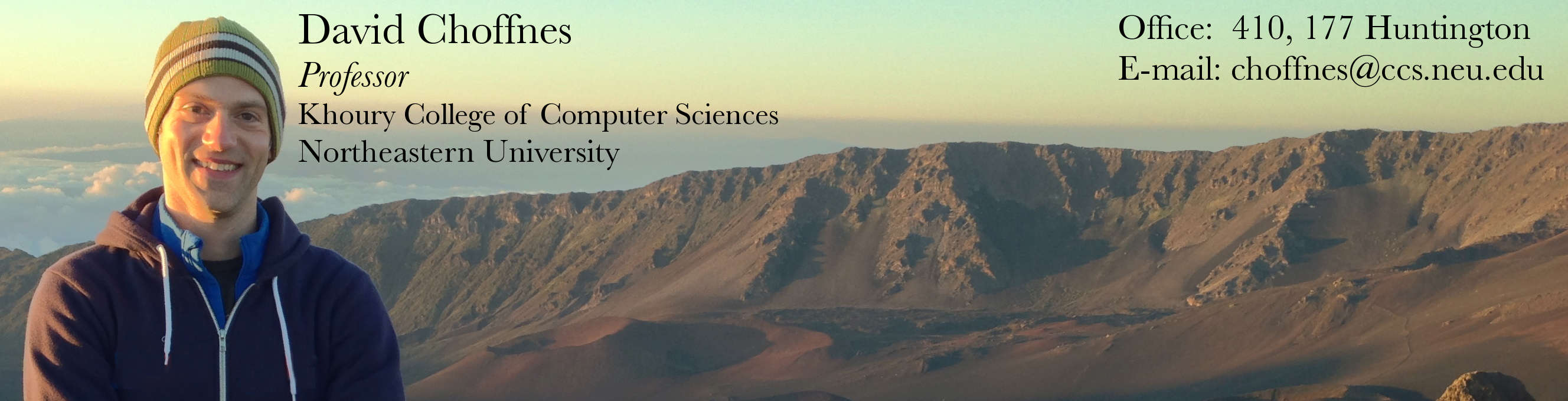
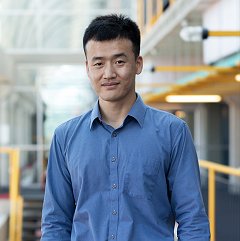
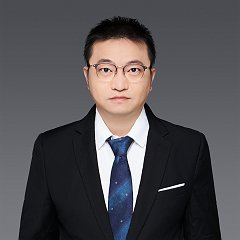
David Choffnes is a Professor at Northeastern University's Khoury College of Computer Sciences and Executive Director of the Cybersecurity and Privacy Institute (2021-2023). He is affiliate faculty at the Center for Law, Innovation and Creativity (CLIC). His research spans Distributed Systems, Networking, Privacy, Security, and Mobile Computing , with emphasis on IoT, transparency, and policy-relevant empirical studies. His research has produced software with over 1 million users , including the net neutrality tool Wehe and ReCon for mobile privacy control. He has received major grants like a $10M NSF SaTC Frontier grant and industry support from Google, Comcast, and Verizon. Recent publications focus on smart speaker profiling , data localization , and gig economy privacy risks , with papers accepted at top venues like PETS and IMC. He has won multiple best paper awards and serves on program committees for SIGCOMM, IMC, and IEEE S&P. Awards include the Caspar Bowden PET Runner-Up (2024) IMC Best Paper Award (2023) NSF CAREER (2018) ACM Senior Member (2021) 10M NSF SaTC Frontier grant He advises PhD students like Tianrui Hu (recently graduated), and leads the Mon(IoT)r Lab analyzing IoT privacy and security implications. His work bridges technical solutions with policy debates , collaborating with regulators and legislators.
Alcherio Martinoli is a Full Professor at the School of Architecture, Civil and Environmental Engineering (ENAC) at École Polytechnique Fédérale de Lausanne (EPFL), leading the Distributed Intelligent Systems and Algorithms Laboratory (DISAL). He holds additional roles as Director of the ENAC School’s SSIE-GE department and is involved in administrative committees such as the ENAC School Direction and CDS. His expertise spans autonomous robotics, distributed systems, and environmental monitoring. Education: He earned his Diploma in Electrical Engineering from ETH Zurich and a Ph.D. in Computer Science from EPFL. His research focuses on designing, controlling, and optimizing distributed systems, including multi-robot teams and sensor networks, with applications in environmental and civil engineering. Research Interests: His work integrates theoretical models with physical experiments, emphasizing mixed societies of natural and artificial systems. Key areas include swarm robotics, intelligent vehicles, and fluid-mediated self-assembly. He emphasizes closing the theory-experiment loop through computational methods. Publications: His recent work addresses multi-robot system architectures, gas sensing with nano aerial vehicles, and distributed control algorithms. These contributions advance environmental monitoring, autonomous navigation, and swarm coordination. Awards: Recognitions include the Best Teacher Award (2016), Best Poster Award (2016), and SNSF Professorships (2003, 2007). Grants & Advising: Supervises numerous PhD students and has advised over 20 graduates. His grants include projects on distributed robotics and environmental systems, though specific grant details are not explicitly listed in the provided texts. Labs & Teams: Directs the DISAL lab, fostering interdisciplinary research in intelligent systems and their applications. Collaborates on projects involving multi-robot coordination and autonomous systems.
Thomas R. Shannon, DVM, PhD is an Associate Professor in the Department of Physiology & Biophysics at Rush Medical College , Rush University. His research focuses on the local control of excitation-contraction coupling in excitable cells , particularly cardiac and muscle cells, with an emphasis on sarcoplasmic reticulum (SR) calcium storage and release mechanisms . Key areas include SR calcium buffering , ryanodine receptor phosphorylation , and pathological calcium regulation in heart failure . Dr. Shannon's work explores how post-translational modifications of regulatory proteins affect SR calcium dynamics, aiming to develop SR-targeted therapeutics for cardiac diseases. His laboratory is internationally recognized for experimental expertise in calcium signaling , using biophysical, biochemical, and molecular approaches . His 15 most recent publications (2003–2022) span topics including β-adrenergic calcium uptake mechanisms , SR ion concentration dynamics , and nitric oxide interactions in cardiac myocytes , reflecting his central role in calcium signaling and cardiac pathophysiology . Dr. Shannon's affiliations include Rush University Medical Center and collaborations with leading researchers like D.M. Bers , E. Rios , and D. Gillespie . He is based in Chicago, IL , at the Jelke Building, 1750 W. Harrison St.
Dr. David Ayala Cabrera is an Ad Astra Fellow and Lecturer/Assistant Professor in the School of Civil Engineering at University College Dublin. He holds a PhD in Water and Environmental Engineering from the Universitat Politècnica de València (UPV, Spain), awarded Cum Laude with the Extraordinary Thesis Award 2017. His research focuses on cybersecurity, resilience engineering, and non-destructive testing (e.g., GPR) for critical infrastructure, particularly water distribution systems. He has contributed to projects like STOP-IT (H2020) and ResiWater, addressing cyber-physical threats and network vulnerability. His teaching includes modules like Civil Engineering Systems and Computer Applications in Civil Engineering. Education: B.Eng. (Sanitary Engineering, Universidad del Valle, Colombia), MSc (Hydraulic & Environmental Engineering, UPV), PhD (Water & Environmental Engineering, UPV). He also holds postgraduate certifications in university teaching and leadership. Research interests include smart city technologies, machine learning applications, and infrastructure resilience. His work spans over 49 publications, with recent focus on GPR-based leak detection, cybersecurity, and data-driven state estimation in water networks. Grants: Led projects like the EU-funded WatQual (2018–2019) and contributed to innovative tools for cyber-physical security. Awards: PhD Cum Laude, International Doctor honor, and multiple research fellowships (e.g., KIOS Research Center, Cyprus). Advising: Co-supervised PhD and Master’s theses at UPV on GPR applications and WDS analysis. His lab collaborations include ICCS (Greece), Irstea (France), and the University of Cyprus’s KIOS Center, advancing tools for infrastructure resilience and smart water management.
Dr. Songnian Li is a Professor in the Department of Civil Engineering at Toronto Metropolitan University, Canada. He holds a Ph.D. in Geodesy and Geomatics Engineering from the University of New Brunswick (2002). Research Interests: Geospatial big data Spatiotemporal analysis Human mobility Geo-collaboration Smart cities Urban digital twin Scientific Awards: ISPRS Fellow Chair of UN-GGIM Academic Network His editorial roles include Executive-Editor-in-Chief of Big Earth Data and Co-Editor-in-Chief of the Canadian Journal of Remote Sensing . His recent publications focus on smart cities, BIM/GIS integration, and indoor localization technologies.
Jessica Sparks serves as Assistant Professor of Journalism in Auburn University's School of Communication & Journalism, researching news trust, credibility, transparency, and college media independence. Previously at Savannah State University, she led journalism programs and advised student media. With a decade of professional journalism experience at outlets like The Wall Street Journal and The Washington Post, she specializes in local news and politics. Education: Ph.D., Mass Communication, University of Florida M.A., Digital Storytelling, Ball State University Honors B.S., Journalism (News/Editorial), Ball State University Her research investigates how transparency practices (e.g., open records) influence media credibility and how readability serves as a heuristic for news judgment. She examines college media independence amid financial/editorial pressures, political journalism dynamics including partisan podcast consumption, and leaked document effects through communication theory integrated with practical journalism challenges. Recent publications (2023-2025) address media credibility heuristics, college journalism sustainability, and political communication. Key studies analyze leaked documents' impact on trust, readability's role in credibility assessment, and legal/financial threats to student media independence using experimental, survey, and content analysis methodologies. Dr. Sparks has advised student media at Savannah State University. While specific grants are not detailed, her active publication record in communication law and media trust indicates ongoing research projects that may involve external funding.
Erik van der Kouwe is an Assistant Professor at the Faculty of Science, Vrije Universiteit Amsterdam, holding dual appointments in the Computer Systems department and the Network Institute. His research focuses on system security, fault injection, fuzzing, and embedded systems security. He contributes to both theoretical advancements and practical implementations of security mechanisms. Key research areas include mitigating vulnerabilities through hardware-software co-design, exposing compiler optimization flaws that evade sanitizers, and developing efficient fuzzing frameworks for malware analysis. His work often bridges academic research with real-world applications in embedded systems and operating systems. Recent publications highlight innovations like InvisiGuard for microcontroller security, hwdbg for hardware debugging frameworks, and Enviral for environment-aware malware analysis. His research has been published in top-tier venues such as IEEE Transactions, ACM conferences, and workshops like EuroSEC. Teaching responsibilities include Advanced Operating Systems, Secure Programming, and Software Security courses. Collaborations span international teams working on topics like compiler hardening, embedded system resilience, and vulnerability benchmarking.
Associate Professor Frederick Lee is an academic clinician at the Central Clinical School of the University of Sydney, holding dual roles as Clinical Senior Lecturer and Associate Professor in Medicine. His research focuses on HIV/AIDS, clinical immunology, and infectious diseases, with particular emphasis on drug resistance mechanisms and autoimmune disorders. He advises current research student Peter Bradhurst on anti-cytokine antibody syndromes. Key research interests include HIV drug resistance testing via whole genome sequencing, management of vaccine-induced anaphylaxis, and standardization of autoantibody assays. Recent work has explored subtype-specific HIV transmission dynamics in New South Wales and the epidemiological impact of demographic shifts on HIV subtypes. Publications span over a decade, addressing topics such as immunosuppressive therapy complications, lipid management in HIV patients, and diagnostic challenges in autoimmune conditions. He contributes to clinical microbiology laboratory practices and public health surveillance. Frederick Lee's interdisciplinary approach bridges clinical practice and academic research, with a focus on translating molecular diagnostics into improved patient care. His email is frederick.ji-yoonlee@sydney.edu.au.
Dr. Wei Zeng is an ARC DECRA Fellow at the School of Architecture and Civil Engineering (University of Adelaide), specializing in hydraulics, hydroacoustics, and smart infrastructure systems. His research focuses on integrating machine learning, IoT, and physics-based modeling for water network monitoring, hydraulic transient analysis, and pipeline condition assessment. He leads the development of anomaly detection systems commercialized via the startup Adelitics Pty Ltd, deployed in five water utilities globally. His work spans smart water networks, sustainable asset maintenance, and pumped hydro energy storage, with contributions to CFD, control systems, and sensor fusion technologies. He supervises PhD students in related fields and teaches engineering courses on structural dynamics and fluid mechanics. Research Interests: Smart IoT-enabled water infrastructure systems Hydraulic transient modeling for aging energy systems Physics-informed machine learning for civil systems Hydroacoustic-based pipeline condition assessment Pumped hydro energy storage integration with renewables Key Contributions: Commercialized IoT leak detection systems through Adelitics Pty Ltd Pioneered paired-impulse response function (IRF) methods for pipeline diagnostics Developed transient prediction frameworks using physics-informed neural networks Advanced sensor placement optimization strategies for sewer systems Teaching & Supervision: Eligible to supervise PhD/Masters students in hydraulics, hydroinformatics, AI, and CFD. Active in courses covering structural analysis, fluid dynamics, and engineering statics.
Professor Paul White is a Professor of Statistical Signal Processing at the University of Southampton's Institute of Sound and Vibration Research (ISVR), within the Faculty of Engineering and Physical Sciences. His research focuses on underwater acoustics, bioacoustics, and signal processing for marine environments. He earned a BSc in Mathematics from Southampton in 1985, completed his PhD there, and became an ISVR lecturer in 1988. He was awarded a Chair in 2004. His work includes developing tools for analyzing underwater sounds, understanding marine mammal vocalizations, and mitigating man-made acoustic impacts. Current projects involve acoustic leak detection for infrastructure sustainability (e.g.,Zero Leakage 2050), and studying fish responses to sound for conservation. He collaborates on interdisciplinary initiatives like BEcoWIND (offshore wind and biodiversity) and STEMM-CCS (carbon capture monitoring). External roles include membership in the Engineering and Physical Sciences Research Council (since 2011) and the Cruise Ship Safety Forum (since 2012). He supervises numerous PhD students in acoustic engineering and environmental acoustics. His lab's work spans underwater noise mitigation, dolphin-inspired radar technologies, and acoustic solutions for marine conservation challenges.
Prof. Dr.-Ing. Matthias Hollick is a Full Professor of Computer Science at the Technical University of Darmstadt, leading the Secure Mobile Networking Lab (SEEMOO). He is co-affiliated with the Electrical Engineering and Information Technology Department. His research focuses on Security, QoS, and Resilience in Mobile Systems, Privacy in Cyber-physical Systems, and Cross-layer Optimization in Wireless Networks. He holds leadership roles as the Speaker of the emergenCITY Research Center (Hessian LOEWE initiative) and Deputy Speaker of the DFG Doctoral School on Privacy and Trust for Mobile Users. His work has been published at top venues including ACM MobiCom, ACM IMWUT, IEEE S&P, and USENIX Security, earning over 15 best paper/demonstration awards. Key contributions include protocols for secure IoT communication, privacy-preserving authentication (e.g., PrivateDrop), and resilient networking solutions for disaster scenarios (e.g., RESCUE framework). His lab’s open-source tools, such as FreeSpeaker and BTLEmap, advance smart home and Bluetooth security research. Scientific recognition includes awards at ACM MobiCom, ACM IMWUT, and IEEE DOCSS. His research bridges academia and industry, addressing real-world challenges like satellite communication security, 5G vulnerabilities, and anti-stalking protections via devices like AirTags. Current work emphasizes 6G resilience, UWB security, and decentralized crisis communication systems.
Professor Joby Boxall FREng is Chair of Water Infrastructure Engineering at the University of Sheffield ’s School of Mechanical, Aerospace and Civil Engineering. His research protects public health by ensuring the quantity and quality of global drinking water supply through interdisciplinary approaches combining hydraulic engineering, applied microbiology, and AI. Core Expertise: Hydraulic modeling, water distribution network analysis, biofilm ecology, contaminant ingress, and fatigue mechanics of ageing infrastructure. Notable Achievements: Leader of the EPSRC Water Grand Challenges consortium, pioneer of discolouration prediction research with real-world impact, and innovator in self-teach open-channel flow laboratory classes. Research Trends show increasing focus on digital water systems, climate change adaptation, and AI-driven leak detection. His work spans fundamental fluid dynamics to practical solutions for multi-million-pound efficiency savings in water utilities. Scientific Awards: Fellow of the Royal Academy of Engineering Fellow of the Chartered Institution of Water and Environmental Management Teaching & Leadership includes roles as Head of Department (2017-2021) and Director of Research (2009-2014). His full description below details over 20 years of publications, grants, and collaborative projects.
Chengnian Sun is an Associate Professor in Software Engineering and Programming Languages at the University of Waterloo, Canada. His research spans program reduction, software testing, and compiler-related technologies, with a focus on developing practical tools for debugging and testing. Dr. Sun's research interests center on Software Engineering and Programming Languages , particularly in program reduction techniques, compiler testing, and software security. His work bridges theoretical foundations with practical applications, developing frameworks like Perses and Latra that have become influential in the software engineering community. His research demonstrates a consistent evolution from basic program reduction techniques to incorporating modern approaches like LLMs for compiler testing. His recent publications show a strong trend toward language-agnostic transformation frameworks and practical debugging tools , with increasing emphasis on security applications and integration of AI techniques. The research spans both theoretical foundations and practical implementations, with several tools developed becoming widely used in the software engineering community. Dr. Sun has served on program committees for major software engineering conferences including ASE, ICSE, ESEC/FSE, and ISSTA, demonstrating his standing in the research community. His extensive publication record shows consistent high-impact contributions across multiple venues, with particular emphasis on program reduction and compiler testing techniques. His work has led to the development of several influential tools including Perses (syntax-guided program reduction), Latra (template-based transformation framework), and AddressWatcher (memory leak localization). These tools have been widely adopted in both academic and industrial settings for debugging and testing purposes.
Dr. Tao Zhang is a Full Professor at the School of Computer Science and Engineering, Macau University of Science and Technology (MUST), Macau SAR. He serves as an Associate Editor for IEEE Transactions on Software Engineering (TSE), IEEE Transactions on Reliability (TRel), and the Journal of Systems and Software (JSS), and is an Editorial Board Member for Empirical Software Engineering (EMSE) and Science of Computer Programming (SCP). His educational background includes: Ph.D. in Computer Science from the University of Seoul B.S. in Automation and M.Eng in Software Engineering from Northeastern University, China Postdoctoral Research Fellow at Hong Kong Polytechnic University Dr. Zhang's research primarily focuses on three interconnected areas that represent the cutting edge of modern software engineering: AI for Software Engineering : Utilizing neural language models and large language models to create automated software engineering tools that help developers produce high-quality software. His work includes evaluating whether pretrained language models truly understand software engineering tasks and developing universal representations for bug reports. Software Security : Employing static analysis, AI technologies, and formal methods to detect malware, vulnerabilities, and privacy leaks in mobile apps and smart contracts. His research spans Android malware detection, smart contract vulnerability analysis, and state manipulation attacks in blockchain systems. Mining Software Repositories : Applying information retrieval and machine learning to extract meaningful insights from software artifacts to improve development efficiency. This includes work on app review analysis, change request localization, and code similarity metrics. His publications demonstrate significant impact across the software engineering community, with over 100 high-quality papers in top venues including ICSE, ESEC/FSE, ASE, TSE, TOSEM, EMSE, JSS, TIFS, and TDSC. Dr. Zhang has received numerous honors and recognitions: Distinguished Member, China Computer Federation (CCF), September 2025 Top Reviewer Award 2023, Journal of Systems and Software (JSS), April 2024 Distinguished Reviewer in 2023, ACM Transactions on Software Engineering and Methodology (TOSEM), February 2024 Senior Member of ACM (October 2020) and IEEE (February 2020) Best Paper Award, 16th Korea Conference on Software Engineering (KCSE), February 2014 As an academic leader, Dr. Zhang serves/served as General or Program Chair for numerous conferences including APSEC 2025, Internetware 2024, SANER 2023, and DSA 2021. He mentors a vibrant research group with multiple postdocs, PhD students, and master's students working on innovative projects in intelligent software engineering and security. His lab actively recruits highly motivated students interested in Data Mining, Artificial Intelligence, Software Security, and Software Engineering. Dr. Zhang leads the "Intelligent Software Data Analysis and Software Security" research team at MUST, which focuses on leveraging AI technologies to solve critical challenges in software development and security. The team maintains strong collaborations with international researchers and regularly publishes in top-tier venues.
Dr. Niall Macquaide is an Honorary Lecturer in the School of Cardiovascular & Metabolic Health at Caledonian University. His research focuses on calcium signaling in cardiac myocytes, cardiac electrophysiology, and mechanisms underlying heart failure. He has contributed extensively to studies on ryanodine receptor (RyR) function, calcium handling defects, and arrhythmia triggers. His work employs advanced imaging techniques like super-resolution microscopy and computational modeling to explore cellular-level mechanisms. Key areas of investigation include Ryanodine receptor clustering and dispersion, calcium transients in cardiac dysfunction, and the role of post-translational modifications (e.g., palmitoylation, SUMOylation) in ion channel regulation. Dr. Macquaide has collaborated on studies involving rabbit, rat, and human cardiac tissue models, addressing topics like ventricular arrhythmias, myocardial infarction effects, and atrial fibrillation mechanisms. His publications span high-impact journals such as Proceedings of the National Academy of Sciences , Cardiovascular Research , and Journal of Molecular and Cellular Cardiology . While no formal awards are listed, his research has implications for understanding and treating cardiac arrhythmias and heart failure.