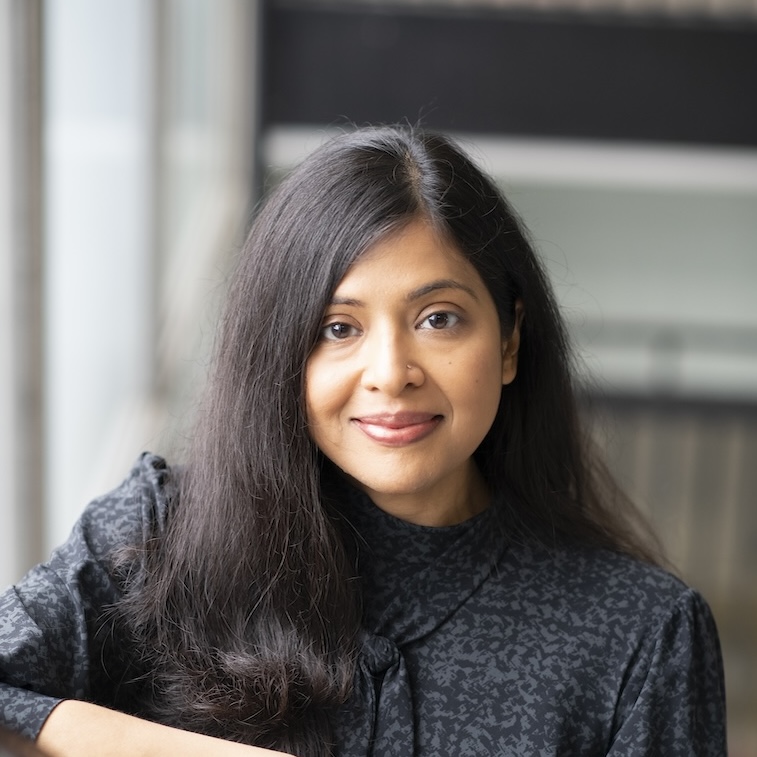
Malini Guha is an Associate Professor of Film Studies at Carleton University , cross-appointed to the Institute for Studies in Art and Culture and affiliated with Migration and Diaspora Studies . She holds the Ruth and Mark Phillips Professorship (2025-2027), focusing on geographical thinking across disciplines. Education: B.A. (University of Toronto), M.A. (York University), PhD (University of Warwick) Research Interests : Guha's work spans cinema and the city , diasporic/postcolonial cinema , public projection art , and ciné-geography . Recent projects include SSHRC-funded research on traction, flight, and becoming in moving images. Selected Publications : Author of From Empire to the World: Migrant London and Paris in the Cinema (2015) and co-editor of London as Screen Gateway (2023). Her articles appear in Feminist Media Histories , Routledge Companion to Media and the City , and Canadian Journal of Film Studies . Scientific Awards : Ruth and Mark Phillips Professorship (2025-2027) FASS Mid-Career Research Grant (2021) SSHRC Insight Development Grant (2023-2025) Collaborative Work : Co-organized Carleton’s Racialized and Indigenous Faculty Alliance (2022-2024), co-taught interdisciplinary course on Race and Representation in the Arts (2023), and collaborates with artist Neven Lochhead on projects like Something Happened (2024).
Golshan Golriz is an Assistant Professor of Sociology at Queen’s University, Canada. She holds a BA in Women and Gender Studies from York University, an MA from the Women and Gender Studies Institute at the University of Toronto, and a PhD in Sociology from McGill University. Her work focuses on structural inequalities affecting Queer and Trans Black Indigenous and People of Colour (QTBIPOC), combining feminist and social scientific methods with intersectional frameworks. Current research includes LGBTQ religious activism, identity-centric social movements, and cancel culture’s relationship with structural inequality. Education: BA: York University (Women and Gender Studies + Sexualities Studies certificate) MA: University of Toronto (Women and Gender Studies Institute) PhD: McGill University (Sociology) Research Interests: Structural inequalities & QTBIPOC communities Queer/Trans Muslim marginalization Racism, capitalism, and Middle Eastern sexuality representations Social movements and comparative historical methods Current Projects: Co-edited volume on LGBTQ religious activism Comparative study of identity-centric movements Critical analysis of cancel culture mechanisms Lab/Team: Research emphasizes interdisciplinary collaboration, integrating qualitative methods with activism-focused research.
Durba Mitra is the Richard B. Wolf Associate Professor in the Department of Studies of Women, Gender, and Sexuality at Harvard University's Faculty of Arts and Sciences. She is a leading scholar at the intersection of feminist and queer studies, global intellectual history, and the history of sexuality in the colonial and postcolonial world, particularly South Asia. Education: PhD, Emory University Research Interests: Her work critically examines how sexuality, gender, and racial difference have shaped modern social thought. She is especially known for her intellectual history of deviant female sexuality in colonial India and its foundational role in social sciences. Her research spans feminist theory, queer studies, histories of science and epistemology, and transnational feminist networks in the Global South. Recent Publications Trends: Her recent articles reflect a deep engagement with Third World feminism, feminist rage, decolonial knowledge production, and the politics of sexuality. She frequently publishes in top journals such as Signs , GLQ , and South Atlantic Quarterly , often in collaborative or roundtable formats, highlighting her role in shaping feminist intellectual discourse. Scientific Awards: Bernard S. Cohn Book Prize Walter Channing Cabot Fellow Award (Harvard) Roslyn Abramson Award for Teaching Excellence Star Family Prize for Faculty Advising Multiple 'Favorite Professor' honors from Harvard undergraduates Fulbright-Nehru and Mellon fellowships Advising and Grants: Mitra has received numerous research grants from Harvard, the Weatherhead Center, and external foundations. She has been recognized for excellence in faculty advising and undergraduate teaching. She has served as Acting Faculty Director of the Schlesinger Library and is active on editorial boards, indicating strong institutional and scholarly leadership. Labs and Teams: She is a faculty associate of the Weatherhead Center for International Affairs, a member of the Asia Center Council, and part of the Mittal South Asia Institute at Harvard. She curated the multimedia exhibit 'Solidarity! Transnational Feminisms Then and Now,' demonstrating her commitment to public scholarship and collaborative knowledge creation.
Professor Cati Connell is an Associate Professor of Sociology at Boston University and former Director of the BU Women’s, Gender, and Sexuality Studies Program. She holds a PhD in Sociology from the University of Texas at Austin (2010). Her research focuses on LGBTQ+ rights, military inclusion, gender dynamics, and workplace experiences. Key themes include queer identity formation, policy impacts on marginalized communities, and the intersection of labor practices with gender and sexuality. Education: PhD in Sociology from the University of Texas at Austin, 2010 Her research interests center on military integration post-DADT repeal, generational solidarities in LGBTQ+ communities, and the evolving meanings of self-identification terms like “lesbian.” She explores how institutions shape queer narratives, analyzing topics such as homonormativity, gendered compromises, and aesthetic labor in retail environments. Her work combines qualitative methodologies with theoretical frameworks like Bourdieu’s sociology of the body. In her recent publications (2015–2024), Connell examines the paradoxes of queer visibility in professional spaces, the tensions between civil rights and institutional policies, and digital platforms’ role in fostering LGBTQ+ solidarity. Her analysis often critiques how equality reforms can inadvertently reinforce exclusionary norms. Scientific awards: No awards explicitly mentioned in the provided texts. Advising and grants: While no specific advisees or grants are listed, Connell’s research trajectory suggests active mentorship in LGBTQ+ studies and sociology. Her work likely involves collaborative projects, though funding details remain undocumented. Labs/teams: Affiliated with Boston University’s Sociology Department and previously led the Women’s, Gender, and Sexuality Studies Program. No specific lab or team affiliations are noted in the texts, but her interdisciplinary focus implies potential collaborations across gender studies, queer theory, and military sociology initiatives.
Peter Gries is a Professor of Chinese Politics and the Lee Kai Hung Chair at the University of Manchester, serving as the founding Director of the Manchester China Institute. He previously held roles at the University of Oklahoma and the University of Colorado, Boulder. Born in Singapore, he holds degrees from Middlebury, the University of Michigan, and a PhD from UC Berkeley. His research focuses on political psychology, particularly U.S.-China relations and Chinese nationalism, with notable works including China’s New Nationalism and The Politics of American Foreign Policy . He leads initiatives like the UK-China International Photography Award and the UK-China Diplomatic Dialogue. His grants include funding from the Ford Foundation and Smith Richardson Foundation for projects on security dialogues and course development. He sits on editorial boards of The China Quarterly , Political Psychology , and Nations & Nationalism . Recent work explores racial stereotypes, intersectionality, and threat perception in international relations. Education : Bachelor's and Master's in Asian Studies from Middlebury and the University of Michigan PhD in Politics from UC Berkeley Research Interests : Political psychology of international affairs U.S.-China relations Chinese nationalism and foreign policy Public opinion dynamics Grants : $60,000 from Smith Richardson Foundation (2005–2006) Multiple grants from Ford Foundation and Mershon Center for Sino-American Security Dialogues $4,000 from Freeman Foundation for Chinese Foreign Policy course development Media Contributions : Expert commentary on BBC World News, NYT, and CGTN Discussions on U.S.-China trade wars, China’s Japan policy, and global perceptions of China Labs/Institutes : Manchester China Institute Former director of the Institute for US-China Issues at University of Oklahoma
Rosana Garciandia is a Senior Lecturer in Public International Law and Co-Director of the Centre for International Governance and Dispute Resolution (CIGAD) at The Dickson Poon School of Law, King's College London. She holds a PhD in Law from the University of Navarra and previously taught at the University of Murcia. Her research focuses on international law responses to human rights abuses, including modern slavery, racial discrimination, and corruption, with an emphasis on state accountability and intersectionality. She is also a Research Leader at the British Institute of International and Comparative Law and a Fellow of the Macrocrimes Center. Education: PhD in Law (University of Navarra) Previous Positions: Secretary General of the European Law Institute, UNODC, EU Agency for Fundamental Rights Her research interests include state responsibility, EU law, migration law, and the law of international organizations. She has published widely on topics such as inter-state communications in UN treaty bodies, domestic servitude, and human rights scrutiny in international trade policies. Recent work includes editing a special issue on inter-state communications (2024) and contributing to the Intersectional Rewrites project. She collaborates with the Leverhulme Centre for Research on Slavery in War, exploring the slavery-war nexus. Her teaching and research address global challenges, linking legal frameworks to issues like modern slavery, corruption, and human dignity. She actively engages with international organizations and policy development.
Dr. Winnie Lem is a Professor in the Department of International Development Studies and Gender and Social Justice program at Trent University. Her research focuses on migration, transnationalism, citizenship, and political economy with a regional emphasis on Europe and Asia. She holds a Ph.D. from the University of Toronto. Her academic work spans migration studies, urbanization, gender, and rural politics. Notable contributions include analyses of Chinese migrant entrepreneurs in France, militant populism in contemporary France, and the dialectics of migration. Lem has co-edited several volumes on migration and capitalism, including Migration Temporalities and Capitalism (2018) and Confronting Capital (2012). Lem teaches courses on global inequality, migration, and development studies. She actively contributes to interdisciplinary research through collaborations with institutions like the Canadian Anthropology Society. Her work often bridges anthropological theory with critical political economy frameworks, examining how global capitalism shapes migrant experiences and social structures. Her recent scholarship (2020) contextualizes the Gilets Jaunes movement within broader populist trends in France, while earlier work (2001–2009) explored labor dynamics in rural France and transnational migrant economies. Lem’s research emphasizes the intersection of class, gender, and ethnicity in migration narratives.
Sarah Sharma is a Professor of Media Theory at the University of Toronto’s Faculty of Information and Director of the Institute of Communication, Culture, Information and Technology (ICCIT). Her work interrogates intersections of technology, temporality, and labor through a feminist lens. She has held leadership roles in the McLuhan Centre (2017–2022) and is recognized for advancing critical media theory. Research focuses include: • Temporality’s role in cultural politics • Feminist reimaginings of McLuhan’s media theory • Digital platforms’ socio-political impacts • Labour dynamics in gig economies (e.g., TaskRabbit). Her upcoming book Insufferable Tools: Big Tech and the Broken Machine critiques tech industry failures. Key achievements: • 2024 Desmond Morton Research Excellence Award • 2014 NCA Critical Cultural Book of the Year for In the Meantime: Temporality and Cultural Politics . Her edited volume Re-Understanding Media (2022) exemplifies feminist extensions of media theory. Recent engagements include keynote addresses at the Canadian Communication Association (June 2025) and University of Michigan’s Digital Ideas Workshop (June 2025). She critiques ‘accelerationist’ narratives about technology and advocates for rethinking media through marginalized perspectives.
Dr. Catrin Lundström is an Assistant Professor of Ethnicity and Migration at the Department of Migration, Ethnicity and Society (REMESO) within the Department of Culture and Society (IKOS) at Linköping University's Faculty of Philosophy. Her research focuses on the intersection of migration, whiteness, and gender, examining how Swedish women experience transnational migration and return migration processes. Dr. Lundström received her PhD in Sociology from Uppsala University in 2007 and became an Associate Professor (Docent) in Sociology there in 2011. Her academic journey includes teaching and research positions at multiple Swedish institutions including Uppsala University, Stockholm University, Mälardalen University, Södertörn University, Umeå University, and Linköping University. She has also been a visiting researcher at the University of Arizona and the University of California. Dr. Lundström's research centers on whiteness as both a place-bound and transnational construction. She challenges conventional migration studies by focusing on privileged Swedish women migrants, developing the concept of 'white capital' to understand how whiteness functions as transferable cultural capital across national borders. Her work examines how racial privilege, gender, and class intersect in migration experiences, particularly among women who migrate for lifestyle, companionship, or professional reasons. Her recent publications demonstrate an expanding focus on the relationship between race, whiteness, and educational systems in Sweden, as well as critical examinations of contemporary political debates through the lens of critical race theory. Lundström's work increasingly addresses how colorblind discourse operates in Swedish society while simultaneously exploring the politics of national identity in a globalized world. Dr. Lundström has led significant research projects including: 'White Migrations: Gender, Whiteness and Privilege in Transnational Migration' (2014) 'Tre faser av hegemonisk vithet' (Three Phases of Hegemonic Whiteness) with Tobias Hübinette 'Att återintegrera svenskheten' (Reintegrating Swedishness) on returning Swedish migrant women, funded by the Swedish Research Council Her research has been supported by organizations including the Sweden-America Foundation and the Swedish Research Council. Dr. Lundström is actively involved in several academic networks: IMISCOE Standing Committee on Gender, Migration and Transnational Lives White Spaces Network at Leeds University Lifestyle Migration Hub, an international network of researchers studying lifestyle migration She regularly lectures within and outside academia, both in Sweden and internationally, and has received significant media attention for her research on school segregation, colorblind language, and gender equality in migration contexts.
Natasha Carver is a Senior Lecturer at the School for Policy Studies, University of Bristol. Her work focuses on migration, gender, and colonial legacies, particularly in the context of FGM-safeguarding policies and their socio-political impacts. She holds an MSc and PhD, though specific disciplinary details are not provided. Her research critiques policy frameworks that marginalize migrant communities, especially those of Somali heritage in the UK. Her research interests include migratory legal frameworks, gendered and racialized power dynamics, and the intersection of colonial history with contemporary policy. She has conducted extensive studies on the over-surveillance of migrant-heritage families and the epistemological injustices embedded in FGM safeguarding procedures. Her publications highlight systemic issues in UK policies, advocating for evidence-based approaches over exaggerated risk narratives. She collaborates with interdisciplinary teams and engages with community perspectives to challenge hegemonic discourses in migration and gender studies. While no grants or lab affiliations are explicitly mentioned, her work frequently intersects with legal and healthcare systems.
Minwoo Jung is an Assistant Professor at Loyola University Chicago, jointly appointed in the Department of Sociology and Women's Studies and Gender Studies (WSGS). His research interrogates the intersections of gender, sexuality, neoliberalism, and globalization through decolonial and queer theoretical frameworks. Research interests include: Queer theory and its epistemological limits Decolonial approaches to globalization and rights Gender and sexuality in East and Southeast Asian contexts Neoliberal political economy and cultural critique Urban inequality in South Korea Transnational LGBTQ+ movements His recent scholarship examines contested cosmopolitanisms in queer activism, flexible masculinities in global Asia, and rights projects as relational sociological phenomena. Current work analyzes sovereignty imaginaries in Taiwan's marriage equality debates and neoliberal violence in global media like Squid Game . Scientific achievements include: Mary Griffin Essay Award Laura Bassi Scholarship Active in teaching and mentorship, Jung contributes to undergraduate and graduate programs in WSGS while maintaining a robust publication record.
Allyson Nadia Field is an Associate Professor in the Department of Cinema and Media Studies and affiliated with The College at the University of Chicago. She is also an Affiliated Faculty member at the Center for the Study of Race, Politics, and Culture and the Center for the Study of Gender and Sexuality. Ph.D., Harvard University Her research explores African American cinema, silent film, and archival studies. She focuses on how cinema shapes race and gender representation, particularly in nontheatrical and nonextant films. Her work bridges film form, media theory, and cultural analysis. Field’s recent publications examine archival rediscovery, speculative methodologies in film history, and the legacy of early Black filmmakers. She co-edited projects on the L.A. Rebellion and nontheatrical film, emphasizing Black feminist curation and institutional critique. 2024-2025 NEH Public Scholars Grant 2020-2021 ACLS/Burkhardt Fellowship 2019 Academy Film Scholar 2021 National Film Preservation Board appointee She has organized major exhibitions, including the 2023 Sojourner Truth Festival of the Arts, and currently co-edits a collection on the visual afterlives of slavery. Her teaching includes courses on silent cinema, experimental film, and archival theory.
Professor Kecia Ali is a scholar of Religion and Islamic Studies at Boston University, with a PhD from Duke University. Her research focuses on Islamic law, gender studies, ethics, and biography, emphasizing feminist critiques of religious texts and institutions. She has authored influential books like Sexual Ethics and Islam and The Lives of Muhammad , exploring intersections of gender, law, and culture in Islamic traditions. Ali has held fellowships at Brandeis University and Harvard Divinity School before joining BU in 2006. She actively contributes to organizations like the American Academy of Religion and served as President of the Society for the Study of Muslim Ethics (2014–2016). Her work bridges religious studies with popular culture, analyzing themes in J.D. Robb's fiction and critiquing academic sexism. Courses taught include Islamic law, Quranic studies, and representations of Muhammad.
Ruba Salih is a Full Professor of Anthropology at the Department of the Arts, University of Bologna. She holds a Laurea in Political Science from the University of Bologna (1994) and a PhD in Social Anthropology from the University of Sussex (2000), supported by a Marie Curie grant. Previously, she served as Full Professor at SOAS, University of London (2010–2022), and as Senior Lecturer at the University of Exeter (2007–2010). Her work focuses on transnational migration, diasporas, colonialism, Palestinian refugee politics, gender, and trauma studies. Research highlights: aesthetics of waiting among Palestinian refugees, decolonial environmental justice, and intersectional solidarity movements Leadership roles: Board Member of the Arab Council for the Social Sciences (2015–2019), Executive Board member of Insaniyyat (Palestinian Anthropologists Association) Publications include Gender in Transnationalism and Musulmane Rivelate (winner of Premio Pozzale 2011). Recent work explores the Anthropocene through colonial ecological destruction in Palestine.
Susan Holmes is Professor at the School of Media, Language and Communication Studies at the University of East Anglia (UEA), where she joined as Reader in Television in 2007 and was appointed to Professor in 2018. She is an active member of several research groups including Media Equality, Film, Television and Media, Gender and Its Intersections Steering Committee, and HealthUEA. Her work spans television studies, celebrity culture, and feminist approaches to eating disorders. Professor Holmes received her academic training at the University of Sussex (BA in English and Media Studies), followed by an MA in Film from the University of Southampton, and completed her PhD on British film and television in the 1950s at the same institution. Prior to joining UEA, she taught Media and Cultural Studies at the Southampton Institute (now Southampton Solent University) and television and film at the University of Kent. Her research focuses on several interconnected areas that challenge traditional disciplinary boundaries. In television studies, she has made significant contributions to understanding British television history, particularly through her books 'British TV and Film in the 1950s' and 'Entertaining TV: the BBC and Popular Programme Culture in the 1950s,' where she challenges canonical ideas about early BBC television. Her work on reality TV examines historical development, generic labeling, and celebrity. Since 2014, she has conducted important empirical research on feminist approaches to eating disorders, analyzing media representations and working directly with people with lived experience. A key focus of this research examines how feminist approaches are neglected in contemporary eating disorder treatment, with implications for both clinical practice and cultural understanding. She co-founded the influential Celebrity Studies journal in 2010 and edited it for the first eight years of its publication. Analysis of Professor Holmes' recent publications reveals a clear trajectory where her expertise in media and television studies converges with her feminist scholarship on eating disorders. Her most recent work (2023-2025) increasingly focuses on cross-cultural applications of feminist approaches to eating disorders (including work in China), the use of innovative methodologies like Photovoice, and examinations of therapeutic alliance in treatment settings. Simultaneously, she continues to analyze contemporary media representations, particularly focusing on motherhood, true crime television, and reality TV through feminist lenses. This dual focus demonstrates how media representations shape cultural understandings of both celebrity and health conditions. Professor Holmes' significant contributions to academia have been recognized with several prestigious awards: Senior Fellowship from Advance HE (2024) UEA engagement award (2017) ALPSP award nomination for Celebrity Studies as best new journal (2011) She currently runs the Feminist Media Studies research cluster at UEA and is actively supervising postgraduate research in areas including popular television, television/film history, British TV history, stardom/celebrity, and feminist approaches to eating disorders. Her current major research project is the 'ALLIANCE study' (2024-2026), funded by the National Institute for Health and Care Research, which aims to develop practice and policy recommendations to support effective therapeutic alliance in inpatient treatment for eating disorders. This builds on her earlier British Academy-funded research on 'Entertaining Television: British TV, the BBC and Popular Programme Culture in the 1950s' (2007-2008). Professor Holmes plays a significant role in the academic community through her editorial work, serving on the boards of journals including Archives of Psychology, Big Data & Society, and Critical Studies in Television, and previously as co-founder and editor of Celebrity Studies. She has also been active in media engagement, contributing expert commentary on topics ranging from Netflix's portrayal of eating disorders to Celebrity Big Brother.