Ye (Sarah) Sun is an Associate Professor in the Department of Mechanical Engineering at the University of Virginia (UVA), part of the School of Engineering and Applied Science. She joined UVA in 2021 after serving as an Associate Professor at Michigan Technological University. Her work focuses on wearable sensors, robotics, smart health systems, and cyber-physical systems. She leads the WEARLab research group. Education: Ph.D. in Electrical Engineering from Case Western Reserve University (2021), B.S. in Instrumentation Engineering from Tianjin University (not specified). Research interests include wearable electronics, health monitoring, and human-technology interaction. Her interdisciplinary approach integrates engineering innovations with healthcare applications. Notable projects involve self-powered triboelectric sensors and optical fiber-based health monitoring systems. Recent publications highlight advancements in photodiode technologies for high-frequency applications, including millimeter-wave generation and photonic integrated circuits. Awards include the NSF CAREER Award (2018) and NSF BRITE Award (2022). She has organized major conferences and holds editorial roles in health technology journals. Grants include NSF funding for cyber-physical systems and smart health initiatives. Her lab collaborates on projects involving wearable robotics and connected health solutions, with a focus on real-world applications in healthcare and IoT.
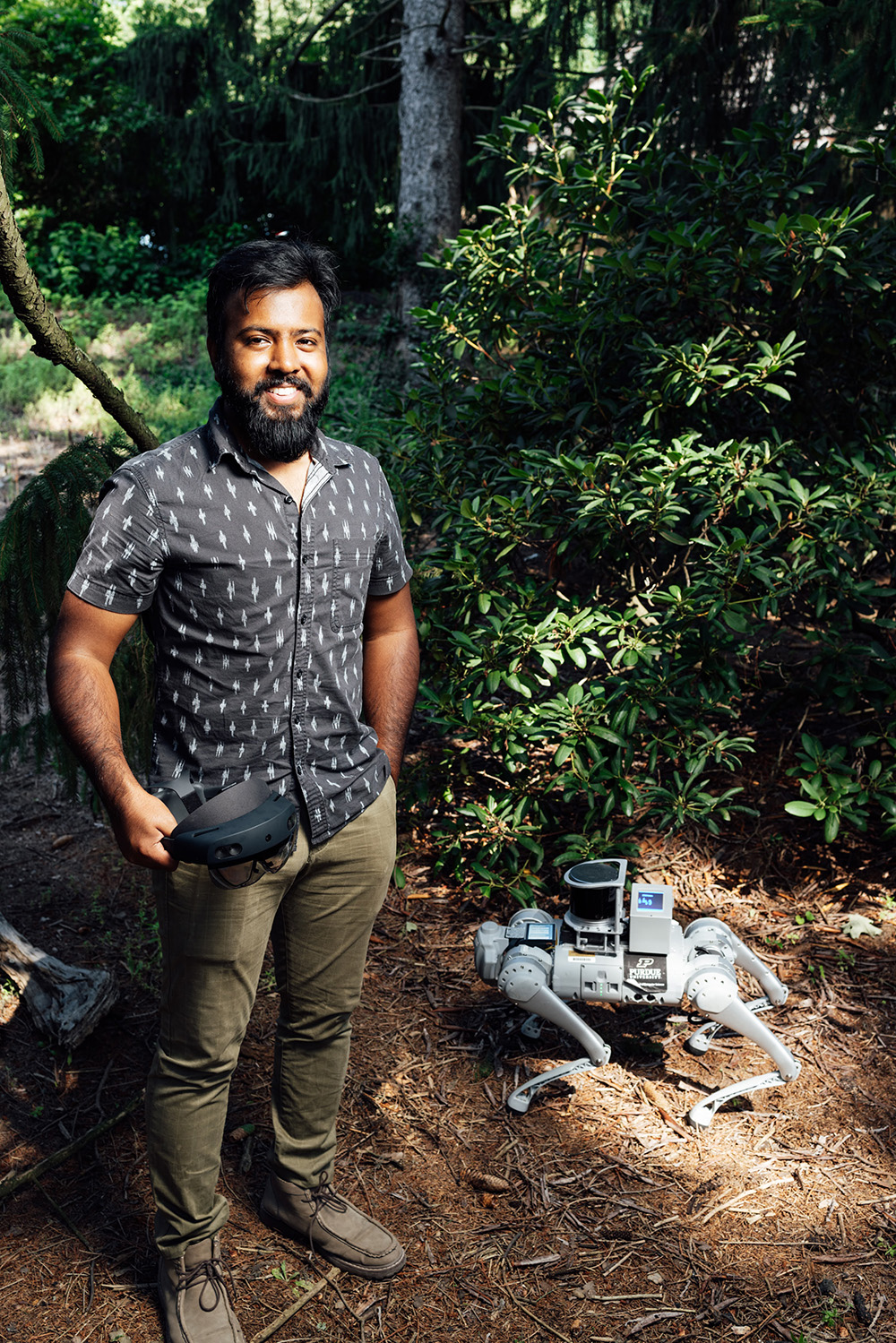
Dr. Aniket Bera is an Associate Professor in Computer Science at Purdue University and holds an Adjunct Associate Professor role at the University of Maryland at College Park (UMIACS). He directs the IDEAS Lab at Purdue and previously served as a Research Assistant Professor at UNC Chapel Hill. His research focuses on Affective Computing, Computer Graphics (AR/VR), AI & Robotics, Social Robotics, and medical AI applications for mental health diagnostics. Affiliations: Purdue University (Primary), University of Maryland (Adjunct), UMIACS Career: Joined Purdue in 2017, extensive industry collaborations with Disney Research, Intel, and C-DAC Research Interests: Affective Computing: Emotion perception via gait analysis, speech, and facial/body expressions AR/VR: Redirected walking, virtual environments, and human motion modeling Medical AI: AI-driven mental health detection systems (e.g., VidSole dataset) in collaboration with medical schools Key Contributions: Developed Project Dost (mental health initiative) Received 2020 Brain & Behavior Seed Grant ($X) for emotion-gait research Authored 65+ papers (1,800+ citations) with awards at IEEE VR 2021 Funding & Leadership: Serves as Senior Editor for IEEE RA-L (Planning/Simulation) Conference Chair for ACM SIGGRAPH MIG 2022 Labs/Teams: IDEAS Lab (Purdue), UMD GAMMA Group
Dr. Matthew Jones is a Senior Lecturer in Criminology at Swinburne University of Technology’s School of Social Sciences, Media, Film and Education. With a career spanning institutions in the UK and Australia, Matthew’s research bridges interdisciplinary domains including policing, sociology, law, and organizational studies. He is a Senior Fellow of the Higher Education Academy, emphasizing evidence-informed pedagogy and curriculum innovation. Affiliation: Swinburne University of Technology (2022–Present) Previous Roles: The Open University (2017–2022), Northumbria University (2014–2017), Cardiff Metropolitan University (2013–2014). Research Themes: Matthew’s work focuses on three core areas: Policing: Police visibility, digital strategies, occupational culture, diversity, and leadership. LGBTQI+ Criminology: Workplace discrimination, hate crimes, community-police relations, and victimology. Digital Criminology: Technology’s role in policing, crime prevention, and digital victim support systems. Publications: His 15 most recent articles highlight evolving trends in digital policing, police visibility, academic standards in policing education, and LGBTQI+ workplace experiences. These works span qualitative studies, policy analysis, and interdisciplinary collaborations, reflecting his commitment to visual criminology and semiotics. Scientific Awards: Senior Fellow of the Higher Education Academy (2022) Fellow of the Higher Education Academy (2013) Professional Activities: Matthew served as Chair (2019–2022) and Board Member (2013–2019) of the British Society of Criminology’s Policing Network. He led curriculum development for police apprenticeships (2017–2019) and contributed to the first UK Subject Benchmark Statement for Policing (2022). He supervises PhD students on topics like community policing, child maltreatment resilience, and crime drama narratives. Education: He holds an LLB in Law, an MSc in Social Science Research Methods, a PhD in Socio-Legal Studies, a PGCert in Higher Education pedagogy, and an MBA in Leadership Practice.
Hamouda Ghonem is a Professor in the Department of Mechanical, Industrial and Systems Engineering at the University of Rhode Island . He established the Mechanics of Materials Research Laboratory (MMRL) in 1981, focusing on experimental and computational studies of deformation and damage in advanced engineering materials under extreme conditions. Education: Ph.D., Mechanical Engineering, McGill University (1978) M.S., Mechanical Engineering, McGill University (1976) B.Sc., Nuclear Engineering, University of Alexandria (1969) Research Interests span high-temperature deformation of metallic alloys, creep-fatigue-environment interactions, dislocation-precipitate interactions, grain boundary mechanics, and ultrafine grain manufacturing. His work quantifies microstructural effects on material failure and develops predictive models for damage evolution in aerospace and nuclear materials. Scientific Awards include: Fellow of ASME Sabbatical appointments at European universities and aerospace research centers Laboratory Facilities at MMRL include: MTS servohydraulic testing machines Creep and high-strain rate (Split Hopkinson Bar, gas gun) systems Computational modeling with Abaqus, MATLAB, and in-house codes Microstructural analysis via SEM and optical microscopy Vacuum and high-temperature (-196°C to 1200°C) testing environments
Kathleen M. Carley is a full professor at Carnegie Mellon University's School of Computer Science with courtesy appointments in Engineering and Public Policy, Heinz School, and Electrical and Computer Engineering. As director of the Center for Computational Analysis of Social and Organizational Systems (CASOS) and the Center for Informed Democracy and Social-Cybersecurity (IDeaS) , she leads interdisciplinary research at the intersection of network science, cognitive modeling, and cybersecurity. Ph.D. in Sociology from Harvard University SB degrees in Economics and Political Science from MIT Her research focuses on Dynamic Network Analysis (DNA) and Social-Cybersecurity (SC) , developing tools like ORA (network analysis), AutoMap (semantic mining), Construct (influence simulation), and BotHunter (bot detection). She has over 400 publications and 15+ active research projects addressing disinformation, cognitive security, and organizational resilience. Recent work examines LLM-powered bots , multi-platform misinformation dynamics , and public health analytics . As an IEEE Fellow, she contributes to standards in computational social science while teaching courses on network analysis and complex socio-technical systems.
Professor Vinayak Dixit serves as the IAG Chair of Risk in Smart Cities and Director of the Research Centre for Integrated Transport Innovation (rCITI) at the University of New South Wales (UNSW), within the School of Civil and Environmental Engineering. With a distinguished career spanning academia and research leadership, Professor Dixit has established himself as a leading expert in transportation risk analysis and smart city infrastructure. Professor Dixit's research focuses on studying risk in transportation infrastructure systems, with particular emphasis on highway safety, travel time uncertainty, and resilience against natural and man-made disasters. His work integrates cutting-edge approaches including quantum computing applications for transportation network optimization, analysis of connected and automated vehicles, and development of models for transportation resilience. His research interests span multiple disciplines, bridging civil engineering, transportation science, risk analysis, and computational methods. Professor Dixit has secured significant research funding from prestigious organizations including the United States National Science Foundation, Federal Highway Administration, and the Strategic Highway Research Program of the Transportation Research Board. His leadership extends to directing the Research Centre for Integrated Transport Innovation (rCITI), where he oversees a comprehensive research program addressing critical transportation challenges in smart cities through multiple focus areas including Connected Mobility Services, Deep Data and Digitization, Engineering Smart Cities & Logistics, Human-Centred And Automated Systems Design, and Integrated Infrastructure Strategic Planning. Professor Dixit previously served as the Associate Director of Research for the Gulf Coast Centre for Evacuation and Transportation Resiliency at Louisiana State University, where he founded the Driving Simulator Laboratory in collaboration with other faculty members. This demonstrates his longstanding commitment to innovative research infrastructure development and interdisciplinary collaboration across engineering, economics, computer science, and urban planning to address complex transportation challenges in the 21st century.
Prof. Dr.-Ing. Christoph Stiller is a full professor at the Karlsruher Institut für Technologie (KIT) and serves as the director of the Institute of Measurement and Control Technology (Institut für Mess- und Regelungstechnik, MRT). His work focuses on autonomous driving, sensor fusion, probabilistic estimation, HD mapping, motion planning, and intelligent transportation systems. Education: Details on his academic degrees are not provided in the text, but he holds the title of Dr.-Ing. indicating a doctoral degree in engineering. Research Interests: Prof. Stiller's research spans a wide array of topics critical to the development of autonomous vehicles. His work includes: Sensor Fusion: Integrating data from LiDAR, cameras, and radar to create robust perception systems. HD Mapping & Localization: Developing high-definition maps and precise localization techniques for urban and highway environments. Motion Planning & Decision Making: Creating algorithms for safe and efficient trajectory planning under uncertainty. Machine Learning & AI: Applying deep learning and reinforcement learning to perception, prediction, and control tasks. Publication Trends: His recent publications (2023–2025) emphasize robust traffic light detection, image stitching for panoramic views, motion prediction using redundancy reduction, and safety-enhanced model predictive control. The work increasingly integrates learning-based methods with classical control and estimation theory. Scientific Awards: No specific awards are listed in the provided text. Teaching & Supervision: Prof. Stiller teaches foundational and advanced courses in measurement and control systems, probabilistic estimation, and autonomous driving. He holds regular office hours during both summer and winter semesters and is actively involved in advising students and researchers. Labs & Teams: He leads the Institute of Measurement and Control Technology (MRT) at KIT, which is engaged in cutting-edge research in autonomous systems. The institute collaborates with industry and academia on large-scale projects such as UNICARagil and various European initiatives.
Joe Pitt-Francis is Associate Professor of Computer Science and Tutorial Fellow in Computer Science at St Edmund Hall, University of Oxford . Since 1999 he has tutored Oxford computer-science students and formally became a Tutorial Fellow of St Edmund Hall in 2024. His research lies at the intersection of computational biology and mathematical biology . Using sophisticated numerical techniques he constructs and analyses models of the heart , cancer and blood flow . A central strand of his work is software development for biological simulation; he is an active contributor to Chaste ( Cancer, Heart and Soft-Tissue Environment ), a large-scale C++ library that supports multiscale computational models in physiology and medicine. Across more than 60 peer-reviewed publications since 1998, his work has progressively advanced from foundational software-engineering papers describing Chaste’s architecture to highly-cited studies on cardiac electrophysiology , tumour-induced angiogenesis , microvascular haemodynamics and cell-cycle dynamics under hypoxia . The 2024-2025 corpus shows strong emphasis on multiscale frameworks , open benchmarking , and radiotherapy-induced vascular remodelling , positioning his group at the forefront of translational in-silico oncology. Contact: Email: Joe.Pitt-Francis@seh.ox.ac.uk
Manjesh Kumar Singh is an Associate Professor in the Department of Mechanical Engineering at Indian Institute of Technology Kanpur. He holds a PhD in Polymer Science from ETH Zurich and has postdoctoral experience at the Max Planck Institute for Polymer Research and ETH Zurich. Education: PhD (2016) - ETH Zurich, Switzerland ME (2011) - Indian Institute of Science, Bangalore BE (2009) - IIEST Shibpur His research focuses on Tribology, Soft Matter, and Rheology , with expertise in molecular dynamics simulations, AFM techniques, and polymer brush systems. Key projects include studying cross-linked polymer brushes under shear, solvation behaviors of elastin-like polypeptides, and tribological responses of disentangled polymer melts. Recent publications highlight his work in polymer tribology, solvation mechanisms, and shear dynamics. He has received multiple scholarships for international conferences and a Best Oral Presentation award at IndiaTrib-2019. Awards & Fellowships: Thailand 2020 International Nanotribology Forum Scholarship IndiaTrib-2019 Best Oral Presentation Kerala 2014 International Nanotribology Forum Scholarship 2012 Gordon Research Conference Travel Grant 2011 Vietnam International Nanotribology Forum Scholarship He works in the Himanshu Hatwal Nonlinear Mechanics Lab at IIT Kanpur.
Marilena Vendittelli is a Professor at Sapienza University of Rome, affiliated with the Robotics group. Her research spans control systems, biomedical robotics, motion planning, and autonomous systems. Research Areas: Control systems for robotics and nonholonomic systems Biomedical applications (hyperthermia therapy, needle insertion) UAV navigation and obstacle avoidance Haptics and human-robot interaction Adaptive estimation algorithms Recent Publications focus on adaptive control of bio-heat equations, safe UAV motion planning, soft robotics actuation, and haptic feedback in medical procedures.
Luís Miguel Mendonça Rato is an Associate Professor at the Universidade de Évora and a Senior Researcher with a PhD at Centro ALGORITMI. He is affiliated with the CST R&D Group and VISTA Lab R&D Lab, focusing on interdisciplinary research at the intersection of Electrical Engineering, Computer Science, and Agricultural/Biomedical applications. Academic Degree: PhD Current Position: Associate Professor Labs: VISTA Lab Researcher IDs: ORCID 0000-0003-4492-7548, ResearcherID A-9152-2013, CiênciaID A914-6344-CD2D His research spans machine learning applications in Agricultural Engineering (Sentinel-2 satellite data for nutrient analysis), Biomedical Imaging (MRI-ADC texture analysis for tumor classification), and Control Systems (predictive control algorithms for water delivery canals and solar fields). With an h-index of 11 and 51 publications, his work emphasizes hybrid systems combining traditional engineering with computational innovation. Recent publications highlight trends in SLAM efficiency (2024), cloud service optimization (2022), and deep learning for medical imaging (2022-2023). He has contributed to Smart Cities initiatives through projects like M-Traffic (2006) and NanoSen-AQM (2020). As a senior researcher, he leads projects in the CST R&D Group and VISTA Lab , with notable work in the Universidade de Évora ecosystem.
Bryan K. Clark is an Associate Professor in the Department of Physics at the University of Illinois, with his office located in the Engineering Sciences Building. He leads the Clark Research Group, which works at the intersection of quantum information, condensed matter physics, machine learning, and computing. Clark's research spans four main areas: Quantum Computing , where his group develops quantum algorithms and collaborates with experimentalists on superconducting qubit systems; Quantum Many-Body Physics , where he applies computational methods to understand emergent behavior in strongly correlated systems; Algorithms for the Quantum Many-Body Problem , where his group has pioneered techniques like Neural Network Backflow (NNBF) that represent state-of-the-art accuracy for simulating fermions and frustrated magnetism; and Machine Learning for Experiment , where his group develops techniques to analyze experimental data like scanning transmission electron microscopy images. His publication record demonstrates consistent innovation in bridging theoretical quantum information science with practical applications. Recent work focuses on neural network approaches to quantum simulation, quantum error correction/mitigation, and novel qubit architectures like the Floquet Fluxonium Molecule. His research shows a clear trajectory from fundamental questions about the quantum-classical boundary to practical implementations in quantum hardware. Clark actively mentors graduate students, with recent thesis defenses by Faisal Alam, Matt Thibodeau, Chad Germany, James Allen, and Abid. His group has secured significant funding from the NSF and IBM's IIDAI institute to support research in quantum computing and machine learning applications for nano-photonics manufacturing and error mitigation. The Clark Research Group maintains strong connections with experimental teams, particularly in superconducting qubit development and materials characterization. They've developed computational tools like QOSY (Quantum Operators from SYmmetry) that are publicly available on GitHub and have gained recognition in the quantum information community.
Paul Withers is a Professor and Chair of the Department of Astronomy at Boston University. He leads research on planetary atmospheres and ionospheres, with a focus on Mars and Venus, and serves as Principal Investigator on multiple NASA-funded research projects. Education: B.A. in Physics, 1998, Queens' College, Cambridge University M.S. in Physics, 1998, Queens' College, Cambridge University M.A., 2001, Queens' College, Cambridge University Ph.D. in Planetary Science, 2003, University of Arizona Professor Withers' research focuses on the upper atmospheres and ionospheres of terrestrial planets, particularly Mars and Venus. His work involves analyzing spacecraft data and developing theoretical models to understand how solar flux, neutral atmospheres, magnetic fields, and ionospheres interact under unique planetary conditions. He has made significant contributions to understanding the response of the Martian ionosphere to solar flares, the structure of the Venus ionosphere, and meteoric plasma layers in planetary ionospheres. His research often involves multi-instrument campaigns and coordinated observations across different spacecraft missions including Mars Express, MAVEN, and Venus Express. Analysis of Professor Withers' recent publications reveals a strong emphasis on Martian ionospheric dynamics, particularly its response to solar activity and its variability under different conditions. His work frequently combines data from multiple missions to create comprehensive models of planetary upper atmospheres. He has developed important methods for analyzing radio occultation data and reconstructing atmospheric properties from entry, descent, and landing measurements. Major Funded Projects: "Characterizing the topside bulge in the ionosphere of Mars" (NASA Mars Data Analysis Program, 2014, $144K) "Integration of MAVEN neutral and plasma observations" (NASA MAVEN Participating Scientist Program, 2013, $284K) "Radio occultation studies at Mars" (NASA Early Career Fellowship Program, 2013, $99K) "EDL reconstruction for MSL" (NASA, JPL contract, 2012, $199K) "Meteoric plasma layers on Venus and Mars" (NASA Planetary Atmospheres Program, 2012, $232K) Professor Withers has been actively involved in mentoring students and collaborating with international researchers. He serves as a key member of the Mars Upper Atmosphere Network (MUAN) and has contributed to community white papers for planetary science decadal surveys. His work supports future Mars landers through atmospheric modeling and surface pressure prediction, with direct applications to mission planning and execution. He has presented his research at numerous international conferences including the American Geophysical Union meetings, Division for Planetary Sciences meetings, and European Planetary Science Congress. His work has important implications for understanding planetary climate evolution, space weather effects on technological systems, and the search for habitable environments beyond Earth.
Steve Collins is an Associate Professor of Mechanical Engineering at Stanford University, with a courtesy appointment in the Department of Bioengineering. His research focuses on wearable robotics, biomechanics, and human-machine interaction. He leads projects on exoskeleton optimization, prosthetic design, and energy-efficient robotic actuators. His work aims to improve mobility for older adults and individuals with mobility impairments through innovative assistive technologies. Research Interests: Collins explores biomechanical principles underlying human movement, exoskeleton torque control strategies, and the design of devices that reduce metabolic costs during walking. His lab develops both hardware (e.g., exoskeleton emulators) and software (e.g., AddBiomechanics modeling tools) to advance assistive technologies. Key Contributions: He pioneered human-in-the-loop optimization methods for exoskeleton control, demonstrated energy-saving designs for ankle exoskeletons, and investigated how exoskeletons can enhance balance and reduce fall risks. His team also developed the 'Tripod' prosthesis emulator and electrostatic clutch systems for energy-efficient actuators. Grants & Collaborations: His work is supported by NSF grants (e.g., NRI: Small grant for exoskeleton control) and industry partnerships. He collaborates with clinicians to translate robotic innovations into clinical applications for amputees and aging populations. Labs & Teams: His research is conducted in Stanford's robotics and biomechanics facilities, focusing on interdisciplinary projects at the intersection of mechanical engineering, bioengineering, and computer science.
Dr. Frederick Li is an Associate Professor in the Department of Computer Science at Durham University, UK. He holds editorial roles as Associate Editor of Frontiers in Education (Digital Education) and Editorial Board Member of Virtual Reality & Intelligent Hardware. His research focuses on Computer Graphics, Machine Learning, Geometric Modelling, Collaborative Virtual Environments, Visual Aesthetics, and Educational Technologies. He earned his B.A. (Hons) and M.Phil. from The Hong Kong Polytechnic University and his Ph.D. in Computer Graphics from City University of Hong Kong. Prior roles include Assistant Professor at HK PolyU and project manager of a Hong Kong Government ITF-funded project. **Education**: B.A. (Computing Studies) and M.Phil. from HK PolyU; Ph.D. in Computer Graphics (CityU Hong Kong). **Research Interests**: His work spans mesh saliency detection, human-object interaction recognition, cloud modeling, face beautification, and educational technology. Recent achievements include awards for papers (e.g., Best Paper at ITiCSE 2014) and recognition such as EPSRC Peer Review College membership. He leads Durham's Undergraduate Board of Examiners and has been an external examiner at Northumbria University. **Awards**: Best Paper (ACM ITiCSE 2014), Outstanding Paper (ICALT 2013), EPSRC Peer Review College (2024), Outstanding BMVC 2024 Reviewer. **Grants & Labs**: His research is supported by grants from EPSRC and others. He collaborates with the Centre for Vision and Visual Cognition, VIViD, and AIHS group at Durham.