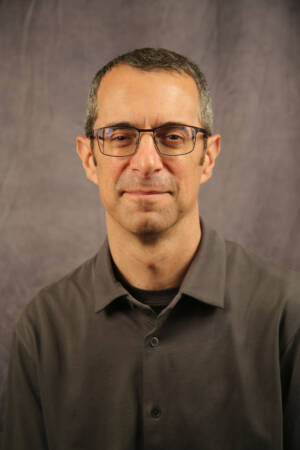
Eduardo DavalosView profile
Assistant Professor
Eduardo Davalos is an Assistant Professor in the Computer Science department at Trinity University in San Antonio, Texas. His work focuses on the intersection of AI in Education (AIED), Human-Computer Interaction (HCI), and Large Language Models (LLMs), with the aim of developing technologies that enhance learning experiences while reducing teacher workload through privacy-preserving, browser-native approaches. Dr. Davalos received his academic training at: B.S. in Electrical Engineering from St. Mary's University M.S. in Electrical Engineering from St. Mary's University Ph.D. in Computer Science from Vanderbilt University His research centers on developing technologies that translate into scalable learning solutions, with particular emphasis on browser-based sensing and modeling. Dr. Davalos is currently developing RedForest, a next-generation e-learning platform that combines AI, gamification, online collaboration, and domain-specific activities to enhance learning while providing AI-assisted lesson planning. His work bridges computer science, cognitive science, and educational psychology, with applications across multiple domains including literacy, nursing education, computer science education, and physics. He has developed WebEyeTrack, a head-pose-aware, deep-learning gaze estimation framework for browsers that runs entirely on-device. Analysis of Dr. Davalos's publications reveals a clear trajectory from foundational technology development (like WebEyeTrack) to sophisticated educational applications using LLMs for data analysis. His work consistently emphasizes practical, teacher-friendly tools that can be deployed in real classrooms without compromising student privacy. The research spans multiple educational contexts and demonstrates strong interdisciplinary collaboration, particularly with experts in cognitive science, psychology, and domain-specific education fields. Dr. Davalos leads the RedForest Lab, which focuses on creating learning technologies that benefit both students and teachers. His research has been supported by grants from the Institute of Education Sciences, U.S. Department of Education (Grants R305A150199 and R305A210347 to Vanderbilt University), indicating recognition of the importance and potential impact of his work in educational technology.