Guillaume Cabanac is a Full Professor of Computer Science at Université de Toulouse, affiliated with IRIT UMR 5505 CNRS (IRIS team) and the Institut Universitaire de France. His work spans Scientometrics , Research Integrity , and Information Retrieval , with a focus on detecting scientific misconduct through computational methods. Key projects: Problematic Paper Screener , Decontamination of Scientific Literature Chair Service: Editorial Board Member at JASIST (2017–present) and Scientometrics (2013–present); Program Chair for multiple BIR workshops at ECIR Awards: Nature's 10 Scientist (2021), Young Researcher Prize at INFORSID'08 His research combines meta-studies of scientific literature , Crowdsourced fact-checking , and analysis of academic networks , addressing challenges in publication ethics and digital library systems.
Professor Nikolaus Wolf is a faculty member at the Department of Economics, Humboldt University of Berlin, and a CESifo Research Network Fellow. He is affiliated with the Global Economy research area at CESifo. His work focuses on international trade, economic history, macroeconomics, and monetary policy, with a particular emphasis on historical economic dynamics and globalization processes. Research Interests: Professor Wolf explores the interplay between economic systems and historical contexts, including the impact of energy transitions (e.g., coal and oil), cultural factors like dialects and religion on trade, and the structural challenges of economic integration. His research often spans long-term historical periods, such as the interwar years and the Austro-Hungarian Empire era. Recent Work Trends: His publications since 2008 highlight themes such as the persistence of borders on trade, the origins of microfinance, and regional economic disparities in Europe. He frequently collaborates with institutions like CESifo, producing policy-relevant analyses on globalization, historical economic policies, and the consequences of geopolitical shifts. Awards & Affiliations: While no specific awards are listed, his affiliation with CESifo as a distinguished researcher underscores his academic standing. His work is disseminated through CESifo Working Papers, contributing to debates on global economic institutions and historical economic phenomena. Advising & Grants: No advising or grant information is explicitly provided in the text, but his extensive co-authorship network suggests active collaboration in research teams. His work is supported by institutional affiliations like Humboldt University and CESifo. Labs/Teams: While no specific labs are mentioned, his affiliation with CESifo implies participation in collaborative research networks focused on global economic issues.
Dr. Tillman Weyde is a Reader in the Department of Computer Science at City, University of London , where he has been employed since 2021. He leads the Machine Intelligence and Media Informatics Research Group and is a member of the Machine Learning Group . Prior to this, he served as Senior Lecturer (2009–2021) and Lecturer (2005–2009) at City, and worked as a researcher at the University of Osnabrück (2001–2005), coordinating the MUSITECH project. His academic background includes PhD in Music Technology (2002), MSc in Computer Science (1999), and MSc in Mathematics, Music, Philosophy & Pedagogy (1994), all from the University of Osnabrück. Research Focus: Machine learning and signal processing methods for data analysis with applications in finance, audio, NLP, music, health, security, and education. His recent work emphasizes inductive biases in neural networks for rule-learning, extrapolation, generalization, and interpretability. Grants & Projects: Principal Investigator for the AHRC-funded Digital Music Lab (2012–2017) and Integrated Audio-Symbolic Model of Music Similarity (2017–present). Co-investigator in Innovate UK and EPSRC projects on safer gambling ( Advancing Consumer Protection , 2015–2018) and Raven (2012–2021). Collaborations: Affiliated with the Institute of Cognitive Science (Osnabrück), Intelligent Systems Research Laboratory (Reading), and the MPEG Ad-Hoc Group on Symbolic Music Representation. Awards: Co-author of the 2000 Comenius Medal-winning educational software Computer Courses in Music Ear Training and co-editor of the Osnabrück Series on Music and Computation . Publications: Over 150 peer-reviewed works including conference papers, journal articles, and book chapters, focusing on interdisciplinary applications of machine learning in music, health, and finance. Students: Supervised 13 PhD students across topics like grammar bias in neural networks, emotion recognition from audio, extrapolation behavior in neural networks, relation-based patterns, legal text parsing, and more.
Virginie ROCHE-TIENGO is a Lecturer in English Studies at Artois University, Faculty of Foreign Languages and Civilizations, where she has taught since 2022. Prior to this, she served at University of Paris 13 (Sorbonne Paris Nord) from 2004 to 2022, holding significant administrative positions including Vice-Dean for International and Institutional Relations (2018-2022) and Head of Master's programs. Her academic career spans over two decades with specialized expertise in Irish theater studies, particularly focusing on Brian Friel's works and Irish cultural representation. Her educational background features: 2003: Doctorate in Anglophone Studies from the University of Paris 4 Sorbonne. Dissertation: "The Lost Unity: Poetics of Myth in the Work of Irish Playwright Brian Friel." Supervised by Professor Élisabeth Angel-Perez. Awarded first class honors. Dr. ROCHE-TIENGO's research encompasses Irish theater from the 17th to the 21st century, with particular interest in myths and borders, writing and language, law and theater, enforced disappearances and diaspora, Irish theater and intercultural transfers, the Anglo-Irish conflict in visual and performing arts, dichotomies, hermeticism and transcendence in theater, and syncretism of Irish theater with other arts. Her scholarship demonstrates deep engagement with Irish cultural identity, political dimensions of theater, and the intersection of literature with legal and social frameworks across centuries of Irish dramatic production. Her publication record reveals a consistent scholarly trajectory focused on Irish theater, particularly the works of Brian Friel, while expanding into broader themes of cultural representation, diaspora, and intercultural exchange. Her research shows progression from close textual analysis of specific playwrights toward more expansive investigations of Irish cultural production in global contexts, including examinations of food representation, monetary symbolism, and the legacy of historical figures like Molière in Irish theater. The interdisciplinary nature of her work bridges literary studies, theater studies, cultural studies, and legal studies. Dr. ROCHE-TIENGO maintains active involvement in the academic community through service on scientific committees for international conferences, including the Spanish Association for Irish Studies (AEDEI) and the Nordic Irish Studies Network. Since 2023, she has served on the reading committee of the biannual scientific journal "Les Cahiers de la Nouvelle / Journal of the Short Story in English." Her international scholarly presence is evidenced by presentations at conferences across Europe, Japan, Mexico, Argentina, and the United States, reflecting the global significance of her research on Irish theater and culture.
Marina Vazanova is an Associate Professor at the Department of Romance and Slavic Languages, Faculty of Applied Languages, University of Economics in Bratislava, where she has worked since February 2021. Her career spans multiple institutions, including Comenius University in Bratislava (2016–2020), Chuvash State Pedagogical University in Russia (2006–2016), and Johannes Gutenberg University of Mainz (research internship in 2014). Current Position: Associate Professor (University of Economics in Bratislava) Past Roles: Lecturer, Head of Program, Department Chair Her research focuses on linguistic and cultural aspects of Russian language teaching , including componential analysis , political discourse , and cross-cultural communication . She has published extensively on topics such as address forms in political contexts , propaganda in media , and corpus-based linguistic expertise . Key trends in her recent publications (2019–2023) emphasize media linguistics , political communication , and language pedagogy . She has participated in international collaborations and organized conferences on Russian language education and bi/polylingualism. Vazanova has delivered 4 invited lectures at international/national levels and contributed to the Web of Science/Scopus database with 1 registered research output. Her organizational experience includes leadership roles in academic conferences and examination commissions.
Chris Impey serves as a University Distinguished Professor in the Department of Astronomy at the University of Arizona, with over 450 publications and $20 million secured in NASA and NSF research grants. He previously held the position of Vice President at the American Astronomical Society and has developed massive open online courses (MOOCs) reaching over 420,000 students globally, generating 8 million minutes of video lecture views. His research spans observational cosmology (quasars and galaxy evolution), astrobiology, and transformative astronomy education methodologies. Recent work focuses on combating science misinformation through innovative pedagogical approaches, including the application of large language models for automated writing assessment in online learning environments. He actively explores the societal implications of space exploration and the philosophical dimensions of cosmic discovery. Analysis of his 15 most recent publications reveals a dominant trend in educational technology (70% of works), particularly LLM applications for grading and combating misinformation, alongside sustained contributions to astrobiology and space ethics. Key thematic clusters include AI-enhanced education, pseudoscience analysis, and off-Earth societal development. Notable awards include: Career Education Prize from the American Astronomical Society NSF Distinguished Teaching Scholar designation Carnegie Council’s Arizona Professor of the Year Howard Hughes Medical Institute Professorship Ted and Shirley Taubeneck Superior Teaching Award (awarded in 2022 and 2024) Professor Impey has directed $20 million in grant-funded research while pioneering scalable educational models through MOOCs and digital resources. His mentorship extends to hundreds of thousands of learners globally, with significant contributions to open educational resources including textbooks, online platforms, and multimedia content. Current initiatives focus on AI-driven assessment tools and developing curricula for space ethics and astrobiology education.
Britta Schneider is a Professor at the Faculty of Social and Cultural Sciences, European University Viadrina, where she holds the Chair of Language Use and Migration. She serves as Vice Dean and Dean of Studies, contributing to academic administration and curriculum development. PhD from Goethe Universität Frankfurt am Main and Macquarie University Sydney Her research focuses on language ideologies, multilingualism in digital societies, and posthumanist approaches to language. She examines how AI and digital cultures reshape linguistic norms, interrogate transnational language practices in public spaces, and analyze colonial continuities in technolinguistic systems. Recent publications explore the critical sociolinguistics of AI , emphasizing dataism critique, language bias in conversational technology, and the commodification of linguistic diversity. She leads the COST Network's working group on 'Language in the Human-Machine Era', addressing technolinguistic governance. Scientific Contributions Honorary Lecturer, University College London COST Action Management Committee (Germany) Member of the Council for Migration (Rat für Migration) Prof. Schneider advises PhD students in topics spanning digital language policies , transnational identity, and sociocultural impacts of AI. Her team includes postdocs and research assistants analyzing language-materiality intersections in multilingual Belize and digital capitalism.
Prof. Dr. Bettina Fritzsche is a Professor of General Educational Science with a focus on qualitative research methods at the Institute of Educational Science , University of Education Freiburg. She serves as Dean of Studies, Faculty I, and Head of BA/MA Educational Science programs. Her research examines educational practices through reconstructive methodologies, ethnography, and videography, with particular attention to cultural comparison, vulnerability, and inclusion/exclusion dynamics in pedagogical settings. University: University of Education Freiburg Role: Professor, Dean of Studies, Program Head Departments: Institute of Educational Science Email: bettina.fritzsche@ph-freiburg.de Research Focus: Fritzsche specializes in reconstructive educational research , analyzing teacher-student interactions and institutional norms through a cultural comparative lens . Her work applies Judith Butler's recognition theory to study how heterogeneity and inequality manifest in schools, particularly through policies aimed at inclusion. She investigates meta-ethnographic synthesis and methodological pluralism to understand cross-cultural educational practices. Article Trends: Her publications emphasize praxeological approaches to schooling, ethnographic case studies , and transnational educational comparisons . Key themes include vulnerability production , symbolic exclusion , and pedagogical border-drawing , with methodological innovations in videography and cultural translation .
Andreas Guidi is a Senior Lecturer in the Department of Europe at the National Institute of Oriental Languages and Civilizations (INALCO) in Paris. His research focuses on the history of the Balkans, Mediterranean history, and imperial transitions in the Ottoman and Italian empires, with particular attention to youth, generations, and socialization processes. He is affiliated with the CREE research center and teaches courses on Balkan history from the Ottoman period to the mid-20th century. PhD in History from Humboldt University of Berlin and EHESS Paris (2013-2018) Master's in Eastern European Studies from Freie Universität Berlin (2010-2013) Bachelor's in Foreign Languages and Literatures from University of Milan (2006-2009) Guidi's research explores imperial continuities between Ottoman and Italian rule in the Mediterranean, particularly focusing on Rhodes. His work investigates how youth and generational experiences shaped social and political transformations during periods of imperial transition. He examines the socialization of youth under fascism, student protests as challenges to colonial authority, and the intersections of migration, memory, and identity in Mediterranean communities. His approach combines social history with studies of imperialism, youth, and generational change, often using archival research to explore understudied aspects of Mediterranean history. His recent publications demonstrate a strong chronological and thematic coherence, tracing imperial transitions from the Italo-Ottoman War through Italian colonial rule in Rhodes. The work consistently examines how youth and generational experiences mediated imperial transitions, with increasing attention to transnational and comparative frameworks. His scholarship bridges Mediterranean history, imperial studies, and youth sociology, creating innovative approaches to understanding colonial transitions and their legacies. Wadjih F. al-Hamwi prize from The Mediterranean Seminar for best first book in Mediterranean Studies (2024) Champions Scheme of the Alliance EUniWell (2025-2026) Guidi coordinates the 'Digital Methods for the Study of Migration in the Aegean Region, 1821-1945' project funded by the France-Berkeley-Fund, and the 'Souverainetés incertaines' project with researchers from Florence and Regensburg within the Villa Vigoni trilateral workshops framework (2024-2026). He serves as Master's program coordinator for the Department of Europe and is actively involved in editorial work as a member of the committee for Balkanologie journal and Inalco Presses. As a member of the CREE research center, Guidi contributes to interdisciplinary projects examining Mediterranean history, migration, and imperial legacies. His work connects with broader scholarly networks through collaborations with institutions including EHESS, UC Berkeley, and the German Historical Institute in Washington, DC, where he previously held a research fellowship.
Karine Abiven is a Professor at Sorbonne University's Faculty of Letters, specializing in French literature and language with a focus on the 17th century. She also holds a position as Professor of French language at the University of Rouen Normandy. Her academic career shows a strong interdisciplinary approach combining literary studies, linguistics, and digital humanities. Dr. Abiven's research primarily centers on discourse analysis, stylistics, and the political dimensions of language during France's Fronde period (mid-17th century civil wars). She has developed significant expertise in analyzing political songs, satirical pamphlets (mazarinades), and other forms of contemporary writing from this turbulent historical period. Her work examines how language functions as both political weapon and narrative device, particularly in contexts of social upheaval. Abiven has been instrumental in several digital humanities initiatives, most notably the Antonomaz project which creates a comprehensive digital collection of Fronde libels. This project demonstrates her commitment to applying computational methods to historical textual analysis. Her publications reveal a consistent research trajectory spanning from 2009 to the present, with increasing emphasis on digital methodologies in recent years. Her scholarly output shows particular interest in the intersection of political discourse and literary form, with recurring themes including the role of satire, the circulation of ideas, and the relationship between oral and written culture in early modern France. Abiven frequently collaborates with other scholars across disciplines, as evidenced by her recent co-authored work on class-defector narratives.
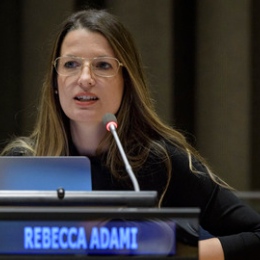
Rebecca Adami is a Senior Lecturer at the Department of Education, Stockholm University, and member of the Philosophical and Critical Studies in Education research group. Her work focuses on transformative processes in education through critical theoretical perspectives. Research Focus: Human rights education, feminist UN history, critical child rights theory, childism, intersectionality, and epistemic injustice Key Publications: 2025 Routledge monograph on Childism, Intersectionality and the Rights of the Child , 2022 Routledge book on Women and the UN , and 2022 co-edited volume The Rights of the Child with Brill Recent research examines linguistic discrimination in Swedish preschools and Cold War-era international welfare feminism. She supervises a PhD project on educational imaginings and prison abolition at Gothenburg University. Scientific Awards: 2022 Bertha Lutz Prize (ISA Diplomatic Studies Section) Dr. Adami teaches courses on Children's Rights and Intersectionality in Stockholm University's Master of Laws program.
Anna Wainwright is an Associate Professor of Italian Studies and Core Faculty in Women's and Gender Studies at the University of New Hampshire, where she serves as the coordinator for the Italian Studies program. Her academic home is within the Department of Classics, Humanities, and Italian Studies in the College of Liberal Arts. Dr. Wainwright earned her B.A. from the University of Chicago and completed both her M.A. and Ph.D. at New York University. Her scholarly trajectory demonstrates deep commitment to interdisciplinary approaches that bridge literary analysis with historical and cultural studies. Her research focuses on gender, race, politics, community and emotion in medieval and early modern Italy, with particular attention to women's writing and the Counter-Reformation period. She has pioneered work on widowhood as a cultural and political phenomenon in Renaissance Italy, examining how widows functioned as both symbols of loss and active participants in community formation. Notably, she explores the intersection of AI, machine learning, and the future of humanities education, bringing contemporary technological concerns to bear on historical scholarship. Dr. Wainwright's publications reveal consistent engagement with questions of representation, authority, and identity formation in Renaissance Italy. Her work demonstrates how literary texts served as sites for negotiating complex social issues including gender roles, religious identity, and cross-cultural encounters. She has made significant contributions to understanding race in Renaissance literature through careful analysis of texts like Tasso's Armida, while also examining how women writers strategically positioned themselves within patriarchal discourse. National Endowment for the Humanities Research Council of Norway Renaissance Society of America Gladys Krieble Delmas Foundation Dr. Wainwright has secured substantial research funding from major granting organizations to support her scholarly work. Her teaching portfolio is extensive, covering courses from elementary Italian language instruction to specialized seminars on topics like 'Mamma Mia! Italian Motherhood' and 'Honors/Feelings.' She has demonstrated commitment to innovative pedagogy, particularly in developing approaches for teaching race in Renaissance contexts. Her editorial work, including 'Teaching Race in the European Renaissance: A Classroom Guide,' reflects her dedication to shaping how these important topics are addressed in university classrooms. As coordinator of the Italian Studies program, Dr. Wainwright leads curriculum development and faculty collaboration. Her translation of Leonora Bernardi's pastoral tragicomedy 'Clorilli' demonstrates her commitment to bringing understudied women's works to contemporary audiences. Her research projects often involve collaborative networks with scholars across institutions and national boundaries, reflecting her transnational approach to Renaissance studies.
Monica Barni is a Full Professor at the Department of Modern Literature and Culture, Sapienza University of Rome, specializing in Educational Linguistics and Multilingualism. She serves as the President of the Degree Course in Communication and Interpreting in Italian Sign Language (LIS and LIST) and directs the Ateneo Linguistic Center. Her research spans language policy, Italian L2 education, and the sociolinguistics of migration. Research Interests: Analysis of linguistic policies in Italy and Europe Assessment of language competencies Plurilingual and intercultural education Linguistic landscapes in multicultural urban contexts Translation theory and practice Recent Article Trends: Her 2025 and 2024 publications focus on urban multilingualism, language transmission in migrant families, and policy intersections in education. Earlier works (2022-2023) examine Italian certifications, museum semiotics during pandemics, and European linguistic frameworks like CEFR. Labs & Teams: She leads the Ateneo Linguistic Center and contributes to the GISCEL research network. Her work intersects with projects like Lingua e cittadinanza (Language and Citizenship) and international collaborations in Italian language education.
Marianne Turner is an Associate Professor in Bilingual Education and TESOL at Monash University's School of Curriculum Teaching & Inclusive Education. Her research focuses on developing socially equitable understandings of language and building capacity for multilingual approaches across educational settings. She has established significant collaborations with Victorian Department of Education and Catholic Education through funded research projects. Her primary research interests include: Translanguaging as a framework addressing social inequity Integration of EAL and content-based learning in English-speaking contexts Language teacher pre-service education and professional development Content and language integrated pedagogies (CLIL) Educating for diversity and inclusion through multilingual strategies Recent publications demonstrate a clear trajectory toward practical implementation of translanguaging in Australian classrooms, with emphasis on teacher development, digital multimodal approaches, and policy frameworks. Her work consistently bridges theoretical concepts like trans-semiotizing with classroom applications through projects involving Home Languages in English Classrooms and Plurilingual Pedagogy initiatives. Turner actively disseminates research through teacher associations (VicTESOL, MLTAV), government resources, and media engagement. Current projects include English as an Additional Language (EAL) pedagogy development for secondary classrooms (2025) and Home Languages in the English Classroom research (2021-2022). She has supervised PhD students focusing on translanguaging approaches but is currently not accepting new candidates. Her research contributes to UN Sustainable Development Goals through advancing educational equity and inclusive language practices.
Professor Guido Bonsaver serves as Professor of Italian Cultural History at the University of Oxford's Faculty of Medieval and Modern Languages, holding fellowships at Pembroke College while tutoring at Merton, Queen's, and Wadham Colleges. His academic career spans contemporary Italian cultural studies with particular expertise in 19th-21st century historical intersections. His research trajectory reveals significant evolution from early work on Fascist-era censorship ( Censorship and Literature in Fascist Italy , 2007) through contemporary immigration narratives in cinema to current investigations of Italian-American cultural exchange ( America in Italian Culture: The Rise of a New Model of Modernity, 1861-1943 , 2023). Key thematic threads include political history's relationship with narrative forms, transnational cultural flows, and cinematic representations of social transformation. Professor Bonsaver's publications demonstrate remarkable interdisciplinary range across monographs, edited volumes, and scholarly articles examining censorship mechanisms, literary adaptations, migration narratives, and historical memory. His work consistently bridges literary analysis, film studies, and socio-political history while maintaining rigorous archival foundations. American Association of Italian Studies Book Prize (2007) for Censorship and Literature in Fascist Italy Extensive media collaborations including BBC World News, BBC 4, Radio 4, Corriere della Sera, and educational platform MASSOLIT Regular contributions to major reference works including The Oxford Handbook of Italian Literature His teaching encompasses undergraduate instruction in Italian history, literature and cinema from the 19th century to present, graduate supervision for MSt programs in Medieval and Modern Languages and Film Aesthetics, and DPhil guidance in modern Italian cultural history. Professor Bonsaver actively participates in public scholarship through video presentations and international media commentary on Italian cultural developments.