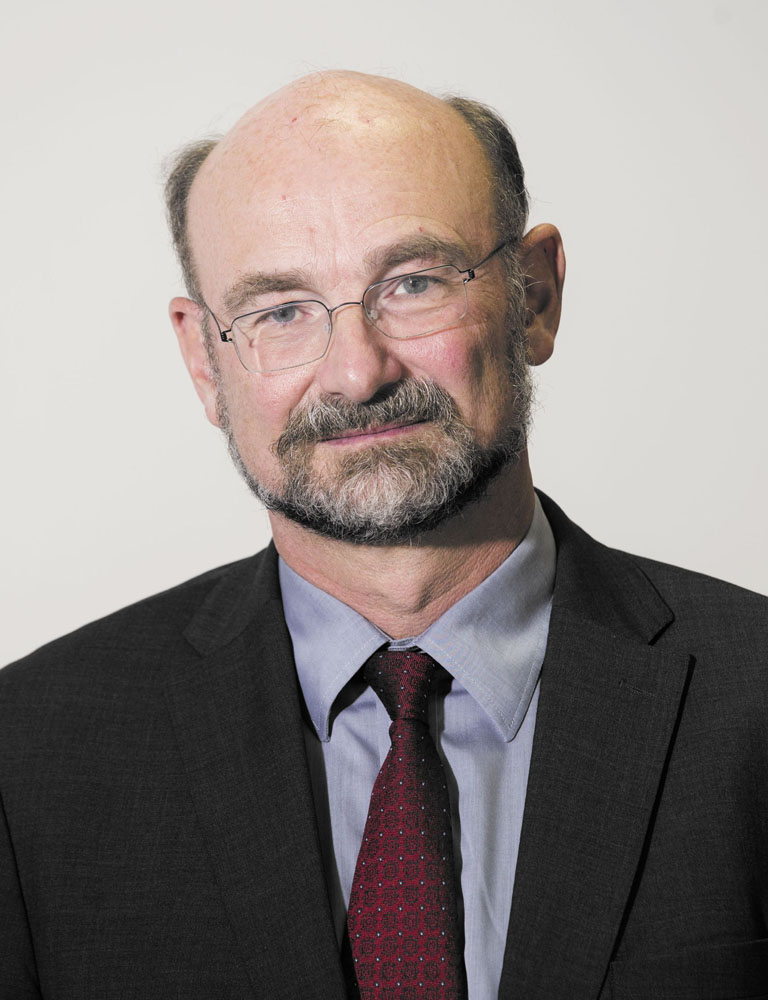
László Veisz is a Professor at the Department of Physics and Head of the RElativistic Attosecond physics Laboratory (REAL) at Umeå University. His research focuses on ultrafast phenomena in high-intensity laser-plasma interactions, attosecond science, and relativistic nanophotonics. Key projects include nonlinear attosecond spectroscopy (2021–2024) and relativistic nanophotonics (2020–2025). Research areas encompass relativistic plasma dynamics, ultrafast laser systems, and advanced pulse characterization techniques. His group develops compact laser-driven accelerators and investigates attosecond light-pulse generation from plasma surfaces. Publications highlight breakthroughs in femtosecond X-ray generation, spatio-temporal analysis of relativistic plasmas, and dual-energy electron beam creation. Collaborations include work with Nobel laureates and contributions to the 2023 Nobel Prize-winning physics research. REAL lab innovations include novel methods for pulse compression, plasma lensing, and nanoscale acceleration. Ongoing work focuses on optimizing optical parametric amplifiers and exploring relativistic effects in nanoplasmonics.
Dr. Hans-Peter Schlenvoigt is a researcher at the Helmholtz-Zentrum Dresden-Rossendorf (HZDR), working in the Department of Laser Particle Acceleration. His research focuses on experimental and theoretical aspects of high-intensity laser-matter interactions, with emphasis on advancing laser-driven particle acceleration techniques. Research Interests: Dr. Schlenvoigt's work spans laser-plasma physics, laser-driven ion acceleration, X-ray polarimetry, and strong-field quantum electrodynamics. Key themes include: Development of diagnostic methods for relativistic plasmas Optimization of laser-driven proton/ion sources Applications in radiobiology and fundamental physics Advanced laser technologies for extreme conditions Publication Trends: His recent articles (2023-2025) demonstrate a focus on laser-driven particle acceleration mechanisms, plasma diagnostics using X-ray techniques, and quantum electrodynamics in strong fields. The research integrates experimental work at major facilities like J-KAREN-P and theoretical modeling, with growing emphasis on medical applications of laser-accelerated particles. Facilities and Tools: He utilizes HZDR's DRACO-PW laser system and collaborates on projects at international facilities including the Helmholtz International Beamline for Extreme Fields (HIBEF).
Julia Mikhailova is an Associate Professor at the Department of Mechanical and Aerospace Engineering, Princeton University. She is also affiliated with the Program in Plasma Physics, the Princeton Plasma Physics Laboratory, and the Andlinger Center for Energy and the Environment. Her research integrates experimental and theoretical approaches to study laser-matter interactions under extreme conditions, focusing on ultrafast dynamics in materials and plasmas. Ph.D. in Physics, Lomonosov Moscow State University (2007) M.A. in Journalism, Lomonosov Moscow State University (2005) M.S. in Physics, Lomonosov Moscow State University (2003) Her research spans Applied Physics , Optical Materials , Light-Matter Interactions , Plasma Physics , and Ultrafast Dynamics . Recent work explores ionization plasma gratings for attosecond pulse compression, relativistic harmonic generation, and magnetized plasma amplification. Articles emphasize nonlinear optics, quantum coherence, and high-intensity laser applications. Scientific Awards: Gordon and Betty Moore Foundation Experimental Physics Investigator award Kavli Frontiers of Science Fellowship (National Academy of Sciences) U.S. Department of Energy Early Career Award Alfred Rheinstein Faculty Award Humboldt Research Fellowship Mikhailova has advised graduate student Matthew Edwards, now a faculty member at Stanford University. Her funded projects include NSF grants (PHY 1506372, PHY 1806911, PHY 2206711) and the DOE Early Career Award DE-SC0017907. She leads the ETOILES (Experimental and Theoretical Optics of Intense Laser Envelopes and Strong fields) research group.
Enam Chowdhury is an Associate Professor of Materials Science and Engineering at The Ohio State University with joint appointments in Electrical and Computer Engineering and Physics. His research focuses on studying materials under extreme conditions induced by high and ultra-high intensity lasers, such as those used in the 400 TW SCARLET laser system at OSU's High Energy Density Physics (HEDP) Laboratory, which he led to completion in 2012. Academic Affiliations: Materials Science and Engineering, Electrical and Computer Engineering, Physics Key Research Areas: High-intensity laser-matter interactions, relativistic and non-perturbative optical phenomena, dynamic metamaterials Applications of his work span from next-generation particle accelerators and cancer therapy to planetary science, astrophysics, and laser micro/nano-machining. He also explores ultrafast non-linear optical properties and defect generation in materials using femtosecond pulses, particularly in mid-infrared wavelengths. His group is part of the AFRL-funded SPACE-MAT Center of Excellence (2024), a $5.5 million initiative to study material behavior in space environments. The Femto-solid Laboratory, which he leads, has produced notable graduates such as Dr. Ryan Siebenaller (PhD 2025), Dr. Emma DeAngelis (PhD 2025), and Dr. Michael Tripepi (PhD 2022), now at Hillsdale College. Former students include Dr. Noah Talisa (PhD 2020) at Johns Hopkins APL, Dr. Kevin Werner (PhD 2019) at BAE Systems, and Dr. Drake Austin (PhD 2017) in postdoctoral research at Agostini-DiMauro Group. Dr. Chowdhury collaborates with Ohio State faculty like Prof. Roberto Myers (NEON Lab), Prof. Michael Chini (Physics), and external institutions including Lawrence Livermore National Laboratory, Cornell University, and Colorado State University. His research has been featured in conferences like SPIE Laser Damage Symposium, International Conference on Ultra-Intense Lasers (Lindau), and LaserNetUS meetings.
Prof. Markus Roth is a leading plasma physicist at the Technische Universität Darmstadt , heading the Laser and Plasma Physics Group within the Department of Physics . His research focuses on experimental investigations of laser-plasma interactions, particularly in developing novel radiation sources and advancing inertial fusion technologies. Research Interests : Energy loss mechanisms in laser-generated plasmas Laser ion acceleration (TNSA, BOA, and relativistic transparency) Laser-driven neutron sources for radiography Warm dense matter generation and diagnostics Target development for high-energy experiments Integration of laser-accelerated ions into accelerators Scientific Awards : APS Fellow (2013) Defense Physics Award of Excellence (2014) Rosen Scholar Award (2012, 2016) Collaborations : Active in international projects including FAIR, ELI-NP, and LIGHT collaboration. His group develops detectors for laser-driven neutron sources and contributes to fusion research.
Soraya Caixeiro is a Research Fellow in the Department of Physics at the University of Bath, affiliated with the Centre for Photonics and Photonic Materials, NanoBioPhotonics, and multiple interdisciplinary research centres. Her work focuses on developing micro- and nanolasers for biosensing and biomedical applications, leveraging photonics, nanofabrication, and chemistry. She is actively involved in advancing laser-based technologies for real-time cellular and molecular monitoring, with a particular emphasis on early disease diagnosis and in vivo measurements. Education: She earned a Doctor of Philosophy in Physics from King’s College London (2014–2018), specializing in random lasing action from biocompatible materials. Her research integrates interdisciplinary expertise, including collaborations with institutions in Ireland, Germany, and the University of Bath’s Department of Life Sciences. Research Interests: Caixeiro’s multidisciplinary research combines photonics with nanofabrication to create compact laser sensors for biological applications. Key areas include enhancing laser specificity, optimizing geometric designs for sensitivity, and developing coatings for targeted biomolecular interactions. Her innovations aim to overcome limitations of traditional biosensing methods, such as low signal intensity and poor tissue penetration. Publications: Her recent work includes breakthroughs in DNA sensing using whispering gallery mode microlasers, hyperspectral confocal imaging for high-throughput analysis, and optical manipulation techniques for cellular delivery. These contributions highlight advancements in both fundamental photonics and translational biomedical applications. Outreach & Engagement: She actively participates in public lectures, school outreach programs, and interdisciplinary conferences (e.g., Photon 2024). Her commitment to diversity drives efforts to attract students from varied backgrounds to photonics research. Labs & Facilities: She utilizes state-of-the-art facilities at Bath, including the Nanofabrication Lab and Photonics and Nanoscience Labs, to pioneer functional biointegrated sensors for tissue and single-cell applications.
Dr. Ioan Nistor is a Professor of Hydraulic and Coastal Engineering at the University of Ottawa , affiliated with the Department of Civil Engineering . He also serves as the Assistant Vice-Provost, Graduate and Postdoctoral Studies . His research focuses on hazards associated with extreme hydrodynamic loading on infrastructure, coastal erosion, and disaster risk reduction. He chairs the Maritime and Coastal Division of IAHR and contributes to design guidelines for tsunami-resistant buildings through the ASCE7 Tsunami Loads Subcommittee . Dr. Nistor holds editorial roles at Journal of Waterways, Ports, Coastal and Ocean Engineering (ASCE), Coastal Engineering Journal , and Canadian Journal of Civil Engineering . He has received prestigious awards, including the 2014 JWPCOE Outstanding Paper Award and the 2010 Tsunami International Society Award. Prior to academia, he worked as a hydraulic engineer at AECOM-TECSULT Montreal , contributing to water resources projects globally. Research Interests: Tsunami impact mitigation, dam failure analysis, coastal vegetation dynamics, climate change adaptation, and nature-based solutions for coastal protection. Professional Activities: Board member of the Canadian Coastal Science and Engineering Association, voting member of ASCE7 Tsunami Subcommittee. His recent work emphasizes probabilistic tsunami hazard assessments and the integration of ecological engineering principles into coastal infrastructure design. Collaborative projects include Living Dyke initiatives and field studies on post-disaster resilience.
Bruno Bauer is a Professor of Physics at the University of Nevada, Reno (UNR), where he has held academic roles since 1996, advancing to full Professor in 2012. He is affiliated with the College of Arts and Science and leads the Department of Physics. Bauer’s research focuses on plasma physics, high-energy density systems, and their applications in fusion energy and radiation sources. He has pioneered experimental and computational studies of plasma formation, waves, and instabilities, co-authoring 53 peer-reviewed articles, 2 patents, and 56 conference proceedings. He founded the Nevada Terawatt Facility at UNR in 1997. Education: PhD in Physics (1992), UCLA; MS in Physics (1983), UCLA; BS in Mathematics (1982), Stanford University. Grants & Funding: Secured $37.5M in proposals (77 as PI/co-PI), yielding 56 awards ($23.8M for UNR). His research innovations include foundational work on laser-plasma interactions and high-energy-density plasma systems. Bauer has been recognized with prestigious awards, including the U.S. Presidential Early Career Award and the LANL Distinguished Achievement Award. He has also contributed to DOE and international workshops as an invited speaker. Labs/Teams: Founder and leader of the Nevada Terawatt Facility, a key site for high-intensity laser-plasma research.
Professor Dirk Lars Engelberg is a Professor in Materials Performance & Corrosion at the Department of Materials, University of Manchester. He holds multiple affiliations including the Dalton Nuclear Institute and the Sellafield Effluent & Decontamination Centre of Expertise (SEDCoE). As Corrosion@Manchester lead and SEDCoE Decontamination Lead, he plays a pivotal role in advancing corrosion science with applications in nuclear energy, net zero engineering, and materials performance. Professor Engelberg's educational background includes a PhD in Metallurgy & Materials Science, an MSc in Corrosion Science & Engineering from UMIST, and a Diplom-Ingenieur (FH) in Surface Engineering & Materials Science from Aalen University in Germany. His industry experience as an electroplater (1991-1994) provided foundational knowledge that has informed his academic career. His research spans carbon steels, stainless steels, aluminum alloys, and nickel alloys, with particular emphasis on their performance in nuclear applications and hydrogen-related environments. Professor Engelberg's expertise covers metallurgy & processing, grain boundary engineering, hydrogen effects, bipolar electrochemistry, in-situ imaging techniques, and cementitious materials for nuclear waste disposal. Professor Engelberg's recent publications demonstrate a strong focus on advanced corrosion testing methodologies, hydrogen effects on material performance, and innovative imaging techniques for corrosion monitoring. His work increasingly addresses challenges related to net zero engineering and sustainable materials solutions, reflecting the growing importance of these areas in materials science. Best Paper Award 2018 - Welding in the World (2019) Henri Coriou Award 2024 (2024) As an educator and mentor, Professor Engelberg has supervised numerous PhD and Master's students. He leads several major research projects funded by EPSRC, NNL, and other organizations. Currently, he serves as Vice Chair of the European Federation of Corrosion Working Party 5 on Environment Sensitive Fracture and as Section Editor for Shreir's Corrosion Handbook, highlighting his standing as a leading expert in the international corrosion science community.
Roland Sauerbrey is a Professor of Quantum Optics at the Technical University of Dresden and Scientific Director at Helmholtz-Zentrum Dresden-Rossendorf since 2006. He previously held faculty positions at Friedrich Schiller University Jena (1994-2006), Rice University (1985-1994), and served as President of the German Physical Society (2002-2004). Education: Ph.D. in Physics (1981), University of Würzburg; Postdoc at Rice University (1981-1982). His research spans quantum optics, laser physics, and strong-field laser-matter interactions, focusing on high-intensity lasers and their applications in atmospheric sensing and plasma acceleration. His work includes pioneering studies on laser-induced filamentation, proton acceleration, and supercontinuum generation. The most recent articles reflect his expertise in laser-matter coupling, atmospheric propagation, and advanced laser applications. Key themes include nonlinear optical phenomena, precision sensing, and high-energy physics experiments. Scientific Awards: Member of Leopoldina (2013), Dr. h.c. from University of Rostock (2010) and Russian Academy of Science (2004), Le Prix La Recherche (2005), Thueringer Forschungspreis (2004), Fellow of OSA and IOP (2002), Rodolf Kangslake Medal (1993). Roland Sauerbrey leads the Helmholtz-Zentrum Dresden-Rossendorf, a multidisciplinary research institution, and has contributed to major advancements in laser technology and its applications across physics and engineering.
Professor Anne L'Huillier is a renowned French/Swedish physicist at Lund University, specializing in atomic physics and attosecond science. She holds the rank of Professor in the Department of Atomic Physics within the Faculty of Engineering (LTH). Her research focuses on ultrafast phenomena, particularly high-order harmonic generation and attosecond light pulses for studying electron dynamics. She leads projects like QU-ATTO and New Trends in Attosecond Science, funded by the EU and Swedish Research Councils. Education: Earned her PhD in 1986 from Université Pierre et Marie Curie (Paris) and CEA. Postdoctoral roles at Chalmers Institute of Technology (1986) and University of Southern California (1988). Became Associate Professor at Lund University in 1995 and Full Professor in 1997. Research Interests: Experimental and theoretical studies of attosecond pulses, laser-atom interactions, and ultrafast electron dynamics. Her work enables insights into quantum processes at the atomic scale. Collaborations span global institutions, advancing applications in condensed matter physics and quantum information science. Key Contributions: Pioneered methods to generate attosecond pulses, recognized by the 2023 Nobel Prize in Physics. Her team's innovations include optimizing attosecond source development and applying these pulses to study electron motion in matter. Awards: Nobel Prize in Physics (2023), Wolf Prize in Physics (2022), and multiple grants including Horizon Europe and Wallenberg Foundation funding. Active in conferences and mentoring, with 34 supervised works and 352 research outputs. Labs/Teams: Principal Investigator at NanoLund, a nanoscience center, and member of strategic initiatives like Light & Materials and Photon Science and Technology profile areas.
Dr. David Belton is a Senior Lecturer in the School of Earth and Planetary Sciences at Curtin University, within the Faculty of Science and Engineering. He also holds a portfolio role in the Office of the Provost. His expertise lies in laser scanning (both terrestrial and mobile) and photogrammetry, with a focus on automated processing, feature extraction, and applications in mining, heritage conservation, and structural monitoring. Dr. Belton holds a BCSc, BSc (First Class Honours), and a PhD from Curtin University. His teaching responsibilities include coordinating and lecturing in Cartographical Statistics and Integrated Surveying, alongside previous roles in Mine Surveying and Mine Survey Project courses. He actively supervises PhD, MPhil, and Honours students, fostering research excellence in spatial sciences. His research emphasizes practical applications of geospatial technologies, including underwater photogrammetry, pipeline monitoring, and coral reef analysis. Key areas include robust statistical methods for point cloud processing, sensor calibration, and open-source device development for marine surveys. His work bridges theoretical advancements with real-world challenges in environmental monitoring, infrastructure assessment, and cultural heritage preservation. Publications span high-impact journals like Corall Reefs , ISPRS Journal of Photogrammetry , and IEEE Transactions , reflecting contributions to geomatics, remote sensing, and computer vision. His research often addresses interdisciplinary challenges, such as UAV-based ecological monitoring and automated 3D model reconstruction from laser scanning data. Dr. Belton collaborates widely, contributing to projects like the Sydney-Kormoran wreck analysis and heritage documentation of Pilbara rock art. His work underscores innovative solutions for spatial data challenges across environmental, engineering, and archaeological domains.
Linda Olafsen is an Associate Professor in the Department of Electrical & Computer Engineering at Baylor University’s School of Engineering and Computer Science. She holds a PhD in Physics from Duke University and has held academic positions at the University of Kansas and Baylor University since 1999. Her research spans photonics, semiconductor optoelectronics, and biomedical device development. PhD, Physics, Duke University (1997) MA, Physics, Duke University (1994) AB, Physics, Princeton University (1991) Her research focuses on mid-infrared semiconductor lasers, optoelectronic devices, graphene-semiconductor integration, and biomedical applications such as endovascular navigation and glucose monitoring. She leads the Semiconductor Optoelectronics Laboratory, where her team develops advanced mid-IR lasers, characterizes 2D/3D material interfaces, and engineers sensors for medical use. Her work bridges fundamental physics with practical engineering solutions in healthcare and defense. The recent publications show a strong trend toward mid-infrared optoelectronics , particularly interband cascade lasers , graphene-based contacts , and biomedical sensing . Her team integrates optical, thermal, and electrical characterization to improve laser efficiency and device performance. Applications span infrared countermeasures, chemical sensing, and endovascular robotics. Scientific Awards and Professional Leadership: Chair, Congressional Visit Day Subcommittee, MRS (2012–2016) Chair, Policy Outreach Working Group, MRS Government Affairs Committee Book Review Board Chair, MRS Bulletin Editorial Board Member, MRS Bulletin Lifetime Member, American Physical Society, OSA, and SPIE Senior Member, IEEE and IEEE Photonics Society Linda Olafsen actively mentors undergraduate and graduate students, involving them in research on laser development, material characterization, and biomedical device design. She has secured funding for projects in mid-IR lasers and sensing technologies. Her lab offers opportunities in device fabrication, graphene integration, beam profiling, and LabVIEW programming. She leads the Semiconductor Optoelectronics Laboratory , which focuses on: Mid-infrared semiconductor laser development Graphene-semiconductor optoelectronic devices Endovascular navigation using shape-memory alloys In vivo infrared and ultrasound sensing Beam and thermal profiling Device fabrication and characterization
Yong-Siang Hsu is affiliated with the Helmholtz Institute Jena , a collaborative institution involving GSI, FAIR, and Friedrich Schiller University (FSU) Jena. His research focuses on advanced photon science, particularly in relativistic laser-plasma interactions, quantum field theory, and atomic physics with highly charged ions. Key research areas include: Relativistic Laser Plasma Theory Quantum Field Theory at highest intensities High Intensity Laser Physics Soft X-ray spectroscopy and microscopy Quantum logic spectroscopy of highly-charged heavy ions Contact: y.hsu@hi-jena.gsi.de
Alperen Kozan is a researcher at the Helmholtz-Institut Jena, affiliated with the Research School of Advanced Photon Science at Friedrich Schiller University Jena. His work focuses on relativistic laser physics, quantum field theory at extreme intensities, and X-ray science. Relativistic Laser Physics Quantum Field Theory at Highest Intensities High Intensity Laser Physics X-Ray Science Atomic Physics with Highly Charged Ions Strong-field Interaction with Ionic Targets Contact: alperen.kozan@uni-jena.de