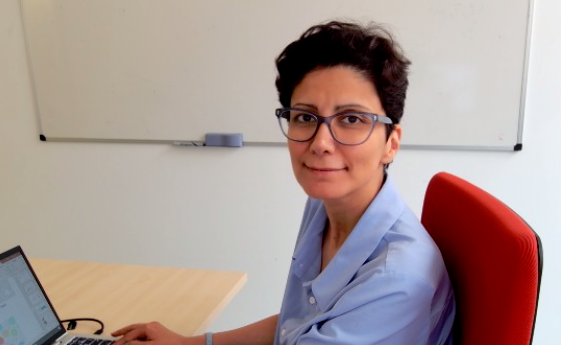
Maria Alberich Carramiñana is a Full Professor (Catedrática) at the Universitat Politècnica de Catalunya (UPC), Department of Mathematics, affiliated with the Faculty of Mathematics and Statistics. She leads the GEOMVAP research group (Geometry of Varieties and Applications) and is part of the Institut de Robòtica i Informàtica Industrial (CSIC-UPC). Her expertise lies in Algebraic Geometry, Singularity Theory, and their applications to robotics, alongside Mathematics Outreach. She holds a Ph.D. from the Universitat de Barcelona and has held roles including Ramón y Cajal Fellow and Associate Professor at UPC. Roles: Deputy Director at CFIS-UPC, member of the IMAGINARY Committee (RSME). Education: M.Sc. (1994), Ph.D. (2000) in Mathematics from UB. Research focuses on analytic and algebraic singularities, robotic perception and manipulation (e.g., cloth modeling), and geometric-topological methods in robotics. Key projects include Interactions of Geometry with Algebra and Applications and GeomVAP . Awards include Sant Jordi IEC Awards (2022, 2024), Vincent Caselles RSME-BBVA (2022), and supervision of award-winning students (e.g., Guillem Blanco, Franco Coltraro). Grants: Competitively funded projects (e.g., Geometria de Varietats i Aplicacions ) and non-competitive initiatives (e.g., LabORA consolidation). Active collaborations in robotics and algebraic geometry.
Marta Fort Masdevall is a Lecturer in the Department of Computer Science, Applied Mathematics and Statistics at the University of Girona. She is affiliated with the Graphics and Image Laboratory Research Group (GILAB) and specializes in computational geometry with applications in service localization and spatial/spatio-temporal data analysis. She has participated in five R&D projects funded through public calls and teaches programming subjects. Her research focuses on Computational geometry algorithms Geospatial data processing Temporal data modeling Location-based service optimization She collaborates with the Institute of Computing and Applications and can be reached at Building P4, Office 236 (Girona) or via phone at +34 9338 (internal) / +34 618361888 (external).
Pooran Memari is a CNRS Researcher at the Laboratoire d'Informatique de l'École Polytechnique (LIX), UMR CNRS 7161, Institut Polytechnique de Paris, and an Affiliate Professor (part-time) at École Polytechnique. She leads research in geometric modeling within the GeomeriX team at LIX-Inria, focusing on theoretical foundations and applications in accessibility and neurocognition. Her academic journey includes: HDR (Habilitation à diriger des recherches), Institut Polytechnique de Paris, 2024 Ph.D. in Geometric Modeling, INRIA Sophia-Antipolis, 2010 Master in Image and Geometry, University of Nice-Sophia Antipolis, 2006 Engineering Degree, École Polytechnique, 2005 Bachelor in Mathematics, Sharif University of Technology, 2002 Dr. Memari's research bridges geometric modeling, computational geometry, and computer graphics with real-world impact. She pioneers techniques in shape representation, point pattern synthesis, and surface reconstruction, advancing proximity encoding and clustering algorithms. Her work extends to accessibility applications—developing geometric models for visually impaired navigation through multisensory perception—and neurocognition validation via tactile interfaces. This interdisciplinary approach integrates theoretical rigor with practical tools like the CGAL library. Recent publications (2024-2019) reveal a cohesive trajectory in geometric processing: advancing point pattern synthesis through image-based editing (Patternshop), stability-incorporated neighborhood graphs (SING), and multi-class disk distributions; innovating surface reconstruction via Voronoi-based methods (BallMerge); and expanding applications to virtual worlds simulation and neurocognitive accessibility. Key themes include bridging discrete geometry operators with high-dimensional data analysis and translating theoretical insights into tools for visual computing. Dr. Memari actively mentors the next generation of researchers, advising eight PhD students on topics ranging from generalized Voronoi diagrams to neurocognition-driven tactile navigation. She coordinates Computer Science Projects for École Polytechnique's Bachelor program since 2019 and co-leads the Interaction, Graphics & Design master's program at IP-Paris. Her leadership extends to editorial roles at Computer Graphics Forum and Graphical Models Journal, alongside prominent conference positions including SGP Program Co-Chair (2023) and Eurographics STARs Co-Chair (2025). As a core GeomeriX team member, she drives collaborative projects in geometric modeling and virtual environments. She coordinates the LIX Seminar since May 2025 and serves on the French Eurographics Chapter board, fostering community engagement through initiatives like the IGD master's program and Eurographics symposia.
Salvador Roura Ferret is a faculty member at the Universitat Politècnica de Catalunya (UPC), affiliated with the Faculty of Informatics of Barcelona (FIB) and the Department of Computer Sciences. He is an active researcher in the ALBCOM group, focusing on algorithmics, bioinformatics, complexity, and formal methods. His research interests span algorithms , randomized data structures , divide-and-conquer methods , and computational complexity . His work often bridges theoretical computer science with practical applications in voting systems, game theory, and educational technologies. The recent publications (2013–2025) reflect a strong trend in theoretical computer science, particularly in algorithm design, data structures (e.g., K-d trees, binary search trees), and game-theoretic models. There is a notable emphasis on mathematical rigor, complexity analysis, and formal modeling of computational problems. Best student paper award Distinció Jaume Vicenç Vives a la qualitat docent universitària (modalitat individual) 18è Premi UPC a la Qualitat en la Docència Universitària Roura has contributed to teaching innovation through projects like Eines per a la Transformació de la Docència en Programació and the development of Jutge.org , an online programming judge platform. He has participated in numerous competitive R+D+i projects, often in collaboration with researchers such as Conrado Martinez, Xavier Molinero, and Maria Serna. His work has been supported by national and regional funding programs. While no direct mention of grants or student advising is made, his extensive publication and project history suggest significant research leadership.
Artur Nicolau is a Professor of Mathematics at the Autonomous University of Barcelona, Spain, where he is affiliated with the Department of Mathematics. His academic career spans several decades, with a prolific research output in complex analysis and related fields. Professor Nicolau's research primarily focuses on complex analysis , with special emphasis on inner functions, Hardy spaces, Bloch space, Nevanlinna theory, and harmonic analysis. His work explores the boundary behavior of analytic functions, function spaces, and connections to dynamical systems and probability theory. He has made significant contributions to understanding the structure of bounded analytic functions and their geometric properties. Analysis of Nicolau's recent publications (2021-2025) reveals a strong focus on inner functions and their properties, including studies on shift invariant subspaces in the Bloch space, central limit theorems for inner functions, and invertibility in quotient algebras of $H^\infty$. His work demonstrates deep connections between complex analysis, functional analysis, and probability theory, with applications to understanding the geometric and dynamical properties of analytic mappings. While no specific scientific awards are mentioned in the available information, Professor Nicolau's extensive publication record in top mathematics journals reflects significant scholarly impact in his field.
Álvaro Heredia Lidón serves as an Associate Professor in the Department of Engineering at Universitat Ramon Llull, specializing in Human-Environment Research with a focus on advanced computational methods for medical applications. His academic position bridges engineering, computer science, and clinical research, with particular emphasis on developing accessible diagnostic tools through innovative image analysis techniques. Dr. Heredia Lidón's research centers on the development and application of computer vision and deep learning methodologies for 3D facial biomarker analysis in medical diagnostics. His work addresses critical challenges in rare genetic disorders, particularly Turner syndrome and Down syndrome, through advanced facial phenotyping techniques. He has pioneered approaches for automated 3D landmarking of anatomical structures, orientation detection of head reconstructions, and the extraction of diagnostic biomarkers from various imaging modalities including MRI and smartphone-based 3D reconstructions. His publication portfolio reveals a strong trend toward creating low-cost, accessible diagnostic solutions that can be deployed in resource-limited settings. The research demonstrates significant interdisciplinary collaboration between engineering, genetics, and clinical medicine, with particular focus on translating computational advances into practical clinical applications. His work on multi-view consensus networks and geometric morphometric methodologies represents cutting-edge innovation in the field of medical image analysis. Dr. Heredia Lidón has secured substantial research funding, including serving as Principal Investigator for the FI-2022 Joan Oró grant for predoctoral researcher training (2022-2025) from the Catalan Department of Research and Universities. He is actively involved in multiple collaborative research projects, most notably the BeNeXT project which uses Turner syndrome as a model for developing biomarker-enhanced diagnostic tools for rare disorders. His laboratory work focuses on the Human-Environment Research group at Universitat Ramon Llull, where he collaborates with an extensive interdisciplinary team including medical researchers, geneticists, and computer scientists. This collaborative environment fosters innovation at the intersection of engineering and healthcare, with particular emphasis on making advanced diagnostic capabilities more widely accessible through cost-effective imaging solutions and automated analysis pipelines.
Anabel-Lise Le Roux is a Researcher at the Institute for Bioengineering of Catalonia (IBEC) within the Cellular and Molecular Mechanobiology research group. Her work focuses on understanding how mechanical forces and membrane dynamics regulate cellular processes, particularly in the context of signaling pathways, mechanotransduction, and cancer biology. She employs advanced imaging and biophysical techniques to study protein-membrane interactions and their implications in health and disease. Key research themes include lipid-driven protein self-assembly (e.g., Src kinase), membrane curvature sensing by BAR proteins, and the role of mechanical strain in secretory trafficking. Her findings bridge biophysics and cell biology, with applications in understanding cellular mechanosensing and oncogenic transformation mechanisms. Collaborations span experimental and theoretical approaches, including computational modeling of protein-membrane interactions. Le Roux’s contributions include pioneering studies on YAP nuclear entry mechanics and membrane tension regulation at the leading edge of migrating cells. Her work has been published in high-impact journals such as *Nature Communications*, *Elife*, and *The EMBO Journal*.
Jose A. Ruiperez Valiente is an Associate Professor at the Information and Communications Engineering Department of the University of Murcia. His academic journey includes a B.Eng. and M.Eng. in Telecommunications, followed by an M.Sc. and Ph.D. in Telematics from UC3M, with research conducted at IMDEA Networks. He completed research stays at MIT and the University of Edinburgh, and a postdoc at MIT Teaching Systems Lab/Playful Journey Lab. He has held academic appointments at Complutense University of Madrid and industry roles at Multimedia Vocento, Accenture, and ExoClick. Current role: Associate Professor, University of Murcia Previous institutions: UC3M, IMDEA Networks, MIT, University of Edinburgh, Complutense University of Madrid Industry experience: Multimedia Vocento, Accenture, ExoClick His research focuses on computational social science, educational technology, cyberdefence, and data science. Key methodologies include learning analytics, game-based assessment, and serious games for skill evaluation. Recent publications analyze trends in educational technology, develop frameworks for game-based assessments, and explore disinformation detection. His work combines machine learning with educational innovation, particularly in stress detection and competency evaluation through biometric data. Scientific awards include: BBVA Award as Outstanding Young CS Researcher Humboldt Research Fellowship He has co-authored over 100 publications with 2100+ citations and participated in 20+ funded projects like DEFENDER, SEMANTIC, and EU-GUARDIAN, focusing on cybersecurity training and decentralized AI systems.
Francisco Calviño Tavares is a Full Professor at the Universitat Politècnica de Catalunya (UPC) in the Department of Physics, affiliated with the Escola Tècnica Superior d'Enginyeria Industrial de Barcelona (ETSEIB) . He leads the Advanced Nuclear Technologies Research Group (ANT) and is part of the Institut de Tècniques Energètiques . His research focuses on experimental nuclear physics, radiation detector development for CERN's n_TOF facility, neutron capture studies, and nuclear waste management. He has pioneered innovations in neutron dosimetry and contributes to nuclear education methodologies. Over 484 documented academic activities, including 207 indexed journal articles and 162 conference presentations. Key projects include the LINEAR neutron dosimeter and collaborations with CERN on neutron physics. Recipient of grants from HORIZON 2020, Euratom, and the Spanish National Research Program. Research interests span nuclear astrophysics (e.g., s-process nucleosynthesis), detector engineering (solid-state and segmented detectors), and radiation protection in medical and industrial settings. His work bridges fundamental physics with applied technologies like neutron dosimetry for particle therapy. Publications emphasize high-energy neutron interactions, fission dynamics, and cross-section measurements at CERN's neutron time-of-flight facility. Collaborations include global teams from institutions like INFN and the University of Tokyo. Led the Grandes experimentos en el CERN. Proyecto n_TOF and the University Network for Innovation, Technology and Engineering educational initiative. Developed innovative detectors like the sTED and miniBELEN-10A for neutron spectroscopy.
Dr. José Manuel Fernández is a Full Professor at the Polytechnic University of Madrid (UPM), specializing in antenna engineering, microwave systems, and millimeter-wave technologies. His research focuses on innovative designs for 5G communication systems, including phased arrays, 3D-printed components, and reconfigurable antennas. He leads projects involving W-band filters, Ka-band SATCOM systems, and low-cost phased array prototypes. His work emphasizes practical applications in aerospace, telecommunications, and energy harvesting. Fernández is affiliated with the Interspace5G research group and contributes to educational initiatives, such as bachelor’s and master’s thesis guidance. He has authored numerous peer-reviewed articles on topics like gradient-index lenses, frequency selective surfaces, and manufacturing processes for mm-wave devices. Research Interests: Dr. Fernández’s expertise spans antenna design, waveguide technologies, and additive manufacturing for RF components. His recent work addresses challenges in beam steering, polarization control, and robust filter designs for high-frequency systems. He also investigates cost-effective fabrication methods, such as electroplating and 3D printing, to enhance mm-wave device performance. Grants & Projects: Fernández has secured funding for predoctoral contracts and scholarships, supporting doctoral research in antenna engineering and related fields. He collaborates on initiatives like DEMERSTEM, focusing on stock identification for sustainable fisheries, and LEHA projects involving measurement systems for 5G terminals. Labs & Teams: His research is anchored in UPM’s advanced labs, including the Interspace5G group, which develops cutting-edge antenna solutions for 5G and satellite communication. He also contributes to interdisciplinary efforts in materials science and aerospace engineering.
Ana Muñoz Sánchez is an Associate Professor in the Department of Mechanical Engineering at University Carlos III of Madrid, where she conducts research in composite materials, additive manufacturing, and manufacturing processes. Her work bridges theoretical modeling with practical applications, particularly in drilling processes, ballistic protection, and engineering education. Her research focuses on several key areas within mechanical engineering and materials science: Composite materials machining, particularly carbon fiber reinforced polymers (CFRP) Tool wear analysis and optimization of drilling parameters Numerical modeling of manufacturing processes Additive manufacturing applications in medical and educational contexts Ballistic protection systems Engineering education tools and methodologies Dr. Muñoz Sánchez's publication record demonstrates consistent contributions to both fundamental manufacturing research and practical educational applications. Her recent work shows a strong emphasis on improving manufacturing processes for composite materials while simultaneously developing innovative educational tools, including specialized resources for visually impaired students. Her research combines computational methods with experimental validation to address complex engineering challenges. She has secured funding from multiple Spanish research agencies for projects including "DIGITDRILL - Digitalization of industrial drilling process" and "DISEÑO AVANZADO, FABRICACIÓN Y ENSAYO DE PROTECCIONES BALÍSTICAS DE CABEZA (PROTECT_BAL)". Her work has practical applications in aerospace, medical simulation, and inclusive education.
Eduardo Antonio Ahedo Galilea is a Full Professor in the Department of Aerospace Engineering at Universidad Carlos III de Madrid (UC3M), leading the Plasmas and Space Propulsion Team (EP2). His research focuses on plasma propulsion systems, particularly Hall thrusters, magnetic nozzles, and helicon plasma thrusters, with expertise in plasma dynamics, wave-plasma interaction, and spacecraft-plume effects. Current projects: MLPLUS-CM (2025-2028), PROPULSION ELECTROMAGNETICA POR EFECTO HALL (2023-2026) International collaborations: European Commission, Airbus Defense and Space, SENER His recent publications analyze non-stationary plasma expansions, electron cooling mechanisms, and magnetic nozzle physics across multiple thruster designs. He supervises theses on turbulent transport, wave-plasma interaction, and fluid-kinetic thruster modeling. Grants include funding from the European Commission Research Executive Agency, Agencia Estatal de Investigación (AEI), and regional programs like RIS3-CAM.
Manuel Rosa Zurera is a Full Professor at the Universidad de Alcalá, specializing in Signal Theory and Communications. He leads the AES3 research group focused on Acoustic and Electromagnetic Smart Sensor Networks and Signal Processing. His research emphasizes machine learning applications in audio analysis, biomedical signal processing, and passive radar systems. Dr. Rosa holds a PhD from Universidad de Alcalá (1999), supervised by Francisco López Ferreras. Research Interests : Dr. Rosa’s work spans acoustic signal localization, UAV detection, emotion recognition via speech analysis, and evolutionary studies of hominin auditory systems. His innovations include robust detection algorithms for passive radar, energy-efficient anger detection systems, and age/gender classification from speech using neural networks. He has pioneered acoustic sensor networks for urban security and biomedical diagnostics. Key Contributions : Over 150 peer-reviewed articles since 1999 demonstrate his expertise in signal processing for aerospace flutter analysis, real-time violence detection in smart cities, and 3D reconstruction of Neanderthal auditory capacities. His work bridges theoretical signal processing with practical applications in healthcare, surveillance, and evolutionary anthropology. Labs/Teams : Directs the AES3 group and collaborates on EU-funded projects like DVB-T radar systems and acoustic drone detection initiatives. Active in designing microphone arrays for hearing aids and wireless sensor networks.
Professor Alvaro Gil Gonzalez is affiliated with the Higher Technical School of Engineering at the University of Santiago de Compostela . As a researcher at the Materials Institute (iMATUS) and member of the Strategic Grouping in Materials (AEMAT) , he specializes in Soil Science and Agricultural Chemistry while leading research in ceramics, industrial materials, and advanced manufacturing techniques through his leadership of the CMInd research group. PhD in Chemistry (University of Santiago de Compostela, 2000) Focus on 3D printing, catalytic materials, and sustainable construction Active in European research projects (2007–2023) His research interests span: 3D Printing of functional ceramics and catalytic systems Catalysis for chemical reactions and environmental applications Sustainable Materials using agricultural waste (argan shells, wheat straw) Ceramic Science including alumina composites and photonic crystals Environmental Engineering through industrial waste recycling Recent publications (2017–2025) demonstrate expertise in: 3D-printed catalytic systems Waste-to-resource material design Graphene-oxide composites Metal-free photocatalysis Nanostructured healthcare materials Photonic crystal fabrication As a faculty member at USC, he combines academic leadership with experimental innovation in advanced material synthesis and characterization techniques.
Dr. Anna Puig Puig is a Professor at the University of Barcelona, affiliated with the Faculty of Mathematics and Computer Science within the Department of Mathematics and Computer Science. Her research focuses on gamification in education, 3D point cloud processing, data visualization, and biomedical applications of computer science. Key research areas include: Gamification and serious games for education 3D point cloud segmentation and analysis Machine learning applications in geospatial and biomedical domains Interactive visualization systems Virtual reality for archaeological and educational purposes Notable projects include: INDOMAIN - Pedagogical Module in Intelligent Tutoring Systems HORIZON 2020 European Cancer Image Platform GRAPES - Machine Learning for Shape Processing CLiC Research Group in Language and Computing Digital Reconstruction of Neolithic Social Life