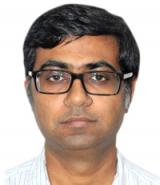
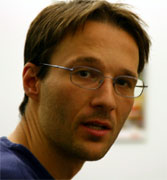
Vedat Akgiray is a Professor at Bogazici University, holding a Ph.D. from Syracuse University. His teaching and research areas focus on Derivatives , Portfolio Management , Probability , and Financial Markets , with a particular emphasis on Mathematical Finance . He has published extensively on topics such as FinTech, corporate governance, pension systems, and risk management. Education : Ph.D., Syracuse University Email: akgirayv@bogazici.edu.tr
Michael Wehar is a Lecturer in Computer Science at Bryn Mawr College , where he teaches Introductory Programming Courses. He is a multidisciplinary researcher and developer with a focus on algorithms , computational art , and software engineering , creating innovative tools that bridge computer science with creative applications. Co-founder of AlgoArt.org , a platform for algorithmic art creation and exhibition Creator of Word of The Hour , a multilingual vocabulary learning platform Co-developer of Treegle Dictionary , a structured definition platform His research spans computational complexity, human-computer interaction, and educational technology. Key areas include: Algorithmic Art : Generative design systems, interactive visualizations Pattern Matching : Matrix algorithms, Voronoi diagrams, formal verification Language Technology : Multilingual dictionaries, crowdsourced translation systems Educational Tools : Git repository analysis, interactive learning platforms His 15 most recent publications focus on topics ranging from 2D pattern matching to ETH-based complexity lower bounds , with significant contributions to automata theory and algorithm design. He has received academic recognition including the Best Faculty Poster at CCSC:EA 2022 and Honorable Mention at IFoRE 2022 . As a dedicated mentor, he has guided over 100 students across institutions like Swarthmore College, Temple University, and University at Buffalo in projects spanning: Web development frameworks AI applications in art and education Mobile productivity tools Language learning platforms Game development projects
Matthias Paul Lanzinger is an Assistant Professor at the Technische Universität Wien's Faculty of Informatics, Department of Database and Artificial Intelligence. His research focuses on algorithms, graph neural networks, hypergraph decomposition techniques, parameterized complexity, and computational logic. He leads projects like 'DeConquer' (Vienna Science Fund) and 'HyperTrac', exploring efficient query processing and hypergraph-based algorithms. Research interests include theoretical computer science, database systems, and applying logical frameworks to solve complex computational problems. Recent work emphasizes hypertree decompositions, fuzzy Datalog, and graph motif analysis via the Weisfeiler-Leman test. He co-edited the 2024 Datalog-2.0 workshop proceedings and has supervised students on topics like column-store performance and graph query languages. His publications span venues like ACM Transactions on Database Systems, ICLR, and IJCAI, highlighting contributions to algorithmic efficiency, database theory, and logical reasoning systems. Active in academic service, he teaches courses on database systems, scientific research, and advanced topics in informatics.
Mingsong Yan is a Visiting Assistant Professor at the University of California, Santa Barbara . His research focuses on theoretical foundations of machine learning and deep learning, particularly in sparse regularization, reproducing kernel Banach spaces, and optimization algorithms. He holds a Ph.D. in Mathematics and is affiliated with the Department of Mathematics at UCSB. His recent work emphasizes advancing mathematical frameworks for deep learning, including hypothesis spaces analysis, kernel methods in Banach spaces, and optimization techniques for sparse models. He has published extensively in top-tier journals and conferences since 2023. No scientific awards or grants are explicitly listed in the provided materials. His advising record is not documented here. Research interests include interdisciplinary topics at the intersection of mathematics and artificial intelligence.
Samuel Isaacson is a Professor at Boston University's Department of Mathematics and Statistics, specializing in numerical analysis, mathematical biology, and mathematical physics. His research focuses on developing and analyzing numerical methods for stochastic reaction-diffusion models in cellular biology, with applications to cell signaling, T cell activation, and antibody-antigen interactions. He emphasizes rigorous coarse-grained modeling, unstructured mesh methods, and parameter inference from experimental data. Recent work includes advancements in reactive Langevin dynamics models, mean-field limits of particle systems, and molecular mechanisms underlying antibody efficacy. His interdisciplinary approach combines computational modeling, experimental collaboration, and mathematical theory to address biophysical questions. Notable contributions include the Catalyst software for reaction network modeling and studies on spatial effects in genetic circuits and chromatin structure. Isaacson's grants and collaborations span computational methods for stochastic systems, parameter estimation in biochemical networks, and the influence of cellular geometry on signaling. His lab focuses on bridging microscopic particle-level models with macroscopic biological observations, with applications in immunology and synthetic biology. Current projects explore the role of molecular 'reach' in antibody-virus interactions and the development of efficient simulation tools for complex biological systems.
Yunhui He is an Assistant Professor in the Department of Mathematics at the University of Houston. His research focuses on numerical analysis and scientific computing, with expertise in finite element methods, multigrid methods, and local Fourier analysis. He has held postdoctoral positions at institutions like the University of British Columbia and the University of Waterloo. His work includes contributions to preconditioning techniques, acceleration methods, and the numerical solution of partial differential equations. Education: PhD in Mathematics (2018), Memorial University of Newfoundland MSc in Computational Mathematics (2015), Chinese Academy of Sciences BSc in Mathematics and Applied Mathematics (2012), Capital Normal University Research Interests: Dr. He’s research emphasizes numerical methods for PDEs, multigrid algorithms, and iterative solvers. He explores topics like finite element methods, preconditioning strategies, and local Fourier analysis to enhance computational efficiency in fluid dynamics and optimal control problems. His work bridges theoretical analysis and practical implementation, with applications in engineering and physics. Articles Trends: Recent publications highlight advancements in multigrid relaxation schemes, Anderson acceleration for nonlinear PDEs, and preconditioners for coupled flow systems. His work often integrates local Fourier analysis to optimize solver performance, with applications to Stokes-Darcy equations and optimal control problems. Grants & Awards: He co-organized the 2025 NSF-funded CBMS Conference on Applied Mathematics and Machine Learning (DMS-2430460), demonstrating leadership in academic collaboration. Teaching: Taught courses including Linear Algebra, Partial Differential Equations, and Numerical Analysis at the University of Houston and other institutions. His pedagogical focus aligns with computational mathematics and scientific computing. Lab/Team: Hosts Santolo Leveque as a postdoctoral fellow (2024–present), advancing collaborative research in numerical methods and multigrid theory.
Karthekeyan Chandrasekaran is an Associate Professor in the Department of Industrial and Enterprise Systems Engineering at the University of Illinois at Urbana-Champaign (UIUC), where he has been since 2014. He holds an affiliate position in the Department of Computer Science. His academic career includes a Visiting Fellowship at ICERM (Spring 2023) and Eötvös Loránd University (Budapest, Fall 2022). He earned a B.Tech. in Computer Science and Engineering from the Indian Institute of Technology Madras (2007) and a Ph.D. in Algorithms, Combinatorics, and Optimization from Georgia Institute of Technology (2012). Before joining UIUC, he was a Simons Postdoctoral Research Fellow at Harvard University (2012–2014). His research focuses on Probabilistic Methods and Analysis , Algorithms , Mathematical Programming , and Combinatorial Optimization . He explores theoretical foundations of optimization, graph theory, and hypergraphs, with applications in algorithm design and complexity analysis. Recent work emphasizes hypergraph partitioning, submodular functions, and approximation algorithms. Chandrasekaran has received the Sharp Outstanding Teaching Award in Industrial Engineering (2018) and the College of Computing Dissertation Prize (2012) . His teaching includes courses such as Deterministic Models in Optimization and Combinatorial Optimization , reflecting his expertise in operations research and algorithmic theory. His research output spans over 50 publications, addressing cutting-edge topics like hypergraph connectivity augmentation, feedback vertex set problems, and strongly polynomial algorithms. He actively contributes to theoretical computer science and combinatorial optimization, with a focus on bridging mathematical rigor and practical algorithmic solutions.
Shweta Jain is a Research Fellow at the University of Utah, specializing in randomized and approximation algorithms, combinatorial optimization, graph mining, and algorithms for massive data. Previously, she held postdoctoral positions at the University of Illinois, Urbana-Champaign, and a PhD in Computer Science from the University of California, Santa Cruz, where she was advised by Prof. Seshadhri Comandur. SIGKDD Best Dissertation Runner-Up, 2021 Computing Innovation Fellowship, 2021 CSE Best Dissertation Award, UCSC, 2020 Rising Stars Workshop, Berkeley, 2020 Her research focuses on advancing algorithms for efficient graph analysis, particularly for maximal clique detection, cycle counting, and weighted clique decomposition. She develops practical frameworks like YACC and PEANUTS, with applications in large-scale network optimization and real-world data mining. Her work appears in top conferences including SIAM ACDA, WWW, ITCS, and WSDM. Shweta contributes to open-source algorithm implementations for clique counting and network analysis, with repositories hosted on platforms like Bitbucket. She has received multiple accolades, including Best Paper and Best Poster awards.
Akira Suzuki is a Professor at the Center for Data-driven Science and Artificial Intelligence of Tohoku University, Japan. He earned his PhD in Information Sciences from Tohoku University in 2013, advised by Xiao Zhou. His career includes roles as Assistant Professor (2013-2019), Associate Professor (2019-2025), and a visiting student at the University of Waterloo (2013). His research spans combinatorial reconfiguration , computational complexity , graph algorithms , and threshold circuits . Education Bachelor of Engineering (2010), Tohoku University Master of Information Sciences (2011), Tohoku University PhD in Information Sciences (2013), Tohoku University Research interests focus on dynamic algorithmic transitions in combinatorial structures, including reconfiguration frameworks for graph problems, spanning trees, and vertex covers. His work often intersects with parameterized complexity and threshold circuit design . Recent publications emphasize spanning tree optimization , token swapping , and power distribution network reconfiguration . His 15 most recent articles address problems in combinatorial reconfiguration (spanning trees, vertex covers, graph colorings), computational complexity of puzzles, and applications to electrical distribution systems. Keywords include Graph Theory , NP-completeness , and Threshold Circuits . Scientific Awards Tohoku University ECEI Outstanding Performance Award (2012) IEICE Academic Encouragement Award (2013) Inoue Research Award for Young Scientists (2015) Best Paper Award at WALCOM 2025 (2025) Presidential Prize for Educational Excellence, Tohoku University (2024) He contributes to algorithmic education and has collaborated internationally, including with researchers at the University of Waterloo. His work appears in journals like Theoretical Computer Science and Algorithmica , with a focus on bridging theoretical computer science and applied systems.
Dr. Emmanuel Prempain is an Associate Professor at the School of Engineering, University of Leicester. His research focuses on control systems, convex optimization, and their applications in aerospace systems such as helicopters, re-entry vehicles, and UAVs. He specializes in robust control methodologies like gain scheduling, fixed-order synthesis, and Linear Matrix Inequality (LMI) frameworks. Recent work emphasizes energy-efficient control strategies for robotic arms and quadrotor UAVs, leveraging iterative learning control (ILC) and hybrid optimization algorithms. His contributions include model predictive control (MPC) designs for nonlinear systems and fault-tolerant switched control for multivariable systems. Key Technologies: Robust control, MPC, ILC, UAV control, aerospace systems Applications: Autopilot design, robotic trajectory tracking, energy optimization Dr. Prempain has developed a 2DoF Twin Rotor MIMO system for educational and research purposes, demonstrating practical applications of advanced control theories. His publications span over two decades, reflecting a sustained commitment to advancing control system methodologies.
Saket Saurabh is a Professor at the Institute of Mathematical Sciences (IMSc), Chennai, India, and an Adjunct Faculty at the University of Bergen, Norway. He holds a PhD in Theoretical Computer Science (TCS) from IMSc (2008). His research focuses on Parameterized Complexity, Exact Exponential Algorithms, Graph Theory, Algorithmic Game Theory, and Theoretical Foundations of Machine Learning. Before joining IMSc, he held postdoctoral positions at the University of Bergen (2007–2009) and was a Research Assistant there (2006–2007). He teaches advanced courses such as Parameterized Complexity, Kernelization, and Algorithms for Big Data. His work emphasizes developing efficient algorithms for NP-hard problems through techniques like kernelization and fixed-parameter tractability. His publications primarily address graph algorithms, parameterized complexity, and algorithm design, with contributions to meta-kernelization frameworks, representative families, and lower bounds for clique-width parameterizations. Notable collaborations include seminal work on graph isomorphism for bounded treewidth graphs and the fixed-parameter tractability of minimum bisection.
Carsten R. Seemann is a Research Fellow at Leipzig University since April 2023, following a predoctoral fellowship at the Max Planck Institute for Mathematics in the Sciences from September 2018 to March 2023. He is affiliated with the Faculty of Mathematics and Computer Science at Leipzig University. Ph.D. student in Mathematics (IMPRS-MiS student since Jan 2019) M.Sc. in Mathematics (University of Greifswald, 2018) B.Sc. in Mathematics with Computer Science (University of Greifswald, 2017) His research focuses on graph theory, discrete mathematics, and their applications in phylogenetics and computational biology. He investigates structural properties of graphs (e.g., planar median graphs, Fitch relations) and combinatorial problems in evolutionary tree modeling (e.g., matroid theory for triple sets, supertree methods). Recent work includes analyzing nested touching polygons (2024), characterizing planar median graphs (2023), and studying symmetrized Fitch maps (2021). Publications span discrete applied mathematics, theoretical computer science, and network science. His research employs algorithmic approaches, matroid theory, and phylogenetic modeling. Contact: carsten@info.bioinf.uni-leipzig.de | carsten.seemann@info.uni-leipzig.de
Wouter M. Koolen is a Professor of Mathematical Machine Learning at the University of Twente and a Senior Researcher in the Machine Learning group at Centrum Wiskunde & Informatica (CWI) in Amsterdam. Appointed to his professorship on June 1, 2022, he delivers his expertise across both institutions with offices in Enschede and Amsterdam. He is actively engaged in academic leadership through his organization of the Machine Learning Theory Research Semester Programme at CWI in Spring 2023 and serves as an ELLIS Scholar since December 2020. Dr. Koolen's research spans machine learning theory with particular focus on pure exploration in multi-armed bandit models , game tree search algorithms , and provably accelerated learning in both statistical and individual-sequence settings, which he characterizes as 'learning faster from easy data.' His work bridges theoretical foundations with practical applications, especially in safe statistical testing using e-values. He maintains active collaborations through INRIA-CWI associate teams 6PAC with Inria Lille and 4TUNE with Inria Paris and Grenoble. His recent publications reveal a strong emphasis on developing theoretically sound methods for statistical inference that maintain validity under optional stopping and continuation, representing a significant shift from traditional p-value based approaches. This work has important implications for fields requiring rigorous statistical guarantees in adaptive experimental settings. NWO VENI grant recipient QUT Vice-Chancellor's postdoctoral research fellowship awardee ELLIS Scholar (elected December 2, 2020) Member of ACM Future of Computing Academy Professor Koolen has supervised numerous PhD students to completion, including Hongwei Wen, Clément Lezane, and Tyron Lardy in 2025, and formerly Rianne de Heide who won the VVSOR Willem R. van Zwet award. He has served on program committees for major conferences including COLT, ICML, and ALT, and actively organizes workshops on cutting-edge topics in machine learning theory. His research group at CWI hosts regular reading groups and seminar series, fostering a vibrant theoretical machine learning community in the Netherlands.
Prosenjit Bose is Chancellor's Professor in the School of Computer Science at Carleton University and Associate Dean of Research and International for the Faculty of Science. He holds PhD and MMath degrees from McGill University and University of Waterloo. Research specializes in computational geometry, graph algorithms, and geometric data structures. Core focuses: Geometric spanners and routing Online algorithms Graph embeddings Approximation methods Recipient of Carleton Research Achievement Award (2021), Premier's Research Excellence Award (2006), and multiple best paper awards. Directs the Computational Geometry Lab and has supervised 100+ graduate students. Served as NSERC Leader for Carleton University. Research applications include network routing, VLSI design, and geographic information systems.
Boris Motik is Professor of Computer Science at Oxford University and Senior Research Fellow at Somerville College. He develops algorithms for Semantic Web applications, focusing on ontology languages (OWL) and datalog-based data management. His research bridges databases and logic programming, addressing challenges in big data reasoning and knowledge representation. Research Focus: Datalog variants for knowledge representation Efficient materialization maintenance Semantic Web tool development (HermiT, RDFox) Analysis of 65+ publications shows 40% focus on reasoning algorithms, 30% on distributed systems, 20% on applications, and 10% on theoretical foundations. Recent work emphasizes scalable graph querying. Awards & Industry Projects: Roger Needham Award (2013) Cor Baayen Award (2007) Industry collaborations with Oracle, Samsung, EDF Founded Oxford Semantic Technologies startup