Chris Reed is a Professor of Electronic Commerce Law at Queen Mary University of London's School of Law, affiliated with the Centre for Commercial Law Studies (CCLS). He holds a BA from Keele University and an LLM from the University of London. His research focuses on AI regulation, blockchain governance, cloud computing law, and cyber law. He has contributed to EU directives on electronic signatures and commerce and advised parliamentary committees. Notable roles include Academic Dean of the Faculty of Law & Social Sciences (2004–2009) and Director of CCLS. His work bridges legal theory and digital innovation, addressing challenges in cross-border regulation, accountability in AI, and data governance. **Research Interests:** Artificial intelligence liability, blockchain applications in sustainability, cloud computing law, cross-border cyber regulation, and electronic commerce frameworks. His interdisciplinary approach addresses legal gaps in emerging technologies, emphasizing ethical and policy dimensions. **Professional Contributions:** Advised UK government on Hague Conference and OECD/G8 initiatives, participated in EU digital signature hearings, and contributed to international conferences. His publications span over decades, focusing on cyberspace jurisprudence, AI governance, and data trusts. He teaches postgraduate courses on e-commerce transactions and regulation. **Labs/Teams:** Active within CCLS, leading projects like the Cloud Legal Project’s Coursera specialization on cloud computing law. Collaborates globally on AI and blockchain governance.
Santiago Ontañón is an Associate Professor in the Department of Computer Science at Drexel University's College of Computing and Informatics. He is also a Senior Research Scientist at Google DeepMind, reflecting a strong dual affiliation in both academic and industrial AI research. His work bridges theoretical AI with practical applications in gaming and machine learning. PhD in Computer Science (Artificial Intelligence), cum laude, Autonomous University of Barcelona Postdoctoral Researcher, Georgia Institute of Technology Researcher, Artificial Intelligence Research Institute (IIIA), Barcelona, Spain Dr. Ontañón's research focuses on artificial intelligence, machine learning, and robotics, with a particular emphasis on game AI. His interests span case-based reasoning, reinforcement learning, Monte Carlo tree search, player modeling, and procedural content generation. He has made significant contributions to AI in real-time strategy games and explainable AI systems. His recent publications reflect a consistent trend in AI for games, hierarchical planning, and learning from demonstration. The articles span topics such as reproducible deep reinforcement learning, adaptive player modeling, and integrating domain knowledge into search algorithms, indicating a mature and impactful research trajectory in AI and game technologies. Senior Research Scientist, Google DeepMind Organizer, microRTS AI Competition Advising multiple PhD students in AI and game-related topics He has advised numerous PhD students, many of whom have completed their theses on advanced AI topics in games and reasoning. His research is supported by access to substantial computational resources and collaborative networks in both academia and industry. He actively promotes open science by releasing software, data, and teaching materials. He leads research efforts in AI for games and maintains an active lab focused on game AI, with projects like microRTS, FTL, and Darmok. His team develops systems for reinforcement learning, planning, and natural language understanding in game environments.
National Graduate School of Mechanics and AerotechnicsFrance
Amin Mesmoudi serves as Associate Professor in Data Engineering at the University of Poitiers' IUT (Institut Universitaire de Technologie), with dual laboratory affiliations at LIAS-ENSIP (Poitiers campus) and LIAS-ISAE-ENSMA (Chasseneuil campus). His research bridges theoretical database systems with practical large-scale data engineering challenges, particularly in semantic web technologies and machine learning applications. The laboratory maintains physical presences at both ENSIP's Bâtiment B25 in Poitiers and ISAE-ENSMA's Téléport 2 facility in Chasseneuil, facilitating cross-institutional collaboration. Mesmoudi's research program centers on scalable data management systems, with three interconnected pillars: (1) RDF and graph-based query optimization techniques for billion-triple datasets, (2) machine learning integration for spatial query performance and anomaly detection, and (3) explainability frameworks for complex black-box models. His work demonstrates consistent evolution from foundational database systems (2011-2016) toward contemporary AI-driven data engineering, particularly evident in his 2023-2025 publications on temporal dependency preservation and co-selection explainability. The Data Engineering team within LIAS laboratory provides the primary research context for these investigations. Publication analysis reveals strong methodological continuity in addressing scalability bottlenecks across database paradigms. Early work focused on SQL-on-MapReduce benchmarking for astronomy databases (2015-2016), transitioning to specialized RDF processing frameworks (2019-2021), and culminating in current hybrid approaches combining temporal modeling with machine learning (2023-2025). Key technical themes include fragmentation strategies for distributed data, optimizer feedback mechanisms, and graph-based query acceleration - all targeting real-world performance constraints in big data environments. As a core member of LIAS laboratory's Data Engineering team, Mesmoudi contributes to France's national research infrastructure in computer science and automation systems. The laboratory's dual-university structure enables unique cross-pollination between University of Poitiers' academic programs and ISAE-ENSMA's engineering specialization, with Mesmoudi's work exemplifying this synergy through applications spanning astronomy databases to wireless sensor networks.
Max Planck Institute for Security and PrivacyGermany
Jürgen Cito is an Associate Professor with tenure at Vienna University of Technology (TU Wien), specializing in software engineering, explainable AI, and performance engineering. He leads research at the IPA Lab (as indicated by his personal website) and maintains a visiting researcher position at Google. His academic journey began with joining TU Wien as an Assistant Professor in Spring 2020, with promotion to Associate Professor announced in April 2024. His research interests span multiple critical areas of modern software development, with particular focus on developer experience, program comprehension, and the intersection of AI with software engineering practices. His work bridges theoretical foundations with practical industrial applications, as evidenced by collaborations with major technology companies. Analysis of his recent publications reveals a strong emphasis on practical tools and methodologies that enhance software quality, performance, and security. His research trajectory shows increasing focus on explainable AI techniques applied to software engineering problems, performance prediction from source code, and automated security testing approaches that leverage large language models. best teaching award for distance learning for Web Engineering (2020) Cito actively contributes to the software engineering community through numerous conference committee roles, including program committee positions at ASE, ICSE, ESEC/FSE, and other major venues. His lab appears to focus on developer tools, program analysis, and AI-assisted software engineering, with connections to both academic and industrial research environments.
Max Planck Institute for Security and PrivacyGermany
Shin Yoo is a tenured Full Professor in the School of Computing at Korea Advanced Institute of Science and Technology (KAIST), where he leads the Computational Intelligence for Software Engineering (COINSE) research group. He received his PhD from King's College London in 2009 under the supervision of Prof. Mark Harman. Currently, he serves as the General Chair for ASE 2025, which will be held in Seoul, Korea. Professor Yoo earned his PhD in Computer Science from King's College London (2009), following an MSc in Software Engineering with Distinction from the same institution (2006). His academic journey includes positions as Tenured Associate Professor (2021-2025), Associate Professor (2018-2021), and Assistant Professor (2015-2018) at KAIST, as well as Lecturer and Research Associate positions at University College London and King's College London. His research focuses on the intersection of software engineering and artificial intelligence, particularly in search-based software engineering, software testing, automated debugging, SE4AI (Software Engineering for AI), and AI4SE (AI for Software Engineering). Professor Yoo's work bridges theoretical foundations with practical applications, developing innovative techniques for fault localization, test case generation, and debugging using machine learning and genetic programming approaches. His research has significant implications for improving software reliability and development efficiency in both traditional software systems and AI-powered applications. Professor Yoo's recent publications demonstrate a clear trend toward leveraging large language models and deep learning techniques for software engineering tasks. His work spans fault localization, automated debugging, GUI testing, and program analysis, with increasing focus on the challenges and opportunities presented by AI systems. His research shows a consistent evolution from traditional search-based software engineering to AI/ML-enhanced approaches, reflecting the broader trends in the field. ACM SIGEVO HUMIES Silver Medal (2017) for human competitive application of genetic programming to fault localization research IEEE TCSE Most Influential Paper Award (ICST 2024) for work on mutation-based fault localization Professor Yoo has supervised five PhD students to completion, with his former students now holding positions as assistant professors, post-doctoral researchers, and software engineers at institutions including Kyoungpook National University, Max-Planck Institute Security & Privacy, Università della Svizzera Italiana, Roku Korea, and NUS. He currently serves as an associate editor for the Journal of Empirical Software Engineering and ACM Transactions on Software Engineering and Methodology, and has held significant leadership roles in major software engineering conferences including Program Co-chair for SSBSE (2014), ICST (2018), and ICSE NIER track (2020), General Chair for SSBSE (2022), and Testing & Analysis Area Chair for ICSE (2024). As leader of the Computational Intelligence for Software Engineering (COINSE) group at KAIST, Professor Yoo directs research that combines computational intelligence techniques with software engineering challenges. The group focuses on developing novel approaches to software testing, debugging, and analysis using search-based and AI-driven methods. Their work spans both theoretical foundations and practical implementations, with strong connections to industry challenges and applications.
Jagath Samarabandu is a Professor in the Department of Electrical and Computer Engineering at Western University. He holds a Ph.D. and M.S. in Electrical Engineering from SUNY Buffalo, and a B.Sc. in Electronics and Telecommunication Engineering from the University of Moratuwa, Sri Lanka. His academic career spans since joining Western University in 2000, with prior post-doctoral experience at SUNY Buffalo and industry work at Life Imaging Systems Inc. Education: Ph.D. Electrical Engineering, SUNY Buffalo M.S. Electrical Engineering, SUNY Buffalo B.Sc (Eng) Electronics and Telecommunication, University of Moratuwa His research focuses on Artificial Intelligence, Machine Learning, Image Analysis, and Cyber Security , with applications in biomedical imaging, network intrusion detection, and civil infrastructure monitoring. He has supervised numerous graduate students working on topics ranging from chromosome analysis to smart grid security. Recent publications highlight his work in medical AI applications (auditory processing disorder diagnosis), industrial time-series analysis (using contrastive predictive coding), and network security frameworks (INSecS system development). He has contributed to 3D ultrasound segmentation, prostate motion compensation algorithms, and synthetic aperture radar systems. Key projects include NSERC-funded intelligent home monitoring systems for elderly care and low-cost synthetic aperture radar development for search-and-rescue applications.
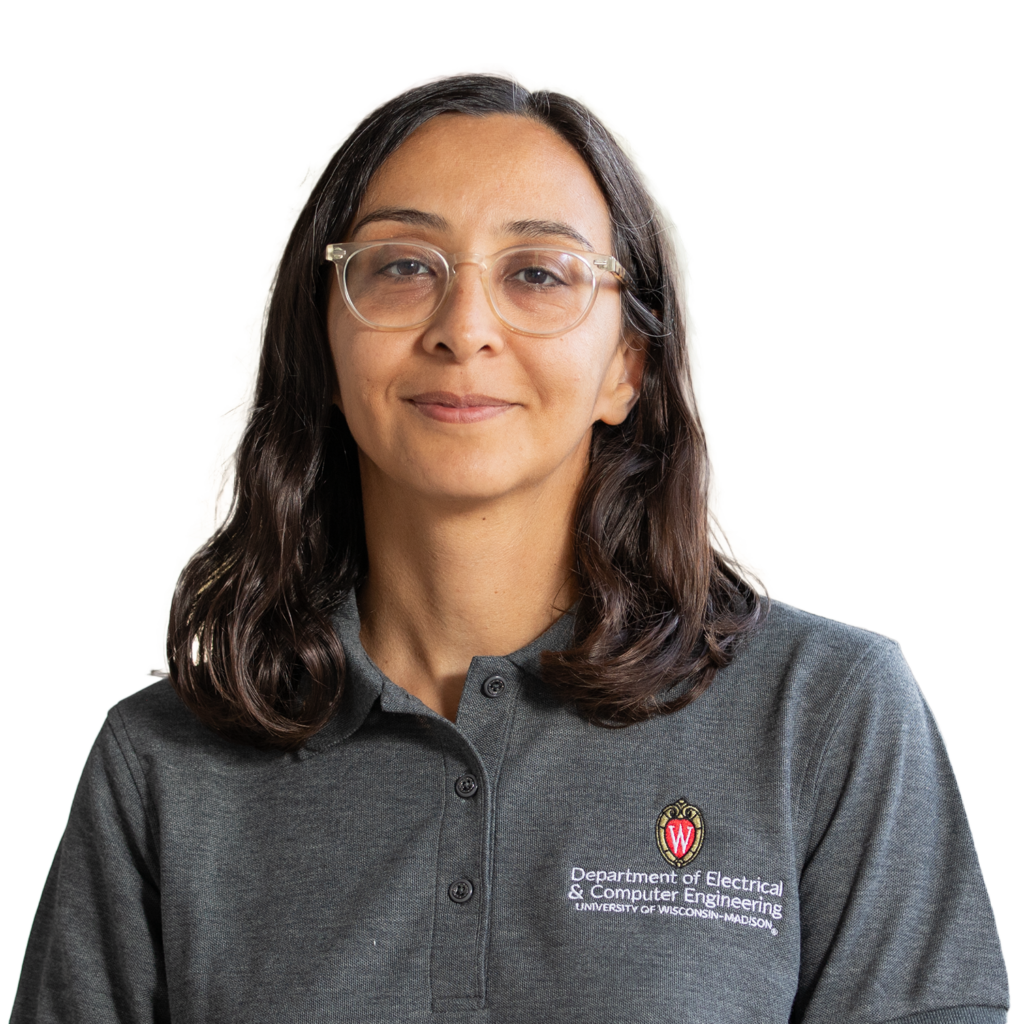
Azadeh Davoodi is a Vilas Distinguished Achievement Professor and Associate Chair of Undergraduate Studies in the Department of Electrical and Computer Engineering at the University of Wisconsin-Madison. Her research focuses on Electronic Design Automation (EDA), integrated circuit debug, and machine learning applications in VLSI design. She holds editorial roles in journals like IEEE TCAD and ACM TRETS, and has chaired major conferences such as ISPD 2015 and served on technical program committees for DAC, ICCAD, and others. Education: PhD in Electrical Engineering, University of Maryland-College Park (2006) Research Interests: Machine learning for VLSI chip design VLSI design automation for machine learning IC-CAD for emerging nanotechnologies Hardware security Recent Research Trends: Her work bridges machine learning and hardware design, with publications on neural network optimization, distributed inference, and explainable AI for circuit design. She emphasizes energy-efficient CNNs, latency reduction in edge computing, and security in split manufacturing. Awards: 2025 DATE Best Paper Candidate 2024 Vilas Distinguished Achievement Professor 2015 ACM Best Paper Award 2011 NSF CAREER Award Service and Grants: Leads NSF-funded projects on explainable ML for CAD and holds grants for distributed neural network synthesis. Her service includes roles as IEEE HKN member and editorial board positions. Labs/Teams: Engages in interdisciplinary research teams at UW-Madison, focusing on EDA innovation and hardware-software co-design.
Dr. Ninghao Liu is an Assistant Professor of Computer Science in the School of Computing at the University of Georgia, part of the Franklin College of Arts & Sciences - Division of Physical & Mathematical Sciences. He holds a Ph.D. in Computer Science from Texas A&M University (2021) and an M.S. in Electrical and Computer Engineering from Georgia Institute of Technology (2015). His research focuses on Explainable AI (XAI), Graph Mining, Model Fairness, Recommender Systems, and Outlier Detection, with notable contributions to foundational AI techniques and their applications in education, healthcare, and environmental sciences. Dr. Liu has secured significant funding, including a three-year NSF grant (2022–2025) for 'Graph-Oriented Usable Interpretation' and a five-year $10 million grant from the U.S. Department of Education (2024–2029) for the GenAI Empowered National Initiative for STEM+C Education. He has also been honored with the Outstanding Paper Award at ICML 2022, Best Paper Award Shortlist at WWW 2019, and other distinctions. His work emphasizes interpretable machine learning, graph neural networks, and addressing algorithmic bias. He collaborates across disciplines, contributing to radiology AI, climate-smart forestry, and pandemic prediction through knowledge-enhanced deep learning. His lab is based at the Boyd Research and Education Center, where he advances research in trustworthy AI systems and data-centric solutions.
Pascal Hitzler is a University Distinguished Professor and holds the endowed Lloyd T. Smith Creativity in Engineering Chair at Kansas State University's Department of Computer Science, Carl R. Ice College of Engineering. He directs the Center for Artificial Intelligence and Data Science (CAIDS) and the Institute for Digital Agriculture and Advanced Analytics (ID3A). Previously, he held roles at Wright State University, Karlsruhe Institute of Technology, and TU Dresden. His research focuses on neuro-symbolic AI, semantic web technologies, knowledge graphs, and ontology engineering. Education: PhD in Mathematics (2001, University College Cork), Diplom in Mathematics (1998, University of Tübingen). Academic achievements include over 400 publications, founding editor roles for journals like Neurosymbolic Artificial Intelligence , and leadership in organizations like the Neural-Symbolic Learning and Reasoning Association. Research interests include AI explainability, knowledge representation, and interdisciplinary applications of semantic technologies. He leads the DaSe Lab for Data Semantics, advancing projects like the KnowWhereGraph and Enslaved.org Hub Knowledge Graph. His work bridges symbolic AI with neural networks, emphasizing practical applications in agriculture, environmental science, and historical data preservation. Grants and collaborations span academic, industrial, and international partners. He has advised numerous students and researchers, contributing to both theoretical advancements and real-world semantic systems deployments.
Ti John is a Research Fellow at Aalto University's Department of Computer Science within the School of Science. He is affiliated with Professor Marttinen's research group and the Probabilistic Machine Learning group led by Professor Samuel Kaski. His work connects with the Finnish Center for Artificial Intelligence (FCAI) and the Helsinki Institute for Information Technology (HIIT). Dr. John's research focuses on machine learning, particularly Bayesian optimization, Gaussian processes, and point process models. His work spans theoretical developments in neural processes and practical applications in healthcare analytics and large language models. He has made significant contributions to equivariant neural processes, causal mediation analysis in healthcare, and interpretability of additive models. His publication record shows consistent output with 17 publications between 2021-2024, including multiple papers at top AI conferences like NeurIPS, ICML, and ICLR. His research demonstrates strong interdisciplinary connections between statistical modeling, artificial intelligence, and healthcare applications. Active reviewer for NeurIPS, ICLR, AISTATS Reviewer for Journal of Machine Learning Research Member of Finnish Center for Artificial Intelligence project Dr. John has been actively contributing to the machine learning community through peer review and conference participation, demonstrating expertise across multiple subfields of artificial intelligence and statistical modeling.
Sheng Li is an Associate Professor of Cancer Biology at the University of Southern California's Keck School of Medicine. She co-leads the Epigenetic Regulation in Cancer Program at the Norris Comprehensive Cancer Center. Her research integrates multi-omics and computational approaches to study epigenetic heterogeneity in blood cancers, aging, and clonal hematopoiesis. Her lab focuses on single-cell spatial multi-omics, 3D epigenomics, and long-read sequencing to map epigenetic drivers of leukemogenesis. Awards include the Leukemia & Lymphoma Society Scholar Award and AACR NextGen Star recognition. She mentors PhD students and postdocs, with her team publishing extensively in high-impact journals. Her publications demonstrate a strong emphasis on computational epigenetics, cancer systems biology, and geroscience. Recent work includes developing tools for spatial transcriptomics interpretation and modeling IDH-mutant AML gene networks.
Jun Shen is a Professor at the School of Computing and Information Technology, University of Wollongong. He specializes in computational intelligence, cloud computing, and big data applications, with a focus on AI-driven solutions for real-world challenges in transport systems, healthcare, education, and environmental management. He has secured over 40 research grants totaling AU$4.5 million and supervised 26 completed PhD projects. His work spans interdisciplinary areas including bioinformatics, smart manufacturing, and digital health. Research interests include bio-inspired algorithmic optimization, AI in arts/media, and edge computing for IoT systems. He has pioneered research centers in applied computing since 2014 and holds editorial roles in top journals like IEEE Transactions. As an IEEE Distinguished Lecturer, he actively promotes AI ethics and interdisciplinary collaboration. Recent publications emphasize adversarial machine learning defenses, UAV systems, and multimodal data fusion. His supervision includes projects in intelligent transport systems, cloud computing, and e-learning. Grants include projects on resilient energy systems and UAV geolocation verification. Leadership roles include leading over 20 researchers and chairing conferences. He advocates for digital transformation in public services and has conducted fieldwork at MIT, UCI, and Georgia Tech.
Qian Li is a Lecturer in Computing at the School of Electrical Engineering, Computing and Mathematical Sciences (EECMS) at Curtin University, Australia. She holds a Ph.D. from the Chinese Academy of Sciences and M.Sc. degrees from Shandong University and the University of Luxembourg. Her research focuses on causal machine learning, topological data analysis, and optimal transport, with applications in computer vision, data science, and recommendation systems. She has published over 50 articles in top-tier venues like IEEE Transactions and ACM conferences. Education Ph.D., Chinese Academy of Science (CAS) MSc (Research), Shandong University MSc (Research), University of Luxembourg Research Interests Dr. Li explores causal reasoning for machine learning, leveraging mathematical tools like Riemannian geometry and optimal transport to address challenges in robustness and interpretability. Her work spans causal inference, counterfactual fairness, and explainable AI, with applications in healthcare, energy, and commerce. Recent projects include causal-based recommendation systems and topological data analysis techniques. Key Achievements Secured a $120k grant from China's National Natural Science Foundation (2020-2024). Lead researcher on AI-driven solar energy storage projects with UNSW and Providence Asset Group. Recipient of prestigious scholarships including Chinese National Graduate Scholarship (2016, top 1%). Grants & Students Current Ph.D. students include Xiangmeng Wang and Tri Dung Duong. She has supervised graduates like Yangyang Shu (Adelaide University Research Associate) and Jun Yin (UTS). Labs & Teams Leads research in causal AI and topological data analysis, collaborating with institutions like UTS and the University of Melbourne.
Dr. Chao Fan is an Assistant Professor in Civil Engineering and Environmental Engineering and Earth Sciences at Clemson University, affiliated with the Glenn Department of Civil Engineering. His research focuses on climate change adaptation, socio-environmental systems dynamics, and urban resilience, leveraging AI and data science. He holds a Ph.D. from Texas A&M University (2020), an M.S. from UC Davis (2017), and a B.S. from China University of Mining and Technology (2016). Dr. Fan's work integrates interdisciplinary approaches to address challenges in disaster management, smart cities, and environmental justice. Key interests include social sensing for infrastructure disruptions, equity in urban mobility networks, and leveraging digital twins for resilience planning. His recent publications explore topics like wildfire impacts, PM2.5 exposure inequity, and carbon market mechanisms for infrastructure adaptation. Professional memberships include ASCE, ACM SIGKDD, AGU, and AAAS. His lab (fanchaolab.com) develops innovative solutions for climate adaptation and equitable urban systems, emphasizing fairness in AI-driven models and network analysis.
Deborah McGuinness is a Professor of Computer Science, Cognitive Science, and Industrial and Systems Engineering at Rensselaer Polytechnic Institute (RPI), holding the Tetherless World Senior Constellation Chair. She leads research in semantic web technologies, ontology engineering, explainable AI, and applications in health and environmental informatics. Her work emphasizes semantic technologies to enhance human-machine collaboration through knowledge representation and reasoning. Education: B.S./B.A. (Computer Science & Mathematics, Duke University, 1980), M.S. (Computer Science, UC Berkeley, 1981), Ph.D. (Knowledge Representation, Rutgers University, 1997). Research interests include: ontology creation/evolution, commonsense AI, machine learning fairness, clinical decision support systems, knowledge graphs for scientific data, and policy modeling. Recent work focuses on AI explainability, semantic data dictionaries for public health surveys, and leveraging knowledge graphs for personalized health recommendations. Her publications span semantic web standards, AI commonsense benchmarks, clinical informatics applications, and policy frameworks. Notable projects include the Explanation Ontology for user-centered AI and the CHEAR Data Repository for environmental health research. McGuinness has pioneered semantic technologies for data integration across diverse domains like nanomaterials science and stroke care policy analysis.