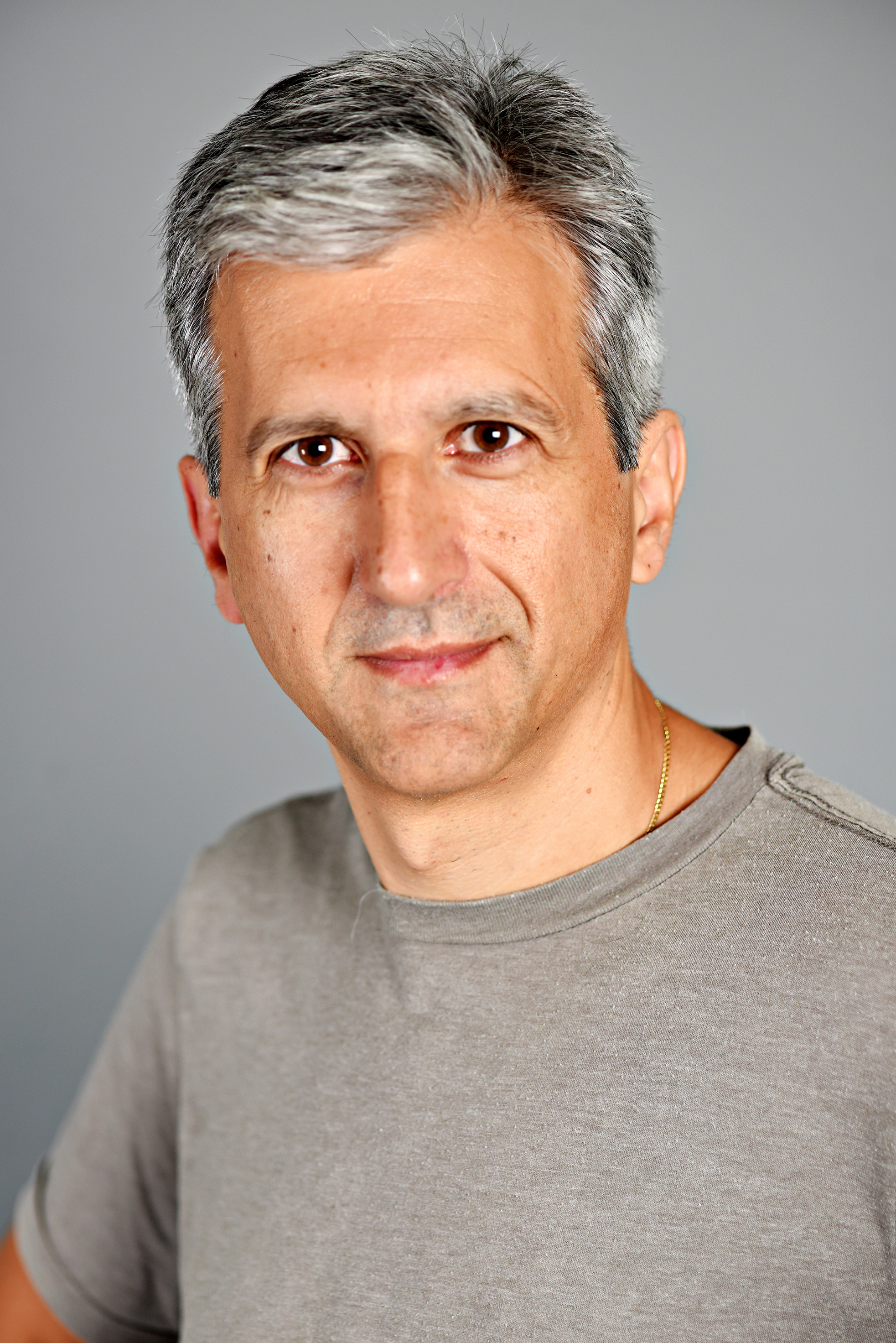
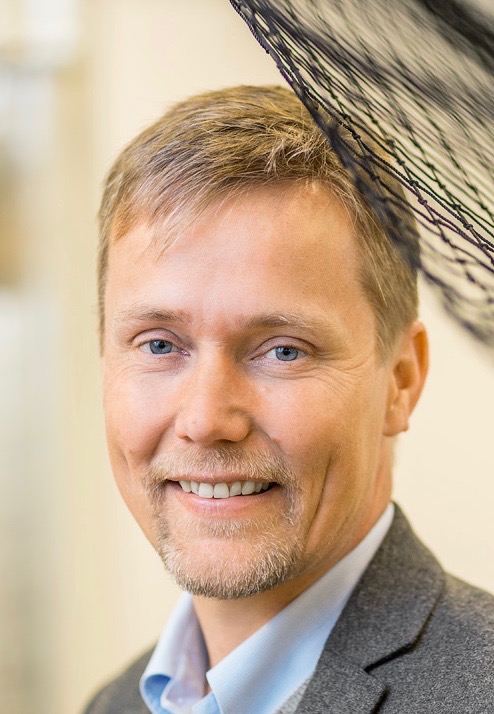
Kyros Kutulakos is a Professor in the Department of Computer Science at the University of Toronto, where he leads research in computational imaging and 3D sensing. His affiliations include the Toronto Computational Imaging Group, Computer Vision Group, Dynamic Graphics Project (DGP), and Vector Institute Group. He teaches graduate and undergraduate courses such as CSC320 (Introduction to Visual Computing) and CSC2530 (Computational Imaging & 3D Sensing). His research interests span computational imaging, non-line-of-sight imaging, single-photon detectors, 3D sensing, and neural rendering. Notable contributions include advancements in structured-light imaging, time-of-flight systems, and super-oscillatory microscopy. He has advised numerous PhD and MSc students, fostering cutting-edge research in imaging technologies. Kutulakos has received prestigious awards, including the Dean’s Research Excellence Award (2023) and multiple best paper prizes (e.g., Marr Prize at ICCV 2023). He has served as program chair for ICCV 2013, ICCP 2010, and CVPR 2003, contributing to academic leadership in computer vision. His work bridges optics, photonics, and computation, with applications in autonomous systems, medical imaging, and astronomy. Current research focuses on extreme imaging scenarios, such as imaging in pitch-black environments and around corners, leveraging novel sensor designs and computational techniques.
Giacomo Indiveri is a dual Professor at the Faculty of Science of the University of Zurich and the Department of Information Technology and Electrical Engineering of ETH Zurich . He serves as the Director of the Institute of Neuroinformatics at both institutions. Indiveri holds an M.Sc. in Electrical Engineering (1992) from the University of Genoa and a Ph.D. in Computer Science (2004) from the same university. Primary Affiliation: University of Zurich (Faculty of Science, Institute of Neuroinformatics) Secondary Affiliation: ETH Zurich (Department of Information Technology and Electrical Engineering) Indiveri's research bridges neuroscience , computer science , and machine learning to develop neuromorphic cognitive systems . His work focuses on spike-based learning , recurrent neural networks , and analog/digital circuit design for real-time sensory-motor systems . He integrates emerging memory technologies into fault-tolerant event-based architectures, enabling brain-inspired computing paradigms in applications like robotics and medical monitoring. His recent publications emphasize neuromorphic hardware for epileptic seizure detection , spiking neural networks in robotic painting , and scalable processors with on-chip learning . These works explore biologically plausible neurons , delay lines , and memory arrays for temporal processing, with applications in healthcare , edge computing , and adaptive control . Scientific Awards & Recognitions: 2021 IEEE Biomedical Circuits and Systems Best Paper Award Senior Member of IEEE Society ERC Fellow with three European Research Council grants Indiveri's group at the Institute of Neuroinformatics develops event-based systems for real-world validation of brain-inspired computing. His work includes multi-core processors , feedback optimizers , and dynamic routing architectures , supported by grants for advancing neuromorphic technologies .
Charles Rahal is an Associate Professor in Data Science and Informatics at the University of Oxford, with additional affiliations as an Associate Member of Nuffield College and Researcher at the Gradel Institute, New College. He serves as a Co-Investigator at the ESRC Centre for Care and sits on the Steering Group of Reproducible Research Oxford. His academic career includes previous roles as a Senior Departmental Research Lecturer at the Leverhulme Centre for Demographic Science and a British Academy Postdoctoral Fellow. Dr. Rahal completed his PhD in 2016 and has established himself as a prominent social science methodologist and applied social data scientist with expertise in high-dimensional econometrics. His research spans multiple domains, focusing particularly on unique Big Data origination processes and their relationship to social inequality, mobility, and stratification. He is deeply engaged in machine learning methods, civic technology, spatial and time series econometrics, model uncertainty, and scientometrics. His recent publications reveal a strong trend toward computational social science, with significant contributions to understanding prediction limits, pandemic impacts, healthcare systems, and environmental sustainability. The articles demonstrate his interdisciplinary approach, bridging traditional social science with cutting-edge computational methods, particularly in the analysis of large-scale datasets and development of novel metrics like the InterModel Vigorish for model comparison. Dr. Rahal is actively involved in teaching and mentoring, co-convening courses in Demographic Analysis, Life Course Research, and the Oxford Partner site of the Summer Institute in Computational Social Sciences. He has developed workshops on machine learning, command line interfaces, and LaTeX, reflecting his commitment to methodological training in social science. He leads the Metrics and Models lab and maintains several open-source projects including the GWAS Diversity Monitor and RobustiPy. His editorial roles include Associate Editor-in-Chief at the Journal of Social Computing and Associate Editor at ACM Transactions on Social Computing, highlighting his influence in shaping computational social science methodology.
Philippe Mueller is a Professor of Finance at Warwick Business School (University of Warwick) and a leading researcher in macro-finance, international finance, and asset pricing. He previously held positions at the London School of Economics (2008–2017) and earned his PhD from Columbia University. His research focuses on factors driving asset prices, foreign exchange markets, corporate credit, and central bank policies. Mueller has published in top journals such as the Journal of Finance and Journal of Financial Economics , and his work on corporate bond pricing won the Fama-DFA Prize (2023). Education: PhD in Finance and Economics, Columbia University, 2008 MBF, Master of Science in Banking and Finance, Université de Lausanne, 2002 lic. rer. pol., Universität Bern, 1999 Research Interests: His primary research areas include asset pricing, financial econometrics, and international finance with a focus on fixed income markets, corporate credit provision, and monetary policy impacts. Recent work examines intraday foreign exchange patterns, central bank swap lines, and volatility dynamics in fixed income and currency markets. Teaching & Grants: Mueller teaches advanced courses in asset pricing and fixed income at Warwick. He has secured grants from the BA/Leverhulme Trust, BIS Research Fellowship, and INQUIRE Europe. His work is supported by collaborations with institutions like the Swiss National Bank and ECB. Awards & Recognition: Fama-DFA Prize for best asset pricing paper (2023) BIS Research Fellowship (2025–2027) Walter Wasserfallen Prize (2000) Professional Activities: He serves on programme committees for major finance conferences (EFA, WFA) and referees for top journals including Journal of Political Economy and Econometrica .
Dimitra Psychogiou is a Full Professor of Microwave Engineering at University College Cork and Principal Investigator at Tyndall National Institute's CONNECT Centre in Cork, Ireland. She leads the Advanced RF Technology Group, driving innovation in reconfigurable RF systems for next-generation wireless networks. Her academic credentials include: Dipl.-Eng. in Electrical and Computer Engineering, University of Patras (2008) Ph.D. in Electrical Engineering, ETH Zurich (2013) Prof. Psychogiou's research pioneers reconfigurable microwave filters , non-reciprocal RF components , and additive manufacturing for antenna systems . Her work bridges theoretical microwave engineering with practical implementations in 5G/6G front-ends, emphasizing sustainability through hyperflexible filtering architectures that reduce hardware complexity and energy consumption. Key innovations include acoustic-wave resonator filters and 3D-printed RF components enabling unprecedented miniaturization. Analysis of her 2022-2025 publications reveals a strategic shift toward multifunctional RF integration , where filtering coexists with isolation, amplification, and switching in single modules. This trend addresses critical industry needs for compact, software-defined radio front-ends in satellite communications and IoT networks, with increasing emphasis on reflectionless topologies and spatiotemporal modulation techniques. Her scientific recognition includes: 2023 MTT-S Outstanding Young Engineer Award 2021 Roberto Sorrentino Prize 2021 SFI Research Professorship 2020 NSF CAREER Award 2020 URSI Young Scientist Award UC Boulder Junior Faculty Research Award Prof. Psychogiou actively shapes her field through leadership roles as Chair of IEEE MTT-13 Committee and Secretary of USNC-URSI Commission D, while serving as Associate Editor for IEEE MWCL and IJMWT. Her group collaborates extensively with semiconductor foundries and wireless infrastructure companies to transition lab innovations to commercial applications. The Advanced RF Technology Group operates state-of-the-art facilities for GaAs MMIC prototyping, 3D-printed RF component fabrication, and full-wave electromagnetic characterization, supporting Ireland's strategic position in European telecommunications research.
Kevin C. Zhou is an Assistant Professor in the Department of Biomedical Engineering at the University of Michigan. His research focuses on developing high-performance computational optical imaging systems with unprecedented spatiotemporal throughput, integrating advanced optical instrumentation with machine learning-driven algorithms to analyze big data in biology and medicine. His lab specializes in creating imaging systems capable of capturing high-resolution, high-speed, and high-dimensional datasets. Dr. Zhou holds a Ph.D. in Biomedical Engineering from Duke University (NSF GRFP Fellow) and a B.S. in Biomedical Engineering from Yale University (Barry Goldwater Scholar). Prior to joining U-M, he was a Schmidt Science Fellow and postdoctoral researcher at UC Berkeley. Key research areas include: High-throughput microscopy (gigapixel-scale systems) 3D tomographic imaging Light field and Fourier-based imaging modalities Machine learning for image reconstruction and analysis Biomedical applications in cellular/molecular imaging His recent work has advanced technologies like multi-camera array microscopes (MCAM/MCAS) and Fourier light field mesoscopes, achieving video-rate 3D imaging of freely moving organisms. These innovations enable applications in digital cytopathology, behavioral tracking, and high-content biological studies. Notable awards include the NSF Graduate Research Fellowship and Barry Goldwater Scholarship. His research has been featured in top journals and conferences with a focus on advancing optical imaging hardware and computational pipelines.
Tim Huh is a Professor and Chair of the Operations and Logistics Division at the University of British Columbia's Faculty of Commerce and Business Administration. He specializes in inventory control, supply chain management, and operations research, with a focus on dynamic decision-making under uncertainty. B.A., B.Math, M.Math from University of Waterloo M.A. from Regent College M.S., Ph.D. from Cornell University His research spans theoretical and applied topics including renewable energy systems, healthcare operations, and digital learning analytics. Recent work explores wind power storage optimization, asynchronous video usage in education, and multi-echelon inventory solutions. Scientific recognition includes the Canada Research Chair in Operations Excellence and Business Analytics He teaches core business analytics and operations management courses at both undergraduate and graduate levels, emphasizing quantitative decision-making and process fundamentals.
Dr. Yuzhang Lin is an Assistant Professor in the Department of Electrical and Computer Engineering at NYU Tandon School of Engineering. Previously, he held an Assistant Professor position at the University of Massachusetts Lowell (2018–2023). He earned his Ph.D. from Northeastern University and B.Eng./M.S. from Tsinghua University. His research focuses on smart grids, renewable energy systems, cyber-physical resilience, and machine learning applications. He leads editorial roles for IEEE Transactions on Power Systems and chairs IEEE PES Task Forces on standard test cases and distribution system operations. Dr. Lin’s research has been funded by NSF, DOE, ONR, and others. He is a recipient of the NSF CAREER Award and Northeastern’s Graduate Student Outstanding Research Award. His work emphasizes data-driven solutions for grid resilience, including state estimation, cyber-physical defense, and distributed energy integration. The Lin Group actively seeks PhD candidates interested in advancing smart grid technologies. Education: Ph.D. (Northeastern University), B.Eng./M.S. (Tsinghua University) Grants: NSF, DOE OE/EECE/CESER, ONR, NYSERDA, MassCEC Service Roles: IEEE PES Task Force Co-chair (Standard Test Cases), Secretary (Distribution System Operations Subcommittee) Publications span top journals/conferences, focusing on state estimation, inverter-based resource control, and machine learning for grid systems. His lab develops cutting-edge tools for power system resilience and renewable energy integration.
Anamitra Pal is an Associate Professor at Arizona State University's School of Electrical, Computer and Energy Engineering. His work focuses on power system resilience, renewable energy integration, and time-synchronized measurement analytics. He leads research initiatives combining artificial intelligence with grid modernization challenges. Ph.D. Electrical Engineering, Virginia Tech (2014) M.S. Electrical Engineering, Virginia Tech (2012) B.E. Electrical and Electronics Engineering, Birla Institute of Technology (2008) Prior to ASU, Pal conducted postdoctoral research at Virginia Tech's Network Dynamics and Simulation Science Laboratory (2014-2016). His research interests center on enhancing grid stability through: Advanced synchrophasor data analytics AI-driven power system security frameworks Renewable generation integration strategies Critical infrastructure protection during extreme events Recent publications demonstrate his focus on grid resilience during wildfires, deep learning-based state estimation, and innovative PMU applications. Pal has received multiple accolades including the NSF CAREER Award (2022) and IEEE Phoenix Section's Outstanding Young Professional Award (2019).
Lars Nordström is a Professor at the Division of Electric Power and Energy Systems within KTH Royal Institute of Technology, Stockholm, Sweden. His work bridges control systems , communication networks , and power systems , with a focus on future architectures, functionality, and quality aspects of ICT for power grid operations. He has led initiatives such as the Swedish Centre of Electric Power Engineering and served as Thematic Leader for Smartgrids in KIC InnoEnergy. In 2014, he was a Visiting Professor at Washington State University. Education : Ph.D., MSc.EE Nordström's research explores the intersection of smart grids , machine learning , and cybersecurity for power systems. Key areas include: Wide-Area Monitoring and Control (WAMC) systems Decentralized control strategies for DC microgrids Impedance modeling using neural networks Data-driven methods for islanding detection ICT reliability and protocol design for grid operations His recent publications emphasize machine learning applications in power systems, including LSTM networks for EV charging management, graph attention networks for stability monitoring, and digital twin approaches for cyber-attack mitigation. These works span disciplines such as Smart Grids, Power Electronics, and Data Science. Scientific Recognitions : Senior Member, IEEE Senior Member, CIRED Senior Member, Cigre Past Chairman, Swedish IEC TC57 Mirror Committee Nordström actively teaches and examines graduate courses like Communication and Control in Electric Power Systems and Computer Applications and Machine Learning in Electric Power Systems . His work influences industry practices through collaborations on digital substations, energy market analysis, and resilience strategies.
Karl Henrik Johansson is a Professor at the School of Electrical Engineering and Computer Science, KTH Royal Institute of Technology in Stockholm, Sweden, where he also serves as the Founding Director of Digital Futures. He is a Fellow of both IEEE and the Royal Swedish Academy of Engineering Sciences, and has held leadership positions including Immediate Past President of the European Control Association and IEEE Control Systems Society Vice President Diversity, Outreach & Development. Dr. Johansson earned his MSc in Electrical Engineering and PhD in Automatic Control from Lund University. His academic journey includes visiting positions at prestigious institutions such as UC Berkeley, Caltech, and NTU. His research focuses on networked control systems and cyber-physical systems with applications in transportation, energy, and automation networks. His work investigates fundamental challenges in connecting physical world systems through communication networks, exploring how wireless communication and sensor technology can enhance system robustness, reliability, energy efficiency, and safety. Current research directions include security of cyber-physical systems, distributed optimization, multi-agent systems, and applications to intelligent transportation and energy networks. Analysis of his recent publications reveals a strong focus on distributed optimization algorithms, secure networked control, multi-agent systems, and applications to transportation and energy networks. His work increasingly integrates machine learning techniques with traditional control theory, addressing challenges in privacy-preserving distributed computation, resilient state estimation, and resource allocation in complex networked systems. IEEE Control Systems Society Hendrik W. Bode Lecture Prize (2024) Swedish Research Council Distinguished Professor (2018-2027) Wallenberg Scholar (2009-2026) IFAC Young Author Prize IEEE CSS Distinguished Lecturer (2017-2019) IFAC Outstanding Service Award IEEE Fellow Dr. Johansson has supervised over 100 postdocs and PhD students, with many now holding prominent positions at institutions worldwide. His research has been supported by significant grants including the Swedish Research Council Distinguished Professor Grant (2018-2027), multiple Wallenberg Foundation grants, and numerous EU and national research projects. He has directed major research centers including ACCESS Linnaeus Centre (2009-2016) and Strategic Research Area ICT TNG (2013-2020). His research group operates within the Digital Futures initiative and maintains strong connections with industry partners through projects like the Integrated Transport Research Lab (supported by Scania and Ericsson) and Smart Mobility Lab. The group actively collaborates with international institutions and participates in major EU-funded projects addressing challenges in cyber-physical systems, transportation, and energy networks.
Naz Koont is an Assistant Professor of Finance at the Stanford Graduate School of Business . Her research explores how technology and nonbank intermediaries reshape banking landscapes, focusing on financial stability, competition, and consumer welfare. PhD in Finance (Columbia Business School, 2024) MPhil in Finance (Columbia Business School, 2021) Honors BSc in Mathematics and Economics (University of Toronto, 2018) Her research interests include: Financial Intermediation : Analyzing digital banking’s impact on bank roles. Credit Markets : Studying credit lines and leverage constraints. Industrial Organization : Modeling competition dynamics in banking. Technology : Assessing digitalization’s effects on financial systems. Article trends reveal her work combines empirical analysis and structural modeling to examine: Digital banking’s role in bank competition and consumer welfare Credit lines’ function in debt dilution mitigation ETFs’ active management strategies in illiquid markets Peer effects in deposit market demand Scientific awards include: HEC Paris Top Finance Graduate Award (2024) Bernstein Center Doctoral Grant (2021) Columbia Finance Department Best 4th Year Paper (2021)
Dr. Shahab Mehraeen is a Professor and holder of the Newton B Thomas Professorship in the Division of Electrical and Computer Engineering at Louisiana State University's College of Engineering. He directs the Renewable Energy and Smart Grid Laboratory, focusing on power systems stability, renewable energies integration, smart grid technologies, energy conversion, and nonlinear/adaptive/decentralized control systems. His research explores innovative solutions for modern power grids, including hybrid AC-DC systems, microgrid stability, and advanced protection mechanisms. He has developed experimental testbeds like the IEEE 14-bus power system and DC microgrid setups for validating control algorithms. Dr. Mehraeen's publications demonstrate consistent focus on renewable integration, grid protection, and smart grid innovations with recent emphasis on DC circuit breakers and co-simulation techniques. His work integrates theoretical development with practical implementation. Research Areas Power systems stability and control Renewable energy grid integration Smart grid technologies Microgrid design and optimization Advanced circuit protection systems Awards and Recognition National Science Foundation CAREER Award recipient Holder of a US patent for infrastructure inspection and rehabilitation Research Team Leads a team of 11 graduate students working on projects related to power systems, renewable energy integration, and smart grid technologies.
Saleem Bahaj is an Associate Professor of Economics and Finance at University College London (UCL), serving as Programme Director for MRes/PhD in Financial Economics. He joined UCL in 2021 after seven years at the Bank of England's research department and holds a PhD from the University of Cambridge. His research focuses on the intersection of macroeconomics and finance, emphasizing international finance, corporate behavior, and bank capital regulation. Notable work includes studies on cross-border financial policy coordination, central bank liquidity lines, and the implications of bank capital requirements. Bahaj's research also explores topics such as open banking's impact, inflation risk markets, and the effects of monetary policy through collateral channels. He is affiliated with UCL's Department of Economics and School of Management, with a professional presence at Drayton House in London. Research interests include global financial stability mechanisms, the macroeconomic effects of fiscal policies, and the transmission channels of monetary policy. His work often addresses systemic risks and policy coordination in international contexts. He has contributed to discussions on liquidity management, solvency hedging strategies, and the anatomy of currency pegs. Bahaj's publications span topics from corporate behavior during crises to the economic impacts of residential collateral dynamics. His advising and grants activities are not explicitly detailed in the provided materials. He maintains a lab or team focused on financial stability and macroeconomic policy analysis, though specific team names are not mentioned. Contact information and a personal website are available via his UCL profile.
Arrvindh Shriraman is an Associate Professor and Program Director of Software Systems at Simon Fraser University's School of Computing Science in Surrey. His research focuses on energy-efficient software, multicore memory systems, and optimizing hardware/software interfaces for parallel programming. He holds a Ph.D. (2010) and M.S. (2006) in Computer Science from the University of Rochester, and a B.Eng. (2004) from the University of Madras. He teaches courses on parallel programming and energy-conscious software design. His research interests include synchronization mechanisms for domain-specific architectures, cache optimization, and FPGA-based acceleration. He has contributed to frameworks like Mu-grind for HLS-generated RTL instrumentation and TAPAS for parallel accelerator generation. Notable projects include RANGE-BLOCKS for synchronization in domain-specific systems and TapeFlow for gradient computation in neural networks. His work emphasizes real-time verification of autonomous systems and safety-critical trajectory planning for underwater vehicles. Shriraman collaborates closely with the Tangent Lab, exploring cutting-edge solutions in hardware-software co-design and embedded systems. His teaching and research bridge theoretical computer science with applied engineering challenges, addressing scalability, efficiency, and safety in modern computing systems.