Prof. Dr. Sabine Windmann is a Professor at the Goethe University Frankfurt am Main , affiliated with the General Psychology II department. Her research spans cognitive psychology, social psychology, neuropsychology, and decision-making, with a focus on altruism, emotional processing, facial perception, and consciousness. Department: General Psychology II, Institute of Psychology University: Goethe University Frankfurt am Main Her work investigates biases in perception, memory, and decision-making, particularly how context and emotional states influence human behavior. Recent publications explore pandemic-related psychological profiles, waste separation behavior, and the neural correlates of altruism and cooperation. Recent trends in her research include mindfulness interventions , social dynamics during crises , and facial perception's role in social cognition . She has published in journals like Health Psychology Open , Personality and Individual Differences , and Frontiers in Psychology . Her lab collaborates internationally and engages in interdisciplinary studies, though no explicit scientific awards or student lists are detailed in the provided texts. Contact: s.windmann@psych.uni-frankfurt.de
Guido Sprenger is a full professor at the Institute of Anthropology, Heidelberg University since 2010, previously holding positions at Academia Sinica (Taipei) and the University of Münster. He specializes in Southeast Asian anthropology, focusing on rituals, animism, sociality, and human-environment relationships. His research includes over two and a half years of fieldwork with highlanders in Laos, particularly the Rmeet and Jru’ communities. Education: Studied Social Anthropology at the University of Münster (1988–1996), with an ERASMUS exchange in Leiden (Netherlands). Earned his M.A. (1996) and Ph.D. (2004) in anthropology, both from Münster. His doctoral thesis, Die Männer, die den Geldbaum fällten , received the 2004 Frobenius Institute Research Award. Research Interests: Southeast Asia, ritual practices, gift exchange, animism, cultural identity, gender, and environmental anthropology. He explores how local theories of sociality and cosmology intersect with broader academic and societal frameworks. Grants & Projects: Led multiple funded initiatives, including the German Research Council’s SFB 1671 'Heimat(en)', the 'Plural Ecologies in Conflict' network, and the DORISEA project on religious dynamics. He has also supervised numerous PhD students, focusing on topics like ritual dynamics, ecological ethics, and transnational identity. Awards: Recipient of the 2004 Frobenius Institute Research Award for his doctoral work. His publications include influential monographs, edited volumes on animism and Southeast Asian ecologies, and peer-reviewed articles in top journals like SOJOURN and Paideuma . Media & Outreach: Active in public discourse, with interviews on topics like gift exchange, ritual practices, and cultural relativism. Featured in radio programs and podcasts, including SWR Kultur and Weitblick Poducation.
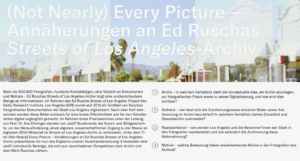
Prof. Dr. Eva Ehninger is a leading academic at the Institute for Art and Visual History at Humboldt University of Berlin , holding the Professorship for Modern Art History . Her research bridges photography theory, modernism, postcolonial studies, and transcultural methodologies , with a focus on visual media’s role in constructing social order. Education: Heidelberg, University of Michigan, Frankfurt/Main Doctoral thesis: Vom Farbfeld zur Land Art (2011, Benvenuto-Cellini Prize) Her research explores how photography, media, and art mediate social, political, and cultural dynamics. Current projects include the Käte Hamburger Kolleg inherit-heritage in transformation and Art Education Between Heritage Making and Critical Transregionality , analyzing entanglements between South Asian and European art education histories. Publications like The Modern Dream of Order (2025) and Ed Ruscha’s Streets of Los Angeles contributions examine Los Angeles as a site of visual critique and urban documentation. Her scholarly output spans 15 recent works addressing topics such as Victorian photography’s social imagination , biological metaphors in Smithson’s art , and dialogue in Nauman’s practice , reflecting interdisciplinary intersections of art history, media theory, and critical studies . She has received prestigious support from institutions like the Getty Research Institute and Terra Foundation for American Art . Scientific awards: Benvenuto-Cellini Prize (for dissertation) Grants: Studienstiftung des deutschen Volkes, Fulbright Commission, BMBF Ehninger supervises 10 ongoing PhD projects and co-edits journals like kritische berichte and Zeitschrift für Kunstgeschichte . She is a Vertrauensdozentin (Trusted Academic Advisor) for the Studienstiftung des deutschen Volkes, demonstrating her commitment to academic mentorship.
Michael Symmons Roberts is Professor of Poetry at Manchester Metropolitan University, within the Department of English, Faculty of Arts and Humanities. A renowned poet, librettist, and broadcaster, he holds a degree in Philosophy and Theology from Oxford University and was formerly Executive Producer at BBC Religion & Ethics. Full Name: Michael Symmons Roberts Position: Professor of Poetry Institution: Manchester Metropolitan University Department: Department of English Field: Poetry and Creative Writing His research interests center on modern and contemporary poetry, with a particular focus on intersections between poetry and theology, science, music, and broadcast media. He is deeply engaged in exploring how poetic form interacts with spiritual, scientific, and ethical questions, often through collaborative and interdisciplinary projects. Michael’s recent publications and creative works reflect a sustained exploration of spiritual and existential themes. His poetry collections such as Drysalter and Ransom , radio dramas like Paradise Lost and Utopia , and choral works including Quickening and The Birds of Rhiannon demonstrate a consistent engagement with religious symbolism, myth, and the human condition. His works are frequently shortlisted for major literary prizes, highlighting their critical acclaim. Among his many honors are the Forward Poetry Prize (twice), the Costa Poetry Prize, the T.S. Eliot Prize shortlist (five times), the Jerwood Award for Non-Fiction, and the Sandford St. Martin Award. He is a Fellow of the Royal Society of Literature and a trustee of the Royal Literary Fund. Forward Poetry Prize for Best Collection (2013, 2004) Costa Poetry Prize (2013) T.S. Eliot Prize Shortlist (2001, 2004, 2013, 2017, 2021) Fellowship of the Royal Society of Literature (2014) Whitbread Poetry Award (2004) Eric Gregory Award (1988) BBC Audio Drama Awards (2013, 2014) He supervises PhD students in poetry and creative writing, teaches campus and online workshops, and is active in public engagement through performances, radio broadcasts, and commemorative poetry projects. His collaborations with composer James MacMillan have resulted in major commissions for the BBC Proms, Royal Opera House, and Welsh National Opera, underscoring his impact across literature and music. He has not been associated with any formal research lab but leads creative teams in interdisciplinary performance and literary projects.
Prof. Dr. Wolfram R. Keller is a Professor at the Department of English Philology, Faculty of Philosophy and Humanities, Freie Universität Berlin. His research focuses on medieval and early modern English/Scottish literature, classical reception, and theories of authorship, with special emphasis on temporal structures in literary works. His research explores the transformation of classical traditions in medieval and Renaissance texts, particularly through the lens of hybridity and temporality. Key areas include Chaucer's dream visions, Shakespearean chronologies, Trojan narratives, and intersections of literature with economics and music. Recent work examines how texts strategically reinvent antiquity to address contemporary concerns. Keller leads multiple collaborative research initiatives, including as Principal Investigator for DFG Research Group FOR 2305 Diskursive Representations (2016-2023) examining discursive innovations, and the Excellence Cluster Temporal Communities (2020-present) studying time as a literary construct. His publications demonstrate consistent engagement with how medieval/early modern authors reframe classical tropes to negotiate cultural identity. He directs projects on 'Troynovant Revisited' (DFG 2023–present) analyzing hybridization of classical antiquity in English literature, and 'Shakespearean Chronologies' (Einstein Circle 2016-2019) investigating asynchronous temporalities. His interdisciplinary approach connects literary studies with philosophy, musicology, and economic history.
PD Dr. Mathias Winkler is a Senior Lecturer in Biblical Theology / Old Testament at the Faculty of Catholic Theology, Ruhr University Bochum, where he has served as the interim chair for Old Testament studies since April 1, 2023. He is also affiliated as a Faculty Member with the Faculty of Catholic Theology at Universität Regensburg. His research interests are centered on Biblical Theology, Old Testament studies, and Biblical Hermeneutics, with a strong focus on Narrative Methods. A significant portion of his recent work applies Critical Masculinity Studies to the Hebrew Bible, exploring themes of masculinity in the patriarchal narratives of Genesis and the portrayal of male characters. His scholarship also delves deeply into the Book of Proverbs, examining its structure, intertextuality with the Solomonic narratives in 1 Kings, and its theological wisdom. Other key areas include the Book of Numbers, particularly the Nazirite vow and the role of the Levites, and the nature of divine revelation. His recent publications demonstrate a consistent trend of sophisticated literary and theological analysis. He frequently investigates the interplay between text, ideology, and social constructs, as seen in his work on masculinity. His articles also reflect a keen interest in textual details, such as the symbolism of hair or the structure of wisdom collections, and in the connections between the Old and New Testaments, as in his study of the testing of God in Exodus and 1 Corinthians. Dr. Winkler is an active scholar with a growing body of work, including two books and numerous articles in respected journals like Vetus Testamentum and Journal for the Study of the Old Testament . He can be contacted via email at mathias.winkler@ruhr-uni-bochum.de .
Hans Harder serves as Professor of Modern South Asian Languages and Literatures at Heidelberg University's South Asia Institute, where he has held his position since 2007. His academic career spans institutions including the universities of Hamburg, Heidelberg, and Martin Luther University in Halle-Wittenberg, where he completed both his PhD and postdoctoral work. Research Interests: Professor Harder's scholarly focus encompasses modern South Asian literatures (particularly Bengali), religious movements from the nineteenth and twentieth centuries , colonial and postcolonial intellectual history , and popular literature and film across South Asia. His work consistently examines the intersections of language, culture, and power in colonial and postcolonial contexts, with special attention to vernacular expressions of identity and resistance. His recent publications reveal a deepening engagement with language ideologies and vernacular conceptualizations in South Asia, particularly evident in his 2024 co-authored work The Vernacular: Three Essays on an Ambivalent Concept and Its Uses in South Asia . Earlier works demonstrate his longstanding interest in religious movements (particularly Sufism in Bangladesh), literary satires from colonial Calcutta, and cross-cultural perceptions between colonized and colonizing societies. His scholarship bridges literary analysis, religious studies, and cultural history through meticulous textual examination and theoretical sophistication. Professor Harder has established himself as a leading scholar through numerous monographs and edited volumes that have significantly shaped South Asian literary and intellectual studies. His collaborative work with scholars like Nishat Zaidi, Torsten Tschacher, Barbara Mittler, and Charu Gupta demonstrates his commitment to interdisciplinary and international scholarly exchange. Based at Heidelberg University's South Asia Institute, Professor Harder continues to advance research on South Asian cultural production while mentoring students and contributing to the global academic community through his extensive publications and editorial work.
Dr. Miriam Henkel is an Acting Professor in Clinical Psychology and Psychotherapy at the University of Kassel, with expertise in psychodynamic diagnosis and therapeutic techniques. She has contributed extensively to research on personality disorders, anxiety disorders, and psychotherapy outcomes. Education : B.Sc. and M.Sc. in Psychology from Ruprecht-Karls-University Heidelberg (2009-2014). Training : Psychodynamic Psychotherapy certification at Lou Andreas-Salomé Institut (2014-2022). Clinical Experience : Psychiatric internship at Ludwig-Noll-Krankenhaus Kassel (2018-2019) Her research focuses on psychodynamic therapy, conflict pathology, therapist-patient dynamics, and psychotherapy assessment tools. She has published in journals like Zeitschrift für Psychosomatische Medizin und Psychotherapie and Psychoanalytic Psychology , emphasizing empirical validation of therapeutic frameworks. Henkel's work includes psychoanalytic techniques, dream analysis, and the differentiation of psychotherapy approaches. She has collaborated with researchers like Cord Benecke and Jana Zimmermann on longitudinal studies assessing psychotherapy efficacy.
Arnulf Deppermann is Professor of German Linguistics at the University of Mannheim and Head of the Pragmatics Department at the Leibniz Institute for German Language. He specializes in conversation analysis, multimodal interaction, and the study of spoken German. His research examines how meaning, understanding, and social action are interactively constituted through linguistic and embodied resources. Research interests focus on interactional semantics, multimodal resource coordination, and the temporal organization of social interaction. Key areas include action ascription, the relationship between grammar and interaction, and methodological advances in conversation analysis. His work spans diverse contexts from psychotherapy to theater rehearsals. Recent publications demonstrate strong emphasis on: Interactional semantics and meaning negotiation Multimodal coordination in institutional settings Therapeutic communication patterns German linguistics and conversation analytic methodology Editorial roles include founding co-editor of the online journal 'Gesprächsforschung'. He organizes major conferences including the International Conference on Conversation Analysis (ICCA).
Raúl Zurita Canessa is a Professor of Literature at Diego Portales University in Santiago, Chile, where he teaches in the Faculty of Communication and Literature. He has held this position since 2001 and is one of the most renowned representatives of contemporary Latin American literature, with his work shaped by the cultural confrontation between Europe and the New World. Professor Zurita's research focuses on intercultural aspects of national and Latin American literary history, bridging Dante's cosmology, early colonial Latin American literature, and Latin American modernism. His scholarly work reflects the upheavals of recent Chilean history and has evolved from avant-garde, cross-genre experimental poetry during Chile's military dictatorship (1973-1990) toward more historical and intercultural literary explorations in recent years. Zurita's extensive publication history reveals a consistent engagement with Chilean history while exploring broader Latin American literary traditions and their intercultural dimensions. His works have been translated into twelve languages including English, German, Swedish, Portuguese, Italian, Russian, Turkish, Bengali and Chinese. His notable awards include: Pablo Neruda Prize (1989) Chilean Premio Nacional de Literatura (2000) Pericle d'Oro Prize (Italy, 1995) José Lezama Lima Prize (Cuba, 2006) Guggenheim Memorial Foundation fellowship (1984) Professor Zurita has lectured internationally at prestigious institutions including Harvard, Yale, Stanford, and Berkeley, and has delivered guest lectures on topics such as 'Poesía y vida. Referencias autobiográficas' and 'Cultura de la memoria: De la Divine Comedia a las Alturas de Machu Picchu'.
Ingrid Hotz-Davies is Professor of English Literature and Gender Studies at the English Seminar, Philosophische Fakultät, Eberhard Karls University of Tübingen. She has held this position since 2001 and leads a dynamic research environment focused on gender, queer theory, early modern literature, and cultural narratives. She is actively involved in multiple academic programs and leadership roles, including co-directing the Tübingen Center for Gender and Diversity Studies and serving as the Gender Equality Representative for academic staff and students. Her academic journey includes a PhD from Dalhousie University (Canada), an MA/State Examination from the University of Munich, and a habilitation completed in Munich in 2000. Her research interests include Gender/Queer Studies, Women’s Literature from the Renaissance to the present, Early Modern Prose, and the dynamics of censorship and identity formation. She has organized numerous seminars on topics such as queer theory, camp aesthetics, postmodern realism, and the cultural construction of heterosexuality. Her work bridges literary analysis with philosophical, psychoanalytic, and sociopolitical inquiry. The recent publications analyzed reflect a consistent engagement with gender performativity, camp aesthetics, closet narratives, and the intersections of literature with psychoanalysis, religion, and political power. Her scholarship spans from Renaissance texts to contemporary science fiction, demonstrating a broad and interdisciplinary reach. Gender Equality Representative, University of Tübingen (since Nov. 2023) Academic Coordinator, Erasmus Mundus MA Program 'Crossway in Cultural Narratives' (since 2017) Co-Director, Tübingen Center for Gender and Diversity Studies (since 2013) Equal Opportunities Officer, University of Tübingen (2014–present; also 2002–2006) Academic Coordinator, Erasmus Mundus Doctoral Program 'Cultural Studies in Literary Interzones' (2010–2018) She supervises a diverse group of PhD candidates working on topics such as precariousness in Jean Rhys, polymigrant imagination, feminist speculative fiction, posthuman weird fiction, and the representation of subaltern female workers. Her mentorship extends into interdisciplinary research involving affect theory, postcolonial studies, and identity politics. While no direct mention of funding grants is made, her leadership in international Erasmus Mundus programs implies significant grant acquisition and project management experience. She is affiliated with the English Seminar's research environment and contributes to collaborative projects such as the 'Dark Side of Camp Aesthetics' and 'Naturalization of Gender'. Her work fosters transnational academic exchange and critical inquiry into marginalized voices and cultural border zones.
Prof. Dr. Marion Eggert is Chair of Korean Studies at the Faculty of East Asian Studies , Ruhr-Universität Bochum . She serves as Head of the Department of Korean Language and Culture and maintains active research in Korean literary and intellectual history (17th–19th centuries) and modern Korean literature . Her current projects include Principal Investigator roles in SFB 1475 'Metaphors of Religion' and managing subproject B02 . Research focus areas include: Korean literary history Intellectual transformations Travel literature analysis Epistolary practices Confucian knowledge systems Key publication trends (2023–2018) examine premodern Korean epistemology , travel writing , dream symbolism , and knowledge circulation between Korea and Europe. She has edited multiple volumes on religious dynamics and cultural status. Contact: marion.eggert@rub.de , Office GB 1/46, Universitätsstr. 150, 44801 Bochum, Germany.
Laura Vordermayer is a postdoctoral researcher and research associate at the Chair of Comparative Literature at Saarland University’s Faculty of Philosophy , where she investigates the interplay between ideologies and European literature, particularly in 19th-century fiction. As a member of the Cluster for European Research (CEUS) and the Research Committee of Saarland University (since 2024), she bridges trauma studies, intermediality, and postcolonial memory through her scholarship. Doctorate (2021) on literary dream recordings in 20th-century authors (Perec, Burroughs, Bachmann, Butor), focusing on trauma representation, especially the Shoah . Organizer of the 2021 Summer Academy Restitution, Reparations, Reparation at Villa Vigoni, leading to an open-access anthology (2023). Her research interests span dream studies , intermediality , and literary adaptations in film, comics, and stage productions. Publications include a 2022 monograph on Georges Perec and collaborative edited volumes on dream typology and postwar memory. She has taught courses on Orientalism , gender roles , and social stereotypes in literature and film since 2021, reflecting her interdisciplinary approach.
Professor Markus Messling holds the Chair of Romance and General Literature and Cultural Studies at Saarland University's Faculty of Philosophy. He is a founding member and collegium member of CEUS since 2021 and currently serves as Director of the Käte Hamburger Kolleg for Cultural Practices of Reparation (CURE) since April 2024. His academic career spans prestigious institutions including Humboldt-Universität zu Berlin and Freie Universität Berlin. PhD in Romance Philology, Freie Universität Berlin (2007) Habilitation, Universität Potsdam (2015) ERC Consolidator Grant recipient (2019-2024) Member of Academia Europaea Professor Messling's research centers on the cultural-historical and cultural-theoretical foundations of European self-reflection and its global relationships. His work critically examines universality thinking after European universalism, Mediterranean studies as public space, and the intersections of philology with colonial knowledge production. His scholarship demonstrates a consistent engagement with postcolonial theory, decolonial approaches to literature, and critical examinations of racism in European intellectual history. His recent publications reveal a strong trajectory in universalism studies, with particular focus on Francophone literatures as sites of alternative universalisms. The 'Rhinozeros' journal series he co-edits explores European transition through various thematic lenses including reparation, property, dreaming, and housing. His monograph 'Champollion's Hieroglyphs' represents a significant contribution to understanding the relationship between philology and colonial world appropriation. ERC Consolidator Grant 'Minor Universality. Narrative World Productions After Western Universalism' (2019-2024) DFG Emmy Noether-Nachwuchsgruppe 'Philologie und Rassismus im 19. Jh.' (2009-2014) Member of Academia Europaea Professor Messling has directed major collaborative research initiatives including the Franco-German Youth Office-funded 'Penser la Méditerranée ensemble – trans-Mediterranean youth policy' (since 2022) and the Käte Hamburger Kolleg CURE (since 2024). His editorial work on the 'Rhinozeros' yearbook series has created an important platform for interdisciplinary European studies. His international collaborations span institutions including EHESS Paris, University of Cambridge, School of Advanced Study/University of London, and Universität Kobe in Japan, reflecting his transnational scholarly approach. As Director of the Käte Hamburger Kolleg CURE, Professor Messling leads a major research team focused on cultural practices of reparation. This interdisciplinary center brings together scholars from multiple European and global institutions to examine reparation not merely as legal or financial concept but as cultural practice across historical and contemporary contexts.
Prof. Dr. Stefani Brusberg-Kiermeier serves as a Professor at the Institute for English Language and Literature within the Faculty of Language and Information Sciences at the University of Hildesheim. She holds multiple leadership positions including membership on the board of the Center for Gender Research, representation of professors on the Doctoral Committee for Faculty 3 (Dr. phil.), and spokesperson role for English Language and Literature in the Interdisciplinary Graduate College 'Gender and Education.' Her research spans multiple literary periods and media forms with particular expertise in Shakespeare studies, Victorian literature, gender research, and film adaptation. Brusberg-Kiermeier's scholarly work demonstrates consistent interdisciplinary engagement, frequently bridging literary analysis with gender theory, film studies, and cultural criticism. Her publications reveal a pattern of examining how literary works from different historical periods engage with contemporary concerns through adaptation and reinterpretation. Analysis of her recent publications shows a clear trajectory toward examining contemporary media representations (particularly film and television) through the lens of historical literary traditions. Her work on James Bond evolution, Shakespeare adaptations in modern cinema, and Victorian literature's influence on contemporary culture demonstrates her ability to connect historical literary analysis with current cultural phenomena. The scholarship consistently incorporates gender perspectives across all subject areas. Brusberg-Kiermeier has served as editor-in-chief of the journal Hard Times (2014-2018) and has edited numerous special issues and book collections. Her editorial work demonstrates commitment to fostering scholarly dialogue across disciplinary boundaries, particularly regarding gender studies and literary adaptation. Her academic leadership extends to multiple institutional roles at the University of Hildesheim, where she contributes to both teaching and research administration while maintaining an active scholarly profile. The depth and breadth of her publications across multiple subfields demonstrate her position as a significant contributor to literary and cultural studies in Germany.