Veronica Frans is a Stanford Science Fellow at Stanford University and a sixth-year PhD Candidate in Fisheries & Wildlife and Ecology, Evolutionary Biology & Behavior at Michigan State University (MSU). She is affiliated with MSU’s Center for Systems Integration and Sustainability (CSIS), the Klausmeier-Litchman lab at Kellogg Biological Station, and holds certifications in Community Engaged Scholarship and Spatial Ecology. Her research focuses on human influence on species distributions, integrating ecological modeling, GIS, and community outreach. BS/BA in Environmental Sciences and French from Messiah College MSc in International Nature Conservation from Goettingen University Her research spans ecology, conservation biology, and sustainability, emphasizing human-nature interactions through metacoupling, telecoupling, and stakeholder collaboration. She has conducted fieldwork in Alaska, Hong Kong, and the Falkland Islands, leveraging local knowledge to address global conservation challenges. Recent publications highlight her expertise in species distribution modeling, sustainability tool development (e.g., seesus, SDGdetector), and conservation policy analysis. Articles frequently explore metacoupling, anthropogenic impacts, and marine ecosystem dynamics, with applications in deforestation, biodiversity, and SDG implementation. NSF GRFP Fellow University Enrichment Fellow Outstanding Paper in Landscape Ecology Award Veronica collaborates with the Klausmeier-Litchman lab at MSU’s Kellogg Biological Station and works under Dr. Jianguo (Jack) Liu at CSIS. Her work bridges marine environments, stakeholder engagement, and global sustainability through interdisciplinary research and community-based conservation.
Zachary Tatlock is an Associate Professor at the Paul G. Allen School of Computer Science & Engineering at the University of Washington, where he leads the Programming Languages & Software Engineering Group (PLSE) and the SAMPL Group. His research spans programming languages, formal verification, compilers, and computational fabrication. He is also an Amazon Scholar with AWS's Automated Reasoning Group and previously advised OctoML. Tatlock's work bridges theoretical foundations with practical systems, focusing on making it easier to write tricky code while ensuring correctness through rigorous proofs and measurements. PhD in Computer Science & Engineering, University of California, San Diego (2014) Thesis: Reducing the Costs of Proof Assistant Based Formal Verification Advisor: Sorin Lerner BS in Computer Science (Honors) and Mathematics, Purdue University (2007) Professor Tatlock's research focuses on the intersection of programming languages, formal methods, and systems. His work in compilers and formal verification aims to make it easier to write tricky code while ensuring correctness through rigorous proofs. He explores computational fabrication techniques that bridge digital design with physical manufacturing. His recent work on equality saturation (via the egg framework) has transformed program optimization and synthesis. Tatlock also investigates floating-point numerics, distributed systems verification, and hardware/software co-design, always seeking to balance theoretical rigor with practical implementation. Tatlock's recent publications demonstrate a strong focus on equality saturation techniques (egg framework), computational fabrication, and verified systems. His work increasingly integrates machine learning with program analysis and synthesis. There's a clear trajectory toward more practical applications of formal methods in real-world systems, particularly in numerical computing and fabrication. His research group has made significant contributions to e-graph technology, floating-point accuracy, and the verification of distributed systems. Distinguished Paper Award for Rewrite Rule Inference Using Equality Saturation (OOPSLA 2021) Spotlight Paper Award for Dynamic Tensor Rematerialization (ICLR 2021) Distinguished Paper Award for egg: Fast and Extensible Equality Saturation (POPL 2021) Faculty Appreciation for Career Education & Training (FACET) Award (2020) NSF CAREER Award: Verifying Distributed System Implementations (2017) Distinguished Paper Award for Automatically Improving Accuracy for Floating Point Expressions (PLDI 2015) Distinguished Teaching Award Nomination (2015) Professor Tatlock has advised numerous doctoral, master's, and undergraduate students who have gone on to prominent positions in academia and industry, including faculty positions at the University of Utah and Brown University, and leadership roles at companies like OctoML and Certora. His research is supported by significant funding from NSF, DARPA, DOE, and industry partners, totaling millions of dollars. Current grants include projects on computer-aided reasoning, formal verification, computational fabrication, and machine learning systems. He has served on numerous program committees and organized workshops including FPTalks, EGRAPHS, and PNW PLSE. As co-leader of the Programming Languages & Software Engineering (PLSE) research group and affiliate of the SAMPL Group at the University of Washington, Tatlock has developed influential tools including egg (an equality saturation toolkit), Carpentry Compiler, and Odyssey. His group actively collaborates with industry partners including Amazon Web Services, where he serves as an Amazon Scholar. The group has made significant contributions to equality saturation, floating-point accuracy, program synthesis, and computational fabrication, with applications ranging from compiler optimization to 3D printing.
Sherif Khattab is a Teaching Assistant Professor in the Department of Computer Science at the University of Pittsburgh's School of Computing and Information. With a Ph.D. in Computer Science from the University of Pittsburgh (2008), he brings extensive expertise in cybersecurity systems with applications across cloud computing, Internet of Things, electronic voting, and Big Data security. His research focuses on the systems aspects of cybersecurity, maintaining an h-index of 16 (Google Scholar) and 10 (Scopus) with over 60 publications. Khattab has successfully supervised more than 15 graduate students throughout his academic career. Prior to his position at Pitt, he served as an Associate Professor at Cairo University's Department of Computer Science, Faculty of Computers and Information. Professor Khattab teaches numerous undergraduate and graduate courses, with particular emphasis on hands-on ethical hacking and security education. His current teaching portfolio includes Algorithms and Data Structures (CS 0445) and Network Security (CS 1653), with extensive experience teaching operating systems, formal methods, and computer networks across multiple semesters. His research publications reveal consistent focus on practical security solutions for emerging technologies, with recent work addressing IoT security frameworks, blockchain-based voting systems, and cloud security challenges. The publication trend shows increasing emphasis on practical implementation aspects alongside theoretical security models. With industry experience from internships at Google Inc., Ericsson Data Networks, and Bosch Research, Khattab bridges academic research with real-world security challenges. His educational background includes a Bachelor's in Computer Engineering from Cairo University (1998) and both M.Sc. and Ph.D. in Computer Science from the University of Pittsburgh (2004 and 2008).
Marcus Gerhold is an Assistant Professor in the Formal Methods and Tools group at the University of Twente's Faculty of Electrical Engineering, Mathematics and Computer Science. His research focuses on model-based testing for software reliability in critical infrastructures, particularly railway systems, alongside significant contributions to game design and programming language analysis. His educational background includes: PhD in Computer Science from University of Twente (2018): Choice and Chance: Model-based Testing of Stochastic Behaviour MSc in Mathematics from Friedrich Schiller Universität Jena (2013): Embeddings of Weighted Morrey Spaces BSc in Mathematics from Friedrich Schiller Universität Jena (2011): Entropy-, Approximation- and Kolmogorov Numbers on Quasi-Banach Spaces Gerhold's research integrates theoretical model-based testing with practical critical infrastructure applications . His work on railway conformance testing addresses EULYNX controller validation, while his game design research explores affective mirroring in NPCs and procedural dungeon generation. The code modernity analysis stream leverages static analysis to quantify legacy code evolution across languages like Python and PHP, revealing version identification challenges through deep learning. Publication trends show consistent focus on model-based testing methodologies (40%), railway safety applications (25%), and innovative game design/code analysis (35%). Recent work increasingly incorporates AI/ML techniques for UML assessment and Python version identification, while maintaining rigorous formal methods foundations. He actively mentors 63 students across all academic levels and contributes to major research initiatives: STORM_SAFE (ERDF, 2024): Daily Supervisor for WP1/WP2 on software reliability for critical infrastructures ZORRO (KIC grant, 2023): Daily Supervisor for WP4 on zero downtime in cyber-physical systems MISSION (MSCA RISE, 2021-2025): Interim coordinator (early 2024) for space systems modeling As part of the Formal Methods and Tools research group, Gerhold participates in European collaborations while serving on SAC-SVT 2024 and FormaliSE 2023 program committees.
Steve Boker is a Professor of Psychology at the University of Virginia, directing the Human Dynamics Laboratory and the LIFE Academy. His research focuses on quantitative psychology, structural equation modeling (SEM), and dynamical systems analysis for longitudinal and time series data. Dr. Boker has pioneered methods like Differential Structural Equation Modeling (dSEM) , Latent Differential Equations (LDE) , and the Windowed Cross-Correlation (WCC) method. He co-developed the widely used OpenMx SEM software framework and invented the RAMpath method for path diagram analysis. Key Research Areas: Dyadic conversation dynamics, adaptive systems in addiction, motion symmetry in social interactions, maternal-infant coupling, and resilience modeling through longitudinal data. Awards & Honors: 2024 Distinguished Researcher Award (UVA) 2020 Saul Sells Award for lifetime achievement in multivariate psychology Fellow, American Psychological Association Fellow, Association for Psychological Science His methodological contributions span over 150 publications, with recent work emphasizing nonlinear dynamics, surrogate data validation, and complexity metrics like the Tangle index for short time series analysis.
Peng Gao is an Assistant Professor in the Department of Computer Science at Virginia Tech. He is affiliated with the Virginia Tech Security & Intelligence Lab and holds a Ph.D. in Electrical Engineering from Princeton University. Prior to his faculty position, he was a postdoctoral researcher at UC Berkeley and held research internships at Microsoft Research, Facebook, and NEC Laboratories America. Education includes a B.Eng. from Shanghai Jiao Tong University (2009-2013), M.A. and Ph.D. from Princeton (2013-2019), and an exchange program at the University of Hong Kong (2012). Key roles include Technical Program Committee memberships for conferences like IEEE S&P, USENIX Security, and CCS. Research focuses on Cybersecurity (APT prevention, network security with P4/eBPF) AI applications (LLMs for security, AI safety) Systems security (attack investigation, threat intelligence) AI for science (molecular/materials prediction) Notable awards include the 2022 Amazon-VT Initiative Faculty Award, CCI Fellowships, and multiple best paper nominations. His lab has received grants from CCI, NSF, and industry partners like Google Cloud and Cisco. Teaching includes courses on Principles of Computer Security (CS 4264) and Blockchain Technologies (CS 5594). He advises ~20 students across Ph.D., MS, and undergraduate levels.
Matt J. Rutherford is an Associate Professor in the Department of Computer Science at the University of Denver, with a joint appointment in the Department of Electrical and Computer Engineering. He is Deputy Director of the Unmanned Systems Research Institute and a faculty fellow of Project X-ITE. His research focuses on autonomous systems, embedded systems, and software engineering, with extensive contributions to UAV navigation, control systems, and robotics. Rutherford holds a Ph.D. in Computer Science from the University of Colorado Boulder (2006), an MS (2001), and a BS in Civil Engineering from Princeton University (1996). His work emphasizes practical applications of software engineering principles in distributed and embedded systems. Notable projects include radar-based collision avoidance for UAVs, self-leveling landing platforms, and studies on electric vehicle charging impacts on power grids. Rutherford's research bridges theoretical computer science with real-world engineering challenges, particularly in unmanned systems and robotic autonomy. Key publications explore UAV flight control using neural networks, ground/ceiling effects in rotorcraft, and GPU-based real-time pose estimation. His contributions to model-driven systems and distributed testbed automation highlight long-term engagement with software reliability and scalable experimentation frameworks. Rutherford collaborates widely, including with institutions like the University of South Carolina and Politecnico di Torino. His interdisciplinary approach integrates robotics, aerospace engineering, and software engineering to advance autonomous system capabilities.
Joshua Garcia is an Assistant Professor in the Informatics Department at the University of California, Irvine (UCI), within the Donald Bren School of Information and Computer Sciences. His research focuses on software architecture, automated testing, and cybersecurity, particularly in autonomous systems and mobile applications. He leads projects like DeltaDroid, Doppelgänger Test Generation, and Darcy, which address software vulnerability management, architectural consistency, and safety-critical systems. Key achievements include an NSF CAREER Award (2025), an NSF CRI Grant (2018), and a DARPA competition win (2024). His work is adopted by organizations like Boeing, Google, and NASA. Garcia collaborates internationally, involving institutions in Padova and researchers like Luca, Jessy Ayala, and Philipp. Research Interests: Software architecture evolution, automated exploit generation, autonomous vehicle testing, and accessibility in software development Grants: NSF CAREER ($500K+), NSF CRI ($1M+) Labs/Teams: HexHive Group, Autonomous Systems Testing Lab
Hoseung Song is an Assistant Professor at KAIST (Korea Advanced Institute of Science & Technology), affiliated with the Department of Industrial and Systems Engineering and the Graduate School of Data Science. His research focuses on statistical data science, decision making, and biomedical applications, particularly in areas like change-point analysis, two-sample tests, and spatial clustering. His work bridges theoretical statistics with practical biomedical and healthcare challenges. Research interests include advanced statistical methodologies for analyzing complex biological and healthcare data, such as viral genomics, microbiota associations, and immune cell clustering. He develops scalable algorithms and kernel-based methods to address high-dimensional and non-Euclidean data challenges. Recent work highlights applications in infectious diseases (e.g., HSV-2) and postmenopausal health through association studies and differential analysis. His publications emphasize robust statistical testing frameworks, including permutation-based limitations, batch effect corrections, and graph-based methodologies. These contributions enhance reliability in biomedical research and safety-critical data applications. His lab likely integrates computational statistics with real-world healthcare datasets to drive translational insights.
Jaco van de Pol is a Full Professor of Computer Science at Aarhus University, holding dual roles in the Digital Society Institute and Formal Methods and Tools. He earned his PhD from Utrecht University in 1996, specializing in Termination of Higher-order Rewrite Systems, and a Master's in Computer Science (Term Rewriting) in 1992. His research focuses on model checking, formal methods, algorithms, and automated verification, contributing to UN Sustainable Development Goals related to innovation and education. Education: PhD, Termination of Higher-order Rewrite Systems, Utrecht University (1996) Master's in Computer Science (Term Rewriting), Utrecht University (1992) Research Interests: His work spans model checking, formal verification, parallel algorithms, and their applications in software engineering and bioengineering. He emphasizes practical formal methods, such as SCC algorithms and timed automata analysis, to solve complex computational challenges. Awards: Best Paper Award SPIN 2017 (2017) Best Student Paper Award (2018) Advising & Grants: Supervised 12 students and contributed to collaborative projects in formal methods and computational biology. His research has been applied to areas like cartilage phenotype modeling and parallel algorithm design. Labs/Teams: Engages with interdisciplinary teams, including computational biology and distributed systems groups, to advance formal methods in practical contexts.
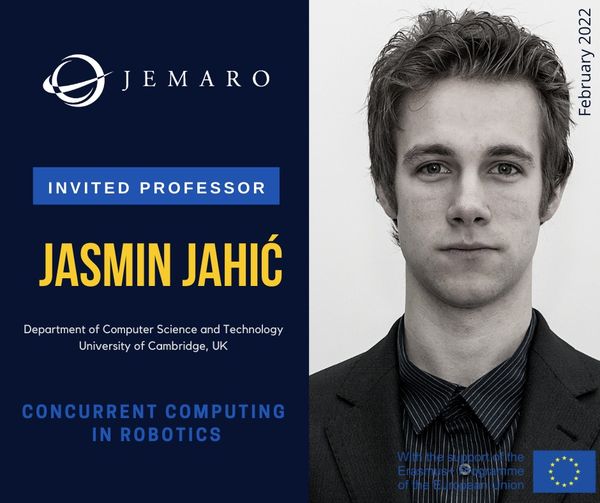
Jasmin Jahic is a Researcher at the Computer Architecture Group of the University of Cambridge, working under Timothy M. Jones. She holds a PhD in 'Supervised Testing of Embedded Concurrent Software' from the University of Kaiserslautern (2020) and has extensive experience as a researcher and project manager at the Fraunhofer Institute for Experimental Software Engineering. Her research focuses on concurrency in embedded systems, software engineering, AI integration, and low-power systems. Education: PhD in Computer Science from the University of Kaiserslautern (2020). Prior roles include Project Manager at Fraunhofer IESE and Coordinator of the European Master Program in Software Engineering. Research Interests: Concurrent computing, embedded systems architecture, AI applications in software engineering, and low-power system design. She explores concurrency bugs, synchronization mechanisms, and software architecture evolution in the context of Industry 4.0 and autonomous systems. Professional Activities: Co-Organizer of SAMOS workshops (2018–2021), Reviewer for IEEE/ACM conferences, and contributor to European Strategic Research Agendas for embedded systems. Teaches courses on software architectures for embedded systems and supervises numerous graduate students. Key Contributions: Frameworks like BOSMI for multithreaded software testing, FERA for concurrency bug detection, and research on AI adoption in traditional embedded systems. Active in HiPEAC conferences and industry partnerships.
Erik Demaine is a Professor in the Department of Electrical Engineering and Computer Science at MIT, affiliated with the Computer Science and Artificial Intelligence Laboratory (CSAIL), the Theory of Computation group, and the Algorithms Group. His research spans algorithms, computational geometry, folding, robotics, complexity theory, and interdisciplinary connections between mathematics and art. He received the MacArthur Fellowship ("genius grant") for his work on folding and computation. Demaine's work includes co-authoring books such as Geometric Folding Algorithms and Games, Puzzles, and Computation . His art collaborations with his father Martin Demaine, including curved-crease sculptures, are in the permanent collections of the Museum of Modern Art (MoMA) and the Renwick Gallery. He is also involved in software projects like Coauthor and Cocreate, supporting collaborative research and education. His research interests include folding and unfolding of geometric structures, computational complexity of games, protein folding, and algorithm design. He has contributed to areas like data structures, robotics, and network computing, with a focus on bridging theoretical computer science and tangible applications. Demaine holds patents and has been recognized with numerous awards, including the NSERC Doctoral Prize and the Gödel Prize. His work often involves supercollaboration, emphasizing open problem-solving and interdisciplinary approaches.
Sandhya Dwarkadas is the Walter N. Munster Professor and Chair of the Department of Computer Science at the University of Virginia. Her research focuses on the intersection of computer hardware and software, particularly in parallel computing, computer architecture, and compiler/runtime-architecture interaction. She holds dual roles as department chair and active researcher, balancing leadership with contributions to energy-efficient and reconfigurable computing systems. Education: B.Tech. in Electrical Engineering, Indian Institute of Technology (1986) M.S. and Ph.D. in Electrical and Computer Engineering, Rice University (1989, 1993) Research interests emphasize parallel and distributed computing architectures, with a focus on energy efficiency, cache coherence, and security in multicore systems. Recent work explores mitigating side-channel attacks via innovations like TimeCache and RollingCache. Her publications span 30+ years, addressing both foundational and applied challenges in computer systems. Awards highlight her impact: ACM and IEEE Fellowships (2018/2017), University of Rochester’s Hajim Award (2020), and AAAS Fellowship (2024). She actively mentors students through courses like CS 6190 and leads interdisciplinary projects like TriForce. Labs/Teams: Her work is anchored in the University of Virginia’s Computer Science Department, collaborating across academia and industry to advance next-generation computing systems.
Dr. Shufang Zhu is a Lecturer (Assistant Professor equivalent) at the Department of Computer Science, University of Liverpool , and an Associate Member at the University of Oxford’s Department of Computer Science . Previously, she held roles including Senior Research Associate at Oxford (2023–2024) and Postdoctoral Researcher at Sapienza Università di Roma (2020–2022). She earned her Ph.D. in Software Engineering from East China Normal University (ECNU, 2020) under Prof. Geguang Pu, with a visiting Ph.D. at Rice University (2016–2018) under Prof. Moshe Y. Vardi. Education: B.Sc./Ph.D. in Software Engineering from ECNU (2010–2020). Scholarships include the Chinese Scholarship Council (CSC) and UT Austin EECS Rising Star (2022). Her research focuses on interdisciplinary areas of Formal Methods and Artificial Intelligence , emphasizing automated reasoning, planning, and synthesis. Key topics include temporal logics (LTL/LTLf), symbolic synthesis frameworks, and applications in reactive systems. Notable work addresses finite-trace specifications, best-effort strategies, and coordination in multi-agent systems. Teaching: Lecturer for Game-Theoretic Approach to Planning and Synthesis (European Summer School) and Foundations of Self-Programming Agents (Oxford). She also supervises funded Ph.D. positions, including a 2025 deadline for CSC-Liverpool scholarships. Awards: Future Digileader (Digital Futures, 2023), UT Austin EECS Rising Star (2022). Erdős number ≤3 via Moshe Y. Vardi. Collaborations: Co-chair of AAAI 2023 symposium on temporal logics in AI. Active in open-source tools like LydiaSyft for LTLf synthesis. Engages with academic networks through Google Scholar, DBLP, and GitHub.
Liqiang Wang is a Professor in the Department of Computer Science at the University of Central Florida (UCF), where he directs the Big Data Lab. Previously, he served as faculty at the University of Wyoming (2006-2015). He holds a Ph.D. in Computer Science from Stony Brook University (2006) and spent a visiting research period at IBM T.J. Watson Research Center (2012-2013). His research focuses on big data analytics, high-performance computing, parallel systems optimization, and applying deep learning to detect programming errors and enhance model robustness. Education: Ph.D., Computer Science, Stony Brook University (2006); Visiting Researcher, IBM Watson (2012-2013). Research Interests: Improving accuracy and security of big data models, optimizing parallel computing systems (HPC, Cloud, GPUs), program analysis for concurrency errors, and deep learning applications in anomaly detection and adversarial robustness. Notable projects include scalable LSQR algorithms for seismic tomography and the OpenMP Analysis Toolkit (OAT) for concurrency error detection. Key Awards: NSF CAREER Award (2011), Castagne Faculty Fellowship (2013-2015), UCF Mid-Career Refresh Award (2020), and grants including a $50K NSF CIVIC-PG grant (2022) and Google/Meta donations. Advising and Grants: Supervises over 20 Ph.D./M.S. students and has secured grants totaling over $100K. Notable collaborations include seismic tomography with NCAR and cloud computing optimization. Labs/Teams: Director of UCF’s Big Data Lab, collaborating on projects like Parallel LSQR and Anti-Neuron Watermarking.