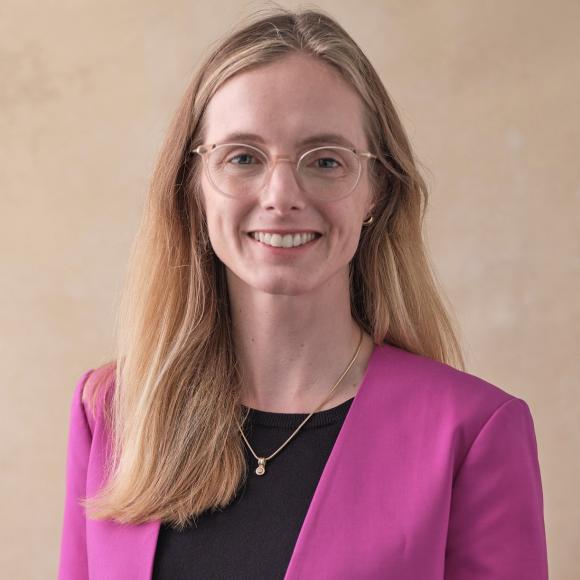
Carolin Pflueger is an Associate Professor at the Harris School of Public Policy , University of Chicago, and holds affiliations as a NBER Faculty Research Fellow and CEPR Research Affiliate . Her work bridges macroeconomics and finance, focusing on inflation dynamics, monetary policy impacts, and financial market risk perception. University: University of Chicago School: Harris School of Public Policy Affiliations: NBER, CEPR Role: Associate Professor Her research explores how inflation and monetary policy influence financial markets, including models connecting Treasury bond risk to stagflation drivers and analyzing economic agents' perceptions of policy uncertainty. Recent work leverages cross-sectional data of stock prices and economic forecasts to quantify macrofinancial linkages. Notable scientific recognitions include the Fama DFA Prize (2023), AQR Insight Award Finalist (2018), and the Arthur Warga Award (2014). She has received NSF Grant 2149193 for macrofinance research. Contact: cpflueger@uchicago.edu | GitHub Code Repositories
California Polytechnic State UniversityUnited States
Brian Ayash is an Associate Professor at the Department of Finance within California Polytechnic State University . He specializes in corporate finance and entrepreneurship , with research focusing on private equity , distressed asset pricing , and bankruptcy . Dr. Ayash teaches courses in these areas and is currently on sabbatical. Education : Bachelor of Science in Mechanical Engineering, Clarkson University MBA, University of Rochester Master of Science & PhD in Business Administration, University of California, Berkeley Research Interests : Dr. Ayash investigates the dynamics of leveraged buyouts , including operating performance, investment patterns, and equity sponsor returns. His work bridges theoretical finance with practical applications in bankruptcy and distressed asset management . Professional Experience : Prior to academia, Dr. Ayash worked at PricewaterhouseCoopers, FTI Consulting, and Alvarez & Marsal Europe. He holds certifications as a Certified Public Accountant (CPA) , Chartered Financial Analyst (CFA) , and Certified Insolvency and Restructuring Advisor (CIRA) .
Asaf Bernstein is an Associate Professor of Finance at the University of Colorado Boulder’s Leeds School of Business, a Faculty Scholar, Co-Director of the Center for Research on Consumer Financial Decision Making, and a Research Associate at the National Bureau of Economic Research. He earned his Ph.D. in Financial Economics from MIT in 2016 and served as Senior Academic Advisor on Climate Issues to the U.S. Securities and Exchange Commission during 2021-22. Education: Ph.D. Financial Economics, Massachusetts Institute of Technology, 2016 B.S. Economics & Mathematics, Harvey Mudd College Research Focus: Bernstein’s work lies at the intersection of policy and finance, using plausibly identified empirical designs to study financial regulation, climate risk, household balance-sheet dynamics, and the real effects of credit markets. His current agenda spans macro-prudential policy, public-pension wealth transmission, historical introduction of credit ratings, and partisan sorting under climate change. Publication Trends: Across more than a dozen forthcoming or published papers, Bernstein consistently exploits natural experiments—regulatory shocks, historical clearinghouses, Dutch amortization reform, Great-Depression bank distress, SLR exposure—to quantify how financial frictions affect prices, allocations, and innovation. The corpus maps broadly onto household finance, corporate finance, and climate-finance fields, with frequent overlap in real-estate and financial-history contexts. Honors & Awards: 2019 AQR Insight Distinguished Paper Award 2016 AQR Top Finance Graduate Award (global top-six PhD honor) 2022 Brattle Group Distinguished Paper Prize, Journal of Finance 2018 Northern Finance Association Best Paper in Risk Management Kahle Family Research Award Grants & Advising: While specific grant amounts are not disclosed, his projects have been supported by data access from Dutch administrative panels, U.S. credit-bureau micro-data, and historical securities archives. He advises PhD students in empirical finance and climate-economics and collaborates extensively across Leeds, NBER, MIT, and Stanford networks. Centers & Labs: Bernstein co-leads the Center for Research on Consumer Financial Decision Making at Leeds, an interdisciplinary lab linking finance, real-estate, and public-policy scholars to external regulatory partners including the SEC, Federal Reserve, and FINRA.
Naz Koont is an Assistant Professor of Finance at the Stanford Graduate School of Business . Her research explores how technology and nonbank intermediaries reshape banking landscapes, focusing on financial stability, competition, and consumer welfare. PhD in Finance (Columbia Business School, 2024) MPhil in Finance (Columbia Business School, 2021) Honors BSc in Mathematics and Economics (University of Toronto, 2018) Her research interests include: Financial Intermediation : Analyzing digital banking’s impact on bank roles. Credit Markets : Studying credit lines and leverage constraints. Industrial Organization : Modeling competition dynamics in banking. Technology : Assessing digitalization’s effects on financial systems. Article trends reveal her work combines empirical analysis and structural modeling to examine: Digital banking’s role in bank competition and consumer welfare Credit lines’ function in debt dilution mitigation ETFs’ active management strategies in illiquid markets Peer effects in deposit market demand Scientific awards include: HEC Paris Top Finance Graduate Award (2024) Bernstein Center Doctoral Grant (2021) Columbia Finance Department Best 4th Year Paper (2021)
Arpit Gupta is an Associate Professor of Finance at the Leonard N. Stern School of Business, New York University, where he has been a faculty member since 2016. His research lies at the intersection of real estate, household finance, and urban economics, with a strong empirical focus on using large datasets to analyze financial behavior and market dynamics. Ph.D. in Finance and Economics, Columbia Business School B.S. in Mathematics and Economics, University of Chicago His research interests include household finance, real estate markets, mortgage default, bankruptcies, urban economics, and the financial impacts of health shocks and pandemics. He explores how financial constraints affect minority borrowers, how remote work reshapes urban real estate, and how public infrastructure influences property values. His recent publications span top journals such as the Journal of Finance , American Economic Review , Journal of Financial Economics , and PNAS . Themes across his work include the economic consequences of the COVID-19 pandemic, the valuation of private equity, and the spillover effects of foreclosures. His research often combines innovative data sources with rigorous econometric methods. Notable scientific awards include the Brattle Prize First Place (2019) and the 2016 Top Finance Graduate Award from Copenhagen Business School. He has advised on policy-relevant topics such as office-to-residential conversions, housing equity, and bail reform, and has received media attention for his insights on urban development and real estate trends. Professor Gupta collaborates with a wide network of researchers and maintains active engagement through a Substack newsletter and public data repositories. He advises students and contributes to academic discourse through conference presentations and policy discussions. He is affiliated with research labs and teams focused on urban economics and financial innovation, often collaborating with scholars at Columbia, NYU, and other institutions. His ongoing projects continue to explore the evolving dynamics of housing, finance, and urban resilience in the post-pandemic era.
University of Illinois Urbana-ChampaignUnited States
Qiping Xu serves as an Assistant Professor in the Finance Department at the University of Illinois' Gies College of Business, where they conduct influential research at the intersection of corporate finance, environmental policy, and tax regulation. Their scholarly work examines how financial constraints, tax policies, and judicial systems impact corporate decision-making and environmental outcomes. Dr. Xu's research portfolio demonstrates significant expertise in several interconnected domains: Corporate environmental policies and sustainability practices with focus on CEO hometown preferences Asset market responses to industrial pollution and greenwashing phenomena Personal tax effects on firm hiring patterns and skill requirements Tax policy impacts on corporate investment behavior Financial consequences of judicial inexperience in bankruptcy proceedings Recent publications in Management Science, Journal of Finance, and Review of Financial Studies showcase rigorous empirical approaches using large datasets (including 27 million job postings) to investigate these complex relationships. Their research has gained substantial traction with citations across academic, policy, and media platforms, including references in policy documents, news coverage, and significant Mendeley readership. Dr. Xu's scholarly contributions have been recognized through citations in policy sources, media coverage by news outlets, mentions on social media platforms, and presentations in academic videos. Their work demonstrates consistent impact across both academic and practical domains, particularly in environmental finance and tax policy applications.
George O. Aragon is a Professor of Finance at the W. P. Carey School of Business, Arizona State University. He specializes in the structure, efficiency, and risk management practices of financial services institutions, particularly hedge funds and mutual funds. His research has been published in leading journals such as the Journal of Financial Economics and the Review of Financial Studies , where he also serves as an associate editor. He has held visiting roles at the U.S. Securities and Exchange Commission and teaches courses on derivatives and risk management at both undergraduate and graduate levels. Education Ph.D. in Finance (Boston College, 2005) M.Sc. in Finance and Economics (London School of Economics, 1999) Research Interests Aragon’s work focuses on institutional investor behavior, liquidity management in volatile markets, and the interplay between regulatory frameworks and financial stability. His recent studies examine hedge fund strategies in crises, ESG investment dynamics, and the impact of investor attention on mutual fund performance. He employs empirical methods and machine learning to analyze large datasets, including SEC filings and market microstructure data. Teaching Regularly teaches FIN 427: Derivative Financial Securities and FIN 530: Derivatives . Courses emphasize practical applications of derivatives in risk management and portfolio optimization. Recent Research Trends His articles highlight themes such as liquidity mismatch in hedge funds, anticipatory trading during crises, and the costs/benefits of responsible investing for university endowments. The 2024 paper on ‘Hedge Fund Liquidity Management’ underscores the tension between crisis resilience and trading opportunities. The 2023 study on ESG preferences uses machine learning to decode investor priorities across 500+ metrics. Grants and Collaborations No specific grants are listed, but his editorial roles and SEC collaborations suggest active involvement in policy-relevant research. Lab/Team Affiliations No formal lab mentioned, but his SSRN and Google Scholar profiles indicate ongoing collaborations with industry and academic partners.
Tony Cookson is a Professor of Finance and the Michael A. Klump Endowed Professor at the Leeds School of Business , University of Colorado Boulder, where he has served since 2013. His research spans empirical finance , household and corporate financial decision-making , and the impact of social media and legal institutions on financial behavior. He has published in top journals like the Journal of Finance , Journal of Financial Economics , and Management Science , focusing on topics from investor disagreement to fracking-induced debt repayment . Education : Ph.D. in Economics (University of Chicago), M.S. in Statistics and Applied Economics (Montana State University), B.S. in Economics (Montana State University) His research interests include: How social media shapes investor sentiment and trading patterns The economic consequences of fracking and casino policy Legal institutions and their role in credit market development Behavioral finance through LLM-driven investor personas His scientific awards include the Best Paper in Investments and Asset Pricing (MFA 2023) , NASDAQ Best Paper in Asset Pricing (WFA 2021) , and Finalist for TIAA Paul A. Samuelson Award (2021) . He serves as Editor at the Review of Corporate Finance Studies and Associate Editor at multiple top journals.
Adam Nowak is an Associate Professor in the Department of Economics at West Virginia University. His research focuses on housing markets, financial economics, and behavioral economics, with a particular emphasis on price dynamics, tax policy, and market inefficiencies. Ph.D. in Economics from Arizona State University B.S. in Mathematics and Economics from Indiana University - Bloomington Degree in Near-East Languages and Cultures from Indiana University - Bloomington Nowak’s expertise spans multiple domains: Housing and real estate market dynamics Corporate tax avoidance and policy implications Behavioral economics in sports betting and hospitality Historical economic analysis of crises and recovery His recent articles (2025-2022) explore housing price bubbles, hotel industry trends, insurance market asymmetries, and behavioral patterns in cultural economics. Nowak’s work often integrates econometric models, game theory, and empirical analysis of policy impacts.
Christopher M. James is the William H. Dial/SunTrust Eminent Scholar in Finance and Economics at the University of Florida's Warrington College of Business. He also serves as a senior advisor to Cornerstone Research. Previously, he taught at the University of Michigan and the University of Oregon. His academic roles include editorships at top journals like Journal of Finance and Journal of Financial Economics . Education: Ph.D. in Economics (Industrial Organization & Finance), University of Michigan, 1978 MBA in Finance, University of Michigan, 1977 BA, Michigan State University, 1973 Research Focus: Professor James specializes in financial intermediaries' role in corporate capital acquisition and mortgage-backed securities valuation. His work explores banking, corporate finance, and applied econometrics, with notable contributions to loan pricing, debt restructuring, and disclosure requirements. Recent themes include interest rate risk exposure and institutional synergies in loan funds. Professional Service: Associate Editor, Journal of Financial Markets (2017–present) Editor, Journal of Financial Services Research (2014–present) Editor, Journal of Managerial and Decision Economics (2014–present) Advising & Grants: Advised PhD students Jing Lu and Mustafa Emin (2021–2022). His research has been supported by grants related to banking crises, mortgage markets, and corporate finance dynamics. Labs/Teams: Active in interdisciplinary teams at the Warrington College of Business focusing on financial stability, corporate governance, and quantitative finance methodologies.
Scott Dyreng is the Senior Associate Dean of Innovation and Professor of Accounting at Duke University's Fuqua School of Business. His research focuses on corporate tax avoidance, international taxation, and accounting for income taxes. He teaches managerial accounting to graduate students and has received the Excellence in Teaching Award three times in Duke's MMS program. Education: PhD in Accounting from University of North Carolina (2008) Master’s in Accounting from Brigham Young University Bachelor’s in Accounting from Brigham Young University Research Interests: Dyreng’s work examines how firms strategically manage taxes through international operations, debt agreements, and financial reporting. He explores topics such as tax reform impacts, covenant compliance, and earnings manipulation to avoid tax liabilities. His research bridges accounting, taxation, and corporate strategy to understand tax-driven firm behavior. Awards: Excellence in Teaching Award (Duke MMS Program) — 3-time recipient Grants & Advising: While specific grants aren’t listed, his publications indicate sustained research funding. No advisee名单 are explicitly provided in the text. Labs/Teams: No specific labs or teams are mentioned, but his role as Senior Associate Dean involves overseeing innovation initiatives at Fuqua.
Dimitrios V. Siskos is an Assistant Professor of Finance at the Department of Business Administration, College of Business, Embry-Riddle Aeronautical University (Worldwide Campus). He holds a Doctorate in Finance from the Swiss Management Center, a Master of Science in Project Management from City University of Seattle, and a Bachelor’s in Accounting from Alexander Technological Educational Institution of Thessaloniki. With over two decades of industry experience in finance and accounting, he brings practical insights into his academic work. His research interests span finance, accounting, business administration, project management, and aviation economics . He specializes in financial statement analysis, risk evaluation, investment decision-making, and business venture assessments. His recent publications focus on airport privatization, seaplane transport networks, and financial distress in projects, reflecting a strong interdisciplinary approach combining finance with aviation and public policy. The analysis of his 15 most recent publications reveals a consistent focus on applied finance in real-world contexts—particularly in aviation infrastructure, project evaluation, and financial regulation. His work integrates quantitative methods, risk assessment frameworks, and strategic decision models, often applied to public sector or large-scale projects. Themes such as PESTLE analysis, privatization, Basel III, and performance measurement systems highlight his engagement with both macroeconomic policy and micro-level financial decision tools. Greek Network of Project Management (IPMA), Scholarship to attend and present Paper to the IPMA World Congress 2007, Cracow, Poland Dimitrios Siskos has taught courses including Corporate Finance, Investments, International Finance, and Airport Administration & Finance. He has served as a financial advisor for a team bidding to consolidate the Caribbean aviation industry, preparing consolidated financial statements under the project titled "Unlocking the Aviation Potential in the Caribbean." He has not received externally mentioned grants, but his research output is substantial and disseminated through SSRN, journals, and conferences. He is actively involved in curriculum development and professional training. He maintains an active research presence through his personal website thinkingfinance.info , where he publishes papers, books, teaching materials, and commentary on financial topics. He also contributes to platforms like SSRN, Google Scholar, and ResearchGate, enhancing academic outreach and knowledge dissemination.
Dr. Ramya R Aroul is an Assistant Professor in the Department of Finance and Real Estate at the Naveen Jindal School of Management, The University of Texas at Arlington. She has previously held faculty positions at Texas A&M University-Commerce and École hôtelière de Lausanne, Switzerland. Her academic journey began with a PhD in Finance and Real Estate from UTA in 2014. Research Interests: Financial distress and valuation in asset markets Sentiment in real estate markets Sustainability in residential real estate Endogeneity and simultaneity in hedonic valuation Climate risk and household wealth ESG and REIT performance Her recent publications (2020–2024) reveal a consistent focus on real estate finance, with particular emphasis on distressed sales, green building impacts, market sentiment (especially during crises like COVID-19), and ESG factors in REITs. She employs advanced econometric methods to study pricing anomalies, sustainability premiums, and investor behavior across residential, commercial, and hospitality real estate sectors. Scientific Awards and Honors: Red Pen Award, Journal of Sustainable Real Estate (2023) Champion who impacted Student Learning and Success, Maverick Advantage Distinction (2023, 2022) Augustine "Chuck" Arize Junior Faculty Award, Texas A&M University-Commerce (2019) James R. Webb ARES Foundation Doctoral Student Award (2013) Multiple teaching and research awards from UT Arlington and professional associations Dr. Aroul actively mentors students, serving as advisor and dissertation committee member for several PhD candidates. She has secured competitive research grants, including a $16,000 Research Enhancement Program (REP) award for climate risk research. She is deeply engaged in service, holding editorial board positions at Journal of Real Estate Literature and Journal of Sustainable Real Estate , and serving on the Board of Directors of the American Real Estate Society. Her professional memberships include the Financial Management Association and active participation in women-in-real-estate initiatives.
Craig Furfine is a Clinical Professor of Finance and Associate Chair of the Finance Department at the Kellogg School of Management, Northwestern University. His research focuses on interbank markets, commercial mortgage securitization, and real estate finance. He holds a PhD in economics from Stanford University and has held roles at the Federal Reserve Bank of Chicago, the Bank for International Settlements, and the Federal Reserve Board of Governors. Professor Furfine teaches courses in corporate finance and real estate finance, including Managerial Finance I for MBA programs. He has authored over 20 case studies and a textbook, Practical Finance for Property Investment , and serves as an Associate Editor of the Journal of Money, Credit, and Banking . His work spans policy analysis, financial regulation, and strategic financial planning, with a focus on mitigating systemic risks in financial markets. His research publications address topics such as liquidity dynamics in financial crises, credit rating procyclicality, and the impact of regulatory frameworks on mortgage-backed securities. Furfine’s contributions bridge academic theory and practical applications, influencing both academic discourse and industry practices in real estate and banking sectors.
Hayong Yun is an Associate Professor of Finance and Co-Director of the Center for Venture Capital, Private Equity and Entrepreneurial Finance at the Eli Broad College of Business, Michigan State University. His expertise spans corporate finance, risk management, law and economics, and AI applications in finance. He teaches advanced finance courses across undergraduate, MBA, and PhD programs, including specialized deep learning applications in finance. He holds a Ph.D. in Finance from Columbia University and previously served as faculty at the University of Notre Dame. His educational journey reflects a strong foundation in quantitative finance methodologies. Professor Yun's research centers on Corporate Finance , Deep Learning Applications , and Bankruptcy Law , with significant contributions to understanding how energy usage patterns predict stock returns and how municipal bankruptcy laws impact healthcare financing. His work uniquely bridges traditional financial theory with modern machine learning techniques, particularly in analyzing production heterogeneity and fairness in algorithmic lending. Publication trends reveal an evolution from early work on corporate governance and liquidity toward contemporary integration of deep learning in financial analysis, while maintaining consistent focus on legal-economic intersections in finance. His accolades include: 2008 JPMorganChase Young Researcher Award (Review of Financial Studies) 2013 Brattle Group First Prize (Journal of Finance) 2017 William F. Sharpe Award for Scholarship in Financial Research (Journal of Financial and Quantitative Analysis) 2014 Best Teaching Award, MSU Finance As an educator, he mentors PhD students through Corporate Finance Theory courses and directs the MSU Student Venture Capital Fund, which provides experiential learning through real-world investments in Michigan startups. His leadership in the Center for Venture Capital fosters cross-disciplinary collaboration between business, engineering, and policy students. He actively leads the Center for Venture Capital, Private Equity and Entrepreneurial Finance, driving initiatives that connect academic research with practical investment strategies through the Student Venture Capital Fund and industry partnerships with Michigan startups.