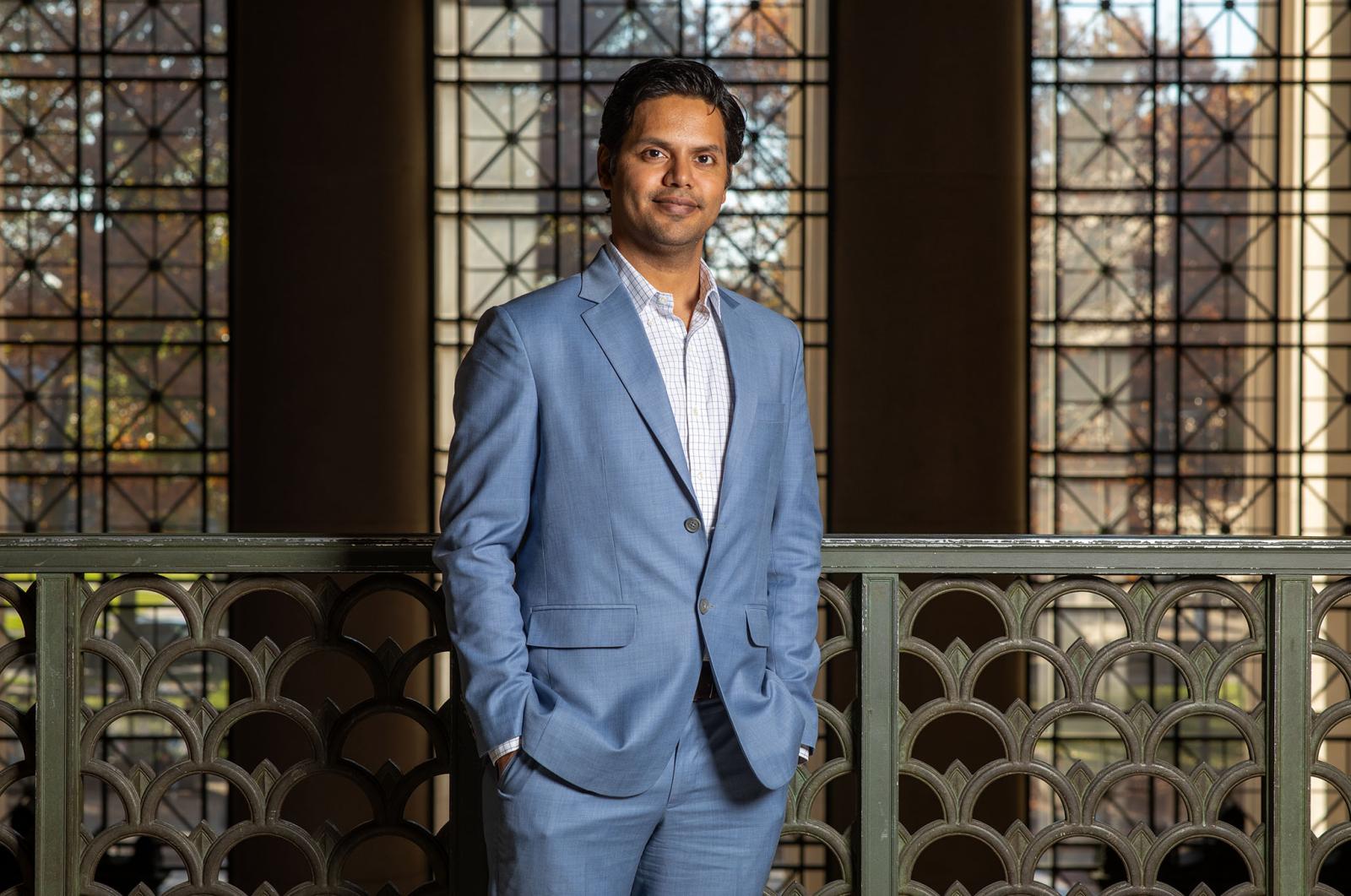
Faez Ahmed is an Associate Professor at the Department of Mechanical Engineering, Massachusetts Institute of Technology (MIT), where he serves as the Doherty Chair in Ocean Utilization. He leads the Design Computation and Digital Engineering (DeCoDE) Lab, focusing on integrating machine learning and optimization with engineering design to enhance human-AI collaboration and accelerate design processes. Ph.D., Mechanical Engineering, University of Maryland College Park (2019) B.Tech.-M.Tech., Mechanical Engineering, Indian Institute of Technology Kanpur (2012) His research interests include generative design methodologies, AI-driven optimization techniques, and the development of algorithms that facilitate collaboration between human designers and artificial intelligence systems. This interdisciplinary work spans applications in automotive design , ship hull synthesis , and wind turbine optimization , with a strong emphasis on creating open-source tools and datasets for the engineering community. Recent publications demonstrate his lab's leadership in fields such as 3D CAD generation , multimodal design datasets , and constraint-aware generative models . These works often address challenges in design space exploration , performance prediction , and data-driven design frameworks . Scientific Awards NSF CAREER Award (2025) ASME Young Investigator Award (2024) Google Research Scholar Award (2024) 3M Non-Tenured Faculty Award (2022) University of Maryland Alumni Research Award (2022) Faez Ahmed's lab has trained numerous Ph.D. candidates and postdoctoral researchers, fostering a collaborative research environment that bridges mechanical engineering , artificial intelligence , and computational methods . The DeCoDE Lab actively engages with industry partners and academic institutions, contributing to large-scale datasets and benchmarks that power the next generation of engineering design research.
Vasileios Mavroeidis is an Associate Professor in Digital Security at the Department of Informatics, University of Oslo (UiO). He specializes in security automation and orchestration (SOAR) and cyber threat intelligence (CTI) representation, reasoning, and sharing. He actively contributes to European cybersecurity initiatives, including Horizon Europe, Connecting Europe Facility, and the European Defense Fund, and serves as the primary representative of UiO at the OASIS standards development organization since 2017. Role : Associate Professor Department : Digital Security (SEC), University of Oslo Standardization Involvement : Chairman of OASIS Threat Actor Context (TAC), Leading Contributor to CACAO and OpenC2 Projects : Concordia, CyberHunt, JCOP (Joint Cyber Security Operations Platform), Oslo Analytics, P4C (Partnership for Cybersecurity) His research focuses on cyber threat intelligence (CTI), exploring its taxonomies, sharing standards (STIX, CACAO), and ontologies, with contributions to the European Union Agency for Cybersecurity (ENISA) Cybersecurity Playbooks task force. He analyzes quantum computing's impact on cryptography, develops automated threat detection systems using machine learning (e.g., recurrent neural networks for malware-generated domains), and investigates privacy issues under GDPR. Recent publications highlight his work on LLMs for code stylometry , neurosymbolic AI for cyber defense , and knowledge management systems for CACAO playbooks . His articles span 2017–2025, emphasizing formal verification, biometric data protection, and incident response automation. He collaborates with organizations like OASIS (Threat Actor Context, CACAO, OpenC2) and FIRST (Traffic Light Protocol), and participates in European research projects. His work includes standardization efforts in cybersecurity playbooks , MITRE ATT&CK representation, and quantum-resistant cryptography .
Alberto Salvo is an Associate Professor at the National University of Singapore (NUS), holding a PhD from the London School of Economics. His research spans environmental economics, industrial organisation, and applied microeconomics, with a focus on urban pollution, consumer behavior, and climate action. Environmental Economics & Policy (Undergraduate) Economics of the Environment (PhD) Advanced Industrial Organisation (PhD) His work examines air pollution impacts on health and productivity, fuel switching dynamics in megacities, and behavioral responses to environmental stress. Recent publications analyze particulate pollution in China, temperature effects in tropical cities, and plastic waste patterns linked to food delivery. Notable awards include the JAERE Best Paper Award (2020), Robert Mundell Prize (2010), and Antitrust Policy Award (2007). His collaborations span institutions in Brazil, China, and Singapore.
Dr Virginia Hagger is a Senior Lecturer in Nursing at Deakin University's School of Nursing & Midwifery, part of the Faculty of Health and the Institute for Health Transformation. She specializes in diabetes education, self-management, and psychological wellbeing. Her research focuses on structured education programs, diabetes distress, and workforce development. She holds a PhD and Master of Public Health from Deakin University. Dr Hagger has led numerous national and international studies, including interventions targeting diabetes distress, insulin therapy barriers, and telehealth support. She is affiliated with the Quality and Patient Safety (QPS) Strategic Research Centre and the Australian Centre for Behavioural Research in Diabetes . Awards include the 2019 Alfred Deakin Medal and 2017 Vice-Chancellor's Award for Teaching Excellence. Her teaching spans undergraduate and postgraduate nursing, including units on diabetes pathophysiology and psychosocial contexts. Current doctoral students focus on diabetes distress, social support in Ethiopia, and autonomy in insulin management. Over 30 peer-reviewed articles and grants (e.g., MRFF-funded HypoPAST and LISTEN trials) underscore her contributions to diabetes care innovation and workforce training.
Amin Hammad is a Professor at the Concordia Institute for Information Systems Engineering, with an additional appointment as Affiliate Professor in Building, Civil, and Environmental Engineering at Concordia University. His research focuses on advancing construction technology through digital transformation, automation, and AI integration. He leads work in BIM applications, 4D simulation, robotic systems, and sustainable infrastructure management. His interdisciplinary approach bridges civil engineering with computer science and data analytics. Key research areas include: Automation and robotics in construction (Construction 4.0) BIM and digital twin lifecycle management AI-driven defect detection and inspection systems Occupational safety through exoskeleton performance evaluation Multi-purpose utility tunnel optimization Energy-efficient building systems Recent work emphasizes applying machine learning to construction equipment activity recognition, UAV path optimization for infrastructure inspection, and ontology development for integrated systems. His research addresses industry challenges in productivity, safety, and sustainability through data-driven solutions.
Thompson S.H. Teo is a Professor in the Department of Analytics and Operations (DAO) at the National University of Singapore (NUS) Business School. He holds editorial roles in top journals including European Journal of Information Systems, International Journal of Information Management, and Communications of the AIS. His research spans information systems strategy, business-IT alignment, e-commerce, sustainability, and AI's societal impacts. With over 200 publications, he ranked #143 globally in 2023 among business scientists (research.com) and was recognized in Stanford's top 2% global scientists (2021-2023). Awards include the Best Associate Editor Award (2017) and AIS Distinguished Membership. Thompson's research interests include IT adoption, cyberloafing, supply chain digitalization, and green innovation. He teaches courses on innovation, Industry 4.0, and strategic IT at undergraduate, masters, and executive levels. Notable contributions include frameworks for commute experience analysis and AI adoption market signals. His work bridges theory and practice, addressing challenges in sustainability, organizational behavior, and digital governance. Affiliations: NUS Business School, Distinguished Editorial Advisory Board (IJoIM), Senior Member (INFORMS) Grants & Leadership: Extensive editorial leadership, supervised China Scholarship Council PhD students, and executive programs on innovation design thinking. Key Contributions: Over 270 publications, four co-edited books on IT/e-commerce, and policy-relevant studies on environmental regulations and green tech adoption. His research often employs mixed methods (e.g., QCA for corruption analysis, PLS-SEM for cyberloafing models) and addresses global issues like fake news mitigation via ChatGPT and pandemic-era customer engagement in short videos.
Vasilis Kostakis is a Professor of Technology Governance and Sustainability at Tallinn University of Technology (TalTech), Estonia, and a Faculty Associate at Harvard University's Berkman Klein Center. He is also the founder of the P2P Lab, a global initiative exploring peer-to-peer production systems, and a founding member of the 'Tzoumakers' rural makerspace and CommonEn energy cooperative in Greece. Research Interests : Kostakis focuses on technology governance, sustainability, and commons-based systems. His work critiques traditional economic models and advocates for decentralized, community-driven approaches to energy, production, and knowledge-sharing. Key themes include post-growth economics, cosmolocal scalability, and the intersection of digital technology with local initiatives. Key Contributions : He has pioneered frameworks like 'cosmolocalism' (balancing local and global systems) and 'design global, manufacture local' (Dgml), emphasizing localized production using global digital designs. His projects, such as TheOtherSchool.art and the P2P Lab, aim to democratize access to technology and knowledge. Labs & Collaborations : The P2P Lab acts as a hub for global commons research, while his hometown initiatives in Ioannina, Greece, exemplify grassroots sustainability. Collaborations span academia, civil society, and policy-making to reimagine socio-technical systems.
Mathias Funk is an Associate Professor in the Industrial Design department at Eindhoven University of Technology (TU/e), leading the Things Ecology lab. His research focuses on designing with data and systems behavior, particularly in IoT and medical technology contexts. He co-founded UXsuite GmbH and developed the OOCSI communication framework. With a PhD in Electrical Engineering from TU/e (2011), Funk has held academic roles since 2013, including postdoctoral positions in Electrical Engineering and Industrial Design. He teaches courses like 'Data-enabled design' and supervises projects on AI, data foundry, and OOCSI applications. His work bridges engineering and design, addressing sustainability and human values through systemic design approaches. Education: PhD in Electrical Engineering, TU/e (2011) Computer Science background from RWTH Aachen Postdoc at TU/e's Electrical Engineering and Industrial Design departments Research Interests: Data-driven design methodologies, IoT systems, medical technology innovation, sustainable design practices, and interactive systems for musical expression. Recent work emphasizes telemonitoring efficacy in heart failure care and federated learning applications. Awards: Best Paper Award (2014) Honorable Mention (2021) Grants/Projects: Leading initiatives like MEDICAID (medtech solutions), ACACIA (interpretable AI), and Data-Driven Servitizing in Professional Printing. Active in clinical workflow prototyping and cardiovascular disease detection projects. Lab Activities: Manages the Things Ecology lab, focusing on systemic design challenges in smart ecosystems. Collaborates internationally through spin-offs and visiting lectureships.
Dr. Stefan Bernritter is an Associate Professor of Marketing at King’s Business School, University of London, and Director of the MSc in Digital Marketing. He holds a PhD in Marketing Communication from the University of Amsterdam. His research focuses on digital technologies, consumer-brand interactions, and advertising in evolving media landscapes. Key areas include mobile marketing, social media, gaming, and AI-driven advertising strategies. Previously, he served as Senior Lecturer at Goldsmiths, University of London, and Assistant Professor at the Amsterdam School of Communication Research. His work has been published in top journals like Journal of the Academy of Marketing Science and Journal of Interactive Marketing . He is an Associate Editor at the Journal of Interactive Marketing and holds editorial roles at leading advertising journals. Research interests emphasize consumer behavior in digital environments, including brand safety in multiplayer games, machine learning applications in marketing, and the impact of social media endorsements on self-evaluation. Awards include recognition from the European Advertising Academy and the International Communication Association. Bernritter actively contributes to academic discourse through editorial roles and guest editing. He currently supervises PhD students and teaches strategic marketing courses. His work aligns with UN Sustainable Development Goals related to responsible consumption and economic growth.
Pawel Kaczmarczyk is affiliated with the University of Warsaw's Migration Research Centre and Faculty of Economic Sciences. He also collaborates with the Institute for the Study of Labor (IZA) in Bonn, Germany. His research focuses on migration economics, labor markets, and public policy impacts of migration. Key areas include Ukrainian migration to Poland, gig economy work conditions, and socioeconomic consequences of refugee influxes. He has contributed to policy analyses on EU mobility frameworks and post-2014 conflict migration trends. Key affiliations: Migration Research Centre (University of Warsaw), Faculty of Economic Sciences (University of Warsaw), IZA Institute of Labor Economics Research emphasizes migration's fiscal impacts, labor market integration, and demographic shifts His work spans Eastern European migration dynamics, refugee integration challenges, and evaluation of migration policies in post-communist contexts. He has addressed contemporary crises such as the Ukraine-Russia conflict's migration repercussions through empirical analyses.
Brendan T. O'Connor is an Associate Professor at the College of Information and Computer Sciences, University of Massachusetts Amherst, where he directs the SLANG Lab and serves as Associate Director of the Computational Social Science Institute. His research bridges statistical machine learning and natural language processing with social science applications, particularly using text data from news and social media to understand societal patterns. His work focuses on developing text analysis methods to answer social science questions in domains like political science and sociolinguistics. Current collaborative projects include combating misinformation, analyzing bias in news coverage, and developing tools for clinical discourse assessment using large language models. O'Connor's publications demonstrate a consistent focus on computational social science, with recent work exploring multilingual analysis, legal discourse patterns, and sociolinguistic variation. His methodological contributions span coreference resolution, event extraction, and argument mining. At UMass, he contributes to multiple research centers including the Computational Social Science Institute, UMass NLP group, and Centers for Data Science and Intelligent Information Retrieval. He teaches graduate seminars in natural language processing and maintains active collaborations across disciplines.
Karyn Moffatt is an Associate Professor in the School of Information Studies at McGill University and holds the Canada Research Chair in Inclusive Social Computing. As Graduate Program Director for the PhD program, she leads the Accessible Computing Technologies Research Group (ACT Lab), focusing on designing inclusive computing applications that support social engagement across diverse lifespans and abilities. Her work bridges human-computer interaction, accessibility research, and real-world community impact. Educational background: PhD in Computer Science, University of British Columbia MSc in Computer Science, University of British Columbia BASc in Computer Engineering, University of British Columbia Research Interests: Dr. Moffatt's work centers on inclusive social computing with emphases on aging populations , disability access , and intergenerational communication . She investigates how technology can overcome barriers to social participation through co-design methodologies, particularly for older adults and individuals with cognitive or physical disabilities. Current projects explore AI-enhanced aging support, dementia-friendly social platforms, accessible financial technology, and respite care coordination systems. Her approach integrates participatory design with rigorous usability testing to create solutions that address real-world challenges in healthcare, finance, and community engagement. Publication Trends: Analysis of her 15 most recent publications reveals consistent focus on aging and accessibility (60% of works), with growing emphasis on AI ethics (2025), dementia support systems (30% of 2023-2024 works), and accessible financial technology (2024). Methodologically, 75% employ co-design or participatory approaches, while 40% involve longitudinal field studies. Key venues include CHI (33%), ASSETS (20%), and ACM Transactions on Accessible Computing (27%), demonstrating leadership in top-tier HCI and accessibility forums. Scientific Awards: Multiple Best Paper Awards from ASSETS, CHI, and CSCW conferences Canada Research Chair in Inclusive Social Computing Advising and Grants: Dr. Moffatt currently supervises PhD candidates Chong Hu and Muhe Yang, having graduated four students since 2022 including Maurício Fontana De Vargas (2023) and Carrie Dai (2023). Her active grants include: NSERC Discovery Grant (2024-2029) as PI: Ethical AI for active aging Canada Research Chair renewal (2022-2027) as PI McGill Nursing Collaborative grant (2023-2025) as Co-I: iRespite mHealth app for palliative care Labs and Teams: She directs the ACT Lab, which partners with healthcare providers, public libraries, and community organizations to develop and deploy inclusive technologies. Current initiatives include the QuickPic AAC system for speech therapy, dementia-focused social programs with Montreal libraries, and Quebec-wide respite care coordination tools, all developed through interdisciplinary collaboration with clinicians, caregivers, and end-users.
Benjamin Andrew Toll is a Professor in the Department of Public Health Sciences and Psychiatry at the Medical University of South Carolina (MUSC) College of Medicine. He serves as Associate Director of Education and Training for the Hollings Cancer Center, Vice Chair of Research in the Department of Public Health Sciences, Co-Director of the Lung Cancer Screening Program, and Director of the Tobacco Treatment Program at MUSC. Dr. Toll received his BA from Cornell University (1996), MS and PhD from Nova Southeastern University (1999, 2002), and completed his Postdoctoral Fellowship and Internship at Yale University. Dr. Toll is a leading researcher in tobacco cessation, with over 20 years of experience conducting clinical trials focused on developing novel therapeutics for tobacco and nicotine use. His work primarily centers on preventing cancer through tobacco treatment interventions, with particular emphasis on lung cancer screening patients and cancer surgery patients. He has expertise in nicotine replacement therapy, contingency management approaches, gain-framed messaging, and digital health interventions for smoking cessation across diverse populations including older adults and young adults. His recent publications demonstrate a strong focus on implementation science for tobacco treatment programs across various healthcare settings including hospitals, oncology clinics, and primary care. His research examines barriers to treatment, optimal delivery methods (including telehealth and EHR-integrated tools), and effectiveness of various pharmacological and behavioral interventions for smoking cessation. National Cancer Institute funding (R01CA235697, R01CA207229, P50CA196530) National Institute on Drug Abuse funding (P50DA036151, K12DA000167) Continuous funding for over 15 years for tobacco cessation research As a mentor and leader, Dr. Toll oversees the Education and Training program at the Hollings Cancer Center, guiding the development of future cancer researchers. His Tobacco Treatment Program serves as a model for integrating tobacco cessation into comprehensive cancer care, and he has successfully implemented 'opt-out' tobacco treatment programs across multiple hospital systems in South Carolina. Dr. Toll leads a multidisciplinary research team focused on tobacco treatment, including psychologists, pharmacists, physicians, and implementation scientists working together to develop and test innovative approaches to smoking cessation for high-risk populations.
Susan Holmes is Professor at the School of Media, Language and Communication Studies at the University of East Anglia (UEA), where she joined as Reader in Television in 2007 and was appointed to Professor in 2018. She is an active member of several research groups including Media Equality, Film, Television and Media, Gender and Its Intersections Steering Committee, and HealthUEA. Her work spans television studies, celebrity culture, and feminist approaches to eating disorders. Professor Holmes received her academic training at the University of Sussex (BA in English and Media Studies), followed by an MA in Film from the University of Southampton, and completed her PhD on British film and television in the 1950s at the same institution. Prior to joining UEA, she taught Media and Cultural Studies at the Southampton Institute (now Southampton Solent University) and television and film at the University of Kent. Her research focuses on several interconnected areas that challenge traditional disciplinary boundaries. In television studies, she has made significant contributions to understanding British television history, particularly through her books 'British TV and Film in the 1950s' and 'Entertaining TV: the BBC and Popular Programme Culture in the 1950s,' where she challenges canonical ideas about early BBC television. Her work on reality TV examines historical development, generic labeling, and celebrity. Since 2014, she has conducted important empirical research on feminist approaches to eating disorders, analyzing media representations and working directly with people with lived experience. A key focus of this research examines how feminist approaches are neglected in contemporary eating disorder treatment, with implications for both clinical practice and cultural understanding. She co-founded the influential Celebrity Studies journal in 2010 and edited it for the first eight years of its publication. Analysis of Professor Holmes' recent publications reveals a clear trajectory where her expertise in media and television studies converges with her feminist scholarship on eating disorders. Her most recent work (2023-2025) increasingly focuses on cross-cultural applications of feminist approaches to eating disorders (including work in China), the use of innovative methodologies like Photovoice, and examinations of therapeutic alliance in treatment settings. Simultaneously, she continues to analyze contemporary media representations, particularly focusing on motherhood, true crime television, and reality TV through feminist lenses. This dual focus demonstrates how media representations shape cultural understandings of both celebrity and health conditions. Professor Holmes' significant contributions to academia have been recognized with several prestigious awards: Senior Fellowship from Advance HE (2024) UEA engagement award (2017) ALPSP award nomination for Celebrity Studies as best new journal (2011) She currently runs the Feminist Media Studies research cluster at UEA and is actively supervising postgraduate research in areas including popular television, television/film history, British TV history, stardom/celebrity, and feminist approaches to eating disorders. Her current major research project is the 'ALLIANCE study' (2024-2026), funded by the National Institute for Health and Care Research, which aims to develop practice and policy recommendations to support effective therapeutic alliance in inpatient treatment for eating disorders. This builds on her earlier British Academy-funded research on 'Entertaining Television: British TV, the BBC and Popular Programme Culture in the 1950s' (2007-2008). Professor Holmes plays a significant role in the academic community through her editorial work, serving on the boards of journals including Archives of Psychology, Big Data & Society, and Critical Studies in Television, and previously as co-founder and editor of Celebrity Studies. She has also been active in media engagement, contributing expert commentary on topics ranging from Netflix's portrayal of eating disorders to Celebrity Big Brother.
Dr. Gary Brewer is a Professor in the Department of Entomology at the University of Nebraska-Lincoln, with a 60% research and 40% teaching appointment. He has served as department head at NDSU (1997-2006) and UNL (2006-2018). His research focuses on field crops entomology, IPM of pasture cattle flies, salt creek tiger beetle conservation, and pollinator health. He has pioneered a push-pull strategy using coconut oil-derived repellents and led curriculum design for Rwanda’s Conservation Agriculture program. Education: B.S. in Zoology, University of Nebraska-Lincoln (1974) M.S. in Entomology, University of Nebraska-Lincoln (1978) Ph.D. in Entomology, Kansas State University (1984) Research Interests: Brewer’s work spans insect ecology, pest management, and conservation. Key areas include stable fly and horn fly control, pollinator protection, and endangered species recovery (e.g., Salt Creek tiger beetle). His lab develops natural product-based pest repellents and evaluates biopesticides for sustainable agriculture. Grants & Contributions: $362,150 USDA grant for undergraduate research in beneficial insect protection (2018) $325,000 USDA grant for multi-tactic stable fly control (2017) NE Game and Parks funded salt creek tiger beetle reintroduction programs Labs & Teams: Brewer’s team collaborates with industry (e.g., Vestergaard Frandsen) and international partners to advance IPM strategies. His work bridges field research with applied solutions for farmers and conservationists.