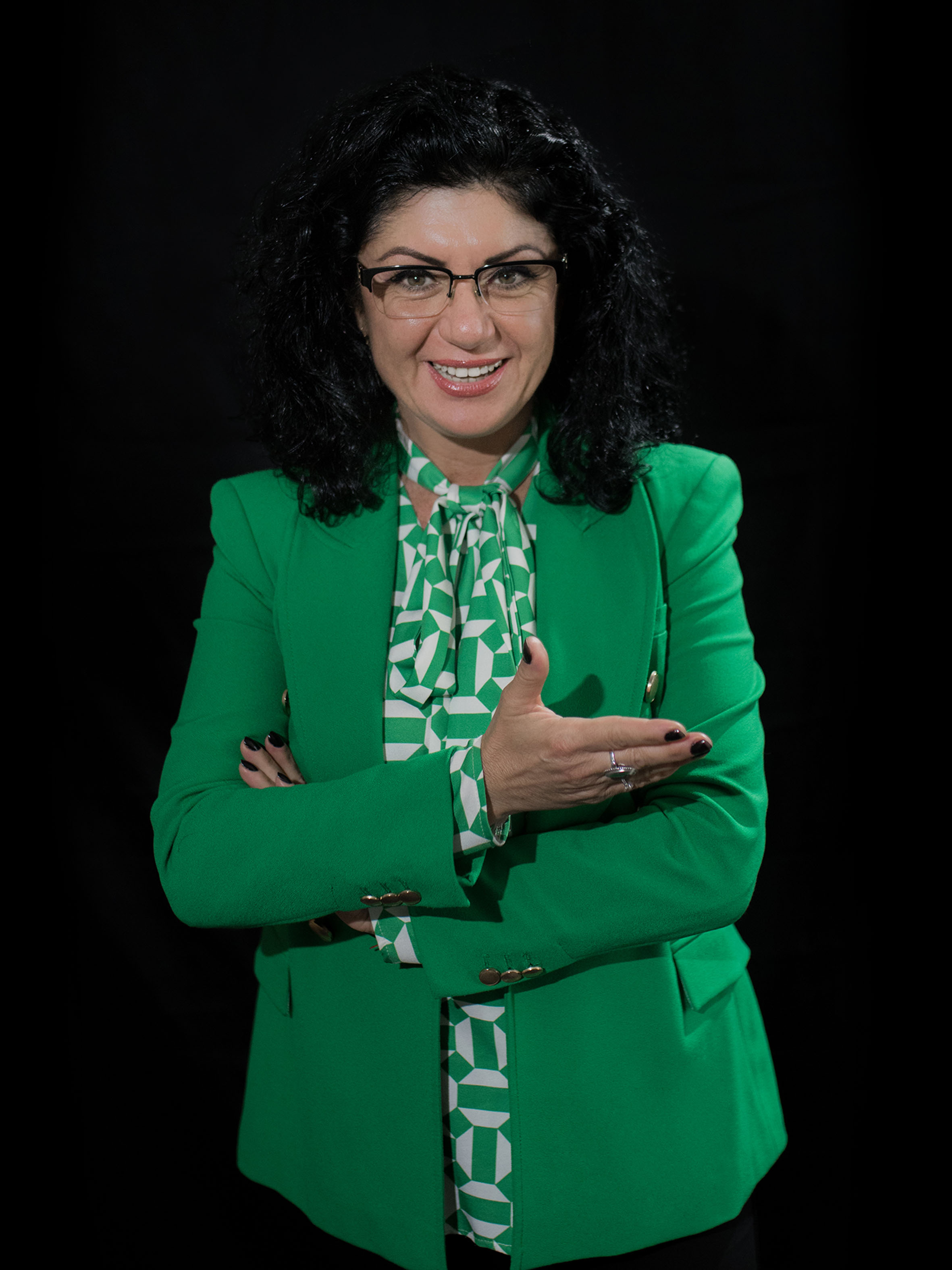
Michela Deni is a University Professor of Semiotics and Director of the PROJEKT research team at the University of Nîmes. She holds an HDR (2015) and a PhD from the University of Bologna (supervised by Umberto Eco). Her research focuses on semiotics, design methodology, and educational strategies in design. She co-leads the Master's program 'Design, Innovation, Society' (DIS) and chairs the 'Epistemology of Design/Ethics and Methodology' cross-disciplinary axis within PROJEKT. Her academic roles include membership in the University Council, Doctoral College, and International Relations Commission. She has supervised numerous theses and co-authored influential works like Oggetti in azione (2002), widely used in Italian design curricula. Her recent publications explore semiotic applications in social innovation, risk communication, and user integration strategies, available via HAL. She has held teaching positions across Italian and French universities, including the ISIA Florence and Politecnico di Milano. Her editorial roles include co-coordinating Ocula.it and contributing to Design Arts Médias .
Johanna Gummerus is a Professor of Marketing at the Hanken School of Economics, specializing in service marketing and management with a focus on Transformative Service Research, innovation, and digital marketing. She examines technology's impact on consumer behavior, corporate social responsibility, and vulnerable consumer groups' well-being. Her work bridges theory and practice, contributing to academic journals like the Journal of Service Research and editorial roles at Journal of Services Marketing . Her research interests include service design, technology infusion in services, and ethical marketing practices. She has published over 30 peer-reviewed articles, emphasizing value creation in service systems and consumer agency. Key themes in her work explore service innovation dynamics, consumer vulnerability, and systemic challenges in service ecosystems. Her recent publications highlight immersive service experiences, captive service systems, and psychological interventions for vulnerable populations. She advocates for socially responsible marketing strategies that prioritize consumer well-being while advancing theoretical frameworks like marketing-as-practice. Prof. Gummerus actively contributes to academic communities through editorial leadership and theoretical advancements in service systems, emphasizing interdisciplinary approaches to modern marketing challenges.
Professor Karim R. Lakhani is the Dorothy & Michael Hintze Professor of Business Administration at Harvard Business School (HBS), specializing in technology management, innovation, digital transformation, and AI. He leads initiatives like the Laboratory for Innovation Science at Harvard and co-founded the Digital, Data, and Design (D^3) Institute. His research explores open innovation, crowdsourcing, and AI-driven business models, with over 150 peer-reviewed publications. Lakhani holds a PhD from MIT and has taught in HBS's MBA, executive, and online programs. His work bridges academia and industry through partnerships with NASA, Harvard Medical School, and private firms. Education: PhD in Management, MIT SM in Technology and Policy, MIT Bachelor's in Electrical Engineering and Management, McMaster University Research Interests: Lakhani's work focuses on leveraging crowds, open-source communities, and contests to solve complex challenges. He explores how digital technologies reshape industries, emphasizing AI's role in redefining business models. His studies on innovation ecosystems and organizational behavior highlight strategies for competitive advantage in the age of AI. Key Contributions: He co-authored Competing in the Age of AI , a seminal work on AI-driven enterprise transformation. His research on blockchain and digital ubiquity has informed global business strategies. Lakhani's initiatives, including the NASA Tournament Lab, demonstrate practical applications of academic research in real-world innovation. Recognition: Aga Khan Foundation International Scholarship Doctoral Fellowship from Canada's Social Science and Humanities Research Council Advising & Grants: Lakhani advises executives on digital transformation through HBS programs like Competing with Big Data. His grants fund projects on AI ethics, innovation contests, and organizational learning. He has co-developed courses on digital strategy and innovation, blending theory with actionable insights. Labs & Teams: He leads the Crowd Innovation Lab and co-chairs HBS's Business Analytics Program. His collaborations span academia, government, and industry, fostering interdisciplinary problem-solving and scaling innovation.
Stewart Riddle is a Professor in the School of Education at the University of Southern Queensland . His research focuses on the democratisation of schooling systems , increasing access and equity in education , and schooling’s response to critical social issues in complex contemporary times. Research Interests include: Sociology of Education Democratic Education Social Justice and Equity Alternative Schooling Research Methodology English Curriculum and Pedagogy Publications from 2025–2024 examine education policy aporia , relational pedagogy , democratic curriculum design , and critical literacy , with a focus on Australia and Thailand. Key keywords span Education Policy , Relational Teaching , Youth Identity , and Curricular Justice . Teaching : Courses include EDX3270 English Curriculum and Pedagogy in Upper Primary , EDS2210 Junior Secondary English Curriculum and Pedagogy , and EDS4110 Senior Secondary English Curriculum and Pedagogy . He supervises doctoral research on topics like teacher autonomy , student engagement , and alternative education frameworks . Affiliations : Member of the Australian Association for Research in Education and English Teachers' Association of Queensland ; affiliated with the Centre for Heritage and Culture at UniSQ.
Jennifer Gustar is an Associate Professor at the Faculty of Creative and Critical Studies, University of British Columbia Okanagan, specializing in Contemporary Women’s Writing and Postcolonial Literature. Her research employs feminist and postcolonial frameworks to analyze works by authors like Kamila Shamsie and Sarah Waters. University: University of British Columbia Okanagan School: Faculty of Creative and Critical Studies Department: Department of English and Cultural Studies Academic Rank: Associate Professor Research Interests: Jennifer focuses on contemporary women’s literature from the UK, South Asia, and diasporic communities, examining how these works reframe history, ethics, and social change through postcolonial and feminist lenses. She is currently writing a book on British women writers including Helen Oyeyemi and Bernardine Evaristo. Publication Trends: Her scholarship spans feminist aesthetics, postcolonial trauma, and narrative subversion. Recent works analyze Angela Carter’s playful style and postmemory in South Asian diasporic literature. Graduate Supervisions: Brianne Christensen (MA), Dravida Huda (MA), Jannik Eichenaar (PhD) Professional Affiliations: Reviews Editor for Contemporary Women’s Writing , UBCO representative for ACCUTE, Co-editor of Bloomsbury Series: Global Women’s Writing
Ding Fan is an Assistant Professor and Master's Supervisor at the School of Art and Media , Tongji University . Holding a PhD in Engineering (Architecture), he serves as Deputy Director of Academic Development Department and leads the "Urban-Rural Communication and Development Strategy" research team. His work bridges architecture with communication studies through interdisciplinary urban research. Education : Tongji University (B.Arch 2011, M.Arch 2014, PhD 2019), with visiting studies at Polytechnic Institute of Madrid (2012-2013) and Columbia University (2017-2018) Research Interests : Urban-rural communication systems, Media-space interactions, Urban cultural studies, Waterfront regeneration theory, Crossmedia urban analysis, City branding strategies His publications focus on urban transformation through media-theoretical frameworks, with 50+ works in journals like Residential Science & Technology and Urban Planning . Notable monographs include Water-City Symbiosis and Globalization and Localization . He received multiple awards including National Natural Science Foundation Youth Project and Shanghai Super Postdoctoral Incentive Plan. As academic service, he reviews for national science funds and serves on editorial boards of Urban and Rural Communication and Global Contemporary Media Theory . His recent 2024 curriculum on "Media, City and Crossdisciplinary Communication" earned national first-class course recognition. Current projects examine media-architectural intersections in urban regeneration processes.
Sonia M. Altizer is a Professor and Department Head of Entomology at the University of Georgia's College of Agricultural and Environmental Sciences. Her research focuses on the intersection of insect ecology, animal migrations, and the ecology of infectious diseases in natural populations. With a Ph.D. from the University of Minnesota and a B.S. from Duke University, she has established herself as a leading expert on monarch butterfly migration and disease dynamics. Her work combines field studies, laboratory experiments, and mathematical modeling to understand host-parasite interactions in migratory systems. Ph.D. – University of Minnesota B.S. – Duke University Dr. Altizer investigates how migration affects disease transmission in wildlife populations, with particular emphasis on monarch butterflies and their protozoan parasites. Her research explores the evolution of host resistance, parasite virulence, and the impacts of climate change and anthropogenic factors on these interactions. She has pioneered studies on tropical milkweed's role in monarch disease risk and developed conservation strategies for declining migratory species. Dr. Altizer's recent articles examine thermal tolerance in butterfly-parasite systems, migratory phenology shifts, and the consequences of resource supplementation for disease dynamics. These publications consistently address climate change effects, pesticide impacts, and conservation-oriented solutions across ecological, evolutionary, and epidemiological contexts. 2025: UGA Distinguished Research Professor 2024: Fellow, Ecological Society of America 2020: AAAS Fellow 2018: Lamar Dodd Creative Research Award 2016: Lothar Tresp Outstanding Honors Professor 2014: UGA Athletic Association Professor of Ecology 2008: Presidential Early Career Award in Science and Engineering (PECASE) 2008: UGA Award for Teaching Excellence As head of the Altizer Lab (altizerlab.org), she leads interdisciplinary research teams investigating migratory animal health, with applications to conservation policy and practice. Her work has shaped understanding of how human-altered landscapes affect disease risks in wildlife populations, particularly for pollinators like monarch butterflies.
Dat Bao is a Senior Lecturer at Monash University's School of Education Culture & Society. Previously, he held positions at Leeds Beckett University (UK), Cornell University (USA), National University of Singapore, and Assumption University of Thailand. His internationally recognized research spans Australia, China, Japan, Philippines, Thailand, Vietnam, and the UK, with nearly 80 publications and numerous plenary conference presentations across four continents. Bao's research centers on silence studies, creative pedagogy in language education, curriculum development, intercultural education, creative thinking, and work-related learning. He investigates silence as a strategic resource in language classrooms and develops innovative approaches to enhance teaching through poetry and creative frameworks. His work bridges theoretical insights with practical classroom applications, particularly in cross-cultural contexts. His 2025 publications reveal three key trajectories:深化研究 on silence as autonomy and relationship-building in teacher-student dynamics, emerging work applying AI (multimodal deep learning) to specialized language domains like legal English, and continued exploration of ecojustice in language teaching. This demonstrates both continuity in his core silence studies and innovative expansion into technological and ecological dimensions of language education. His accolades include: Dean's Award for Excellence in Teaching (2018), Monash University Dat Bao has led multiple externally funded projects, primarily consultancy programs for TESOL teachers from China's Zhejiang Province (2018-2019) and research on Vietnamese graduates' brain circulation. These collaborative initiatives involved Monash colleagues and addressed practical teacher development needs while generating empirical insights into international education flows.
Professor Hee-Sup Han is a distinguished academic in the field of hospitality and tourism management, currently serving as a Full Professor at Sejong University's College of Hospitality and Tourism Management since 2013. He has held visiting positions at The Hong Kong Polytechnic University's School of Hotel and Tourism Management (2019) and previously served as Assistant Professor at Dong-A University's Department of Tourism Management (2009-2013) and as Adjunct Professor at Kansas State University's Department of Hospitality Management (2007-2008). His academic credentials include a Ph.D. (2007) and M.S. (2005) from Kansas State University, and a B.S. (2000) from Dankook University. Professor Han has established himself as a leading authority in hospitality and tourism research with an impressive publication record of over 642 research outputs. Professor Han's research focuses on diverse areas within hospitality and tourism, with particular emphasis on hotel and restaurant marketing, consumer behavior, Muslim tourism, cultural and heritage tourism, airline and cruise tourism, medical tourism, and green marketing. His work consistently explores the intersection of sustainability, consumer psychology, and industry practices, contributing significantly to the advancement of knowledge in these fields. His extensive publication portfolio demonstrates a strong trend toward sustainability-focused research, with increasing attention to environmental, social, and governance (ESG) factors, corporate social responsibility in tourism contexts, and the implementation of sustainable practices across various tourism sectors including airlines, hotels, and heritage sites. Recent work also explores emerging technologies in tourism, cryptocurrency payments, and service automation. Highly cited researcher of the world in social science (Top 1%) - 2019-2023 Most productive author of the world (6th place) - Journal of Business Research Most cited author of the world in hospitality and tourism (2nd place) - International Journal of Hospitality Management Most prolific author of the world in the hotel sector (4th place) - Journal of Hospitality & Tourism Research World's most influential researcher for 2019-2023 (awarded by Web of Science Group - Clarivate) Professor Han's research has significant practical implications for the tourism and hospitality industry, with numerous studies providing actionable insights for destination marketers, hotel managers, and airline executives. His work bridges theoretical frameworks with real-world applications, particularly in understanding consumer decision-making processes and developing effective sustainability strategies. He leads the Hospitality & Tourism Development Lab at Sejong University, which serves as a hub for innovative research in tourism development and hospitality management.
Scott L. Anderson is a Professor in the Department of Chemistry at the University of Utah, with a distinguished career in nanoparticle chemistry and catalysis. He received his B.A. from Rice University (1977), Ph.D. from UC Berkeley (1981), and trained at Stanford (1981-1983). His research focuses on size-dependent catalytic behavior, high-temperature reaction kinetics, and advanced analytical techniques like single nanoparticle mass spectrometry. Chair, Division of Chemical Physics, American Physical Society (2018-2019) ACS Physical Division Award in Experimental Physical Chemistry (2016) Robert W. Parry Teaching Award (2015) Fellow of the American Association for the Advancement of Science (2011) Distinguished Scholarly and Creative Research Award (2007) His work spans cluster model catalysts, oxidation mechanisms, and functional nanoparticle synthesis, with significant contributions to understanding coking resistance, sintering suppression, and surface interactions. He has held visiting positions at institutions in Japan, Germany, and France, and currently serves as Associate Director for Surface Analysis and Nano-imaging at the Utah Nanofab. Selected publications reveal a focus on nanoscale catalysis, thermal stability of nanoparticles, and innovative applications of mass spectrometry. His research bridges fundamental studies of cluster reactivity and practical applications in energy and materials science.
Kaiju Kangas is a Senior Lecturer at the Department of Education, University of Helsinki, specializing in Technology Education and Maker Culture . He coordinates the CreaTE (Creative Technology Education) initiative and supervises doctoral studies under the Doctoral Programme in School, Education, Society, and Culture . His work focuses on integrating Design Learning into educational frameworks, emphasizing creativity and critical thinking. Research Trends : Recent publications highlight intersections between Artificial Intelligence , Maker Education , and Epistemic Competence . He explores pedagogical infrastructures for Multidisciplinary Technology Education , materiality in maker practices, and teacher perceptions of maker mindsets. Scientific Awards : Behavioral Sciences Dissertation Prize (2014) Projects : Leading initiatives like GenAI: Generation AI (2022–2025) and Maker-Centered Learning (2021–2025), funded by the Strategic Research Council and Academy of Finland. His work bridges formal education with maker culture.
Karin Peters is a Full Professor of Romance Literature and Cultural Studies with a Focus on Ibero-Romania at the University of Bonn since 2023. Her academic journey includes a habilitation at Johannes Gutenberg University Mainz (2021-2022), a doctorate from LMU Munich (2010), and a Magister Artium from the same institution (2006). Her research spans transnational literary history, affect theory, pastoral poetry, and intersections of gender and politics in Spanish and Argentinian literatures. Key projects include co-editing The Face as Scene. Virtuality and Embodiment of Affect and leading the network 'Comic Literacies. Cultural Techniques of the Comic' at KWI Essen. She has supervised doctoral work on Iberoamerican Baroque theater and published extensively on Roland Barthes, Georges Bataille, and contemporary Latin American narratives. Her recent publications analyze the European myth of the emotional subject, pastoral masks in Cervantes, and affective economies in 18th-century literature. She has received scholarships from DAAD, Studienstiftung des deutschen Volkes, and e-fellows.net, and actively contributes to academic organizations including the Romanistenverband and the Bonn Center for Dependency Studies.
Lecturer Aydin Uçar has been affiliated with Akdeniz University's Faculty of Architecture, Department of Interior Architecture since 2000. He holds a postgraduate degree in Architecture/Reconstruction and Restoration from Yildiz Technical University (2000) and an undergraduate degree in Architecture from Anadolu University (1997). Education: Anadolu University (B.Arch), Yildiz Technical University (M.Arch) Research Areas: Architecture, History of Architecture and Restoration, Restoration, Engineering and Technology Aydin Uçar's work focuses on architectural restoration, cultural heritage, and spatial planning. His research bridges historical analysis with modern applications, particularly in post-disaster rural settlements and digital fabrication technologies like CNC in furniture design. He has explored the interplay between traditional architecture and contemporary tourism development strategies. His recent projects include the use of AR technology in Phaselis case studies (2022-2024). Uçar has contributed to understanding Anatolian architectural identity through publications on topics ranging from archaeological reconstruction to 20th-century rural modernization. Scientific Awards : Best Papers WSEAS (2010) Grants & Scholarships : SEE together Traveling Academy Scholarship (2022) Travel Grants (2015, 2014) Research Scholarship (2003) Professional Activities : Founder of Pratikiz Mimarlık Ltd. Şti. (2017) Jury member in architectural competitions (2002-2008) Active in international academic conferences (2008-2022)
Daniela Margareta Chiorean serves as University Professor in the Graphics Department at the University of Art and Design Cluj-Napoca, where she has held academic positions since 2000 and currently serves as Prorector responsible for quality assurance (2023-2024). She previously served as Dean of the Faculty of Plastic Arts (2012-2015) and Department Director for Graphics (2015-2023). Concurrently, she maintains an active legal practice as an attorney specializing in civil law and intellectual property at the Cluj Bar Association since 2007. Her educational background includes a PhD in Visual Arts (2007) from UAD Cluj-Napoca with thesis 'Man - Media. Traditional and new media in graphics,' a Master's in Civil Law (2005-2007), Law degree (2001-2005), and dual Master's degrees in Visual Arts (2001-2003). She completed specialized training in intellectual property at WIPO (2002) and cultural management/multimedia in Germany (2002-2003). Chiorean's research bridges graphic design, digital media, and intellectual property law, examining how traditional media interacts with contemporary digital environments. Her work explores symbolic dynamics in advertising, the evolution of typography from Gutenberg to virtual publications, and the legal frameworks governing creative works in digital spaces. She investigates how new technologies transform artistic practices while maintaining connections to historical techniques, with particular focus on remix culture and copyright issues in visual communication. Her publication trends reveal consistent exploration of media transitions, with recent work analyzing digital image processing, urban-nature representations in artificial environments, and comparative studies of display versus print media. These publications demonstrate her interdisciplinary approach connecting artistic practice with scholarly inquiry into media evolution. Premiul UAP România pentru grafică - tineret (2002) Premiul Vespasian Lungu pentru grafică (1997) As a researcher, she has led multiple nationally-funded projects including 'Vector – Design and Book Illustration' (2012) through the National Cultural Fund and 'Center for Promoting Entrepreneurship in Sustainable Development' (2010-2013). She coordinates international collaborations through Erasmus+ and Leonardo da Vinci programs, organizing workshops on infographics, bookbinding, and digital media. Her professional activities span academic leadership, legal practice in intellectual property, and active participation in national and international artistic communities as both creator and evaluator. She coordinates specialized workshops in infographics and bookbinding techniques, and participates annually in the Brâncuși International Workshops for sculpture, painting, and graphics. Her collaborative network extends across European institutions through multiple international partnerships, with recent involvement in Korea's 'O întâlnire și o altă călătorie începe' exhibition (2024).
Verena Krieger is Chair of Art History at Friedrich Schiller University Jena, where she has held a professorship since 2011. Her academic career spans multiple institutions including the University of Applied Arts Vienna (2008-2011), and visiting professorships at the Universities of Bern, Jena, Munich, and Karlsruhe University of Art and Design. She previously served as a research assistant at the Institute of Art History in Stuttgart (1998-2008) and completed her doctorate at the University of Bochum in 1996 followed by habilitation at the University of Stuttgart in 2004. Her research interests focus on art and art theory of modern and contemporary periods, with particular emphasis on ambiguity in art, collage/montage techniques, monument and culture of remembrance, European avant-gardes, gender constructions in art, concepts of the artist and creativity, methods of art history, politics of art, visualization of unborn children, and temporality in art. She approaches these topics through both historical analysis and contemporary theoretical frameworks, often examining the political dimensions of artistic production and exhibition practices. Krieger's recent scholarly output demonstrates a consistent engagement with visual representation in politically charged contexts, particularly regarding Holocaust imagery, right-wing extremism, and memorial culture. Her work shows a methodological commitment to examining ambiguity as both an artistic strategy and a political tool, with increasing focus on decentralized memorial practices and artistic responses to intolerance. Her publications reveal a trajectory from studies of Russian avant-garde and modern art toward contemporary political art practices and memory culture. Professor Krieger supervises numerous doctoral candidates working on diverse topics including Jiri Kolár's work, artistic articulations from Buchenwald concentration camp, art in provenance research, Soviet architecture, art during the German reunification period, and feminist artistic practices in East Germany. Her academic leadership extends to organizing significant conferences on topics such as visual representations from Nazi camps, collage/montage practices, and ambiguous relationships in art and politics. She has directed several major research projects including 'Kunst zur 'Wende'-Zeit' examining artistic reflections of the 1989/90 transformation period, 'Jenseits der Undarstellbarkeit' analyzing artistic artifacts created by concentration camp prisoners, and the 'BrandSchutz' project addressing intolerance through contemporary art. The 'decentrale Denkmal' project for Eduard Rosenthal represents her innovative approach to memorial culture through decentralized artistic interventions across multiple locations in Thuringia.