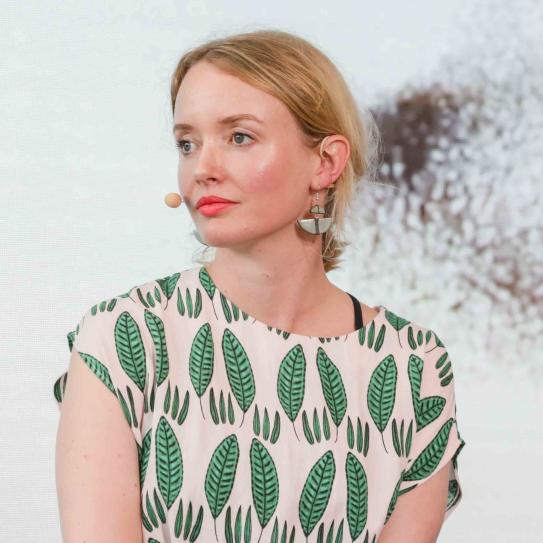
Elizabeth Wilson is Lecturer and Acting Course Leader for MRes Creative Computing at UAL. Her interdisciplinary research explores computer music, AI epistemologies, and human-machine creative collaboration. Her current projects investigate explainable AI for arts, responsible AI music creation with small datasets, and affective modeling for autonomous code generation. She performs internationally as digital selves. Wilson contributes to international initiatives on responsible AI in music and arts. She serves as reviewer for major conferences including NIME, ICMC, and AIMC.
Joana Chicau is an Associate Lecturer at the University of the Arts London (UAL) within the Creative Computing Institute, specializing in the intersection of choreography, digital design, and computational ethics. Her research focuses on widening public understanding of digital systems through embodied practices, emphasizing algorithmic transparency and digital rights. She holds a PhD under Prof. Rebecca Fiebrink, investigating fair data practices in algorithmic design. Chicau’s academic background includes a Master’s in Media Design & Communication from the Piet Zwart Institute and a Communication Design degree from Faculdade de Belas Artes in Porto. She has lectured at institutions like the University of Cambridge, Pratt Institute, and Lucerne School of Art and Design. Her teaching spans UX/UI design, feminist coding, and internet equalities. Her professional activities include organizing events on digital justice and activism, co-founding Netherlands Coding Live, and participating in global conferences like CHI, TEI, and ISEA. She is a Fellow of the Higher Education Academy (FHEA) and has been recognized with awards such as the Connected by Data Fellowship (2024) and grants from the Creative Industries Fund NL. Chicau’s work bridges art and technology through performances, workshops, and collaborative projects addressing data privacy, algorithmic accountability, and embodied interaction. She actively contributes to open-source communities and has curated initiatives like Relearn and Algo~Rhythms series.
Pamela Gershuny, JD is a Professor of Marketing at Southeast Missouri State University. She is affiliated with the Department of Marketing and can be reached at pgershuny@semo.edu or Dempster Hall 254. Her research spans tax law, intellectual property, employment law, environmental policy, and legal education. Her research interests focus on intersections between law and business practices, including tax incentives like the Domestic Production Activities Deduction (DPAD), state and federal copyright law, workplace surveillance policies, and legislative impacts on family welfare. She also explores educational methodologies in legal training and policy implications of climate change regulation. Her publications analyze diverse topics such as corporate use of tax codes, mock trial effectiveness in business law education, and legal conflicts involving parenting responsibilities. While no grants or awards are listed, her work demonstrates a commitment to interdisciplinary legal studies with practical business applications.
Dr. Andrea Surovek is a Professor at South Dakota School of Mines & Technology (SDSMT), serving as Director of Faculty Development within Academic Affairs and the Office of the Provost. She holds a PhD from Georgia Institute of Technology and B.A./B.S./M.S. degrees from Purdue University. A Fellow of ASCE and SEI, she has pioneered work in engineering pedagogy, gender equity, and biomimicry. Her research bridges structural engineering with educational innovation, emphasizing creativity and inclusivity. Education: B.A., B.S., Purdue University M.S., Purdue University Ph.D., Georgia Institute of Technology Research Interests: Surovek’s work focuses on fostering creativity in engineering education, advancing gender equity through mentorship programs, and applying biomimicry principles to sustainable structural design. She has led NSF-funded projects addressing problem-based learning and industry-academia collaboration, while her structural engineering research examines stability in steel framing systems. Her pedagogical innovations include ungraded classrooms and flipped learning models post-pandemic. Scientific Awards: ASCE George Winter Medal (2016) ASEE Seely Fellowship Beer and Johnston New Mechanics Educator Award SDSMT Ennenga Award Grants & Advising: As PI/Co-PI on NSF grants totaling over $3M, her work includes NSF 2121601 (equity pathways) and NSF 2021135 (complex problem-solving). She mentors faculty through South Dakota WISE initiatives and advises on structural sustainability projects. Her Music Adds Up nonprofit supports K-12 music education in Rapid City schools. Labs & Teams: Leads the Engineering Education Innovation Lab and collaborates with the Bioinspired Structures Group . Her work integrates interdisciplinary teams from academia and industry to address global engineering challenges.
Echo Theohar is an Assistant Professor in Applied Computer Science - Media Arts at Woodbury University, located in Los Angeles. She previously earned her BA in Design | Media Arts from UCLA and holds an MFA in Fine Art with an emphasis in Art + Technology from UCSB, supported by Chancellor and Levitan Fellowships. Her work bridges art and technology, focusing on generative visualization, computational literature, surveillance studies, and interdisciplinary performance. Research interests include exploring the impact of technology on societal structures, algorithmic creativity, and the intersection of digital tools with artistic expression. Her projects often critique surveillance mechanisms and military-industrial complexes through generative text and immersive media. She has collaborated with UCLA's World Arts and Cultures department and utilized software like Processing 3, Rita, WordNet, Blender, and Maya. Notable achievements include the VoidLab initiative (2015–2017) and the Critical Coding Cookbook. Awards include both Chancellor and Levitan Fellowships during her MFA. She has presented at institutions like LACMA, The College Art Association, and AUP (Paris), alongside exhibitions internationally. Her teaching includes a Beginning Processing educational web series tailored for young women. Her projects Roleplay Americana (2018–2019) and 3D Sketchbook (2015–2018) showcase her technical versatility and thematic depth, blending generative art with social critique. The Panopticon performance (2017) merges choreography and live video to address anxieties in networked environments. No formal graduate advisees are listed, but her work engages collaboratively with students and interdisciplinary teams.
Dr. Robyn Ruttenberg-Rozen is an Assistant Professor in the Faculty of Education at Ontario Tech University, specializing in inclusive pedagogies within K-16 STEAM education. Her research focuses on equity, innovation, and disrupting deficit perceptions of ability, particularly for underserved, linguistically diverse, and exceptional learners. She has received the 2020 Ontario Tech Early Career Teaching Award and serves as co-newsletter editor for the Canadian Mathematics Education Study Group (CMESG) and editorial board member for the Journal of Educational Informatics . Her teaching spans undergraduate and graduate programs, including courses on mathematics education, STEM integration, and reflective practice. Research Interests: Equity in STEAM education for marginalized populations Interventions for learners with mathematics difficulties Implicit bias awareness in educational spaces Intersectionality in STEM identity formation Online learning equity strategies Teaching Responsibilities: Bachelor of Education: Mathematics Thinking and Doing (Primary/Junior), STEM I & II Master of Education: Principles of Learning, Curriculum Foundations Undergraduate: Reflective Practice/Action Research Awards: Ontario Tech Early Career Teaching Award (2020) Lab/Team: Visit her lab website for collaborative research projects and student involvement opportunities.
Dr. Brigid Barron is a Professor at Stanford University's Graduate School of Education, specializing in developmental psychology and collaborative learning. Her work bridges home, school, and community contexts, focusing on how digital technologies can create equitable learning opportunities. Education : BS in Psychology (UC Santa Cruz, 1984), MA (1989) and PhD (1992) in Clinical and Developmental Psychology from Vanderbilt University. Research interests center on interest-driven learning , learning ecologies , and technology's role in education equity . Current projects include longitudinal studies of learner pathways, family learning teams, and personal learning networks. Recent publications analyze learning ecologies, collaborative problem-solving, and technology's impact on educational equity. Key journals include Applied Developmental Science and Journal of the Learning Sciences . She founded the YouthLAB and co-leads TELOS , a Stanford initiative for equitable technology access. Formerly, she was a lead researcher at the NSF-funded LIFE Center.
Denis Gillet is a Senior Scientist at the École Polytechnique Fédérale de Lausanne (EPFL) , affiliated with the School of Engineering . He leads the REACT Interaction Systems Group , focusing on innovative information systems for interdisciplinary applications including cyber physical systems, digital education, and explainable AI. His roles span research, teaching, and PhD program committee membership. Education : Diploma in Electrical Engineering (1988), PhD in Information Systems (1995) from EPFL Research : Technology-Enhanced Learning, Human-Computer Interaction, Cyber Physical Systems, Explainable AI Grants : Swiss Digital Skills Academy (2021-2024), iHub4Schools (2021-2023), GraphNEx (2021-2023) Students : Supervised 17 PhD students including Abassi Nour Ghalia and La Scala-Jayet Jérémy Alain His recent publications examine AI in education, digital wellbeing, and collaborative learning technologies. He has contributed to over 30 funded projects since 2005, including EU Horizon initiatives and collaborations with MSF.
Dr. Kate Miltner is a Lecturer (Assistant Professor) in Data, AI, and Society at the Information School of the University of Sheffield, where she also serves as Co-Director of the Digital Society Network. She is an active Member of the UK Young Academy and previously held a prestigious Marie Skłodowska-Curie Actions Postdoctoral Fellowship at the Centre for Research in Digital Education at the University of Edinburgh. Dr. Miltner received her PhD in Communication in 2019 from the Annenberg School for Communication and Journalism at the University of Southern California. She also holds an MSc in Media and Communications (Merit) from the London School of Economics and Political Science and a BA in English (cum laude) from Barnard College, Columbia University. Her research program explores critical questions about power and inequality in digital systems, institutions, and cultures. She investigates how power circulates through digital ecosystems, how structural inequalities are (re)produced within digital contexts, and how power and inequality shape experiences in digital spaces for different groups. Her work spans three interconnected research areas: Digital Cultures & Platform Politics , where she examines internet memes, influencer communities, and online misogyny; Digital Skills & Digital Economy , where she critically analyzes the "learn to code" phenomenon as the "coding fetish"; and (Generative) AI and Society , where she examines portrayals of generative AI in media and advertising. Dr. Miltner's recent publications reveal a trajectory from analyzing foundational digital culture phenomena like GIFs and memes toward increasingly critical examinations of AI systems and their societal implications. Her work consistently demonstrates how seemingly trivial digital objects reflect significant power dynamics and structural inequalities. The most recent articles (2023-2024) focus on generative AI's societal impact, platformed solidarity, and the politics of digital representation. AHRC-BBC New Generation Thinkers scheme finalist (2024) Dr. Miltner has held research appointments at Twitter and Microsoft Research New England, was a 2018 Joint Fellow at UC Berkeley's technology centers, and has served as a Guest Researcher at the University of Amsterdam. Before her academic career, she worked in social media strategy and advertising for nearly a decade in major agencies including Saatchi and Saatchi. Her industry experience informs her critical perspective on digital cultures and platforms. She is currently a co-investigator on the Framing Responsible AI Management (FRAIM) project funded by the UK Arts and Humanities Research Council. Dr. Miltner is actively involved with the Digital Society Network at Sheffield and collaborates with institutions including the British Library, Open Data Institute, and Sheffield City Council on responsible AI implementation projects. Her work bridges academic research and practical applications in digital policy and platform governance.
Peggy Bustamante is an Associate Professor of Professional Practice of Journalism at the USC Annenberg School for Communication and Journalism, affiliated with the Department of Journalism. She joined USC Annenberg in 2014 and specializes in teaching coding and data journalism to empower creative professionals in digital storytelling. Her expertise spans data-driven storytelling, interactive web development, and multimedia journalism. Education: Master’s Degree in Information Technology/Computer Science, Harvard University Bachelor’s Degree in English Literature, Harvard University Research & Practice: Bustamante focuses on integrating technology into journalism, including web development (HTML/CSS/JavaScript), data visualization, and interactive storytelling. She emphasizes skills critical for modern journalism and creative industries. Awards: 2012 New York Emmy nomination for Innovation in Online Storytelling (for a 12-part interactive video series) Advising & Leadership: She developed coding and data journalism courses at USC Annenberg and served as Associate Dean for Diversity, Inclusion, and Access (2017–2020), leading a 5-year Diversity Plan rewrite. Her advocacy prioritizes student success in academia and professional careers. Labs/Teams: Oversees interactive coding curriculum and collaborates on digital news platform projects.
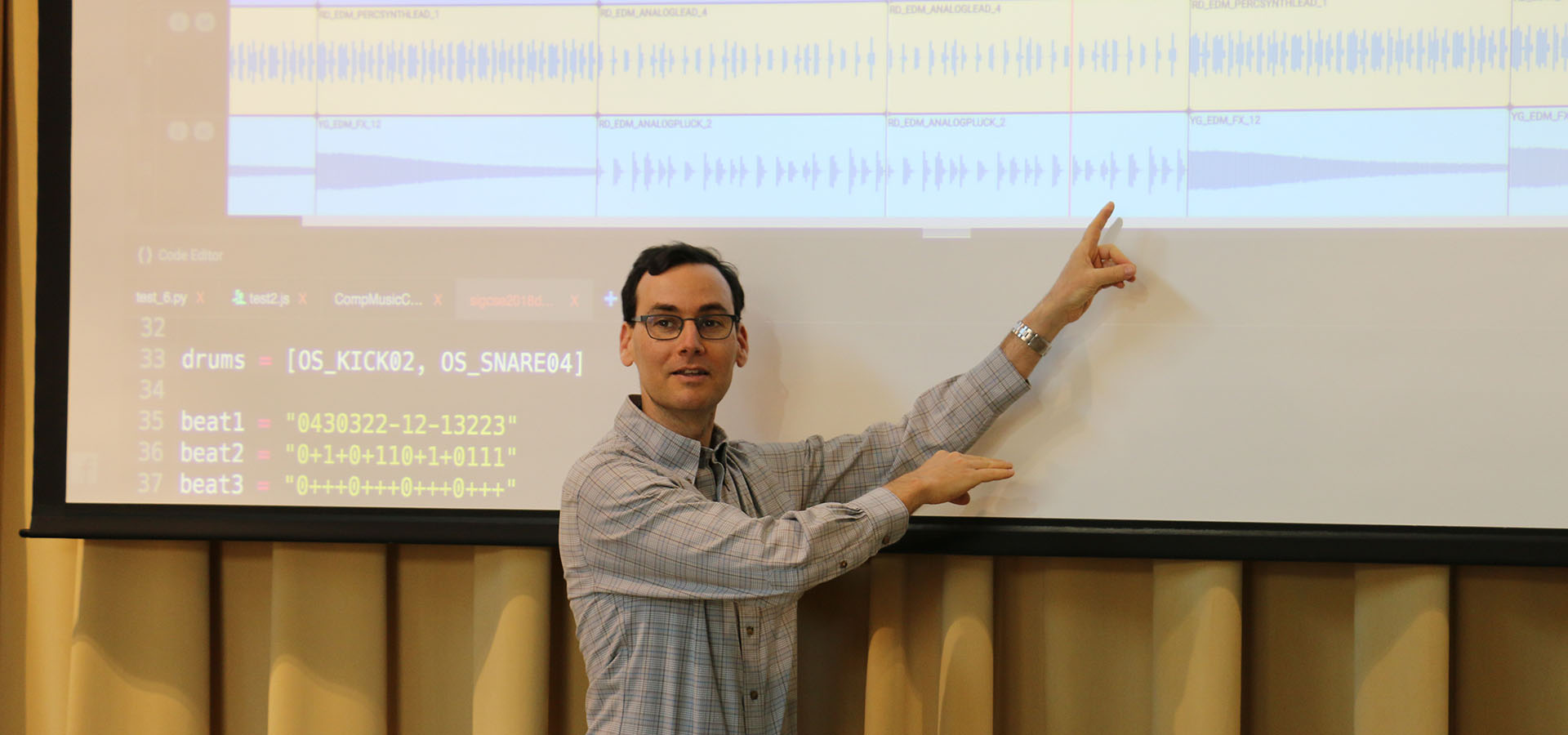
Jason Freeman is a Professor and Chair of the School of Music at Georgia Institute of Technology, part of the College of Design. His research focuses on interactive music, computer science education, and STEAM integration, emphasizing technology-driven engagement in music and broadening participation in computing. Freeman holds degrees from Yale University (B.A.) and Columbia University (M.A., D.M.A.). His work spans creative projects like the EarSketch platform, which teaches coding through music remixing, and collaborations with institutions like the American Composers Orchestra. Freeman has received over 25 awards, including the Best Paper Award at the Web Audio Conference (2022) and recognition from the National Science Foundation, Google, and Amazon. Freeman’s contributions extend to service roles, including leading the Center for Music Technology and initiatives like the Music Tech Metz festival. His research has been published in over 100 refereed journals and conferences, emphasizing computational creativity, educational interventions, and participatory music systems. Key grants include NSF funding for projects like UrbanRemix and CreativeIT, supporting locative media and audience participation. His teaching has been honored with awards such as the Georgia Tech Class of 1934 Teaching Award (2020), reflecting his dedication to pedagogical innovation. Freeman leads the Georgia Tech Laptop Orchestra and collaborates on projects like Ripples, an auditory augmented reality app. His work bridges art and technology, fostering accessible, inclusive engagement in both music and computing.
Andrew Dean is Lecturer in Writing and Literature at Deakin University, affiliated with the Alfred Deakin Institute. His research examines Jewish American literature, computational creativity, and postcolonial metafiction, with publications on authors like Saul Bellow and J.M. Coetzee. Education : PhD from University of Oxford (2017) Dean's award-winning scholarship includes the Landfall Essay Prize (2021) for 'The New Man'. Current projects investigate AI's impact on literary studies while supervising doctoral candidates exploring autofiction, fairy tale revisions, and Jewish-Australian narratives.
Dr. Christina Silver is an Associate Professor (Teaching) in Sociology at the University of Surrey and Director of the CAQDAS Networking Project. She holds a PhD from the University of Surrey (2002), an MSc in Social Research Methods (Surrey, 2000), and a BA (Hons) in Politics and Sociology (Essex, 1997). Her work focuses on qualitative methodology, particularly the integration of technology like CAQDAS software into research and pedagogy. As Director of the CAQDAS Networking Project since 1998, she oversees training programs, advisory services, and course development for researchers globally. Her research explores how software tools like NVivo, ATLAS.ti, and MAXQDA enhance qualitative analysis, with a focus on pedagogical frameworks such as the Five-Level QDA method. She has pioneered online teaching strategies for CAQDAS during the pandemic, emphasizing synchronous learning and digital adaptability. Key contributions include co-developing the Five-Level QDA method, which structures learning through objectives, plans, and software tool utilization. Her recent work addresses AI’s role in qualitative analysis, balancing innovation with critical reflection. She has collaborated with institutions like Southampton and Birmingham Universities on projects such as the Mass Observation longitudinal study. Publications span over two decades, covering CAQDAS software comparisons, methodological debates, and educational innovations. Her work bridges technical proficiency with methodological rigor, influencing both researchers and educators worldwide.
Rosa Filgueira is a Lecturer at the School of Computer Science, University of St Andrews, and Group Leader of the Systems Research Group (SRG). She holds an Honorary Research Fellow title and is a member of the UK Young Academy. Her career includes roles as Assistant Professor at Heriot-Watt University, Vice President Applied Researcher at JPMorgan Chase, and Senior Data Scientist at the British Geological Survey. She earned her BSc and MSc from the University of Deusto (Spain) and a PhD from University Carlos III Madrid (Spain). Her research focuses on advanced information processing technologies to accelerate scientific discovery, emphasizing distributed systems, data-streaming optimizations, and reproducible frameworks. Key areas include serverless computing, adaptive communication techniques, and AI-driven software analysis. She teaches CS3031 Databases (undergraduate) and CS5020 Principles of Computer Communication Systems (postgraduate), supervising multiple student projects. Rosa’s work addresses challenges in health, earth sciences, and digital humanities. Notable projects include cultural analytics frameworks for the creative industries and AI tools for historical text mining. She leads initiatives like the Laminar serverless framework and the frances NLP tool for heritage texts. Her awards include the UK Young Academy membership and National Librarian's Research Fellowship. Current grants include the British Academy-funded Decoding Democracy project. She actively collaborates internationally, contributing to IEEE eScience conferences and open-source projects like dispel4py and Inspect4py. Labs/Teams: Systems Research Group (SRG), leading interdisciplinary collaborations in HPC and data science. Her work bridges computer science with domain-specific applications, emphasizing real-world impact through reproducible software solutions.
Tega Brain is an Industry Associate Professor at New York University’s Technology, Culture and Society department, specializing in Integrated Design and Media. Her work bridges art, environmental engineering, and critical design, addressing ecological challenges, data systems, and infrastructure. She holds a PhD in New Media Arts and Technology from the Australian National University and serves on the board of the School for Poetic Computation. Her research explores how technologies shape agency in ecological contexts, with projects like Solar Protocol and FloodNet addressing climate resilience and equitable urban monitoring. A 2023 Creative Capital Awardee, her work has been exhibited globally, including at the Whitney Museum, Smithsonian, and ZKM. Her book Code as Creative Medium (MIT Press, 2021), co-authored with Golan Levin, explores computational art practices. Key projects include FloodNet , a sensor network for hyperlocal flood monitoring, and Solar Protocol , reimagining the internet as energy-driven. She has received grants for initiatives like Botanical Archives (NEH) and Coin-Operated Wetland . Teaching focuses on creative coding, radical ecologies, and the history of computing. Her exhibitions and publications reflect interdisciplinary engagement with technology’s societal and environmental impacts.