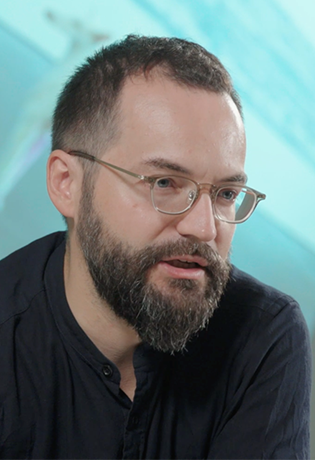
Tom McEnaney is an Associate Professor of Comparative Literature and Spanish & Portuguese at the University of California, Berkeley, and Director of the Berkeley Center for New Media (BCNM). He holds a joint appointment in the Department of Spanish & Portuguese and serves on the Executive Board of UC Cuba. He is affiliated with the Center for Cultural Analytics, the Program in Critical Theory, the Center for Science, Technology, Medicine and Society, and the Data Science Lab (D-Lab). His research focuses on the history of media and technology, Argentine, Cuban, and U.S. literature, sound studies, linguistic anthropology, computational humanities, and new media studies. His book Acoustic Properties: Radio, Narrative, and the New Neighborhood of the Americas (2017) explores the interplay of radio and narrative in Argentina, Cuba, and the U.S., analyzing populism, state socialism, and the reimagining of the vox populi through listening practices. McEnaney’s work has appeared in journals such as diacritics , PMLA , and Representations , and media outlets like The New York Times and Public Books . He is a Mellon New Directions Fellow (2020–2023) in cultural analytics and leads a project on tape technology’s impact on testimonial writing, rock nacional, electronic music, and audiobooks in the Americas. Previously an Assistant Professor at Cornell University, he founded the Latin American Journals Project, an online archive of digitized literary journals from Latin America and the Hispanophone Caribbean. His current affiliations emphasize interdisciplinary collaboration and expanding access to cultural archives globally.
Matthew Louis Mauriello is an Assistant Professor in the Department of Computer and Information Sciences at the University of Delaware , where he directs the Sensify Lab . He holds a PhD in Computer Science from the University of Maryland (2018) and completed postdoctoral work at Stanford University (School of Medicine, 2020; School of Public Policy & Environmental Engineering Department, 2019). Research interests span Human-Computer Interaction (HCI), Ubiquitous Computing, and User-Centered Design with applications in: Sustainability Human-Building Interaction Wearable Technology Personal Informatics Educational Game Design Mental Health Interventions Recent publications highlight trends in stress monitoring (skin-like biosensors, workplace wellbeing), energy auditing (thermography systems), and educational technology (block-based programming tools for teachers). His work appears in ACM CHI, ACM Human-Computer Interaction, and Building and Environment. Scientific awards include: Best Paper Honorable Mention, CHI 2016 Best Paper Honorable Mention, CHI 2015 Best of WebSci'18 Teaching at University of Delaware encompasses courses like Educational Game Design Operating Systems Advanced Web Technologies Computing for Social Good with a focus on project-based learning and systems thinking.
Mark Steedman is a Professor in the School of Informatics at the University of Edinburgh, where he conducts research in Artificial Intelligence, Computational Cognitive and Social Science, and Natural Language and Speech Processing. He is affiliated with the Institute for Language, Cognition and Computation (ILCC), the Centre for Speech Technology Research (CSTR), and the Human Communications Research Center (HCRC). He also holds an adjunct professorship in Computer and Information Science at the University of Pennsylvania. His research focuses on Combinatory Categorial Grammar (CCG) , computational linguistics , prosody and intonation , temporal semantics , gesture in communication , and computational music analysis . He has authored foundational books including Surface Structure and Interpretation , The Syntactic Process , and Taking Scope . The recent publications reflect a strong trend toward integrating formal grammatical frameworks like CCG with modern neural and distributional models, particularly in semantic parsing, entailment reasoning, and cognitive modeling. His work bridges symbolic and statistical approaches in NLP, often focusing on robust, wide-coverage parsing and semantic interpretation. Best Paper Award at AACL/IJCNLP 2023 for 'Smoothing Entailment Graphs with Language Models' Best Paper Award at ACL 2023 for 'Extrinsic Evaluation of Machine Translation Metrics' Influential Paper Award 2017 from IFAAMAS for 'Animated Conversation' Mark Steedman has supervised numerous PhD students and collaborated widely across institutions. He leads research in formal grammar applications to cognitive modeling, dialogue, and multimodal communication. His lab contributes to CCG software and semantic parsing tools, and he continues to be actively involved in advancing the integration of symbolic and neural AI.
Chris Donahue is an Assistant Professor in the Computer Science Department at Carnegie Mellon University . He also serves as a part-time Research Scientist at Google DeepMind on the Magenta team. His work focuses on leveraging generative AI to enhance human creativity, particularly in music. Education: PhD in Computer Science (UC San Diego), Postdoctoral Scholar (Stanford University) His research spans controllable generative modeling of music and audio , with a focus on real-time interactive systems. Projects like Piano Genie , Beat Sage , and Copilot Arena demonstrate his commitment to real-world deployment. His Generative Creativity Lab (G-CLef) explores AI applications beyond music, including programming and natural language. Recent publications highlight advancements in multimodal music evaluation , real-time adaptation , and AI-driven sound morphing . He co-developed Magenta RealTime , an open-weight real-time music generation model, and MusicFX DJ Mode . Scientific Awards: Best Paper Award (top 1) at NAACL Student Research Workshop 2025 Best Paper Award (top 1% of submissions) at CHI 2025 Best Paper Runner-up at ISMIR 2021 He co-advises PhD students like Wayne Chi (NDSEG Fellow) and mentors Irmak Bukey . His lab receives support from the AIxArts incubator fund at CMU .
Celestine Mendler-Dünner is a Principal Investigator at the ELLIS Institute in Tübingen, co-affiliated with the Max Planck Institute for Intelligent Systems and the Tübingen AI Center. She leads the Algorithms and Society research group, focusing on machine learning in social contexts and the role of prediction in digital economies. Her work bridges theoretical machine learning with practical societal impact, developing tools for safe, reliable, and equitable AI ecosystems. Her educational background includes a PhD from ETH Zurich in collaboration with IBM Research, followed by an SNSF postdoctoral fellowship at UC Berkeley hosted by Moritz Hardt. She was previously a group leader at the Max Planck Institute for Intelligent Systems before joining the ELLIS Institute. Mendler-Dünner's research spans several interconnected themes including performative prediction (where predictions change the behavior they aim to predict), algorithmic collective action (how participants can steer AI systems toward common goals), and the role of LLMs in social science research. Her work combines theoretical foundations with practical implementations, addressing challenges in interactive machine learning, optimization in dynamic environments, and context-specific evaluation of AI systems. She particularly examines how algorithmic predictions mediate services and platforms at societal scale, exploring concepts of economic power in digital markets. Her publication record shows a clear evolution from system-aware machine learning algorithms (including foundational work on IBM Snap ML) toward increasingly sociotechnical questions at the intersection of machine learning, economics, and policy. Recent work focuses on measuring performative power in digital economies, evaluating LLMs as risk scores, and developing frameworks for algorithmic collective action in recommender systems and labor markets. Among her notable recognitions are the ETH Medal for her dissertation, the IBM Research Division Award, the Fritz Kutter Award, and the IBM Eminence and Excellence Award. She is an ELLIS Scholar, a fellow of the Elisabeth-Schiemann-Kolleg, and affiliated with several prestigious research programs including the International Max Planck Research School for Intelligent Systems and the Max Planck ETH Center for Learning Systems. ETH Medal (dissertation award) IBM Research Division Award Fritz Kutter Award IBM Eminence and Excellence Award SNSF Early Postdoc Mobility Fellowship Mendler-Dünner actively mentors the next generation of researchers, advising PhD student Patrik Wolf and supervising research interns including Joachim Baumann, Haiqing Zhu, and Anna Badalyan, as well as Master's student Dorothee Sigg. She serves as core faculty for the International Max Planck Research School and associated faculty for the Max Planck ETH Center for Learning Systems. Her group has secured significant research funding through fellowships and institutional support, enabling work on projects like Powermeter (measuring search engine influence) and Snap ML (resource-efficient machine learning library with over 1 million PyPI downloads). She leads the Algorithms and Society research group, which examines machine learning as part of broader sociotechnical ecosystems. The group explores human-population interactions with algorithmic systems and incorporates these insights into learning system fundamentals. Current projects include investigating economic incentives in digital platforms, developing tools for systematic LLM evaluation in social science contexts, and creating frameworks for collective action in algorithmic systems. Mendler-Dünner also co-organizes the Algorithmic Collective Action workshop at NeurIPS 2025, demonstrating her leadership in emerging research directions at the AI-society interface.
Daniel Dominic Kaplan Sleator is a Professor of Computer Science at Carnegie Mellon University's School of Computer Science. He maintains an office in the Gates-Hillman Center (7205 Gates-Hillman) and teaches various courses in algorithms and theoretical computer science. Professor Sleator's research spans several areas of theoretical computer science and algorithms. His primary interests include: Algorithms and Data Structures Amortized Analysis and Competitive Analysis Persistent and Self-Adjusting Data Structures Computational Geometry and Combinatorial Optimization Combinatorial Game Theory and Mathematical Games Music Analysis using Computational Methods His extensive publication record shows a consistent focus on efficient data structures and algorithms. Over the years, his work has evolved from foundational data structures like splay trees and skew heaps to applications in diverse areas such as music analysis and combinatorial games. A notable trend in his work is the development of self-adjusting data structures that achieve excellent amortized performance without maintaining explicit structural constraints. His papers on splay trees, skew heaps, and persistent data structures have become classics in the field. Professor Sleator has made significant contributions across multiple domains of computer science. His work on competitive algorithms for paging and list update problems has been particularly influential, establishing fundamental results in online algorithms. His research extends beyond traditional computer science into interdisciplinary areas like computational music theory, demonstrating the broad applicability of algorithmic thinking. He teaches a variety of courses including Algorithms 15-451/651, Competition Programming 15-295, and specialized topics like mathematical games.
Prof. Roger Wattenhofer is a Full Professor at the Department of Information Technology and Electrical Engineering, ETH Zurich, Switzerland, and Deputy head of the Computer Engineering and Networks Lab. He holds a doctorate in Computer Science from ETH Zurich (1998) and has held positions at Brown University and Microsoft Research before returning to ETH. His research focuses on distributed computing, wireless networks, and algorithmic systems design, with contributions to Byzantine agreement protocols, blockchain technologies, and neural network architectures. He teaches courses such as Distributed Systems and Computational Thinking. Education: Ph.D. in Computer Science (ETH Zurich, 1998). Research interests include distributed systems, network algorithms, and the intersection of machine learning with distributed computing. His work spans both theoretical foundations and practical implementations, addressing challenges in fault tolerance, consensus mechanisms, and algorithmic efficiency. Recent publications explore topics like adversarial robustness in voting systems, privacy in reinforcement learning, and generative music models. He actively contributes to open-source frameworks and benchmarks for neural algorithmic reasoning.
Xavier Serra is a Full Professor at the Department of Engineering at Universitat Pompeu Fabra (UPF), Barcelona. He is the founder and director of the Music Technology Group (MTG), and leads the UPF-BMAT Chair on AI and Music. He also coordinates the Master in Sound and Music Computing and serves as President of the Phonos Foundation. His research focuses on audio signal processing, sound and music computing, and computational musicology, emphasizing open science and open innovation. Education: BSc in Biology, University of Barcelona (1981) Master in Music, Florida State University (1983) PhD in Computer Music, Stanford University (1989) Research Interests: Audio Signal Processing Data-Driven and Knowledge-Driven Methodologies Music Information Retrieval Cultural Music Analysis (e.g., Carnatic/Turkish/Andalusian Music) Music Education Technology Notable Projects: CompMusic (ERC Advanced Grant, 2010-2017): Multicultural computational music analysis Open datasets: Freesound, Saraga, FSD50K Technologies: Reactable, Vocaloid, Essentia API Recent Trends in Articles: Focus on AI-driven audio processing (neural fingerprints, generative models), cross-cultural music analysis, and explainable music difficulty estimation. Awards: ERC Advanced Grant (2010) for CompMusic Project. Labs/Teams: Director of MTG, Phonos Foundation, and UPF-BMAT Chair. Active in open-source projects and international collaborations.
James McCann is an Associate Professor at the Carnegie Mellon Robotics Institute, where he leads the Carnegie Mellon Textiles Lab. He has been a faculty member since May 2017 after working at Disney Research Pittsburgh. McCann's academic journey includes a PhD from Carnegie Mellon advised by Nancy Pollard, followed by a postdoc at Adobe Research and a period developing video games. McCann's research focuses on building creative tools that operate in real-time and build user intuition, with particular emphasis on textiles fabrication and machine knitting. His work spans computer-aided fabrication, simulation, graphics, and creative tools development. He has pioneered systems for machine knitting design, including compilers for knitting instructions and tools for automatic conversion of 3D meshes to knitting patterns. His recent publications demonstrate a strong trend toward computational textiles, with significant contributions to knitting semantics, deployable textile structures, and applications of machine knitting in healthcare and robotics. McCann's work bridges computer science, robotics, and textile arts, creating practical systems for once-off manufacturing with industrial knitting machines. McCann actively mentors students, with current PhD candidates working on solid knitting machines, knit calibration, and assistive devices. His teaching portfolio includes courses on Real-Time Graphics, Algorithmic Textiles Design, and Game Programming. He has taught at CMU since 2017, developing innovative courses that blend computer science with physical fabrication. As director of the Textiles Lab, McCann oversees research projects spanning machine knitting, robotic painting, and real-time graphics systems. His lab develops practical tools for creators, emphasizing intuitive interfaces and real-time feedback that lower barriers to advanced fabrication techniques.
David Lindlbauer is an Assistant Professor at the Human-Computer Interaction Institute (HCII) of Carnegie Mellon University, where he leads the Augmented Perception Lab and co-directs the CMU Extended Reality Technology Center. His research bridges human perception, extended reality (AR/VR), and computational interaction techniques, focusing on developing systems that dynamically adapt interface elements based on environmental context, user cognition, and task requirements. He completed his PhD at TU Berlin under Prof. Marc Alexa and held a postdoctoral position at ETH Zurich's Advanced Interactive Technologies lab. His work has been published extensively at top venues including ACM CHI, UIST, and IEEE VR, with research themes spanning gaze tracking, spatial audio optimization, haptic feedback, and multimodal notification systems. Media outlets like MIT Technology Review and Fast Company Design have featured his innovations. Dr. Lindlbauer has received prestigious grants from Meta, NSF, and ETH Zurich, and serves on program committees for CHI, UIST, and ISMAR. He has been recognized with Best Paper awards at ISS 2023 and CHI 2016, and his lab develops tools like MineXR for personalized XR interfaces and RealityReplay for temporal change visualization in mixed reality environments.
Peter A. Flach is Professor of Artificial Intelligence at the Intelligent Systems Laboratory, School of Computer Science, University of Bristol, where he has been faculty since 1997 and was promoted to Professor in 2003. He currently directs the UKRI AI Centre for Doctoral Training in Practice-Oriented Artificial Intelligence and serves as Vice-President of the European Association for Data Science (EuADS), having previously served as its President. His research centers on rigorous evaluation and improvement of machine learning systems, with seminal contributions to classifier calibration (including Beta Calibration and Precision-Recall-Gain curves), explainable AI frameworks, and data science methodology. He pioneered the extension of CRISP-DM to data science trajectories and developed Explainability Fact Sheets for systematic assessment of XAI approaches. His work bridges theoretical foundations with practical deployment in real-world systems. Analysis of his recent publications reveals a dominant focus on interpretable and reliable machine learning, with strong emphasis on performance evaluation metrics, model calibration techniques, and human-centered explainability. His research increasingly addresses healthcare applications through projects like SPHERE and clinical decision support systems, while maintaining core contributions to fundamental ML theory. His scientific recognition includes prestigious fellowships: Fellow of the European Lab for Learning and Intelligent Systems (ELLIS) Fellow of the European Association for Artificial Intelligence (EurAI) Professor Flach has secured major research funding including UKRI Centre for Doctoral Training grants and EU network funding (TAILOR). He leads extensive collaborations across Engineering, Population Health Science, and international institutions (Monash University, Polytechnic University of Valencia), plus over 20 industry partners in the Practice-Oriented AI CDT including LV= and QinetiQ. His work with the SPHERE project demonstrates successful translation of AI research into residential healthcare settings. He leads the Intelligent Systems Laboratory at Bristol, which develops influential open-source tools including the FAT Forensics Python toolbox for algorithmic fairness and the Explainability Fact Sheets framework. His lab maintains strong connections with the European AI community through ELLIS and EurAI, positioning Bristol as a hub for human-centered and methodologically rigorous AI research.
Dr. Damien Charrieras is an Associate Professor at the School of Creative Media , City University of Hong Kong, where he serves as Program Leader for the Master of Art in Creative Media and deputy program leader for the PhD in Creative Media. His work bridges cultural studies, new media theory, and the intersection of financial technologies with artistic practices through the ACIM Laboratory for Interventions in Speculative Finance . Doctoral research on digital artists' trajectories in Montreal FRQSC Postdoctoral Fellowship at McGill University Research spans game engine design , datafication of creativity , blockchain in art , and post-anthropocentric creative processes . With over HK$3.14M in grants as Principal Investigator, he explores situated digital creativity in urban contexts, critical worldbuilding pedagogy , and the mediation of technical systems in cultural production. His publications in Cities , Organized Sound , and Human Relations analyze the reconfiguration of artistic practices through software infrastructures and automation paradigms. Scientific awards include: FRQSC Postdoctoral Fellowship
Julian McAuley is a Professor in the Department of Computer Science and Engineering at the University of California, San Diego's Jacobs School of Engineering. His research spans recommender systems, machine learning, natural language processing, music information retrieval, and multimodal learning. He maintains an active research group with numerous PhD students and postdocs working on cutting-edge AI problems. His research interests focus on developing advanced algorithms for personalized recommendation systems, with particular emphasis on sequential recommendation, multimodal learning, and integrating large language models with traditional recommendation approaches. His work bridges the gap between theoretical machine learning and practical applications across multiple domains including e-commerce, music, and healthcare. McAuley has published extensively in top-tier conferences including NeurIPS, ICML, KDD, SIGIR, and ACL, with his most recent work exploring the intersection of large language models and recommendation systems. His publications reveal a strong trend toward multimodal approaches that combine text, vision, and audio for more comprehensive understanding and recommendation. He has received significant research funding from major technology companies including Google, Amazon, Facebook, Adobe, and Samsung, as well as government agencies like the National Science Foundation and Department of Defense. His work has practical applications across multiple industries, with a focus on improving user experience through better personalization. McAuley advises numerous PhD students who have gone on to successful careers at leading technology companies and academic institutions. His former students include Wang-Cheng Kang and Jianmo Ni at Google DeepMind, Chris Donahue and Zachary Lipton as assistant professors at CMU, and Ruining He at Google Deepmind.
Dr. George Stamou is a Professor at the School of Electrical and Computer Engineering of the National Technical University of Athens (NTUA), serving as Director of the Artificial Intelligence and Learning Systems Laboratory (AILS). His expertise spans knowledge representation, machine learning, neural networks, and semantic technologies. He leads interdisciplinary initiatives such as the postgraduate program 'Data Science and Machine Learning' (2018–2022). Research Interests: Focuses on knowledge graphs, interpretable AI, semantic web applications, and multimodal learning. His work integrates formal logic systems (e.g., description logics) with modern deep learning techniques, addressing challenges in explainability, bias detection, and ethical AI applications. Publications: Over 150 articles in AI journals/conferences with an h-index of 34 (Google Scholar). Notable contributions include datasets like CHORDONOMICON (music analysis), GOSt-MT (gender bias in MT), and methodologies for counterfactual explanations in machine learning. Awards & Committees: Active in W3C and RuleML standardization bodies. Co-organized major AI conferences. Recognized for contributions to semantic interoperability and knowledge-based systems. Labs & Teams: Directs AILS-NTUA lab and collaborates with CISRI (Computer & Information Systems Research Institute). Engages in EU projects like CultureLabs (cultural heritage digitalization) andsmarty4covid (health data analysis).
Wenhu Chen is an Assistant Professor at the University of Waterloo's Computer Science Department and a CIFAR AI Chair at the Vector Institute. He also holds a part-time role as a Senior Research Scientist at Google DeepMind (20% allocation). His research focuses on natural language processing, deep learning, and multimodal reasoning, with contributions to models like MAmmoTH, OpenCoderInterpreter, and VISTA. He received awards including the Canada CIFAR AI Chair (2022) and the UCSB CS Outstanding Dissertation Award (2021). Education: PhD in Computer Science from the University of California, Santa Barbara (under William Wang and Xifeng Yan). Research interests include complex reasoning, controllable GenAI, and multimodal benchmarks like MEGABench and MMMU. Grants include CIFAR AI Chair Funding (2022-2027), NSERC Discovery Fund (2023-2028), and multiple NRC Canada grants. He directs the TIGER Lab, advancing generative models in text, images, videos, and music. Recent talks include presentations on multimodal reasoning at Apple and NeurIPS workshops.