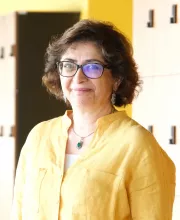
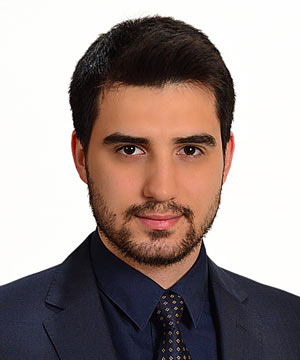
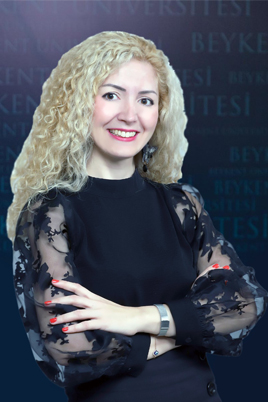
Assoc. Prof. Dr. Sema Alaçam Doğan has been affiliated with Istanbul Technical University since 2014, serving as an Associate Professor in the Department of Architecture . She has held administrative roles including Deputy Head of Department and Erasmus Coordinator. Education : PhD in Informatics in Architectural Design (2008-2014), MS in Informatics in Architectural Design (2005-2008), and BS in Architecture (1999-2005) from Istanbul Technical University. Her research explores Computational Design , Artificial Intelligence in Architecture , and Sustainable Material Innovation . She investigates digital tools for heritage preservation, daylight optimization in BIM, and cognitive development in architecture students. Recent publications analyze AI-assisted design literacy , machine learning for Sinan mosques , and environmental comfort in Harran houses . Her work integrates algorithmic frameworks with sustainable practices. Scientific awards include multiple ITU Publication and Performance Awards (2021-2024), FABFEST Prizes , and the 2024 Artemis Educator Award from NASA. Active projects like "Physical Computation in Architectural Drawing" and "Robotic Fabrication with Recycled Wind Turbine Blades" demonstrate her leadership in computational and sustainable research.
Can Güler is an Assistant Professor in the Department of Lifelong Learning and Adult Education at the Faculty of Education, Anadolu University, Turkey. Previously, from 2002 to 2023, he served as a Lecturer in the Department of Distance Education at the Faculty of Open Education, Anadolu University. His academic career spans over two decades with continuous contributions to open and distance education systems. His educational background includes: Bachelor's degree in Computer and Instructional Technologies Education, Anadolu University (2002) Master's degree in Distance Education, Institute of Social Sciences, Anadolu University (2007) Ph.D. in Distance Education, Institute of Social Sciences, Anadolu University (2022) Güler's research centers on open and distance learning methodologies, educational technology integration, and instructional material development. He specializes in video-based learning systems, interactive media design, and gamification strategies for enhancing learner engagement. His work addresses practical challenges in digital content creation and accessibility for diverse learner demographics, particularly adult populations. Analysis of his publication trajectory reveals consistent innovation in multimedia applications for distance education, with recent emphasis on generative AI awareness among educators and interactive video transformation techniques. His research frequently employs design-based methodologies and institutional case studies from Anadolu University's open education infrastructure. Scientific Awards: None mentioned in available sources. Advising and Grants: No information provided regarding student supervision or research funding in current documentation.
Prof. Dr. Ahmet ÖZMEN is a Professor at Sakarya University's Faculty of Computer and Information Sciences, Department of Software Engineering. He has held various administrative positions including Head of the Software Engineering Department (2019-2028) and Director of the Computer Research and Application Center (2019-2022). With extensive experience in academia since 1991, he has made significant contributions to computer vision, traffic monitoring systems, and sensor technologies. Sakarya University: Professor (2019-present), Associate Professor (2011-2019) Dumlupınar University: Assistant Professor (2001-2011), Research Assistant (2000-2001, 1993-1998) Istanbul Technical University: Research Assistant (1991-1993) Prof. ÖZMEN's research spans computer vision applications for traffic monitoring, indoor air quality systems, parallel computing, and sensor technologies. His work bridges theoretical computer science with practical engineering applications, particularly in developing vision-based systems for nighttime vehicle detection, traffic flow monitoring, and environmental sensing. His interdisciplinary approach combines machine learning, image processing, and embedded systems to solve real-world problems in transportation and environmental monitoring. His publication record shows a clear evolution from parallel and distributed systems in his early career to computer vision and sensor applications in recent years. The majority of his recent work focuses on traffic monitoring systems using computer vision techniques, particularly for nighttime conditions, and indoor air quality monitoring systems using sensor networks. His research demonstrates strong industry and societal relevance, with applications in smart transportation, environmental protection, and educational technology. TÜBİTAK Publication Awards (2006, 2008, 2009, 2010) Physical implementation award from TÜBİDER (2008) Microsoft Certified Professional Certificate (2005) YÖK overseas study scholarships (1993, 1998) Elginkan graduate scholarships (1990, 1991) Prof. ÖZMEN has supervised numerous graduate students across multiple institutions, with a focus on practical engineering problems. His research has been supported by various projects including TÜBİTAK projects, institutional research grants, and industry collaborations. He has led significant research initiatives in traffic monitoring systems, indoor air quality monitoring, and educational technology platforms. His administrative leadership has included directing research centers and shaping curriculum development in software engineering. His work has involved establishing research teams focused on computer vision applications, sensor network development, and educational technology. These teams have produced numerous publications, developed practical systems, and trained the next generation of computer engineers. Current research directions include advanced traffic monitoring systems using deep learning and multi-camera setups for urban planning applications.
Assoc. Prof. Dr. Ali Şükrü Özbay currently serves as an Associate Professor at Karadeniz Technical University's Faculty of Arts, Department of English Language and Literature. He earned his PhD and MA in Applied Linguistics from Karadeniz Technical University and holds a BA in English Language and Literature from Ankara University. Education : PhD (2015) and MA (2004) from Karadeniz Technical University; BA (1996) from Ankara University Dr. Özbay's research focuses on Corpus Linguistics , Learner Corpora , Academic Writing , Translation Studies , and Language Pedagogy . His work investigates lexical bundles, support verb constructions, and pragmatic markers through computational corpus analysis. Recent publications analyze four-word recurrent expressions in educational technology contexts, collocational priming in Turkish EFL learners' mental lexicon, and semantic prosody of intensifiers in academic corpora. He supervises theses on data-driven learning applications and corpus-based teaching materials. Dr. Özbay has held managerial roles including Deputy Head of Department (2019–present) and Assistant Coordinator for Erasmus+ programs (2017–2021). He actively participates in international conferences and has published in journals like Turkish Studies , Australian Journal of Applied Linguistics , and Hacettepe Eğitim Dergisi .
Tülin Haşlaman is an Associate Professor at the Department of Elementary Education - Primary Education, TED University. She holds roles as a Coordinator and Vice Head of Department. Her teaching portfolio includes courses such as Instructional Technologies, Technology-Enhanced Language Learning, and Micro Teaching, reflecting her expertise in educational technology and pedagogical innovation. Her research focuses on ICT integration in education, self-regulated learning strategies, and teacher development. Notable areas of interest include the use of digital storytelling for computational thinking, infographics in supporting student autonomy, and smartphone addiction among university students. She has also studied the impact of social media platforms like Facebook on teacher training and the integration of ICT into teaching processes. Dr. Haşlaman’s work emphasizes bridging technology with educational practices, particularly in primary education contexts. Her articles highlight themes such as pre-service teacher digital competency, disabled teachers’ technology integration challenges, and peer assessment in online environments. Despite her extensive academic contributions, she has no explicitly listed awards or grants in the provided materials. Her courses over the years span foundational education topics like Learning Environments, Observation in Schools, and Research Methods, demonstrating a commitment to both theoretical and applied aspects of education. While she has not specified any affiliated labs or teams, her teaching and research activities suggest active engagement in educational technology initiatives and teacher professional development programs.
Dr. Gözde Damla Turhan is a Researcher at the Department of Architecture within the Faculty of Fine Arts and Design at İzmir University of Economics, a position she has held since September 2017. She holds a B.Sc. in Architecture from İzmir Ekonomi Üniversitesi (2014), followed by dual Master's degrees: M.Arch in Advanced Architectural Design (2016) and M.Sc. in Architecture (2016). Her Ph.D. in Design Studies (2022) focused on biobased materials, computational design, and digital fabrication. Current research interests include AI applications in design (machine learning, diffusion models, LLMs), and sustainable material innovation. Her work bridges architecture and computational technologies, emphasizing bio-based materials (e.g., bacterial cellulose), digital fabrication methods, and AI-driven design processes. She has explored topics like urban rehabilitation via GANs, NFT art hybrid experiences, and life cycle assessments of unconventional construction materials. Publications (2016–2023) span computational form-finding, material science, and digital tools in architecture. She actively contributes to design pedagogy, investigating how AI tools like diffusion models can reshape educational frameworks.
Semih Doğu is an Assistant Professor at the Department of Electronics and Communication Engineering , Faculty of Electrical and Electronics Engineering , Istanbul Technical University . His research focuses on Electromagnetic Theory , Microwave Imaging , Inverse Scattering Problems , and Antenna Design . Doctorate: Istanbul Technical University (2023) Master's: Istanbul Technical University (2017) Bachelor's: Yıldız Technical University (2015) His research interests emphasize microwave-based diagnostics, including: Microwave imaging for breast cancer detection Antenna optimization for medical and security applications Inverse problem solving in electromagnetic systems Through-the-wall imaging for surveillance Semih Doğu's recent publications demonstrate his expertise in: Neural networks for temperature monitoring in hyperthermia Ku/Ka-band antenna designs for satellite systems Microwave salinity sensing Algorithm development for improved imaging accuracy He contributes to the ITU Electromagnetics Research Group , participating in projects like: Microwave Brain and Breast Imaging Device Development Compressed Sensing for Energy-Efficient Communication Microwave Tissue Analysis
Tuğçe Bilen is an Assistant Professor at Istanbul Technical University's Department of Artificial Intelligence and Data Engineering, within the School of Computer and Informatics. Her research focuses on Artificial Intelligence and Computer and Communication Networks, particularly Digital Twin technologies, 6G wireless systems, and smart IoT applications. PhD in Computer Engineering (2017-2022), Istanbul Technical University Master's in Computer Engineering (2016-2017), Istanbul Technical University Licence in Computer Engineering (2010-2015), Istanbul Technical University Her research explores Digital Twin middleware for smart farms, energy-aware task scheduling in 6G edge networks, aeronautical ad-hoc network optimization, and cloud-based protocol enhancements. Recent work addresses metaverse-driven supply chain optimization and secure routing for aircraft networks. Key publication trends show strong focus on: Digital Twin integration across domains 6G wireless network architectures Adaptive routing algorithms Energy-efficient IoT systems Security in airborne communication Machine Learning for network management Scientific recognition includes: Serhat Özyar Young Scientist of the Year Honorary Award (2023) Doctoral Thesis Award from Istanbul Technical University (2023) TÜBA Doctoral Science Awards-Teknofest (2023) She serves as Principal Investigator for the Unsupervised Learning-Based Management of Ad Hoc Airborne Network Topology project (2024-2026) and holds a patent for Parametric Parsing Based Routing System in Content Delivery Networks (2021). As IEEE member since 2015, she contributes to telecommunications standards.
Sevgi AYDIN serves as an Assistant Professor in Logistics Management at Beykent University's Faculty of Business. Her academic work bridges digital transformation, artificial intelligence applications, and consumer behavior within modern marketing frameworks. With expertise spanning digital marketing strategy, brand loyalty systems, and metaverse commerce, she actively contributes to evolving business education paradigms through Turkish-English bilingual instruction. Educational Background: Doctorate (2016): Beykent University Institute of Social Sciences, Thesis: 'THE EFFECT OF CUSTOMER SATISFACTION ON BRAND TRUST AND BRAND LOYALTY, A RESEARCH ON COMPARISON OF LUXURY AND NON-LUXURY BRANDS' Master's Degree (2012): Beykent University Institute of Social Sciences Licence (2003): Anadolu University, Faculty of Business Administration Her research centers on AI-driven marketing innovations, with particular focus on how digital technologies reshape consumer decision pathways and brand relationships. Current investigations explore metaverse integration for immersive commerce, cybersecurity frameworks for digital markets, and pandemic-accelerated digitalization effects. Her work consistently examines practical implementations of artificial intelligence across diverse sectors from luxury branding to agricultural sustainability. Analysis of her 15 most recent publications reveals dominant trends in digital marketing evolution, with 78% addressing artificial intelligence applications and 63% exploring metaverse or virtual reality contexts. Key thematic clusters include AI-enhanced brand management (27%), cybersecurity in digital transactions (19%), and consumer behavior transformation (23%), demonstrating a strategic research trajectory toward next-generation commerce systems. Academic Supervision: SEVİL AYDIN (2024): 'THE USE OF SOCIAL MEDIA IN HOSPITAL CHOICE AND THE EFFECT OF WORD-OF-MOUTH MARKETING ON BRAND LOYALTY' RUKEN BAYONET (2021): 'The role of the food engineer in ensuring occupational health and safety management in food businesses producing hot meals' MERYEM BALTACI (2023): 'The Future of Graphic Design and the Impact of Artificial Intelligence on Graphic Design: Maw Agency Client Applications'
Professor Hakan Temeltaş is affiliated with Istanbul Technical University , where he serves in the Department of Control and Automation Engineering . His research focuses on robotics, control systems, and autonomous technologies. He has contributed to advancements in motion planning, localization, and deep reinforcement learning for robotic systems. Research Interests: Robotics, Autonomous Systems, Control Engineering, Machine Learning Current Projects: Deep reinforcement learning for quadrupedal robots, localization frameworks, multi-agent systems His recent work includes autonomous exploration strategies using Rapidly-Exploring Random Trees (RRT), multi-stage localization for mobile robots, and quaternion-based orientation estimation in robot manipulators. He supervises projects involving adversarial attack mitigation and self-recovery mechanisms in quadrupedal robots. Publications highlight applications of deep reinforcement learning in robotics, with a focus on dynamic stability, sensor fusion, and simulation environments. His research outputs span conferences like IEEE RAAI and journals such as Robotica and Unmanned Systems . Scientific Awards : None explicitly mentioned in the provided data. As a principal investigator, he leads projects on ground reaction force balancing, autonomous navigation, and swarm robotics. His collaborations extend to simulation frameworks and real-time control systems for mobile robots.
Oğuzhan Atabek is an Associate Professor of Educational Technology at the Department of Curriculum and Instruction , Akdeniz University . With 42 publications (WoS), 16 h-index (WoS), and 520 h-index (Scholar), his research focuses on technology integration , distance education , and human-computer interaction in pedagogical contexts. Research Interests: Artificial Intelligence in Education Digital Writing and Anxiety Psychological Aspects of Technology Use Music Education Technology Teacher Training Innovations Scientific Recognition: Elsevier Outstanding Reviewer Award (2018) Current Affiliations: Member of Nilay Özaydın's Lab at Akdeniz University. Collaborates internationally on educational technology applications and psychological dimensions of digital learning.
Dr. Deniz Mertkan GEZGİN serves as an Associate Professor in the Department of Computer Education and Instructional Technology within the Faculty of Education at Trakya University. His academic journey includes post-doctoral studies at Middle East Technical University (2016) following doctoral and master's degrees in Computer Engineering from Trakya University (2011, 2006), and a bachelor's degree from Çanakkale Onsekiz Mart University (1999). Doctoral Degree: Trakya University - Computer Engineering (2011) Master's Degree: Trakya University - Computer Engineering (2006) Bachelor's Degree: Çanakkale Onsekiz Mart University - Computer Engineering (1999) High School: İzmir Selçuk High School - Science and Mathematics (1995) His research centers on digital behavior pathologies, with primary focus on smartphone addiction, nomophobia, and Fear of Missing Out (FoMO) among students. Secondary interests include cyberloafing, cyberbullying, mobile learning, and AI applications in education. His work demonstrates strong interdisciplinary connections between computer science, psychology, and educational technology, particularly examining how technology use impacts academic performance and mental health. Publications reveal consistent productivity in high-impact journals like Computers in Human Behavior and British Journal of Educational Technology, with recent emphasis on AI-driven addiction prediction (2025) and AIlessphobia scale development (2024). His research methodology frequently employs structural equation modeling and latent profile analysis to explore complex behavioral relationships. Guest Editor for Frontiers in Public Health (2023) Science Board member for International Conferences (2014, 2016) As an active academic contributor, he serves as referee for 40+ journals including Computers in Human Behavior, PLOS One, and Cyberpsychology, demonstrating recognition in both computer science and psychological research communities. His editorial work focuses on digital behavior pathologies and educational technology applications.
Ali İbrahim Can GÖZÜM serves as an Associate Professor in the Department of Preschool Education at Kafkas University's Dede Korkut Faculty of Education. With dual doctoral degrees in Preschool Education from Gazi University and Science Education from Ondokuz Mayıs University, he specializes in early childhood science and technology education. His academic journey includes progressive appointments from Research Assistant (2013) to Associate Professor (2022), alongside administrative roles including Dean Assistant and Career Center Director. His research focuses on early childhood STEM education , digital game mediation , and cognitive development , reflected in over 90 publications with significant international impact (Google Scholar h-index: 18). Current projects examine flipped classroom models in language education and nature-based learning environments. His editorial leadership includes Editor-in-Chief of e-Kafkas Journal of Educational Research and Associate Editor for Frontiers in Education 's STEM section. Notable scientific recognition includes TUBITAK's Publication Incentive Award. His advising includes master's theses on self-regulation and number sense development. Active in professional development, he conducts workshops on digital parenting and AI libraries, demonstrating commitment to bridging research with practical educational applications.
Uğur Efe Uçar is a Researcher at the Department of Interior Architecture, Faculty of Architecture, Istanbul Technical University. He holds a PhD in Informatics in Architectural Design (2021) and has been a Research Assistant since 2019. His academic journey includes a Master's in Interior Architecture Design International (2018–2020) and a Bachelor's in Interior Architecture (2015–2018), all from Istanbul Technical University. His research focuses on integrating technology into architectural education and design practices, particularly through virtual reality (VR) applications, computational frameworks, and phenomenological studies of interior spaces. Key areas include generative design pedagogy, anthropometric measurements using VR, and earthquake-resistant interior design. He has explored topics like the implicit meanings of domestic elements (e.g., beds, water systems) and flexible shelter designs for emergency scenarios. Uçar has authored over a dozen peer-reviewed articles since 2021, consistently advancing interdisciplinary approaches at the intersection of technology, human behavior, and space. His work emphasizes both theoretical exploration and practical applications in sustainable and resilient design. No scientific awards are listed, but his contributions reflect a strong commitment to academic innovation and pedagogical development.
Dr. Serkan Düzgün is an Associate Professor at Gazi University's Faculty of Education, Department of Basic Education, specializing in Classroom Education. He has previously worked as a part-time lecturer at Ankara Hacı Bayram Veli University and Ankara Yıldırım Beyazıt University. PhD, Master's, and Bachelor's degrees from Gazi University Active in instructional technologies, AI in education, STEM, and neuroscience applications Key contributor to Turkey's national education projects and civil society initiatives His research focuses on the integration of artificial intelligence in pedagogical practices, robotic coding platforms for K-12 education, and the cognitive impacts of neuroscience-based teaching methods . Recent work examines distance education challenges during the pandemic, learning style adaptations, and self-regulated learning in virtual environments. Current publications emphasize AI-driven educational tools , technology-enhanced literacy instruction , and virtual classroom dynamics . His 15 most recent articles (2021-2024) span topics like robotic coding in STEM education, emotional intelligence in remote teaching, and AI applications in qualitative research. Dr. Düzgün has conducted 108 projects, advised 3 theses, and actively participates in open-access initiatives and UN Sustainable Development Goals implementation through educational technology. He also played a pivotal role in establishing the "Voice of Turkish" Radio at Yunus Emre Institute.