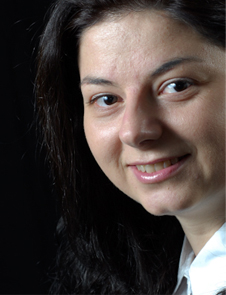
Elena DragomirescuView profile
Associate Professor
Elena Dragomirescu is an Associate Professor in the Department of Civil Engineering at the University of Ottawa's Faculty of Engineering. She joined the department in 2008 after research positions at Yokohama National University (2004) and Nagoya University (2006), establishing expertise in structural reliability and wind engineering for bridges and infrastructure. Her educational background includes: Ph.D. in Civil Engineering from Yokohama National University, Japan M.A.Sc. in Civil Engineering from University of Bucharest, Romania (UNESCO Chair Program) B.Sc. in Civil Engineering from University of Bucharest, Romania Dr. Dragomirescu's research focuses on wind effects on structures , particularly aerodynamics of suspension bridges and structural reliability . She develops probabilistic methods for predicting wind-induced fatigue in slender structures using computational wind engineering (CFD) and aerodynamic formulations. Current projects address moisture ingress in building envelopes and machine learning applications for structural health monitoring, reflecting adaptation to climate resilience challenges. Analysis of her 2021-2025 publications reveals dual research thrusts: (1) moisture dynamics in building envelopes across Canadian climates, and (2) deep learning (LSTM/transformers) for structural assessment of bridges/beams. This strategic integration of data-driven methods with core wind engineering expertise demonstrates responsiveness to infrastructure resilience demands while maintaining theoretical rigor in probabilistic structural dynamics. She has received numerous scholarships and awards throughout her career, though specific honors are not detailed in available sources. Professional service includes membership in the Steering Committee for Japanese National Wind Engineering Guidelines (2008-2010) and active roles in JAWE, JSCE, CSCE, and IAWE. As coordinator of the International Exchange Program for Students, Dr. Dragomirescu facilitates global academic partnerships. Her research has been supported through international collaborations with Ecoland and UNESCO, and she regularly serves as a journal reviewer. Future work appears directed at machine learning applications for real-time structural integrity assessment under extreme winds, with implications for bridge safety standards and climate-adaptive building design. Her laboratory work involves wind tunnel testing and computational simulations for aerodynamic studies of bridge components (cable stays, multi-box decks) and building envelope systems, complemented by experimental validation of structural dynamics phenomena.