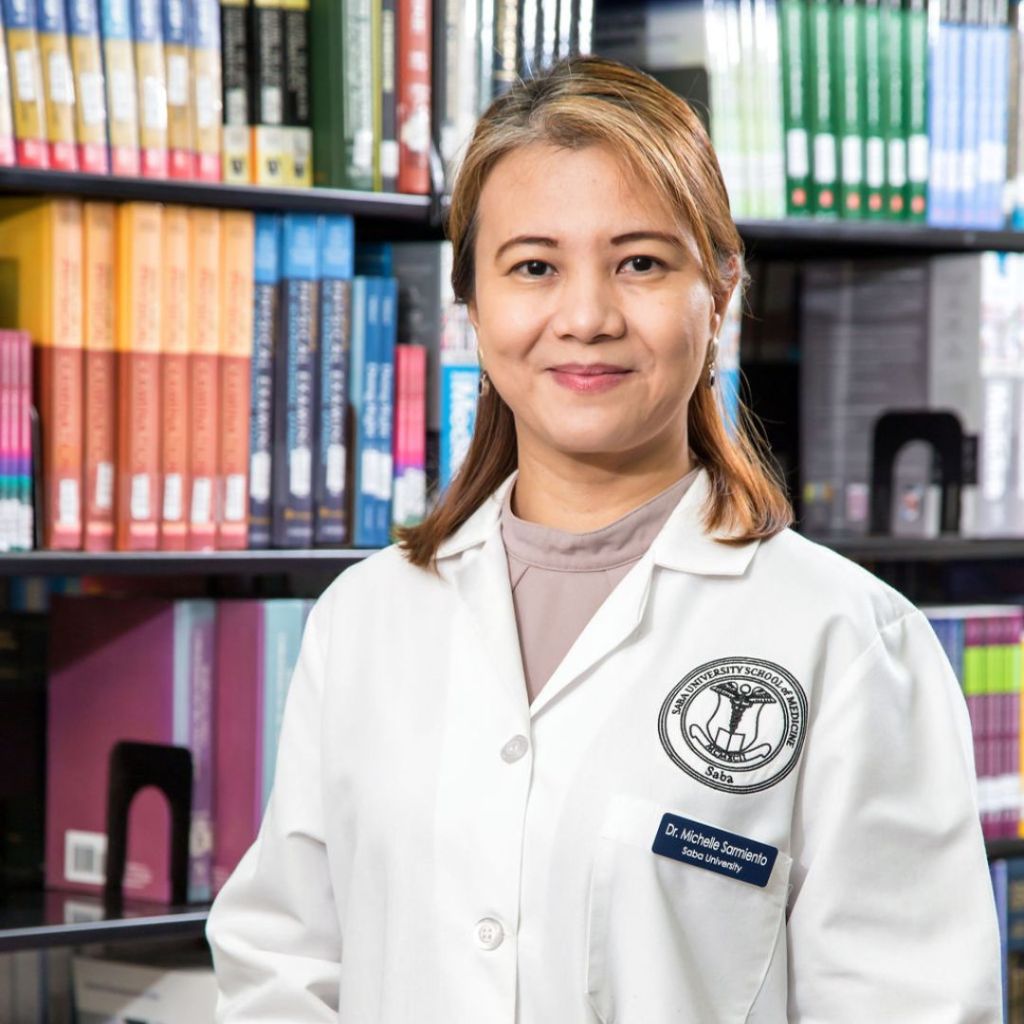
Dr. Michelle Sarmiento is an Assistant Professor and Course Director of Human Body Structure & Function at Saba University School of Medicine, where she chairs the Anatomical Department. With dual qualifications as a licensed pharmacist (BS Industrial Pharmacy) and physician (MD), she brings 23 years of teaching experience in Gross Anatomy and clinical disciplines. Her medical background includes Radiology residency and subspecialization in Maxillofacial Surgery at Universitatsspital Bern. She previously implemented Problem-Based Learning curricula in Bahrain and served in academic leadership roles including Assistant Dean. Research interests include medical education innovations and herbal medicine applications.
Molly Volanth Hall (she/her) is an Assistant Professor at the Rhode Island School of Design's Literary Arts and Studies division. She holds a PhD from the University of Rhode Island, an MA from the University of New Hampshire, and an MEd from Cambridge College-Massachusetts, with a BA from the University of Massachusetts-Boston. Her research focuses on 20th-century English literature, particularly modernist works, exploring intersections between environmental humanities, race, nationalism, and war studies. Her current book project Base Matters: Modernist Environments of War and Empire examines material elements like mud and soil in shaping cultural belonging. 2020 : Ecologies of Materiality in British Modernist War-Time Literature 2019 : Co-edited Affective Materialities collection 2018 : Ecological analysis of Toni Morrison's Beloved 2017 : Trauma theory contributions and Next Generation PhD planning grant Honors include the Frazier Award for Excellence in Teaching (2023–24). Her pedagogy emphasizes connections between artistic practice, cultural history, and environmental futures.
Dr. Paola Mengotti is a Senior Researcher in the Cognitive Neuroscience group (INM-3) at the Research Center Jülich, Germany. Her work focuses on cognitive processes, particularly spatial attention, neurostimulation techniques, and neuropsychological mechanisms. She investigates the interplay between neural networks and behavioral outcomes using advanced methodologies such as neuroimaging (fMRI, EEG) and transcranial magnetic stimulation (TMS). Her research interests include belief updating during attentional tasks, the role of the temporo-parietal junction in cognitive functions, and the neural correlates of food valuation and eating behavior. She also explores motor intention and decision-making processes, with studies on how brain responses modulate trust-repayment behaviors and energy estimation of food items. Mengotti's studies often integrate behavioral experiments with neuroimaging data to uncover mechanisms underlying attentional deployment, conflict resolution, and probabilistic reasoning. Her work highlights the importance of network-based approaches in understanding both typical and pathological cognitive functions, such as in stroke patients and aging populations. Key contributions include identifying neural signatures of belief updating and spatial attention deficits, as well as the impact of body-part specificity in gesture imitation post-stroke. Her research bridges cognitive neuroscience with clinical applications, emphasizing translational outcomes for neuropsychological rehabilitation and neurostimulation therapies.
Akimasa Miyake is a Professor in the Department of Physics and Astronomy at the University of New Mexico (UNM). His research focuses on quantum information science, quantum computation, and quantum many-body physics, with particular emphasis on symmetry-protected topological orders and their applications to quantum computing. He leads the Miyake Research Group, which participates in the NSF-funded STAQ project, a major initiative advancing quantum computing co-design. Miyake earned his PhD from the University of Tokyo in 2004. His work bridges theoretical physics and quantum information, exploring novel approaches to quantum metrology, error mitigation, and computational advantage using nonlocal games. He has contributed to foundational studies on topological phases, matchgate circuits, and measurement-based quantum computation. Recent research highlights include hardness results for surface code decoding and group-theoretic error mitigation techniques. Miyake teaches advanced undergraduate and graduate courses in quantum mechanics, mathematical physics, and quantum computation. His educational activities emphasize active learning and preparation for interdisciplinary challenges in quantum technologies. He maintains an active lab focused on theoretical and applied aspects of quantum systems, with collaborations spanning computational physics and condensed matter theory.
Charlotte Rees is an Honorary Professor and Head of the School of Health Sciences at the University of Newcastle, Australia. She holds a prominent role in academic leadership, previously serving as Dean of Research at Murdoch University and Director of the Monash Centre for Scholarship in Health Education. Her work bridges research and teaching excellence, emphasizing healthcare professionalism and medical education innovation. Education: PhD from the University of Sheffield, UK, and a BSc (Hons) in Psychology from the University of Liverpool, UK. Research Interests: Focuses on healthcare professionalism, workplace learning, and educational methodologies. Key areas include professionalism dilemmas, interprofessional collaboration, and curriculum development. Her work has influenced national policies and curricula, with notable impacts on medical education practices globally. Publications: Over 160 peer-reviewed articles and 200 conference presentations, including influential books like Healthcare Professionalism: Improving Practice through Reflections on Workplace Dilemmas . Recent work explores dignity in clinical placements and leadership in intensive care environments. Awards & Recognition: Top #5 author in medical professionalism research (2021), Principal Fellow of Advance HE, and Fellow of the Royal College of Physicians in Edinburgh. Grants & Leadership: Funded by bodies such as the NHS Education for Scotland and Australian Health Practitioner Regulation Agency. Advocates for methodological innovation and collaborative research to enhance health professions education quality and impact. Labs & Projects: Leads strategic initiatives at the University of Newcastle, co-edits Wiley-Blackwell books on health professions education research, and drives translational research to improve healthcare practitioner training.
Dr. Robb Lindgren is a Professor of Educational Psychology and Curriculum & Instruction at the University of Illinois, Urbana-Champaign , with affiliate appointments at the Beckman Institute, National Center for Supercomputing Applications, iSchool Informatics, Center for Social & Behavioral Science, and Grainger College of Engineering. His research focuses on interactive and immersive digital technologies for learning, particularly in STEM education . PhD in Learning Sciences and Technology Design from Stanford University MA in Psychology from Stanford University BS in Computer Science from Northwestern University Dr. Lindgren explores how body-based interactions with technologies like virtual reality and augmented reality enhance understanding of abstract concepts. His work combines embodied cognition with digital learning environments , examining how physical engagement shapes multimodal learning and collaborative problem-solving . Recent projects include haptic feedback systems and gesture-augmented simulations for molecular visualization and climate change education. His publications analyze trends in XR (Extended Reality) applications, emphasizing gestural agency , collaborative discourse , and multisensory learning . Key findings show how embodied interactions improve conceptual retention in physics and explanatory modeling in thermal conduction, alongside innovative assessment methods using attention tracking and behavioral analytics. 2017 - Jan Hawkins Award for Early Career Contributions Multiple NSF-funded projects on technology-enhanced learning As Director of the Technology Innovations in Educational Research and Design (TIER-ED) initiative, Dr. Lindgren fosters cross-campus collaboration to address educational challenges through emerging technologies. He teaches courses on digital learning environments , educational game design , and embodied learning theories , while developing prototypes for STEM education in partnership with schools and museums.
Winslow Burleson is a Professor at the University of Arizona's School of Information, specializing in Human-Computer Interaction (HCI), Robotics, and Assistive Technology. His research focuses on developing innovative systems for education, healthcare, and marine engineering. Notable projects include the DRESS system for dementia care, CrowdMuse for collaborative creativity, and underwater robotics interfaces. He has received the James Chen Annual Award for Best Journal Article (2012) and leads interdisciplinary teams in cyberlearning and adaptive tutoring systems. Education background includes advanced studies in computer science and engineering, though specific details are not provided. His work integrates robotics, affective computing, and smart environments to address real-world challenges such as aging, education, and environmental exploration. Research interests span robotics applications in education (e.g., co-robotic learning agents), assistive technologies for independent living, and multimodal learning environments. His contributions include adaptive systems for creative crowdsourcing, emotion-aware tutoring platforms, and underwater human-robot interaction frameworks. Current projects emphasize scalable crowd ideation tools and sensor-driven behavior change interventions. Awards include recognition for impactful journal contributions, while grants fund initiatives like cyberlearning with teachable robots and precision oncology IT tools. Advising and grant activities are central to his academic contributions, though specific student names are not listed. Collaborations involve cross-disciplinary teams in engineering, healthcare, and arts to create impactful technologies. Burleson's lab focuses on developing responsive emotive systems, wearable assistive devices, and immersive multimedia applications. Ongoing work explores scalable solutions for dementia support, marine technology interfaces, and creative human-computer interaction paradigms.
Josep Casanovas is a Full Professor at the Statistics and Operations Research Department of the Technical University of Catalonia (UPC), affiliated with the Barcelona School of Informatics. He previously served as head of inLab FIB (2012-2020) and as dean (1998-2004) and vice-rector (2006-2011) of UPC, leading strategic initiatives in university governance and ICT policies. His research focuses on Modelling and Simulation , Internet and Information Systems , and Urban Mobility . He has led projects for the European Union, including C-ROADS Spain, REMEDiAL, and ECHORD++, addressing intelligent transport, software automation, and robotic innovation. Recent publications highlight his work on agent-based simulation for urban health, deep learning applications in traffic and energy savings, and wildfire management tools . He co-directs LogiSim and coordinates the Severo Ochoa Research Excellence Program at the Barcelona Supercomputing Center (BSC-CNS).
Niels Christian Nilsson is a faculty member at Aalborg University , Denmark, with a research focus on Virtual Reality , Haptic Feedback , and Human-Computer Interaction . His work explores techniques for enhancing immersion and realism in VR through multimodal feedback, including tactile, auditory, and visual cues. Key research themes include redirected walking , body ownership illusions , and interactive sound synthesis , often in collaboration with Stefania Serafin and Rolf Nordahl. Nilsson's recent publications (2023-2024) address VR sickness in locomotion systems, tactile auditory augmentation for hearing-impaired users, and applications of VR in rehabilitation. He investigates novel input methods like blink-based interaction and geometric environments for mathematics education. His contributions span both practical implementations (e.g., ElboVR for post-surgery recovery) and theoretical frameworks for sensory feedback in virtual environments. Nilsson's work has been presented at premier venues such as CHI , VR , and IEEE Transactions on Visualization and Computer Graphics . While no formal awards or students are listed in this dataset, his research emphasizes interdisciplinary collaboration and user-centered design in immersive technologies, with implications for healthcare, gaming, and education.
Dahlia Kairy is an Associate Professor at the School of Rehabilitation, University of Montreal, with a focus on telerehabilitation , virtual reality , and innovative rehabilitation technologies . She leads interdisciplinary research through affiliations with the CRIR (Interdisciplinary Research in Rehabilitation), INTER (Interactive Technologies in Rehabilitation), and REPAR networks. Education: Physiotherapy graduate from McGill University (1997) Clinical experience: Specialized in vestibular and balance disorders since 2005 Her research explores implementation strategies for technology-driven rehabilitation, emphasizing health equity and knowledge translation . Recent work investigates AI integration , smart mobility devices , and virtual care policy development . Academic contributions include 15+ peer-reviewed publications and numerous funded projects from organizations like CIHR, FRQS, and AGE-WELL NCE. Key awards include: Royal Society of Canada College membership (2021) Fortissimo Jeune Chercheur Award (2018) She has supervised 7+ graduate students and co-led multidisciplinary grants totaling millions in funding. Current projects focus on metaverse-era rehabilitation , precision rehabilitation , and AI ethics in healthcare delivery.
Tawna L. Mangosh, PharmD, PhD, serves as Assistant Professor in the Department of Pharmacology at Case Western Reserve University School of Medicine. She concurrently holds the position of Program Director for the Translational Pharmaceutical Science Program and maintains affiliation with the Center for Medical Education. Educational background includes: Doctor of Pharmacy (PharmD) from The University of Findlay Ph.D. in Pharmacology from Case Western Reserve University Her research spans pharmacology, cancer biology, and educational scholarship. Initial work focused on telomere maintenance mechanisms in castration-resistant prostate cancer, while current efforts center on curriculum development and reform in medical/graduate education, particularly integrating pharmacology into problem-based learning frameworks. Publication analysis reveals a distinct transition from cancer biology (2018-2021) to medical education innovation (2023). Recent work emphasizes educational resource development like integrated illness scripts and pharmacology integration in clinical case studies, demonstrating strategic redirection of expertise toward pedagogical advancement. Dr. Mangosh actively mentors students across undergraduate, dental, medical, and doctoral programs. She develops specialized pharmacology curricula and leads institutional educational initiatives through her program directorship. As core faculty in the Center for Medical Education, she drives the Translational Pharmaceutical Science Program, implementing evidence-based teaching methodologies to enhance health sciences education across the School of Medicine.
Katherine Brookfield is a Senior Lecturer in the Department of Environment and Geography at the University of York, and Theme Lead at the York Environmental Sustainability Institute (YESI). Her research focuses on quality of life, urban planning, age-friendly environments, and nature-health relations. She employs mixed qualitative methods and has secured funding from major bodies like the ESRC and EPSRC. Education: BA (Hons) Politics (First Class), MSc Planning, PhD Civil & Environmental Engineering (Russell Group Universities). Teaching includes modules on environmental psychology, sustainable transport, and qualitative research methods. She supervises PhD students in planning, built environments, and age-friendly housing. Previous roles include academic positions at Southampton, Sheffield, and Edinburgh Universities, alongside consultancy in real estate and urban development. Awards include the AESOP Best Paper Award (2023) and FHEA. Leadership roles include Board Chair at Environment & Geography and Pathway Director for the ESRC White Rose DTP until 2024.
Naomi McAreavey is an Associate Professor in the School of English, Drama and Film at University College Dublin (UCD), where she has been a faculty member since 2006. Her research and teaching focus on early modern Irish literature and culture, particularly women's writing and the memory cultures of the 1641 rebellion. She is actively involved in academic leadership, having served as Head of Teaching and Learning and Vice Principal for Teaching and Learning in the College of Arts and Humanities, and currently serves as the University for All Faculty Partner for Arts and Humanities. PhD, Queen’s University Belfast MA, Queen’s University Belfast BA, Queen’s University Belfast Graduate Diploma in University Teaching and Learning, University College Dublin McAreavey specializes in seventeenth-century Irish literature , with a focus on women’s life writing , 1641 rebellion memory cultures , and aristocratic female networks . Her work bridges literary studies, history, and trauma theory, using archival sources like the 1641 Depositions and the letters of the Duchess of Ormonde. She advocates for inclusive pedagogy through Universal Design for Learning and has published on Shakespeare, Renaissance drama, and innovative teaching methods. Her recent publications explore themes of memory, trauma, gender, and political agency , particularly through the lens of women’s writing and testimony. She has edited major volumes such as Women's Life Writing and Early Modern Ireland (2019) and The Letters of the First Duchess of Ormonde (2023), and her articles appear in journals like Memory Studies , Irish Historical Studies , and Parergon . These works demonstrate a consistent engagement with historical trauma, female alliances, and editorial methodology . President's Teaching Award, UCD, 2012 Teaching Excellence Award, College of Arts and Humanities, 2017 McAreavey has supervised PhD and MA students, particularly in early modern women’s writing, and coordinates modules on Shakespeare, Renaissance literature, and primary source research. She is Principal Investigator of a SATLE-funded project on generative AI in Arts and Humanities education. Her professional roles include external examiner positions at Ulster University and Dublin City University. She is also active in curriculum development and tutor training programs. She is involved in multiple collaborative research projects and edited collections, including The Body in Pain in Irish Culture (2016) and current work on a monograph titled Memory, Trauma and the 1641 Depositions . Her research lab or team is not explicitly named, but she works closely with scholars like Julie Eckerle and participates in international academic networks.
Prof. Dr. Kai Niebert is a Professor of Natural Science Education and Sustainability at the University of Zurich, Switzerland, and leads the Department of Science Didactics. He established the Anthropocene Learning Lab and the Science Education degree program. Previously, he held professorial roles at Leuphana University Lüneburg and served as a visiting scholar at Penn State University and Curtin University of Technology. His research focuses on science education for sustainability, climate change communication, and the integration of planetary boundaries into curricula. Education: Kai Niebert earned a Dr. rer. nat. (Doctor of Natural Sciences) from Leibniz University Hannover in 2011, following studies in biology, chemistry, and political science. He was a scholarship recipient of the German Academic Scholarship Foundation from 2002–2006. Research Interests: Niebert’s work bridges science communication, sustainability education, and embodied cognition. Key areas include conceptual change in learning, the role of metaphors in teaching complex systems, and designing evidence-based educational programs for sustainable development. He co-created MOOCs on 'Teaching Science at University' and 'Teaching Sustainability' on Coursera. Publications: Over 50 peer-reviewed articles and books, including works on climate education, planetary boundaries, and energy transition. Recent topics address decision-makers’ competencies for sustainability and the political dimensions of climate education. Awards: 2014 Teaching Award from Leuphana University; 2011 Young Talent Award in Biology Didactics. Leadership Roles: President of the German Nature Conservation Association (DNR), member of the Bioeconomy Council, and EU High-Level Group for Sustainability Financing. He has advised government bodies like Germany’s Coal Commission and the National Advisory Committee for Repository Search. Lab/Initiatives: Head of the PhD program 'Public Understanding of Science' at UZH. Co-developed the 'Rohstoff-Expedition' curriculum to teach material cycles and sustainability in schools.
Joy Y. Balta is a Professor of Anatomy and Founding Director of the Anatomy Learning Institute at Point Loma Nazarene University (PLNU). She has held academic positions at Lebanese American University (LAU), University College Cork (UCC), and The Ohio State University, where she served as Associate Professor of Anatomy and Director of Anatomical Services & Body Donation Program. Her career spans anatomy education, research on embalming techniques, and leadership in developing academic programs like Ireland's first taught MSc in Human Anatomy. Education BS in Zoology, Lebanese University MSc in Human Anatomy, University of Dundee PhD in Anatomical Sciences, University College Cork MA in Teaching and Learning in Higher Education, University College Cork Dr. Balta’s research focuses on anatomy education methodologies, embalming fluid efficacy, and the scholarship of teaching and learning. She has pioneered studies comparing Thiel and formalin embalming techniques, explored the antimicrobial properties of preservation solutions, and investigated radiological imaging effects on cadavers. Her work also addresses ethical considerations in body donation and student-centered learning environments. Scientific Awards Faculty Development Grant from Lebanese American University (LAU) Dr. Balta’s publications highlight trends in multimedia integration, UDL frameworks, and informed consent practices for body donors. She established The Balta Lab at Ohio State, mentoring students at all degree levels, and has served on organizations including the American Association for Anatomy and the Anatomical Society of Great Britain and Ireland. Her leadership in program development and commitment to medical education reform underscore her impact across institutions.